
What Colorbond re-roofing actually costs in 2026
Colorbond re-roofing cost Australia typically falls between $8,000 and $35,000 for a complete job, with the average three-bedroom suburban home landing somewhere around $14,000–$20,000. According to data compiled by the Housing Industry Association, roofing remains one of the top five renovation expenditures for Australian homeowners, and Colorbond’s share of that market has grown steadily as tile roofs age out.
Colorbond re-roofing cost Australia ranges from roughly $8,000 for a small straightforward roof to $35,000 or more for a large complex one. Most average-sized homes land between $12,000 and $22,000 all in. The price per square metre typically runs $50–$95 for supply and installation, before extras like insulation, fascia, or guttering are added.
Most people budget for the steel sheeting and labour, then get a shock when they see the full quote. Removal and disposal of old tiles, insulation upgrades, fascia replacement, guttering, and flashing work all add to the base price. The steel itself is often the smallest line item.
State-by-state pricing: what you’ll pay in 2026
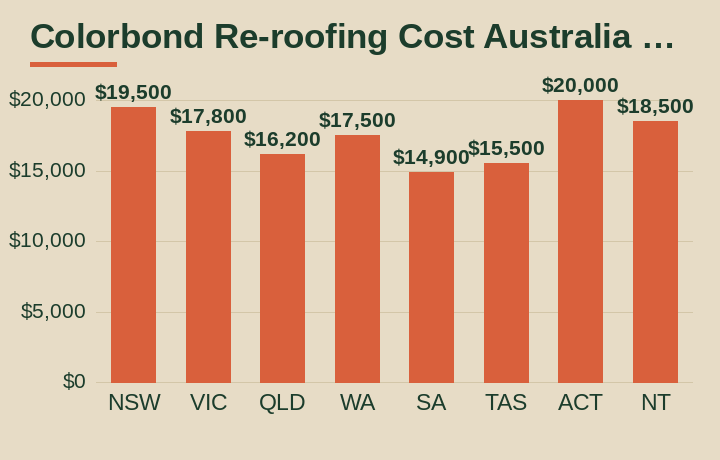
Labour costs vary meaningfully across Australia, driven by award rates, tradie availability, and regional demand. Comparing figures for this guide, the gap between the cheapest and most expensive states for the same job can run to $4,000–$6,000 on a standard home. NSW and ACT consistently sit at the top end, while SA and regional Queensland come in lower.
| State | Average Cost | Typical Range |
|---|---|---|
| NSW | $19,500 | $13,000 – $35,000 |
| VIC | $17,800 | $11,500 – $32,000 |
| QLD | $16,200 | $10,000 – $30,000 |
| WA | $17,500 | $11,000 – $31,000 |
| SA | $14,900 | $9,000 – $27,000 |
| TAS | $15,500 | $9,500 – $28,000 |
| ACT | $20,000 | $13,500 – $35,000 |
| NT | $18,500 | $12,000 – $33,000 |
Get free quotes from local providers in your area. No obligation.
The NT premium reflects higher freight costs for steel and fewer competing contractors in Darwin and Alice Springs. Prices honestly bounce around more there than anywhere else. For context on how roofing costs fit into larger renovation budgets, see our guide to home extension costs in Australia.
A real-world scenario: a 1970s brick home in Adelaide’s inner north
Consider a typical 1970s three-bedroom brick home in Prospect, SA, with a 180m² hip-and-gable roof currently clad in original concrete tiles. The owner gets three quotes for full Colorbond re-roofing in 2026.
Quote breakdown on the mid-range option: tile removal and disposal $3,400, structural batten replacement $1,800, Colorbond corrugated sheeting supply and fix $9,200, reflective foil insulation $1,100, new gutters and downpipes $2,400, ridge capping and flashings $1,600. Total: $19,500. The cheapest quote came in at $14,800 and excluded the gutters entirely. The most expensive was $24,000 and included a full fascia replacement the homeowner didn’t actually need.
That spread is completely normal. The detail is in what each quote includes. Always ask for an itemised breakdown.
Colorbond profile and size comparison
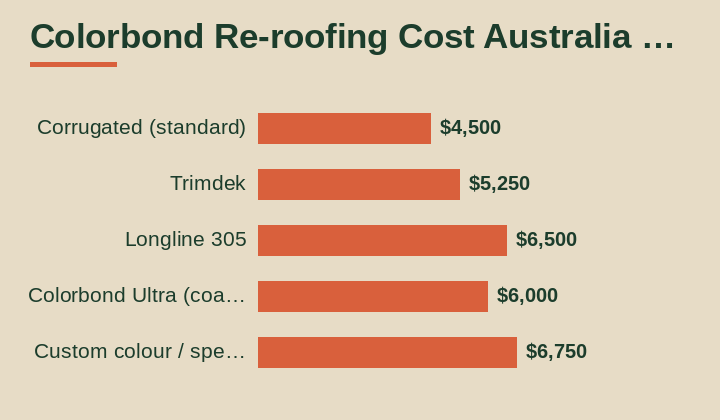
The profile and grade of Colorbond you choose affects cost more than most people realise. Standard corrugated is the workhorse and cheapest option. Longline and Trimdek look sharper but command a real premium. Here’s how the main options stack up for a typical 180m² roof in 2026.
| Profile / Grade | Supply Cost (180m²) | Total Installed (180m²) | Best For |
|---|---|---|---|
| Corrugated (standard) | $3,800 – $5,200 | $11,000 – $17,000 | Most suburban homes |
| Trimdek | $4,500 – $6,000 | $13,000 – $20,000 | Modern or angular rooflines |
| Longline 305 | $5,500 – $7,500 | $15,500 – $23,000 | Contemporary builds, low pitch |
| Colorbond Ultra (coastal) | $5,000 – $7,000 | $14,000 – $22,000 | Within 1km of salt air |
| Custom colour / special order | $5,500 – $8,000 | $16,000 – $25,000 | Heritage overlays, specific aesthetics |
The Colorbond Ultra grade is the one to specify if you’re within a few kilometres of the coast. Regular Colorbond will corrode faster in that environment regardless of what a salesperson might tell you. The price gap is roughly $800–$1,500 on a full re-roof. Not worth skimping on.
Where the money actually goes: what drives the price up
Roof size and pitch
This one’s straightforward but the numbers are bigger than most people expect. A 120m² low-pitch gable roof in a flat Hobart suburb might quote at $55/m² installed. A 220m² steeply pitched hip roof in Sydney’s Hills District could hit $90/m² because of the extra labour time, safety equipment requirements, and material waste from cutting around hips and valleys. That difference translates to roughly $6,600 vs $19,800 on materials and labour alone before any extras.
Old roof removal
Removing existing materials is often the biggest variable in any re-roofing quote. Concrete tiles weigh roughly 45–55kg per square metre, so a 180m² roof means shifting up to 10 tonnes of material. Disposal fees, skip hire, and labour for this alone typically run $3,000–$5,500. Asbestos cement sheeting (common on homes built pre-1990) is a different situation entirely: licensed asbestos removal in NSW can add $5,000–$12,000 depending on the roof size. If you’re unsure whether your existing roof contains asbestos, get it tested before getting roofing quotes.
Roof complexity and penetrations
Every valley, hip, skylight, solar panel, chimney, or plumbing vent adds time and materials. A simple gable roof might have four or five flashing points. A complex hip roof with two skylights and a chimney could have 20. Flashings alone on a complex roof can add $1,500–$3,500 to the total. In areas like Sydney’s North Shore and Melbourne’s eastern suburbs where older homes have multiple chimneys, this can blow out a quote significantly.
Insulation and sarking
Insulation under a Colorbond roof is strongly recommended and, in most new builds, required by the NCC. Sarking (reflective foil membrane) typically adds $600–$1,400 to a re-roofing job. Bulk insulation batts on top of sarking add another $800–$2,500. Worth doing at the same time as a re-roof since the labour cost to come back later and install it is higher. You can supply your own roof insulation blanket to reduce this cost slightly.
Gutters, fascia, and downpipes
A re-roof naturally exposes the condition of your gutters and fascia. If they’re corroded or sagging, most roofers will recommend replacement at the same time, which makes sense given the access they already have. Gutter replacement runs $80–$150 per linear metre including installation. A standard suburban home with 40 linear metres of guttering adds $3,200–$6,000 to the job. For more on Colorbond fencing and guttering products, see our guide to Colorbond fencing costs.
Location and accessibility
A double-storey home in Newtown’s terrace belt is harder to scaffold and access than a single-storey brick veneer in Toowoomba. Difficult access adds $800–$2,500 in scaffolding and safety costs. Steep sloping blocks in areas like the Blue Mountains or Brisbane’s western suburbs can add even more. Always ask whether the quote includes full scaffolding or just ladder access.
Questions to ask before you book a roofer
Is this a fixed-price quote or an estimate?
A genuine fixed-price written quote protects you if the job takes longer than expected. Some contractors quote an estimate, then bill hourly for anything that runs over. On a roofing job, that difference can cost you $1,000–$3,000. Push for fixed price.
What does the quote include for waste removal?
Tile removal and disposal is one of the biggest cost variables and some contractors deliberately exclude it to look cheaper. Ask directly: “Is tile removal and skip hire included in this price?” If it’s not itemised, assume it’s not included.
Who actually does the work?
Many roofing companies subcontract the labour. That’s not necessarily a problem, but you want to know whether the person you’re contracting with is the one on your roof. Ask whether the installation crew are direct employees or subbies, and whether the company holds its own licence and insurance rather than relying on the subcontractor’s.
What warranty comes with the installation?
Colorbond steel itself carries a manufacturer’s warranty of 25–36 years. But that’s separate from the workmanship warranty, which should be at least 5–10 years from a reputable installer. Ask for both warranties in writing. A contractor who won’t put a workmanship warranty in writing is worth walking away from.
Does the quote include ridge capping, flashings, and penetration sealing?
These are the details that determine whether a roof leaks in five years. Some lowball quotes leave out ridge capping or use cheap flashings. Confirm every line item is included, and ask what brand of flashing and sealant they use. Cheap flashing fails faster and voids some manufacturer warranties.
Have you done a load calculation for re-roofing over existing tiles?
If a contractor is proposing to install Colorbond over existing concrete tiles without removing them, they should be able to show you a structural assessment confirming the roof frame can carry the additional load. Don’t accept “we do this all the time” as an answer. The Australian Bureau of Statistics data on home age shows a large proportion of Australian homes were built in eras when roof frames weren’t engineered for added loading.
Common mistakes that cost homeowners money
- Accepting the first quote. The range between a low and high quote for identical scope can genuinely be $5,000–$8,000 on a standard home. Three quotes minimum.
- Ignoring what’s not in the quote. Tile removal, insulation, gutters, and flashings are all frequently excluded from teaser quotes. Always compare like for like before deciding which quote is cheapest.
- Skipping the structural assessment. Proceeding with a batten-over installation without a structural check risks overloading an ageing roof frame. This is a safety issue, not just a compliance one. It also affects your home insurance if something goes wrong.
- Choosing colour based on aesthetics alone. In heritage overlay areas (parts of Sydney’s inner west, Adelaide’s North Adelaide, Melbourne’s Fitzroy), some Colorbond colours require council approval. Check before you choose. Getting this wrong means potentially having to re-do the roof or face fines.
If you’re bundling a re-roof with other property upgrades, it’s worth costing out other projects at the same time. Adding a solar system after a new Colorbond roof is common, and the interaction between roofing installers and solar installers is worth coordinating upfront. See our breakdown of solar panel installation costs in Australia for 2026 numbers. Similarly, if your home project extends further, our guides to bathroom renovation costs and ensuite addition costs are worth a read before you get into discussions with builders.
How to bring the cost down
Going through the available industry data and Choice Australia’s guidance on tradespeople, a few cost-saving strategies consistently come up. Book in the quieter season (May to August), get three detailed written quotes, and bundle any guttering and fascia work into the one job rather than scheduling it separately. The saving on bundling is real: getting a roofer back separately just for gutters costs you a call-out fee plus mobilisation time you’ve already paid once.
Choosing standard corrugated Colorbond over a premium profile is worth considering if aesthetics aren’t the priority. The performance difference for most homes is negligible. The price difference is $2,000–$5,000. For smaller related projects that might come up around the same time, check the retaining wall cost guide and concrete driveway pricing if you’re doing a broader property refresh.
Frequently asked questions about Colorbond re-roofing cost Australia
How much does Colorbond re-roofing cost per square metre in Australia?
Supply and installation typically runs $50–$95 per square metre depending on roof pitch, accessibility, and state labour rates. Steep or complex roofs with lots of hips and valleys sit at the higher end. A standard gable roof on a single-storey home usually comes in at $55–$75/m².
Does old roof removal add much to the cost?
Yes, significantly. Removing and disposing of old terracotta or concrete tiles adds $2,000–$6,000 to the job depending on roof size and tile weight. Asbestos cement sheeting removal is a separate licensed job entirely and can add $3,000–$10,000 or more. Always get this quoted separately so you can see exactly what you’re paying for.
How long does a Colorbond roof last?
Colorbond steel carries a 25–36 year warranty depending on the product grade and coastal proximity. In low-corrosion inland areas, a well-installed roof realistically lasts 40–50 years with basic maintenance. In coastal zones within a few kilometres of salt air, you’ll want the higher-spec Ultra grade, formulated specifically for that environment.
Can I re-roof over existing tiles without removing them?
In some cases, yes. Colorbond sheeting can be installed over existing concrete tiles using a batten-over system, which saves on removal costs. But this only works if the existing structure is sound, the added load is within the roof frame’s capacity, and your council permits it. Get a structural assessment first, it’s not always a safe shortcut.
Do I need council approval to re-roof with Colorbond?
In most Australian states, like-for-like re-roofing with similar materials is classified as exempt development and doesn’t need a DA. But if you’re changing the roof material type, colour in heritage overlay areas, or profile significantly, you may need approval. Check with your local council before signing contracts.
People Also Ask About Colorbond Re-Roofing Cost Australia
Is Colorbond re-roofing worth it compared to repairing the existing roof?
If your roof is over 25 years old and you’re spending more than $2,000–$3,000 on recurring repairs, re-roofing usually makes more financial sense. A patch-repair on an old terracotta roof can cost $800–$2,500 and still leave you with an aging structure that needs attention again in a few years. A full Colorbond re-roof gives you a 36-year warranty and eliminates most maintenance costs for a long stretch.
How does Colorbond compare to Zincalume for re-roofing cost?
Zincalume is uncoated metallic steel and is generally $5–$12 per square metre cheaper than Colorbond. But Colorbond’s baked-on paint finish means better heat reflectance, a wider colour range, and better corrosion resistance in most environments. For most homeowners, the small price premium for Colorbond is worth it for the aesthetics and performance over a 30-plus year lifespan.
What is the best Colorbond colour for reducing heat in Australian summers?
Lighter colours like Surfmist, Paperbark, and Classic Cream reflect more solar radiation than dark tones like Monument or Ironstone. In hot climates like Perth, Darwin, or western Queensland, choosing a light Colorbond colour combined with a foil insulation blanket underneath can noticeably reduce ceiling temperatures and cooling costs. The difference in roof surface temperature between dark and light Colorbond can be 20°C or more on a hot day.
Does re-roofing with Colorbond increase home value?
Generally yes, though the uplift varies. A new Colorbond roof removes a major maintenance liability that shows up in pre-purchase inspections, and buyers notice it. In competitive markets like Sydney’s inner west and Melbourne’s middle ring suburbs, a recently re-roofed home can command $10,000–$30,000 more at auction than an equivalent property with an aging tile roof. The exact value depends on suburb and market conditions at the time.
How long does a Colorbond re-roofing job take?
For a standard suburban home, expect two to four days for the full job including removal of old materials, installation, and flashings. Larger or more complex roofs with multiple hips, valleys, or skylights can take five to seven days. Weather delays are common in tropical climates, and most contractors schedule a buffer rather than giving a firm completion date, which is fair enough given Queensland’s afternoon storm season.
Related Cost Guides
Recommended Products for Colorbond Re-roofing Cost Australia
If you’re tackling this yourself, here are some products from Amazon Australia that can help:
Getting the right price on a Colorbond re-roof comes down to comparing detailed, itemised quotes and knowing what to ask. The difference between a good job and a cheap one shows up about five years later when the flashings start leaking. For other major property projects you might be planning, our guides to pergola and verandah costs, decking costs, and pool installation costs are worth bookmarking before you start calling contractors.
This guide contains affiliate links. We may earn a small commission from qualifying purchases at no extra cost to you.