
What bathroom renovations actually cost in 2026
Bathroom renovation cost Australia is one of those topics where quotes vary so wildly that people aren’t sure if they’re being ripped off or just paying the going rate. The short answer: a functional mid-range renovation in a standard-size bathroom runs $15,000–$22,000 in most capital cities. Budget jobs start around $8,000 if you’re disciplined. Premium renovations with floor-to-ceiling stone, heated floors and frameless everything push well past $30,000.
Bathroom renovation cost Australia typically runs $8,000–$15,000 for a budget renovation, $15,000–$25,000 for a mid-range job, and $25,000–$35,000+ for a high-end remodel. Labour accounts for roughly 40–50% of total spend. Expect to pay more in Sydney and Melbourne than in regional areas.
The spread is real. According to the Australian Bureau of Statistics, residential building activity, including alterations and additions, has remained elevated through 2025 and into 2026, which means tradies are still in high demand and labour costs haven’t softened much. That’s relevant context when you’re budgeting.
Before you get any quotes, understand the three rough tiers most bathrooms fall into.
Bathroom renovation prices by state
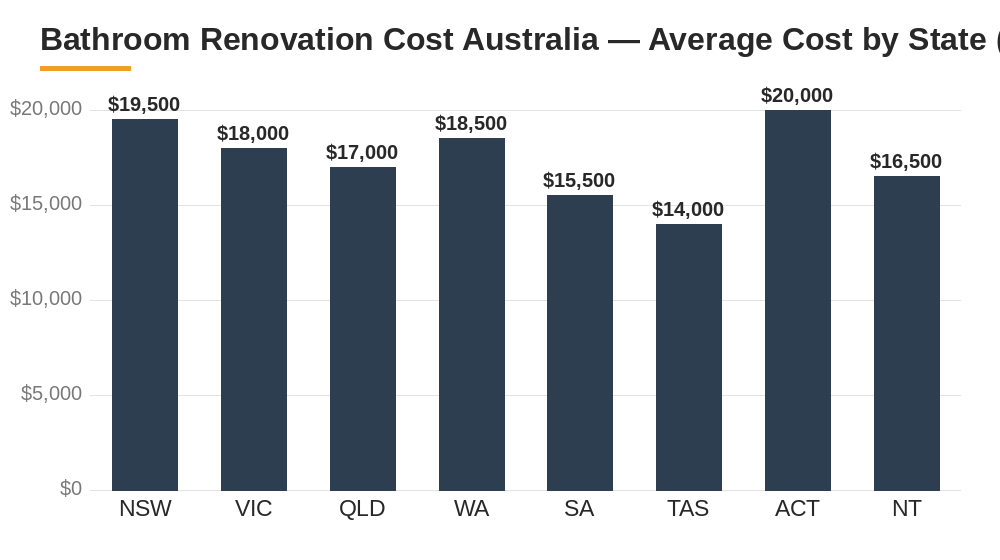
Geography matters more than most people expect. A mid-range bathroom renovation in inner Sydney runs noticeably higher than the same job in Hobart or Darwin, mostly because of labour rates and tradie availability. Here’s a realistic state-by-state breakdown for a standard 5–7 sqm bathroom at mid-range spec.
| State | Average Cost | Typical Range |
|---|---|---|
| NSW | $19,500 | $12,000 – $32,000 |
| VIC | $18,000 | $11,000 – $30,000 |
| QLD | $17,000 | $10,500 – $28,000 |
| WA | $18,500 | $11,500 – $31,000 |
| SA | $15,500 | $9,500 – $26,000 |
| TAS | $14,000 | $8,500 – $23,000 |
| ACT | $20,000 | $13,000 – $33,000 |
| NT | $16,500 | $10,000 – $27,000 |
Get 3 free quotes from local providers in your area. No obligation.
NSW and ACT consistently sit at the top. In inner-Sydney suburbs like Surry Hills or Newtown, expect to pay 15–25% above the NSW average because tradies factor in parking, travel and the premium they can charge in tight urban markets. Outer suburbs like Penrith or Campbelltown are noticeably cheaper for the same scope.
Budget vs mid-range vs premium: what you actually get
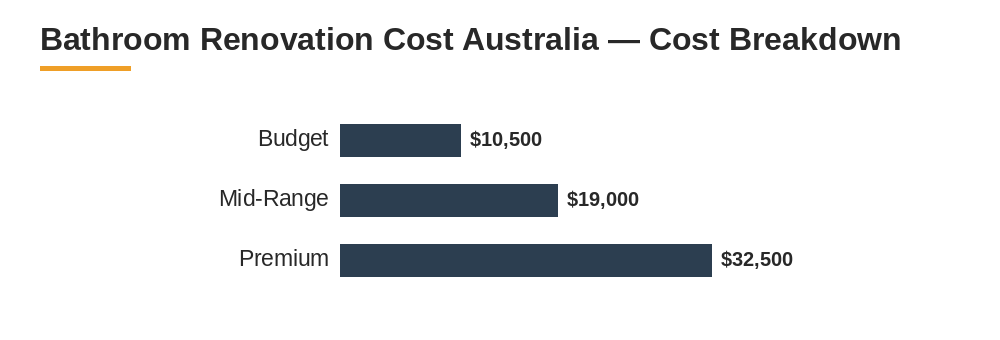
The biggest mistake people make is comparing quotes without comparing scope. A $9,000 quote and a $19,000 quote often aren’t for the same job. Here’s how the tiers stack up in practical terms.
| Tier | Typical Cost | What’s Included |
|---|---|---|
| Budget | $8,000 – $13,000 | Same layout, basic vanity, standard 300x300mm tiles, shower screen, toilet suite, basic tapware |
| Mid-Range | $14,000 – $24,000 | Updated layout possible, semi-frameless shower, wall-hung vanity, rectified tiles up to 600x600mm, upgraded tapware, exhaust fan |
| Premium | $25,000 – $40,000+ | Full layout change, freestanding bath, floor-to-ceiling stone or large-format tiles, heated floor, custom joinery, frameless shower, designer fixtures |
The jump from mid-range to premium is where spending accelerates fast. A freestanding bath alone adds $1,500–$4,000 in fixture costs, plus the extra labour to replumb the fill and waste. Heated floors add $800–$1,800 depending on the area. If you’re eyeing the premium tier, budget with a 15–20% contingency from the start.
Where the money actually goes
Five factors consistently move the bathroom renovation cost Australia needle more than anything else. Each one comes with a real dollar impact.
1. Labour as a percentage of total cost
Labour typically eats 40–50% of a bathroom renovation budget. On a $20,000 job, expect $8,000–$10,000 going to tradespeople: tiler, plumber, electrician, waterproofer and sometimes a plasterer. In regions like Brisbane’s inner suburbs or Fremantle in WA, day rates for tilers run $450–$650. In Toowoomba or regional SA, you might get the same quality for $320–$420 per day. That difference adds up across a multi-day tile job.
2. Layout changes and plumbing relocation
Keeping your existing plumbing positions is the single biggest lever on cost. Moving a toilet drain even 300mm requires breaking up the concrete slab, repositioning the p-trap, and re-setting the floor. That’s $1,500–$4,000 just for that one change, before you’ve touched a tile. Full wet area relocation (moving the shower to the opposite wall, for example) can add $3,000–$6,000 to a job that was otherwise straightforward.
3. Tile selection and complexity
Standard 300x300mm ceramic floor tiles with a simple wall tile might cost $25–$45 per sqm in materials. Step up to large-format 600x1200mm rectified porcelain and you’re at $65–$120 per sqm for materials, plus higher labour because larger tiles require a flatter substrate and more precise layout. A herringbone pattern in a small bathroom can add $400–$700 in tiling time compared to a straight lay. Choose your tiles before finalising your quote, many builders can’t give accurate tiling labour costs until they see what you’re working with. A grout maintenance kit is also worth picking up once tiling is done to keep the new grout looking fresh for years.
4. Fixture and fittings quality
The difference between builder-grade tapware and a mid-range Meir or Caroma set is roughly $300–$800 per bathroom. Go designer (Brodware, Astra Walker) and you’re looking at $1,500–$3,500 just in tapware. Vanities vary similarly: a standard freestanding unit from Bunnings or a bathroom warehouse runs $250–$600, while a custom-made wall-hung unit with soft-close drawers and integrated basin runs $1,200–$2,800. Neither is wrong, it depends on what you value.
5. Waterproofing and compliance
This one’s non-negotiable. Australian Standard AS 3740 requires wet area waterproofing in all bathrooms, and it must be done by a licensed tradesperson. Budget $450–$900 for a standard bathroom. If the existing substrate is damaged or the previous waterproofing has failed (common in bathrooms over 15 years old), you may need a full membrane system that adds another $300–$600 in materials and prep. Skipping or cutting corners here is how bathrooms leak into the room below. It’s not worth it.
For a broader look at ongoing pet or home costs that compound over time, monthly cost breakdowns can help you see where renovation spend fits into total household budgeting.
Questions to ask before you book
Is this a fixed-price contract or an estimate?
Fixed-price contracts protect you if the job blows out. Estimates don’t. Always ask which one you’re getting in writing. For anything over $10,000, a fixed-price contract with a clearly defined scope is standard practice in NSW and Victoria. If a builder won’t commit to one, ask why.
What’s not included in this quote?
Most quoted prices exclude tiling materials, fixtures, vanities and tapware, those are usually ‘prime cost items’ you supply or select separately. Ask specifically whether the quote includes waterproofing, exhaust fan installation, and any patching of walls after plumbing. The gap between a $13,000 quote and what you actually pay can be $3,000–$6,000 if these aren’t locked in.
Who is doing the waterproofing, and are they licensed?
Waterproofing must be done by a licensed operator in most states. Some builders subcontract this to a one-person outfit, that’s fine, as long as they’re licensed and issue a certificate of waterproofing. Ask to see the certificate on completion. This matters for insurance and for any future warranty claim.
What happens if you find asbestos or structural damage during demo?
Homes built before 1987 may contain asbestos sheeting around wet areas. If a tiler or plumber hits it, work stops until it’s assessed and removed by a licensed removalist. That’s an unexpected $800–$2,500 cost that almost no quote covers upfront. Ask your builder how they handle it and whether there’s a provisional sum allowance in the contract.
What’s the payment schedule?
In NSW, the Home Building Act sets out maximum deposit rules: no more than 10% on jobs over $20,000. Be wary of anyone asking for 30–50% upfront on a fixed contract. A reasonable schedule is deposit, progress payment at waterproofing completion, another at tiling done, and final payment on practical completion.
How do you handle delays in material delivery?
Tile and vanity lead times have been unpredictable. If your tiles are on backorder for six weeks, what happens to the tradie schedule? Ask if they have a buffer job they move to, or if your bathroom sits unfinished. Some renovation specialists hold stock for exactly this reason, worth asking.
How to bring the cost down
Keep the layout identical. This is the most effective cost lever available to you. Plumbing relocation adds $2,000–$6,000 depending on scope. If the toilet, shower and vanity are in sensible positions, leave them there. Spend that money on better tiles instead.
Source tiles from overstock suppliers or clearance centres. Tile warehouses in industrial suburbs often carry discontinued lines at 40–60% off retail. You lose the option to re-order exactly, so buy 15–20% extra and store it. For a 5 sqm bathroom, the materials saving can be $400–$900 compared to full retail.
Do your own demolition where your builder allows it. Removing towel rails, mirror cabinets, toilet roll holders and old accessories yourself saves about $300–$600 in labourer time. Ask first, some builders prefer to demo themselves for liability reasons, and that’s fair.
Get three quotes. Not one, not two. Three. On a $18,000 job, I’ve personally seen a spread of $5,000 between the lowest and highest quote for nearly identical scope. The cheapest isn’t automatically right (you need to check what’s excluded), but the most expensive rarely justifies itself either. Choice Australia has published useful advice on comparing tradesperson quotes and what to watch for in contracts.
Consider a DIY waterproofing membrane for the floor prep if your builder is open to owner-supply. Some products on the market are AS 3740 compliant for owner application on certain substrates, worth asking your builder if this saves money on the quote. Not all will go for it, but some will.
If you’re thinking about related home or pet costs, our breakdown of what dog food costs annually in Australia and the real cost of pet insurance follow a similar approach to budgeting for ongoing vs one-off expenses. And if you’re renovating ahead of a sale, the cost of professional photography for listings is worth factoring in separately.
Bathroom renovation cost Australia: frequently asked questions
How much does a basic bathroom renovation cost in Australia in 2026?
A basic bathroom renovation, think new toilet, vanity, shower screen, tiling and basic fixtures, typically costs $8,000–$13,000. That assumes you’re keeping the same layout and plumbing positions. Go outside that scope and costs climb fast.
How long does a bathroom renovation take?
A standard bathroom renovation takes 2–4 weeks from demo to completion, assuming no waterproofing or structural surprises. Complex jobs or those requiring council approval can run 5–8 weeks. Delays in tile delivery are surprisingly common and add days.
Do I need council approval to renovate my bathroom in Australia?
Most cosmetic bathroom renovations don’t require council approval, but any structural changes, relocating wet areas, or work in strata buildings usually do. Your builder or certifier should tell you upfront. Skipping this step can cause problems when you sell.
Is it worth renovating a bathroom before selling?
Depends on the current state of it, honestly. A dated but functional bathroom might not move the needle much. A genuinely broken or mouldy bathroom will deter buyers. Domain’s property insights suggest a well-executed bathroom renovation adds meaningful resale value, but overcapitalising in a cheaper suburb rarely pays off.
What is the most expensive part of a bathroom renovation?
Labour is consistently the biggest single cost, making up 40–50% of the total budget. Within that, tiling labour is often the priciest trade on site. After labour, waterproofing, shower screens and vanities tend to eat the most budget, especially once you upgrade from builder-grade fittings.
People Also Ask About Bathroom Renovation Cost Australia
Can I renovate a small bathroom for under $10,000 in Australia?
Yes, but you’ll need to be disciplined. Keep the layout identical, use mid-range (not budget) tiles from a clearance supplier, a basic vanity from a bathroom warehouse, and limit feature tiles to one wall. In regional areas or outer suburbs like Penrith or Geelong, $9,000–$10,000 is achievable. In inner Sydney or Melbourne, you’re tight at that figure.
How much do bathroom tiles cost to install in Australia?
Tiling labour runs $45–$75 per square metre for standard floor and wall tiles. Add 20–30% for small-format mosaic tiles, rectified tiles, or diagonal layouts, which take significantly longer to lay. A standard 5–6 sqm bathroom floor might cost $350–$500 just in tiling labour, before any material costs.
Does bathroom renovation require a licensed builder in Australia?
Plumbing, waterproofing and electrical work must be done by licensed tradespeople in every Australian state. In NSW, any renovation over $5,000 requires a licensed builder or contractor. In Victoria the threshold is similar. Hiring an unlicensed operator to save money is a real risk, insurance won’t cover defective work, and it can complicate property sales.
How much does it cost to waterproof a bathroom in Australia?
Professional bathroom waterproofing typically costs $400–$900 for a standard-size bathroom, depending on the area being treated and the membrane system used. This is non-negotiable under Australian Building Code AS 3740, so don’t let anyone skip it to trim the quote. Leaks cost a lot more than $900 to fix.
What’s the cheapest way to update a bathroom without a full renovation?
Regrouting, replacing a vanity tap and mirror, and adding new towel rails can freshen up a bathroom for $800–$2,500 without any tiling or waterproofing. A wall-hung vanity swap costs $400–$900 in labour plus materials. These cosmetic changes don’t add the same value as a full renovation but they’re far less disruptive.
Related Cost Guides
Recommended Products for Bathroom Renovation Cost Australia
If you’re tackling this yourself, here are some products from Amazon Australia that can help:
If you’re working through a broader home budget, the cost of dog walking and dog daycare are two other recurring costs worth having in your numbers. Bathroom renovation cost Australia is a significant one-off spend, getting the scope and quotes right upfront is what separates a renovation that stays on budget from one that blows out by 30%.
This guide contains affiliate links. We may earn a small commission from qualifying purchases at no extra cost to you.