
Pool installation cost Australia sits at a wide range because there are genuinely three different products being sold under the same name. A standard fibreglass pool dropped into a flat suburban block in Logan or Elizabeth runs roughly $27,000–$38,000 all in. A custom concrete pool built into a sloped Mosman or Toorak block with travertine coping and a glass fence is a $90,000+ project. Same words, very different budgets. According to the Australian Bureau of Statistics, residential construction activity has remained elevated through 2025–26, which means pool builders are busy and lead times are longer than usual in most states.
Pool installation cost Australia typically runs $25,000–$45,000 for a fibreglass pool, $35,000–$60,000 for a vinyl-lined pool, and $50,000–$85,000+ for a concrete (gunite or shotcrete) pool. Final figures depend heavily on pool size, site access, soil type, fencing requirements, and your state's council approval fees.
The variation isn’t just about type. Soil conditions, site access, council fees, fencing requirements, and what you choose to do with the surrounds all shift the final number. This breakdown covers what each pool type typically costs, what’s included versus what gets added later, and where the biggest savings actually come from.
What you’ll typically pay in 2026
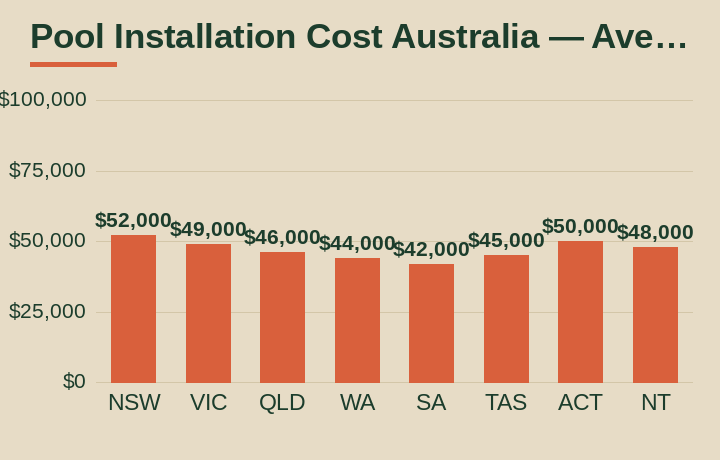
The prices below reflect a mid-size inground fibreglass or concrete pool (approximately 7m x 3.5m, 35,000–40,000 litres) with basic filtration and a compliant barrier fence. They don’t include heating, automation, landscaping, or anything remotely fancy. Expect the higher end of ranges in coastal and capital city metro areas.
| State | Average Cost | Typical Range |
|---|---|---|
| NSW | $52,000 | $32,000 – $85,000 |
| VIC | $49,000 | $30,000 – $80,000 |
| QLD | $46,000 | $28,000 – $78,000 |
| WA | $44,000 | $27,000 – $72,000 |
| SA | $42,000 | $26,000 – $68,000 |
| TAS | $45,000 | $29,000 – $70,000 |
| ACT | $50,000 | $31,000 – $78,000 |
| NT | $48,000 | $30,000 – $75,000 |
Get 3 free quotes from local providers in your area. No obligation.
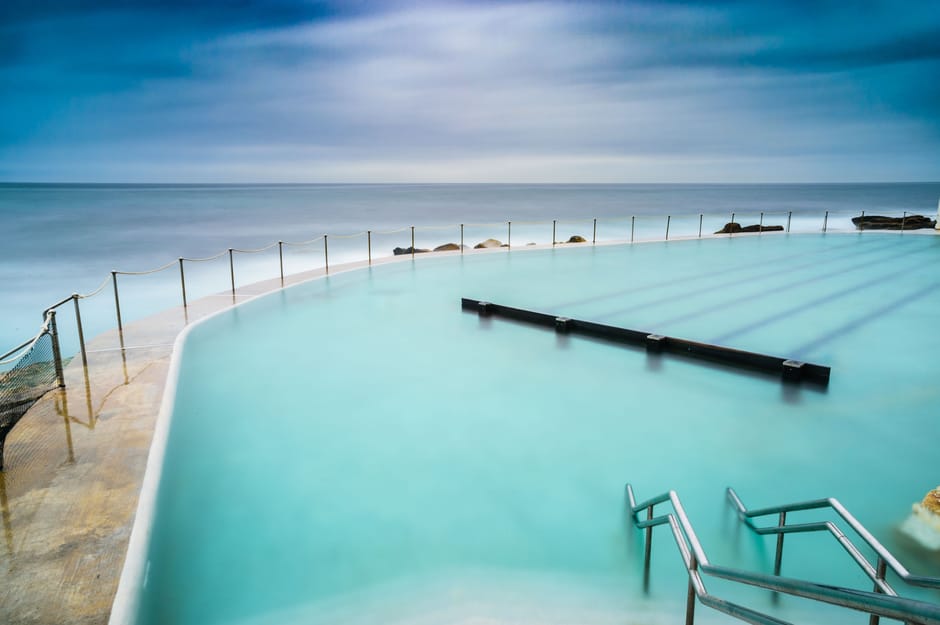
Queensland sits cheaper partly because pool demand is high enough to sustain more competition, and partly because soil conditions in most SEQ suburbs are more predictable. Sydney’s North Shore and Eastern Suburbs push well past $80,000 for a custom concrete build due to rock excavation, tight site access, and the premium most builders charge for the postcode. This aligns with Canstar’s home improvement cost data, which consistently shows Sydney and inner Melbourne running 15–25% above national averages for installation trades.
What’s included in a standard quote, and what’s extra
Most pool builders quote a headline price that sounds complete but leaves out several items you’ll definitely need. The table below separates what a standard installation contract typically covers from the add-ons that show up in a separate quote or a surprise variation after excavation starts.
| Typically Included | Usually Costs Extra |
|---|---|
| Fibreglass shell or concrete structure | Pool heating (solar, heat pump or gas) |
| Basic filtration and pump system | Automation and remote control systems |
| Standard interior finish (gelcoat or basic plaster) | Premium finishes (pebble, aggregate, tiles) |
| Pool fencing (aluminium, basic compliance) | Glass pool fencing |
| Backfill and basic site reinstatement | Landscaping, paving and decking |
| Council approval lodgement (fees usually extra) | Soil disposal if rock is encountered |
| Safety signage | Pool lighting (LED or colour) |
| Standard coping | Spa or water feature additions |
The two biggest budget blowouts are rock excavation and landscaping. If your builder hits rock mid-dig, removal can add $5,000–$18,000 to the bill. That’s not a margin grab, it’s genuinely expensive work. Ask specifically about a rock clause before you sign, and get it capped or priced separately if your street has any history of rocky soil.
Where the money actually goes
Pool type and construction method
This is the biggest single variable. Fibreglass pools (a pre-formed shell craned into an excavated hole) are the fastest and usually cheapest inground option. A standard shell costs $8,000–$18,000; installed with excavation, plumbing, electrical and fencing you’re looking at $25,000–$45,000. The limitation is size and shape, you’re choosing from a catalogue.
Concrete pools (either gunite or shotcrete) are custom-built on site. They can be any shape, size or depth you want. That flexibility has a price: expect $50,000–$85,000+ for a standard residential build. Vinyl-lined pools sit in the middle, the steel or aluminium frame is installed on site and a vinyl liner is fitted to the interior. Costs typically run $35,000–$60,000, but liner replacement every 10–12 years adds to lifetime cost.
Pool size
An extra metre of length adds real money. A 6m x 3m pool might quote at $28,000 installed. The same builder’s 9m x 4m version can be $42,000 or more. Excavation volume, concrete volume, liner area and filtration capacity all scale with size. Don’t size up beyond what you’ll actually use, a bigger pool costs more to heat, more to chemically treat and more to maintain every single year.
Soil conditions and site access
Flat sandy soil in Perth’s northern suburbs is a pool builder’s dream. Steep blocks in Sydney’s Northern Beaches or clay-heavy soils in parts of Melbourne’s south-east are not. Rock excavation in suburbs like Cremorne or Wahroonga can add $8,000–$15,000 to a standard dig. Difficult access (narrow side gates, properties backing onto steep terrain) adds crane or special equipment costs of $1,500–$5,000.
A pool water testing kit is useful from day one, but site preparation is where the real money leaks out. Ask your builder what’s in the ground before they do.
Council approvals and compliance
Every state requires development or building approval, and the fees aren’t trivial. In NSW, a basic pool DA can cost $800–$2,500. In Victoria, a building permit for a pool averages $600–$1,800. Then there’s the pool safety inspection, barrier compliance certificate, and in some councils, neighbour notification requirements. Budget $1,000–$3,500 for all of this, on top of the pool build cost. Lead times range from 4 weeks (smaller regional councils) to 12 weeks (some Sydney councils with backlogs). You cannot legally begin excavation without approval.
Filtration, heating, and automation
A basic single-speed pump and sand filter is often included in quotes, but it’s the most expensive filtration option to run. Upgrading to a variable-speed pump at installation adds $800–$1,500 to the quote but saves $400–$700 annually in electricity. Pool heating is almost always a separate cost: solar heating runs $2,500–$5,500 installed, a heat pump costs $3,500–$7,500, and gas heating (popular in Victoria and ACT) is $3,000–$6,000. Automation systems that let you control everything from your phone add $2,000–$5,000.
If you’re already paying for landscaping and installation, tacking on a solar pool cover blanket at this point costs a few hundred dollars and can meaningfully reduce your ongoing heating and evaporation losses.
Questions to ask before you book a pool builder
Does this quote include council approval fees, or just the lodgement service?
Many builders include “council approval” as a line item but only mean they’ll do the paperwork. The actual council fees ($800–$2,500 in most states) are passed through as an extra. Get clarity on who pays the council before you sign, not after.
What happens if you hit rock during excavation?
This is the most important question you can ask. A builder who can’t give you a clear rock clause is one you should approach carefully. Ask whether rock removal is included up to a certain depth, capped at a specific dollar figure, or billed at cost per hour. “We’ll deal with it if it happens” is not an acceptable answer for a job this size.
Is the fencing you’re quoting compliant with current state regulations?
Pool barrier regulations changed in most states in the last 5–8 years, and some builders still quote older non-compliant fencing styles to keep headline prices low. Ask specifically which compliance standard the fence meets and whether it includes a final safety inspection sign-off.
Who handles the trades, and are they your employees or subcontractors?
Most pool builders subcontract the electrical, plumbing and fencing components. That’s normal. What matters is whether the head builder takes responsibility for their subs’ work or whether you’re managing warranty claims with four different companies. Ask who your single point of contact is for defects within the first 12 months.
What’s the payment schedule, and what triggers each payment?
A legitimate pool contract staggers payments against milestones: excavation complete, shell installed, plumbing done, inspection passed, and so on. Be wary of contracts asking for more than 10–15% upfront. If a builder wants 50% before a hole is dug, that’s worth questioning.
Can I see a recently completed pool in a similar-sized yard?
Any decent builder should be able to point you to a reference job in comparable conditions. If they can’t (or won’t), that’s useful information. A physical inspection of their finish quality takes 30 minutes and can save you significant grief.
How to bring the cost down
The single most reliable way to pay less is to get three genuine competing quotes, not three quotes from companies owned by the same group. Pool building in Australia has a few large operators that trade under multiple brand names. Check ABN lookups if you’re unsure.
Booking in autumn or winter genuinely works. Pool builders in Sydney and Melbourne are noticeably quieter from April through August. Some will discount $2,000–$5,000 off their summer rate just to keep crews working. Lead times are shorter too, which matters when you’ve already waited 8 weeks for council approval.
Separating the landscaping from the pool contract is another reliable saving. Builders typically mark up paving, decking, and garden work by 20–40% because they’re sourcing it through a subcontractor anyway. Getting your own landscaper in after the pool is filled typically saves $3,000–$8,000 depending on the scope.
If you’re weighing up pool type, and your block suits either fibreglass or concrete, run the numbers over a 15-year horizon. Fibreglass costs $15,000–$25,000 less upfront and roughly $400–$800 less per year to maintain. Over 15 years, that’s a $20,000–$35,000 total difference. Concrete’s advantage is customisation, not economics.
Thinking about ongoing costs? Our breakdown of monthly pet ownership costs uses the same 12-month view that helps pool owners budget running costs properly.
Frequently Asked Questions
How much does a pool installation cost in Australia in 2026?
Fibreglass pools typically cost $25,000–$45,000 installed. Vinyl-lined pools run $35,000–$60,000. Concrete pools start around $50,000 and often reach $85,000 or more for a large custom build. These figures include basic fencing and a simple filtration system, but not landscaping, heating, or automation.
How long does pool installation take in Australia?
A fibreglass pool can be in the ground within 1–3 weeks once council approval comes through. Concrete pools take 8–16 weeks from excavation to filled and ready to swim. Council approval timelines vary by state, allow 4–12 weeks before any physical work begins.
Do I need council approval to install a pool in Australia?
Yes, in every state and territory. You’ll need a development application or building approval, a pool safety certificate, and in most states a barrier compliance inspection before anyone can legally swim in it. Fees range from $300 to $2,500 depending on your council and pool size.
What is the cheapest type of pool to install in Australia?
Fibreglass is generally the most affordable inground option, starting around $25,000. Above-ground pools can be installed for $3,000–$10,000 but don’t add the same property value and have restrictions in some councils. Semi-inground pools sit in the middle at roughly $10,000–$20,000.
What ongoing costs should I budget for after pool installation?
Budget $1,500–$3,500 per year for chemicals, electricity (pump and filtration), and routine servicing. A pool blanket and variable-speed pump can cut running costs meaningfully. Factor in resurfacing every 10–15 years for fibreglass ($3,000–$7,000) and more frequently for plaster-finished concrete pools.
People Also Ask About Pool Installation Cost Australia
Does a pool increase property value in Australia?
It depends heavily on location and buyer demographics. In family-heavy suburbs like Castle Hill or Carindale, a well-maintained pool can add $30,000–$80,000 in perceived value. In apartment-dense inner suburbs or cool-climate cities like Hobart, the value uplift is much smaller. Domain insights suggest pools are most valued in Queensland and coastal NSW markets.
How much does a pool fence cost in Australia?
Pool fencing is a legal requirement in all states and costs $3,000–$8,000 for a standard installation. Glass panels are at the higher end ($6,000–$12,000+), while aluminium pool fencing starts around $2,500. Most pool builders include a basic compliant fence in their quoted price, but verify this before signing the contract.
What is the cheapest way to heat a pool in Australia?
A solar pool blanket is the cheapest option at $200–$600 and can raise water temperature by 6–10°C. For active heating, a solar panel heating system costs $2,000–$5,000 installed and has minimal running costs. Heat pumps are more expensive upfront ($3,000–$7,000) but work well in shaded yards where solar panels aren’t practical.
Can I install a pool myself in Australia?
Not legally, for inground pools. Excavation, plumbing, electrical connections, and barrier compliance all require licensed tradespeople. Above-ground pools have more DIY leeway, but pool plumbing and electrical work (pumps, lighting, heaters) still need to be done by licensed contractors in every state.
How long does a fibreglass pool last in Australia?
A quality fibreglass shell is rated to last 25–30 years. The gelcoat surface may need resurfacing after 15–20 years, costing $3,500–$7,500. Concrete pools last longer structurally but require more frequent surface maintenance, plastered concrete typically needs replastering every 8–12 years at $5,000–$12,000 a time.
Related Cost Guides
Recommended Products for Pool Installation Cost Australia
If you’re tackling this yourself, here are some products from Amazon Australia that can help:
Pool installation cost Australia is one of those home improvement decisions where the headline price and the actual final cost can be quite far apart. Get specific quotes, ask the hard questions about rock and site conditions, and separate the landscaping contract from the pool contract if you want real control over the budget. If you’re comparing broader home ownership costs, our look at annual pet ownership expenses uses a similar long-range cost methodology worth reading before you commit to any major ongoing financial decision.
This guide contains affiliate links. We may earn a small commission from qualifying purchases at no extra cost to you.