
Pergola verandah cost Australia is one of those questions where the range is genuinely enormous, and that’s not a cop-out. According to the Housing Industry Association, residential outdoor structure work is one of the fastest-growing renovation categories in 2026, and with that demand comes real price variation. You’re looking at anywhere from $3,500 for a pine flat-pack pergola installed in your backyard to $35,000 or more for a custom spotted gum verandah wrapping around a Federation home in Balmain. The gap exists because ‘pergola’ and ‘verandah’ actually describe very different structures built to very different standards.
Pergola verandah cost Australia typically runs $3,500 to $35,000 depending on size, materials and council requirements. A basic flat-roof pergola kit starts around $3,500 installed; a custom hardwood verandah with roofing can exceed $30,000. Most homeowners spend $8,000 to $18,000 for a mid-range structure.
This guide breaks down what you’ll actually pay, by state, by material and by structure type. No fluff, no padding, just the numbers and the reasoning behind them.
What this normally costs in 2026
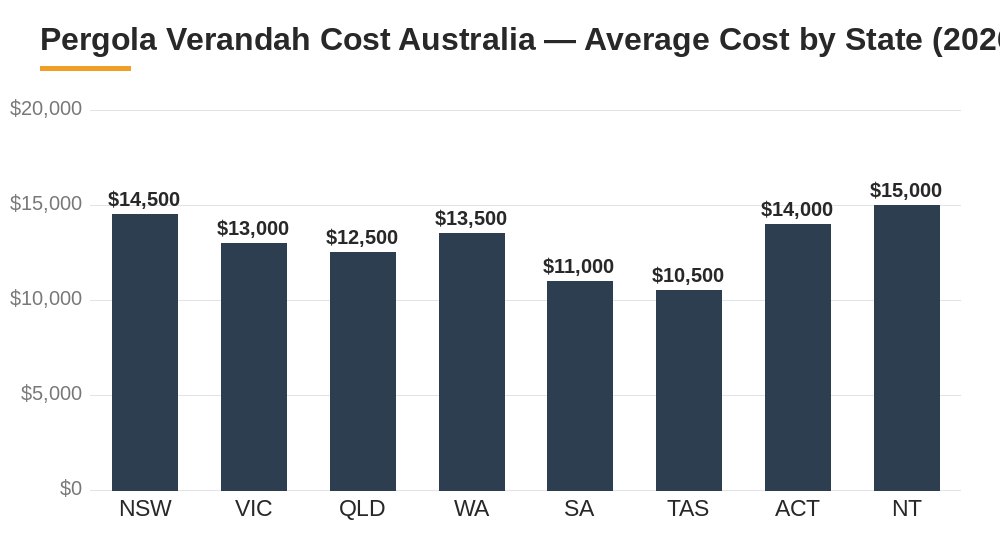
Here’s the honest baseline: most Australian homeowners spending on a pergola or verandah fall into the $8,000-$18,000 range. That covers a mid-size structure (roughly 15-25 square metres), an attached or freestanding design, standard Colorbond or polycarbonate roofing, and basic concrete footings. You pay less if you go aluminium kit; you pay more if you go custom hardwood with electrical or drainage.
| State | Average Cost | Typical Range |
|---|---|---|
| NSW | $14,500 | $6,000 – $32,000 |
| VIC | $13,000 | $5,500 – $28,000 |
| QLD | $12,500 | $5,000 – $30,000 |
| WA | $13,500 | $5,500 – $29,000 |
| SA | $11,000 | $4,500 – $24,000 |
| TAS | $10,500 | $4,000 – $22,000 |
| ACT | $14,000 | $6,000 – $30,000 |
| NT | $15,000 | $7,000 – $35,000 |
Get 3 free quotes from local providers in your area. No obligation.
NSW and ACT prices are higher primarily because of labour costs and council compliance requirements. The NT is expensive for a different reason: cyclone-rated engineering standards mean more steel, deeper footings and higher engineering fees. Queensland is often cheaper per square metre than you’d expect, there’s a lot of competition among outdoor builders there, particularly along the southeast coast.
A real-world scenario: what one Sydney family actually paid
A couple in Ermington (western Sydney) wanted an attached verandah across the back of their 1990s brick veneer, roughly 6m x 3.5m, with a Colorbond roof matching the existing house, two downlights and one ceiling fan. Here’s how the quote broke down:
- Engineering and council DA: $1,800
- Concrete footings (4 posts): $1,200
- Steel frame and posts: $3,400
- Colorbond roofing with insulation: $2,800
- Fascia, guttering and downpipe: $900
- Electrician (2 lights, 1 fan): $850
- Labour (builder): $2,600
- Total: $13,550
They got three quotes. The lowest was $11,200 (no insulation, no DA assistance), the highest was $17,400 (custom timber framing). They chose the middle quote from a licensed builder who handled the DA paperwork, worth the extra $2,300 to avoid the headache, they said.
Pergola and verandah types compared
The type of structure you choose determines your cost ceiling more than anything else. A basic shade pergola and a fully engineered verandah are completely different jobs, same category, very different price.
| Structure Type | Typical Cost | Roofed? | Council Approval Usually Needed? |
|---|---|---|---|
| DIY flat-pack kit (aluminium) | $1,500 – $4,500 | Partial / slatted | Often exempt |
| Builder-installed kit (pine or aluminium) | $4,000 – $9,000 | Slatted or open | Sometimes |
| Custom pergola (hardwood or steel) | $9,000 – $18,000 | Open or partial | Usually yes |
| Attached verandah (Colorbond roof) | $10,000 – $22,000 | Full weatherproof | Yes |
| Custom hardwood verandah (full roof) | $18,000 – $35,000+ | Full weatherproof | Yes |
| Enclosed patio / alfresco room | $20,000 – $50,000+ | Full + walls | Yes |
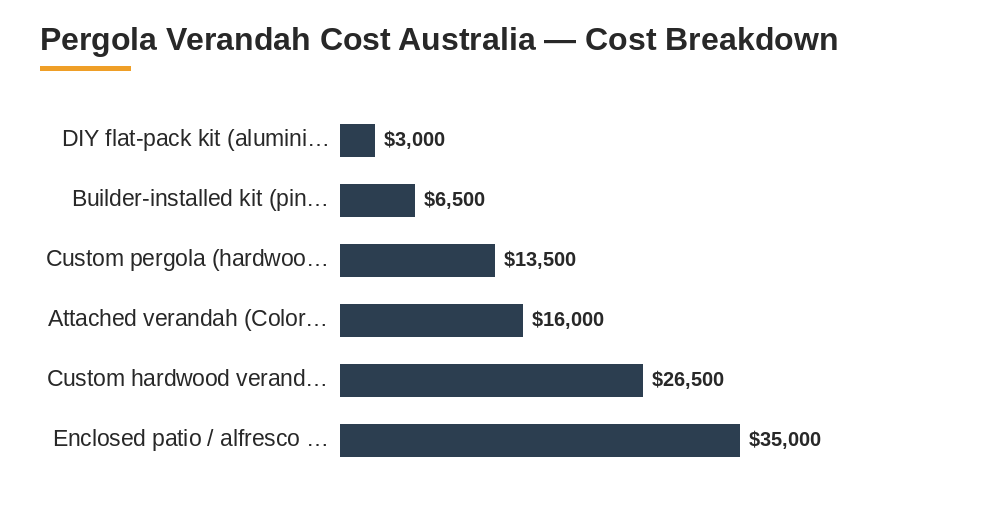
The gap between a builder-installed kit and a custom pergola is where most buyers make their decision. Honestly, for most suburban backyards, a quality installed kit is hard to fault. Custom builds make sense if you’ve got a heritage property, an unusual site or you want the structure to genuinely match the house’s architecture.
Where the money actually goes
Material choice
This is the single biggest lever. Treated pine is the cheapest structural timber option at around $35-$55 per linear metre. Hardwoods like spotted gum or merbau run $75-$120 per linear metre and require less maintenance long-term. Aluminium sits in the middle on cost, lasts longer than pine with zero upkeep, and frankly looks fine on most modern homes. A 20-square-metre pergola in pine might cost $6,500-$9,000; the same footprint in hardwood timber with a proper roof is $14,000-$22,000. That’s a real difference.
Size and footprint
Builders typically price outdoor structures per square metre for materials, but labour doesn’t scale linearly. A 15 sq m pergola might cost $9,000; a 25 sq m version from the same builder won’t cost $15,000, it’s more like $12,500-$13,500. The reason is that footings, frame setup and council costs are largely fixed regardless of size. You get better value per square metre as you go bigger, up to a point. Aim for at least 15-20 square metres if you’re commissioning a custom build, smaller than that and the fixed costs make the per-square-metre rate look painful.
Roofing type and quality
Open slatted roofs (timber or aluminium battens) are the cheapest option at around $40-$70 per square metre installed. Polycarbonate sheets are next at $60-$100/m², letting in light but trapping heat. Colorbond steel with insulation panel underneath, the standard for a proper verandah, runs $95-$140/m². Tiled roofing to match an existing house is the premium option at $150-$220/m² and requires proper structural engineering to handle the load. For most people, Colorbond with insulation is the right balance. In Darwin or Cairns, insulation isn’t optional, it’s the difference between an outdoor area that’s usable and one that isn’t. You can also find a flat-pack pergola kit that handles simpler slatted designs for under $4,000 in materials.
Council approval and engineering
A Development Application in NSW costs $1,300-$2,500 depending on the council. Victoria’s building permit process typically adds $800-$1,800 for a residential outdoor structure. The NT adds cyclone-rated engineering assessments on top, which can add $1,500-$3,000 to the project. Check whether your project qualifies as exempt development before you assume you need a DA, in many councils, structures under 20 square metres attached to a single dwelling are exempt. The Australian Bureau of Statistics data on residential building approvals confirms the northeast states process far more of these applications than southern states, reflecting both climate demand and stricter compliance environments.
Site access and ground conditions
A flat, clear backyard with easy vehicle access costs nothing extra. A sloped block in the hills outside Adelaide or a property with poor soil in Frankston’s clay-heavy suburbs adds real cost. Sloped sites need either cut-and-fill earthworks ($800-$3,000) or adjustable post footings. Rocky ground in inner-Brisbane or parts of Perth’s Hills can double the footing cost. Ask your builder specifically about your soil conditions before accepting a quote, a $500 soil assessment can save you a $3,000 surprise mid-build.
Questions to ask before you book
Is this a fixed price or an estimate?
Some outdoor builders quote a ballpark and then adjust based on what they find on site. For anything involving footings or council approval, push for a fixed-price contract. The difference between a $12,000 estimate and a $16,000 invoice is not a conversation you want to have once your yard’s been dug up.
Who handles the council paperwork?
Some builders include DA lodgement as part of their service; others quote for the build only and leave you to sort the permits. Clarify this upfront. If you’re organising it yourself, factor in 4-12 weeks of waiting time before a single post goes in the ground.
What’s included in the quote, specifically?
Does it include footings? Guttering? Fascia? Downpipes? Electrical rough-in? These can each add $500-$1,500 and builders vary on whether they’re standard or extra. Ask for a line-item breakdown, not just a lump sum.
What roofing insulation are you using?
Some builders default to uninsulated Colorbond, which is significantly cheaper but turns the space into an oven in summer. A reflective foil or rigid foam insulation panel underneath costs $800-$1,800 extra but makes the structure usable year-round. Worth knowing upfront rather than retrofitting it later.
Are your plans engineer-certified?
Any structure attached to your house or over 3 metres high generally needs engineer-signed drawings. In cyclone zones (NT, northern QLD, northern WA), this is non-negotiable. An uncertified structure can void your home insurance and create real issues when you sell. Ask to see the engineering certification before work starts.
What’s the payment schedule?
Reputable builders typically request a deposit (10-20%), a progress payment at frame stage and the balance on completion. Be cautious of anyone asking for 50% or more upfront. That’s a warning sign in any trade.
Common mistakes worth avoiding
- Skipping the council check. Building without required approval means you may be forced to demolish at your own cost. That’s not hypothetical, councils do audit structures, especially when properties change hands.
- Choosing the cheapest quote without reading the scope. A $9,500 quote that excludes footings, guttering and electrical rough-in is not actually cheaper than an $11,800 quote that includes all three. Line-item comparison matters.
- Underestimating ongoing maintenance costs. A treated pine pergola needs oiling or staining every 2-3 years. Budget $150-$400 for materials, or $500-$900 if you pay someone. Over 10 years, that’s $1,500-$4,500 in upkeep. Factor this in when comparing pine versus aluminium or hardwood. A good outdoor timber stain and protector extends the life of pine significantly if applied regularly.
- Not checking setback requirements. Structures too close to a boundary fence can breach local planning rules regardless of size. In most councils, the setback is 900mm-1m from the boundary. Get this confirmed before you finalise your design.
For context on broader outdoor living costs and how they fit into overall home improvement budgets, the Choice Australia home renovation research is worth reading if you’re planning multiple projects at once and trying to prioritise spend.
If you’re also thinking about other pet or home costs alongside this project, our guide to dog walking costs in Australia and dog daycare pricing might be worth a look, outdoor entertaining spaces and pet-friendly yards often go hand in hand. And if you’re budgeting across multiple home services, our pet insurance cost breakdown gives you a sense of what ongoing commitments look like. More broadly, our monthly pet food cost guide and cat boarding prices round out the picture for households managing multiple expenses at once.
Frequently asked questions
Do I need council approval for a pergola or verandah in Australia?
In most states, structures under a certain size (typically 20 square metres in NSW and VIC, 10 square metres in some councils) qualify as exempt development and don’t need formal approval. Anything larger, taller than 3 metres, or attached to a heritage property usually does need a Development Application or building permit. Check with your local council before any work starts.
How long does it take to build a pergola or verandah?
A basic kit pergola can be installed in 1-2 days by a couple of experienced tradies. A custom hardwood verandah with roofing, footings and electrical work typically takes 1-2 weeks. Lead times for the build itself are usually quick; the wait is often council approval, which can add 4-12 weeks.
What’s the difference between a pergola and a verandah?
A pergola is a freestanding or attached open-frame structure, usually with an open or slatted roof. A verandah is an attached roofed structure that forms part of the home’s exterior, typically with a full weatherproof roof. Verandahs cost more because they require proper roofing, guttering and often structural integration with the house.
Is Colorbond or timber better value for a verandah roof?
Colorbond roofing is cheaper upfront (around $80-$120 per square metre installed) and needs almost no maintenance. Timber looks better and adds more resale value, but it requires sealing every 2-3 years and can cost 40-60% more. For most suburban homes in QLD or WA where heat is a real issue, Colorbond with adequate insulation is the smarter practical choice.
Can I save money by using a kit pergola instead of a custom build?
Yes, substantially. A quality aluminium or pine kit from a supplier can cost $1,500-$4,000 for materials alone, versus $10,000-$25,000 for a custom build. The trade-off is limited sizing options, less structural permanence, and often a less polished finish. For a temporary setup or a rental property, kits are hard to beat on value.
People Also Ask About Pergola Verandah Cost Australia
Does a pergola or verandah add value to an Australian home?
Generally yes, particularly in QLD, WA and NSW where outdoor living is a major selling point. A well-built verandah can add 5-10% to a property’s value in these markets. A basic flat-pack pergola adds little to nil. The structure needs to look permanent and match the house style to actually shift buyer perception.
How much does it cost to enclose a pergola with screens or glass?
Enclosing an existing pergola with café blinds or shade screens typically costs $1,500-$4,000 depending on the number of sides and material. Full glass or polycarbonate enclosures are significantly more, running $5,000-$15,000 for a standard 3m x 4m structure. Ziptrak-style blinds are the most popular middle-ground option and usually cost $800-$1,800 per panel.
What’s the cheapest way to cover a verandah roof in Australia?
Polycarbonate sheeting is the most affordable full roof option, starting around $40-$60 per square metre for materials. It’s lightweight, DIY-friendly and lets in natural light. The downside is heat transfer, in Queensland or WA summers it can turn an outdoor area into an oven without proper ventilation. Shade cloth is even cheaper but doesn’t offer weather protection.
How much do pergola footings cost in Australia?
Concrete footings for a standard pergola typically add $500-$1,500 to the total cost, depending on depth required and soil conditions. Rocky ground or sloped blocks can push this higher. Some freestanding kit pergolas use screw-in ground anchors instead of poured footings, which is cheaper and avoids the need for a concreter.
Is it cheaper to build a pergola attached to the house or freestanding?
Freestanding pergolas are slightly cheaper to engineer because they don’t require structural attachment to the house wall, but they need their own footings on all sides. Attached structures share a wall, which reduces the number of posts and footings needed. In practice, the cost difference is modest, maybe $500-$1,500, and the decision is usually driven by your yard layout and council setback rules rather than cost.
Related Cost Guides
Recommended Products for Pergola Verandah Cost Australia
If you’re tackling this yourself, here are some products from Amazon Australia that can help:
Getting the most out of your pergola verandah cost Australia comes down to three things: understanding what type of structure you actually need, getting genuine fixed-price quotes with a clear scope, and checking your council’s exempt development thresholds before you spend anything on design. Do those three things and you’ll avoid the most expensive mistakes. The price range is wide, but the sweet spot, a well-built 20 square metre attached verandah with Colorbond roofing, is achievable for $12,000-$16,000 in most Australian capital cities in 2026.
This guide contains affiliate links. We may earn a small commission from qualifying purchases at no extra cost to you.