
Garage conversion cost Australia starts at around $15,000 for a stripped-back bedroom or home office, and climbs to $80,000 or more for a fully self-contained studio with plumbing, separate entry and council-compliant fitout. Most homeowners end up somewhere in the $20,000–$45,000 range for a practical single-car garage conversion. According to the Australian Bureau of Statistics, residential alterations and additions have been rising steadily as homeowners maximise existing space rather than buy bigger.
Garage conversion cost Australia typically runs $15,000 to $80,000, with most single-garage projects landing between $20,000 and $45,000. A basic bedroom or home office conversion sits at the lower end; a full self-contained studio with bathroom, kitchen and compliant insulation pushes toward $60,000–$80,000. Location, council approval fees and the existing slab condition all shift the final number significantly.
The reason the range is so wide? Garages vary enormously. A concrete-slab double garage in a Brisbane suburb with an existing electrical connection needs far less structural work than a single-car garage in a Hobart terrace with a timber subfloor and zero insulation. The existing conditions drive the budget as much as the fitout quality does.
What this normally costs in 2026
The numbers below reflect pricing gathered across capital cities and regional centres for 2026. They assume a licensed builder doing the work under a proper contract, with council approvals where required. These are not DIY estimates.
| State | Average Cost | Typical Range |
|---|---|---|
| NSW | $42,000 | $22,000 – $75,000 |
| VIC | $38,000 | $20,000 – $70,000 |
| QLD | $35,000 | $18,000 – $65,000 |
| WA | $36,000 | $19,000 – $68,000 |
| SA | $32,000 | $17,000 – $60,000 |
| TAS | $30,000 | $15,000 – $55,000 |
| ACT | $44,000 | $24,000 – $78,000 |
| NT | $33,000 | $18,000 – $58,000 |
Get free quotes from local providers in your area. No obligation.
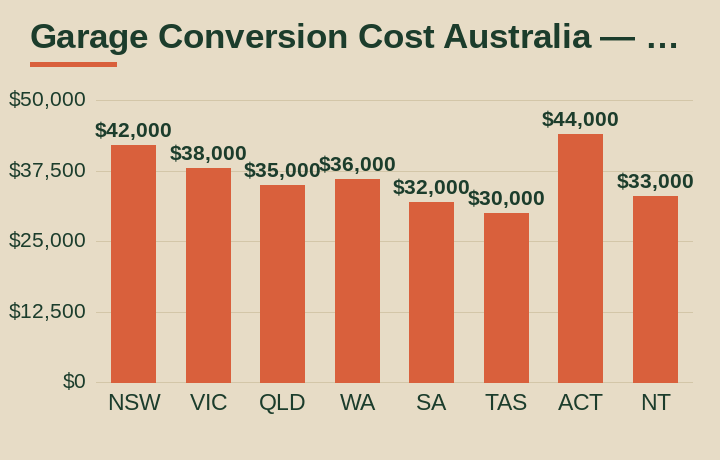
NSW and the ACT sit at the top of the range, driven by higher labour costs, council fees and the cost of meeting stricter energy compliance requirements. Queensland and South Australia tend to come in 10–20% cheaper for equivalent work. Tasmania often has the lowest absolute costs, though the building industry there is smaller and trade availability can be patchy in regional areas.
What’s included versus what’s extra
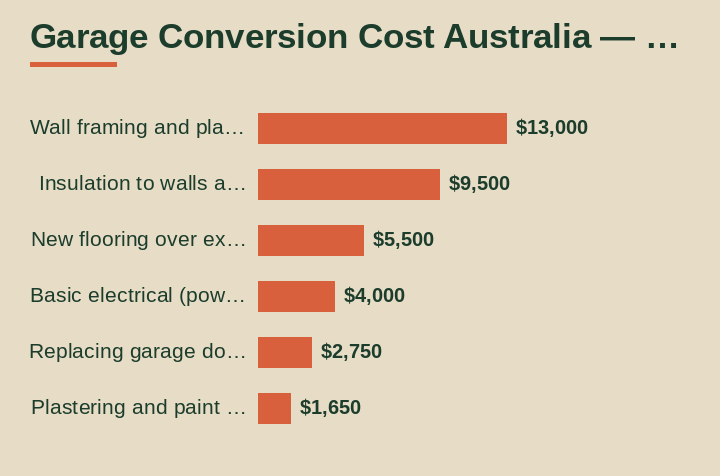
The confusion around garage conversion pricing often comes down to what different builders mean by “a conversion.” A basic quote from one tradie and a full turnkey quote from another might look like $15,000 apart, even for the same garage. Here’s a clearer breakdown of what’s typically included in a standard conversion and what gets added on.
| Typically Included | Usually Extra (Additional Cost) |
|---|---|
| Wall framing and plasterboard lining | Bathroom or en suite ($8,000–$18,000) |
| Insulation to walls and ceiling | Kitchenette or wet bar ($5,000–$14,000) |
| New flooring over existing slab | Slab replacement or levelling ($3,000–$8,000) |
| Basic electrical (power points, lighting) | Split-system air conditioning ($2,500–$5,500 installed) |
| Replacing garage door with wall/window | Separate entry or external door ($1,500–$4,000) |
| Plastering and paint prep | Interior painting ($800–$2,500) |
| Building permit or DA fees (varies) | Landscaping or driveway changes ($2,000–$10,000+) |
The gap between “shell done” and “move-in ready” is commonly $10,000–$20,000. Make sure your quote specifies which items are in scope before you sign anything.
Where the money actually goes
Understanding the cost breakdown helps you spot where quotes are lean and where they’re inflated. These are the five factors that genuinely move the needle.
1. Whether plumbing is involved
This is the biggest single variable. A bedroom or office conversion with no plumbing can be done cleanly for $18,000–$30,000. Add a bathroom, and you’re looking at an extra $8,000–$18,000 depending on how far the plumber needs to run waste and water lines to connect to the main system. If the garage is at the back of the block and your main drainage is at the front, that extra pipe run alone can cost $3,000–$6,000. A granny flat with a full kitchen and bathroom easily adds $20,000–$30,000 to the base conversion cost. For more on total ownership costs, see our guide on ongoing home and pet costs for Australian households.
2. Ceiling height and structural work
Many older Australian garages were built with 2.1–2.2 metre ceilings. The NCC requires at least 2.4 metres for a habitable room. Raising the roof structure on a single-garage conversion adds $8,000–$18,000 to the budget and requires engineering sign-off. Garages built from the 1990s onward often clear the 2.4m mark already, which removes this cost entirely. Worth confirming before you get excited about a low quote.
3. Slab condition and floor treatment
If the concrete slab is sound and level (within 5mm over 3 metres), a floating floor goes straight on top at $60–$120 per square metre installed. A slab that’s cracked, sloped or damp needs either a grind-and-level ($1,500–$3,500) or full replacement ($4,000–$9,000 for a standard single-car garage). Moisture in slabs is common in older homes, particularly in Melbourne’s south-east and Sydney’s western suburbs. Get a moisture reading before the floor goes in or you’ll be pulling it up later.
4. Council approval and compliance costs
Development application fees vary from around $500 in some regional councils to over $3,000 in inner-Sydney LGAs. Add draftsperson or architect fees ($1,500–$4,000) to draw compliant plans, and a private building surveyor ($900–$2,200) if you’re going the private certification route in VIC or QLD. Some projects qualify as exempt development (particularly in NSW under SEPP), which cuts approval costs to near zero, but you need to confirm eligibility first. Skipping permits might seem like a saving but it’s a real liability at resale. MoneySmart’s home renovation guidance is clear on why undocumented work creates financial risk.
5. Location within Australia and local trade rates
Inner-city projects in Sydney’s Surry Hills or Melbourne’s Fitzroy attract a 20–35% premium over the same work in outer suburbs like Penrith or Dandenong. The premium isn’t just demand, parking costs, access restrictions and the higher cost of living in those areas all flow through to builder rates. In regional centres like Toowoomba, Geelong or Fremantle, you’ll often find better value but longer lead times, because quality tradies are booked out weeks ahead. Brisbane and Queensland generally sit 10–15% below Sydney pricing for equivalent conversion work.
Questions to ask before you commit
Is your quote fixed price or a cost-plus estimate?
Fixed-price contracts give you certainty on the total cost. Cost-plus contracts, where you pay the builder’s costs plus a margin, can blow out significantly if unexpected work is uncovered (moisture, asbestos, structural issues). For a garage conversion, push for a fixed price once the scope is clear. If a builder won’t give you one, ask why.
Does the quote include council approvals and certification?
Some builders quote the construction only and leave approvals to you. Others include the full end-to-end cost. The difference in out-of-pocket expense can be $2,000–$5,000 when you factor in DA fees, engineering certificates and final building sign-off. Clarify this before comparing quotes side by side.
How will the garage door opening be treated?
Replacing the garage door with a framed wall, window and weatherproofing is a significant piece of work. Costs range from $2,500 to $6,500 depending on what goes in. Some quotes include this; others treat it as a separate item. It’s one of the first visual elements of a converted garage, so don’t let it become an afterthought.
Is asbestos testing included?
Garages built before 1990 frequently contain asbestos in wall sheeting, soffits or the roof. Removal and disposal is a licensed-only job and costs $1,500–$5,000 depending on quantity. If the garage is pre-1990, ask specifically whether asbestos testing is included in the quote, or whether it’s flagged as a potential variation. Discovering it mid-project is a budget and timeline headache.
What energy compliance does the space need to meet?
Under the NCC 2022, new habitable spaces must meet specific energy efficiency requirements: insulation levels by climate zone, window glazing performance and sometimes external shading. A builder who doesn’t mention Section J compliance for your climate zone is one to be cautious about. Non-compliant work can fail inspection and require expensive rectification.
What’s the payment schedule?
For projects over $20,000, most states require a written contract with a staged payment schedule tied to construction milestones. Avoid builders who ask for more than 10% upfront. Progress payments at frame, fitout and practical completion are standard. If anyone asks for 50% before a slab is poured, walk away.
How to bring the cost down
The single most effective cost-saving move is keeping plumbing out of the conversion. A bedroom or home office that shares the main house’s bathroom doesn’t need any new plumbing runs, which strips $8,000–$18,000 off the build cost immediately. Most home offices, teenage retreats and guest rooms don’t actually need their own bathroom, even if it feels like they should.
Using the existing concrete slab saves real money too, assuming it’s in good condition. Don’t let a builder talk you into a full slab replacement unless there’s a genuine structural reason. A sound slab that needs only a moisture barrier and floating floor is a $2,000–$4,000 job, not a $7,000 one. Get a second opinion if a builder pushes hard for replacement.
Handling your own development application is genuinely possible for standard residential projects in most states. Council websites in NSW, VIC and QLD now have online DA portals with checklists. A town planner or draftsperson charges $1,500–$4,000 to do this. If the project is straightforward, spending a weekend understanding the council requirements can save you that fee entirely. For more on smart ways to approach renovation decisions, the Choice Australia home improvement section has some useful independent context.
Getting multiple quotes also matters more for garage conversions than for smaller jobs. Pricing across builders for the same scope regularly varies by 20–30%. Three quotes is the minimum. You’re not trying to find the cheapest, you’re trying to understand what a realistic price is and to spot outliers in either direction. A quote that’s 40% below the others usually means something’s missing from the scope.
For the finishing trades, consider what you can genuinely do yourself. Interior painting, garden tidying around the new entry and even some of the flooring installation are realistic for capable DIYers. Saving on a good set of insulation batts by sourcing them directly from a trade supplier rather than through your builder is another option worth exploring if your builder is charging a significant markup on materials.
If the conversion is destined to be a home office or study, you also don’t necessarily need a full split-system aircon from day one. A portable unit handles many climates adequately and doesn’t require installation by a licensed electrician. That’s a $2,500–$4,500 saving you can revisit once the space is in use. You can always look at portable and small split-system options as a lower-cost starting point.
Common mistakes people make with garage conversions
Starting work before getting permits. It’s tempting to skip council approval, especially for what feels like “just” an internal fit-out. But a change of use is a change of use. Unpermitted habitable rooms create insurance issues, can block property sales and sometimes require demolition. The permit process isn’t designed to frustrate you; it’s there because garages weren’t built to habitable standards.
Assuming the slab is fine without checking it. Moisture rising through an unsealed concrete slab destroys flooring and encourages mould. A simple moisture meter test costs almost nothing and takes ten minutes. Skip it and you may find yourself replacing $4,000 worth of vinyl plank flooring twelve months later.
Underestimating trade lead times. In 2026, good builders in Sydney, Melbourne and Brisbane are often booked out 8–14 weeks. Plumbers and electricians even longer in some suburbs. If you’re hoping to have the conversion done before Christmas or before a specific life event, back-calculate the start date carefully and add buffer. Running out of builder halfway through is not a fun position to be in.
Treating a garage conversion and a granny flat as the same thing. A granny flat is a self-contained dwelling. It has its own legal definition, its own planning pathway and its own cost profile. If you want to rent the converted space independently, you need the granny flat pathway, which typically costs $40,000–$80,000 all in, not $20,000. Anyone quoting $20,000 for a rentable granny flat is missing something. See our full breakdown on how to read a renovation quote for tips on spotting gaps.
A few terms worth knowing
DA (Development Application): A formal application to your local council for permission to carry out building works. Required for most garage conversions classified as a change of use.
Exempt development: A category of minor building work that doesn’t need a DA in certain states, provided specific criteria are met (size limits, setbacks, no heritage overlay). Check your state’s planning portal to see if your project qualifies.
NCC (National Construction Code): The framework of building standards that apply across Australia. For habitable rooms, it sets minimum requirements for ceiling height, insulation, ventilation, waterproofing and fire safety.
Section J / NatHERS: The energy efficiency provisions of the NCC. These set minimum insulation and glazing performance requirements for new habitable spaces, and they apply to garage conversions in most states.
Frequently asked questions about garage conversion cost Australia
Do I need council approval to convert my garage in Australia?
In most cases, yes. Converting a garage into a habitable room is classified as a change of use under the National Construction Code, which typically triggers a development application or building permit. Exempt development provisions exist in some states (particularly NSW and Victoria) but have strict size, setback and bushfire zone conditions. Always check with your local council before starting work.
How long does a garage conversion take in Australia?
A basic single-garage conversion (bedroom or home office) typically takes 4–8 weeks once approvals are in place. A more involved project with bathroom, kitchenette and new flooring can run 10–16 weeks. Delays from council approvals, inspections or trades availability can push timelines out significantly, especially in metro areas where builders are stretched.
Can I convert my garage into a granny flat?
Yes, but a granny flat conversion is one of the most expensive types. You’ll need a self-contained bathroom, kitchenette and separate entry in most states. Total costs typically range from $40,000 to $80,000 once plumbing, electrical, council approvals and compliant insulation are accounted for. NSW has a relatively streamlined SEPP (Affordable Rental Housing) pathway for secondary dwellings, but rules vary significantly by council.
Does a garage conversion add value to my home?
It can, but not automatically. A properly permitted, finished conversion that’s compliant with the NCC adds legitimate living space to a property’s floor area, which does reflect positively in valuations. An unpermitted conversion, on the other hand, can create liability at sale time and may need to be reversed. According to CoreLogic Australia, liveable floor area is one of the strongest drivers of property value in Australian capital cities.
What’s the cheapest type of garage conversion?
A basic home office or bedroom conversion with no plumbing is the most affordable route, typically $15,000–$25,000 for a single garage. The big cost-savers are avoiding new plumbing runs, keeping the existing concrete slab and not needing to raise the ceiling. Adding a bathroom alone adds $8,000–$18,000 to the budget, depending on how far the plumbing needs to run.
People Also Ask About Garage Conversion Cost Australia
Can I legally sleep in a converted garage in Australia?
Only if the conversion meets the National Construction Code’s requirements for a habitable room. That includes minimum ceiling heights (typically 2.4 metres), adequate natural light and ventilation, compliant insulation and fire separation from the garage if it previously housed a vehicle. Without a building permit confirming these are met, sleeping in the space is technically non-compliant and can affect your home insurance.
Is a garage conversion cheaper than building an extension?
Generally, yes. A new ground-floor extension starts around $2,000–$3,500 per square metre in most capital cities. A garage conversion uses existing structure, walls, slab and roof, which eliminates the most expensive part of a build. That said, if the garage needs significant structural work (raising the roof, underpinning the slab), the gap closes quickly.
What NCC requirements apply to a garage conversion in Australia?
The National Construction Code (NCC) classifies a converted garage as a Class 1a dwelling if it becomes part of the main home, or Class 1b/2 for secondary dwellings. Requirements include minimum ceiling height of 2.4 metres, NCC Section J energy compliance (insulation, glazing), weatherproofing, smoke alarms and compliant electrical circuits. Your local council building surveyor or private building surveyor can confirm exactly what applies in your state.
Will my home insurance cover a converted garage?
Only if the conversion was done with proper permits and you’ve updated your policy. Insurers assess a property based on its disclosed use and floor area. An unpermitted conversion that’s in use as a bedroom or rental could result in a claim being denied, particularly if the work didn’t meet building code. Notify your insurer before work starts and again on completion.
How do I insulate a garage conversion in Australia?
Walls typically need R2.0–R2.5 bulk insulation batts between studs, plus sarking or a reflective layer. Ceiling insulation is usually R3.5 or higher depending on your climate zone. Concrete slabs need either a floating floor with insulation underneath or a direct-stick system with thermal break matting. Energy compliance requirements vary by state and climate zone under the NCC 2022 framework, so check what applies to your postcode.
Related Cost Guides
Recommended Products for Garage Conversion Cost Australia
If you’re tackling this yourself, here are some products from Amazon Australia that can help:
Comparing prices for this guide, the pattern that stood out was how much the presence or absence of plumbing shifts the entire budget conversation. Two conversions that look similar on paper, same square meterage, same suburb, same finish level, can sit $20,000 apart based purely on whether one includes a bathroom. If you’re approaching a garage conversion in 2026, get absolutely clear on your use case before talking to a builder. It will determine whether you’re in the $20,000 bracket or the $60,000 one, and that’s not a rounding error.
This guide contains affiliate links. We may earn a small commission from qualifying purchases at no extra cost to you.