
What an ensuite addition actually costs in Australia right now
Ensuite addition cost in Australia starts at around $15,000 for a stripped-back wet room and climbs past $50,000 for a full-size, stone-finished bathroom attached to a master bedroom. Most projects land somewhere between $20,000 and $38,000. That range sounds wide, but the variables that push the number up or down are fairly predictable once you know what to look for.
Adding an ensuite in Australia costs between $15,000 and $50,000 for most builds, with a modest 3–4 sqm wet room running $15,000–$22,000 and a fully tiled, stone-bench ensuite hitting $35,000–$50,000+. Costs are highest in Sydney and Melbourne and noticeably lower in regional Queensland, SA and Tasmania. Budget separately for planning approvals, which add $1,500–$5,000 depending on your council.
Comparing the figures compiled for this guide, the pattern that stood out was how dramatically location and existing plumbing access affect the final invoice. Two identical ensuite footprints, one in Surry Hills with poor wall access and one in a newer Geelong house with a nearby wet wall, can easily differ by $8,000–$12,000 in hydraulics costs alone.
According to the Housing Industry Association, bathroom additions and renovations remain one of the most consistently popular home improvement categories in Australia, driven largely by the push for a private bathroom off the master bedroom in family homes.
State-by-state ensuite addition prices in 2026
Prices shift with labour markets, council fees and trade availability. Inner-city Sydney and Melbourne consistently sit at the top end. Regional Queensland, SA and Tasmania are noticeably more affordable, assuming you can get the trades.
| State | Average Cost | Typical Range |
|---|---|---|
| NSW | $32,000 | $19,000 – $52,000 |
| VIC | $30,000 | $18,000 – $50,000 |
| QLD | $27,000 | $15,000 – $44,000 |
| WA | $29,000 | $17,000 – $48,000 |
| SA | $25,000 | $14,500 – $40,000 |
| TAS | $24,000 | $14,000 – $38,000 |
| ACT | $31,000 | $19,000 – $50,000 |
| NT | $33,000 | $20,000 – $54,000 |
Get free quotes from local providers in your area. No obligation.
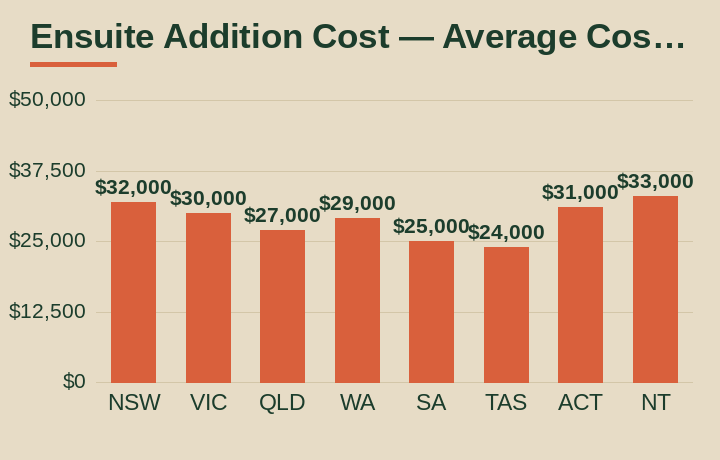
The NT sits high partly because of freight costs for materials and limited trade competition in Darwin and Alice Springs. Perth’s prices have risen sharply since 2023 off the back of the mining boom and strong population growth putting pressure on construction labour.
A real-world ensuite addition: what one Sydney couple actually spent
To make this concrete: a couple in Newtown, Sydney converted a walk-in robe adjacent to their master bedroom into a 3.8 sqm ensuite in early 2026. Here’s roughly what the itemised invoice looked like.
Demolition and framing came to $3,200. Plumbing (extending from a shared wall with the main bathroom two metres away) ran $7,400. Electrical work including an exhaust fan with integrated heat lamp was $1,850. Waterproofing was $1,100. Tiling at 1.2 sqm/hr for floor and walls added $3,600 in labour plus $2,100 in tiles. Fixtures, a wall-hung vanity, toilet suite and 900mm shower screen, came to $4,300 using a trade supplier rather than builder supply. Council CDC approval cost $1,750. Builder’s project management margin: $4,800. Total: $30,100.
That’s fairly typical for inner Sydney on a 3–4 sqm footprint with mid-range finishes. Swap the vanity for a freestanding stone-top version and add heated flooring, and you’re looking at $36,000–$40,000 for the same footprint.
What you get at each price point
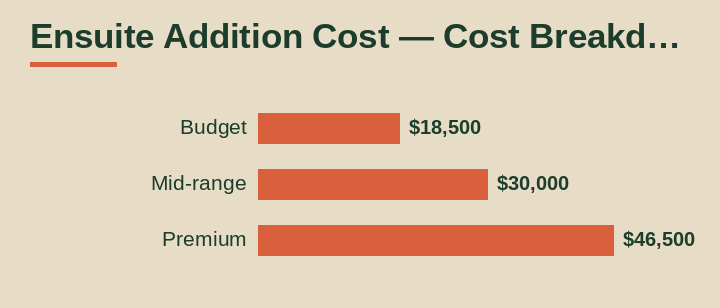
The price isn’t just about size. What you choose to put in the ensuite matters as much as how many square metres you’re working with. Here’s how the tiers break down.
| Tier | Typical Cost | What’s Included |
|---|---|---|
| Budget | $15,000 – $22,000 | Compact 2.5–3 sqm wet room, builder-grade fixtures, basic ceramic tiles, single vanity, no bath |
| Mid-range | $22,000 – $38,000 | 3–5 sqm, semi-frameless shower screen, stone-look porcelain tiles, quality tapware, heated towel rail |
| Premium | $38,000 – $55,000+ | 5+ sqm, natural stone, heated floors, niche shelving, freestanding bath, custom joinery, high-end tapware brands |
The jump from mid-range to premium is largely in materials and fixtures, not labour. A set of Brodware or Rogerseller tapware costs $1,800–$3,500 where a builder-grade equivalent costs $350–$600. That gap multiplies across every fitting in the room.
Where the money actually goes
Plumbing access and existing pipe location
This is the biggest wildcard on any ensuite addition. If your new ensuite sits against a wet wall that already carries plumbing from the main bathroom, hydraulics might cost $4,500–$7,000. Move the design to the other side of the room or house, and you’re looking at $9,000–$14,000 just for the plumbing reroute. That’s not an exaggeration. Pipe run distance and access dramatically change the quote. Always ask your plumber how close the proposed ensuite is to existing waste lines before you finalise the floor plan.
Floor area and ceiling height
Waterproofing, tiling and wet-area framing are all priced per square metre. Going from 3 sqm to 5 sqm adds roughly $3,500–$6,000 in those trades alone, before you factor in extra fixtures. Ceiling height matters too, ensuites with raked ceilings or ceilings over 2.7m cost more to plaster and paint, and scaffold access may be required for taller spaces. A standard 2.4m ceiling is the most cost-efficient to work with.
Fixture and fitting quality
Builder-grade fixtures from a trade plumbing supplier (think Caroma, Fowler Ware, standard Reece catalogue) typically cost $3,000–$5,500 for a complete ensuite fit-out including toilet, vanity, shower rose and tapware. Mid-range Brodware, Grohe or Villeroy and Boch equivalents push that to $6,000–$10,000. Premium European imports or custom joinery can add $15,000–$25,000 to fixtures alone. If budget’s a concern, this is where you have the most control. Sourcing your own wall-hung vanity units for ensuite builds rather than using builder supply can save $800–$2,000 on that item alone.
Structural and demolition complexity
Converting a walk-in robe is usually straightforward. Carving space out of a bedroom or breaking through a load-bearing wall is a different matter. Structural engineer fees run $1,200–$2,800, and the beam or lintel work needed to support a removed wall adds another $2,500–$6,000 in carpentry and concrete. If the existing floor isn’t reinforced enough to carry new tiles and a heavy vanity, additional structural support adds cost too. Always get a structural engineer’s opinion before assuming a wall can come out easily.
Council approvals and compliance
Most ensuite additions need either a DA (Development Application) or a CDC (Complying Development Certificate). A CDC through a private certifier is faster and generally costs $1,500–$3,000. A DA through council is slower and costs $1,800–$5,000 depending on your local government area, with some Sydney and Melbourne councils at the higher end. The Australian Bureau of Statistics building approval data shows residential bathroom additions are among the most commonly approved minor works nationally, so the process is well-trodden even if it feels bureaucratic. Don’t skip it, unapproved bathroom additions create serious problems when you sell.
Questions to ask before you book a builder
Is this a fixed-price contract or an estimate?
There’s a meaningful difference. An estimate can legally increase during the build; a fixed-price contract cannot (barring genuine variations you authorise). For an ensuite addition, push for a fixed-price contract once the design is finalised. Open-ended estimates on renovations are where budgets blow out.
Where are you planning to run the new waste pipes?
Ask this before you fall in love with a floor plan. A builder who hasn’t thought through the plumbing route hasn’t thought through the cost. If they can’t answer clearly, that’s a red flag. The waste route determines a large chunk of the hydraulics cost.
What does your quote include, and specifically, what doesn’t it include?
Get every exclusion in writing. Common exclusions that catch people out: painting (often excluded), tiling above a standard height, disposal of demolished materials, and prime cost allowances for fixtures that may not reflect real market prices. A quote with a $400 PC allowance for tapware isn’t realistic, that’s $400 of tap for a $30,000 build. Know what’s a placeholder versus a real cost.
Who are your licensed plumber and electrician?
Confirm they’ll be using licensed subcontractors, not labourers doing unlicensed wet-area work. Ask for the plumber’s and electrician’s licence numbers. This protects your home insurance and your peace of mind. You can verify these on the relevant state licensing register.
Do I need to vacate during the build?
For a straightforward ensuite addition that doesn’t touch the main bathroom, you generally don’t need to move out. But dust, noise and lack of water access for short periods are real. Get clarity upfront on which days the water will be off and whether you’ll need alternative arrangements.
What warranty do you provide on workmanship?
In most states, builders are required to provide a statutory warranty on residential building work (typically 6 years for structural defects, 2 years for non-structural defects in NSW, for example). Confirm this verbally and in writing. Some smaller operators try to limit warranty to 12 months, that’s below the legal minimum in most jurisdictions.
Common mistakes that add thousands to the final bill
- Finalising fixtures too late: Changing your mind on the vanity or shower position after waterproofing has begun is expensive. Lock down every fixture location before tiling starts. Changes at that stage can add $2,000–$5,000 in rework.
- Underestimating the approvals timeline: Many people budget for the build but not the waiting time. A DA can take 8–20 weeks. Starting construction before approval is granted risks stop-work orders and fines. Build the approval timeline into your project schedule from day one.
- Choosing the cheapest waterproofer: Waterproofing failure is catastrophic and expensive to fix. It’s not visible once tiled and can cause structural damage for years before you notice. Don’t trade down on this trade. A reputable waterproofer charges $1,000–$1,800 for a standard ensuite. Anyone quoting $500 for this work is cutting corners.
- Skipping the ventilation calculation: Ensuites need adequate exhaust capacity for the room size. An underpowered fan leads to mould issues within 12–18 months. It’s worth specifying a quality bathroom exhaust fan with integrated lighting that matches the actual cubic meterage of the space.
Frequently asked questions about ensuite addition cost
How much does it cost to add an ensuite in Australia in 2026?
Most Australian homeowners spend $15,000–$50,000 on an ensuite addition. A compact 3 sqm wet room with mid-range fixtures typically lands at $15,000–$22,000. A full-size ensuite with stone benchtops, heated floors and quality tapware runs $35,000–$50,000 or more.
Do I need council approval to add an ensuite?
In most cases, yes. Adding an ensuite involves structural work, plumbing and sometimes changes to external walls, which usually require a Development Application (DA) or Complying Development Certificate (CDC). Budget $1,500–$5,000 for approvals. Check with your local council before starting, rules vary significantly between LGAs.
How long does an ensuite addition take to build?
The build itself takes 3–6 weeks for a standard ensuite addition once trades are on site. Factor in 4–12 weeks for design, approvals and materials lead times before a spade hits the ground. Total project timeline from first meeting to finished bathroom is commonly 3–5 months.
Can I add an ensuite without a builder?
You can manage trades yourself as an owner-builder in most states, but licensed plumbers and electricians are always required by law regardless. For structural work above $10,000–$20,000 (depending on the state), a licensed builder is legally required. Owner-builder routes save on margin but add personal liability and can complicate home insurance.
Does adding an ensuite add value to a home?
Generally yes, particularly on properties with only one bathroom. Real estate agents commonly cite ensuites as a strong selling point in family-sized homes. A well-finished ensuite in a home that previously lacked one can return 50–80% of its cost in added property value, though this varies significantly by suburb and property type.
People Also Ask About Ensuite Addition Cost
What is the minimum size for an ensuite bathroom in Australia?
The National Construction Code doesn’t set a minimum ensuite size, but most builders work to a practical minimum of around 2.5–3 sqm to fit a shower, toilet and basin comfortably. Some compact wet-room designs can work in 2 sqm but feel very tight. Check your local council’s planning overlays, some LGAs have their own minimum room size rules.
Can you add an ensuite to a house that wasn’t designed for one?
Yes, and it’s done regularly. It typically involves converting part of a walk-in robe, a storage room, or a section of the master bedroom. The key constraint is plumbing access, the further the new ensuite sits from existing waste lines, the more the hydraulics cost. Structural work may also be needed if load-bearing walls are involved.
How much does an ensuite addition add to property value in Australia?
A well-finished ensuite in a home that previously had only one bathroom typically adds $20,000–$50,000 to the property’s market value in metropolitan areas. The return depends heavily on the suburb, property type and quality of the fit-out. In strong markets like inner Sydney or Melbourne, the return can be higher. In regional areas or on properties that already have multiple bathrooms, the uplift is smaller.
What trades are needed to add an ensuite?
At minimum, you’ll need a licensed plumber (for waste, water and vent work), a licensed electrician (for lights, exhaust fan and heated flooring if applicable), a waterproofer, a tiler, and either a builder to project manage or a separate carpenter for framing. Many builders sub out all these trades and charge a project management margin of 15–25% on top.
Is it cheaper to add an ensuite during a new build or as a renovation?
Always cheaper during a new build. Retrospective ensuites involve demolition, wall removal, re-routing plumbing and often ceiling access work that simply doesn’t exist in a new build scenario. Adding an ensuite during new construction typically costs 30–45% less than retrofitting the same ensuite into an existing home, mainly because the walls are open and the trades are already on site.
How to bring the cost down
Going through the project data for this guide, a few cost-saving moves kept coming up consistently among homeowners who came in under budget. The biggest lever is almost always location relative to existing plumbing.
- Position against a wet wall: Placing the ensuite against the wall that backs onto your main bathroom’s plumbing can save $2,000–$5,000 in pipe runs alone.
- Keep the footprint under 4 sqm: Every square metre adds tiling, waterproofing and framing costs. A well-designed 3.5 sqm ensuite is genuinely comfortable for daily use.
- Source your own fixtures: Builders typically mark up fixtures 20–40%. Buying your vanity, tapware and toilet through a trade supplier or online saves $1,500–$4,000 on a mid-range fit-out. Confirm your builder accepts owner-supplied goods before signing.
- Skip the freestanding bath: It adds $1,800–$6,000 and takes up space most people don’t use daily. A larger shower alcove is more practical for an ensuite.
- Build in autumn or winter: Trade availability improves and some builders offer better rates to fill schedule gaps in the cooler months.
- Don’t move the toilet: Relocating a toilet requires rerouting the soil stack. That’s $1,200–$3,500 extra. Work the toilet into the design where it is if at all possible.
If you’re weighing up costs across other pet or home projects at the same time, it’s worth knowing that the full cost of owning a Labrador in Australia runs higher than most people expect annually, and an ensuite addition can be a comparable one-time outlay. Also useful as context: if you’re budgeting across a renovation and a new pet, see what Chihuahua vet costs look like in 2026 or French Bulldog vet costs for comparison. For homeowners interested in how this fits alongside other property improvements, MoneySmart’s home renovation planning tools are worth checking before committing to a major budget.
If you’re already renovating multiple rooms, there can be efficiency in bundling an ensuite addition with a main bathroom renovation, some builders will reduce their project margin if there’s enough combined scope. That said, it’s not always cheaper: simultaneous projects mean simultaneous trade access disruptions. Worth the conversation, but don’t bank on a discount until you see it in writing.
For comparison, dog grooming cost in Brisbane and Maltese grooming cost Australia-wide are covered separately if you’re budgeting across home and pet expenses simultaneously. And if you’re wondering about other significant home-adjacent decisions, reptile licence cost in NSW and Cavoodle prices in Australia are popular reads on this site for context on where Australians are spending in 2026.
Related Cost Guides
Recommended Products for Ensuite Addition Cost
If you’re tackling this yourself, here are some products from Amazon Australia that can help:
One last thing: get your quotes itemised, not just a single lump sum. A builder who won’t break down their quote by trade and materials is a builder who knows the individual line items won’t hold up to scrutiny. That’s a fair bit of leverage you want on your side when approving variations or disputing extras at the end.
This guide contains affiliate links. We may earn a small commission from qualifying purchases at no extra cost to you.