
Roof replacement cost Australia sits between $8,000 and $35,000 for most residential homes, with the typical job landing somewhere around $15,000–$22,000 once labour, materials and removal are factored in. That’s a wide range, and it reflects just how much pitch complexity, material choice and your postcode can shift the final number. According to the Australian Bureau of Statistics, construction labour costs have risen steadily since 2022, and roofing hasn’t been immune to that trend.
Roof replacement cost Australia typically runs $8,000 to $35,000 for a standard home, with most jobs landing in the $12,000–$22,000 range. Colorbond steel is the most popular choice at $15,000–$25,000 installed; terracotta or concrete tiles can push past $30,000 on larger homes. The biggest variables are roof size, pitch, material, and whether the battens and sarking need replacing too.
The cheapest jobs are usually small, simple gable roofs on older homes being converted to Colorbond steel. The most expensive are large two-storey homes with multiple valleys, dormer windows and premium terracotta tiles. Your roof is doing serious work keeping everything below it intact, so it’s not the place to go bargain-hunting without understanding what you’re getting.
What this normally costs in 2026
For a standard three-bedroom single-storey home with a roof area of roughly 150–180 m², here’s the ballpark by material:
- Corrugated iron or Zincalume: $8,000–$15,000
- Colorbond steel: $12,000–$22,000
- Concrete tiles: $11,000–$20,000
- Terracotta tiles: $18,000–$32,000
- Asphalt shingles (less common): $10,000–$18,000
These figures include removal of the old roof, materials, labour and basic waste disposal. They don’t always include sarking, new gutters, fascia, or ridge capping repairs. Always confirm what’s in and out of your quote in writing.
Roof replacement cost Australia by state
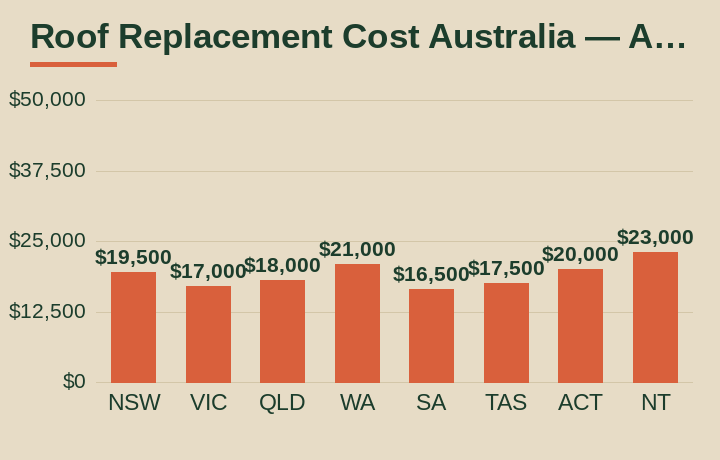
Labour rates and material supply chains vary enough across Australia that where you live has a real impact on the final bill. WA and the NT tend to run higher due to freight costs and fewer competing tradies. Victoria and South Australia are often the most competitive markets for roofing quotes.
| State | Average Cost | Typical Range |
|---|---|---|
| NSW | $19,500 | $13,000 – $32,000 |
| VIC | $17,000 | $11,000 – $28,000 |
| QLD | $18,000 | $12,000 – $30,000 |
| WA | $21,000 | $14,000 – $35,000 |
| SA | $16,500 | $10,500 – $27,000 |
| TAS | $17,500 | $11,500 – $28,000 |
| ACT | $20,000 | $13,500 – $31,000 |
| NT | $23,000 | $15,000 – $38,000 |
Get free quotes from local providers in your area. No obligation.
Sydney metro jobs often command a premium on top of the NSW average, particularly inner-west suburbs like Newtown and Leichhardt where scaffold access is trickier. In outer areas like Penrith or Campbelltown, prices tend to track closer to the state midpoint. Brisbane’s northern suburbs are well-served by roofing contractors and competition keeps prices reasonable; regional QLD is a different story, especially after cyclone season.
Where the money actually goes
Understanding what drives roof replacement cost Australia helps you push back on quotes that seem inflated and spot ones that might be cutting corners.
Roof size and pitch
This is the single biggest cost driver. A flat or low-pitched roof on a standard 3-bed home might cover 140 m²; a steeply pitched two-storey home in Wahroonga or Toorak could hit 280–320 m². At $65–$90 per m² for Colorbond installed, that difference is $9,100–$16,200 in material and labour alone. Steep pitches also slow down the crew significantly, adding hours to the job. Complex roofs with multiple valleys, hips and dormers can push the effective rate to $100–$130 per m².
Roofing material
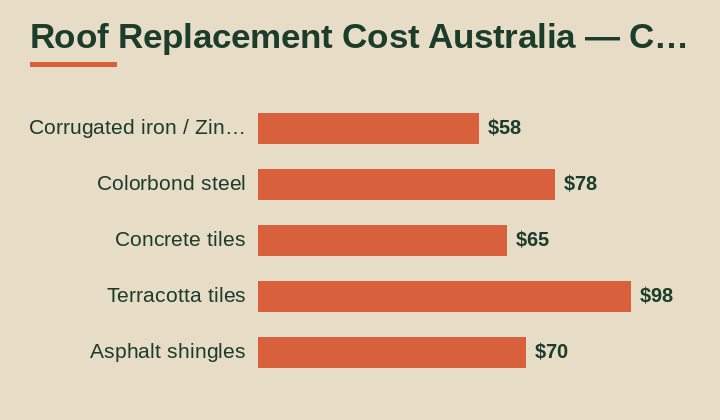
Concrete tiles sit at roughly $50–$75 per m² installed; Colorbond runs $60–$95 per m²; terracotta pushes to $75–$120 per m². The gap looks modest per square metre, but on a 200 m² roof, choosing terracotta over concrete tiles adds $5,000–$9,000 to the total. Worth it for aesthetics on a Federation-era home in Ashfield or Malvern, perhaps less so on a 1980s brick veneer in Toowoomba. You can also buy a roof sarking insulation blanket and discuss adding it during the replacement to improve your home’s thermal performance without paying inflated contractor mark-ups.
Removal and disposal of the old roof
This gets overlooked until it appears on the invoice. Tile removal generates a lot of heavy waste. Skip hire alone can cost $600–$1,200, and if your old roof contains asbestos (common in homes built before 1985), you’re looking at licensed asbestos removal at $2,000–$6,000 before any new roofing starts. Always ask a contractor to inspect for asbestos before quoting. Some don’t mention it, which means the bill changes dramatically on the day. For more on managing costs on large renovation projects, the home extension cost breakdown is worth a read as a parallel reference.
Sarking, battens and structural work
If the timber battens underneath the tiles are rotten or the sarking (the waterproof underliner) is degraded, those need replacing too. New sarking typically adds $1,500–$4,500 to the bill depending on roof size. Replacing battens can add another $800–$2,500. Neither is optional if they’re compromised. A good contractor will photograph any structural issues and show you before proceeding.
Location and access
A double-storey home in inner Brisbane is harder to scaffold safely than a single-storey home in regional SA. Scaffolding hire runs $800–$2,500 for a standard job but can reach $4,000+ for multi-level or tight-access properties. Coastal locations in places like Fremantle or Cairns Northern Beaches also attract a premium for cyclone-rated fixings and salt-resistant coatings. That’s not price gouging; it’s a genuine engineering requirement.
Material comparison: what you’re trading off
Beyond price, each roofing material has a different lifespan, maintenance requirement and aesthetic. Here’s how they stack up side by side.
| Material | Typical Installed Cost (per m²) | Lifespan | Maintenance |
|---|---|---|---|
| Corrugated iron / Zincalume | $45–$70 | 25–40 years | Low |
| Colorbond steel | $60–$95 | 40–70 years | Very low |
| Concrete tiles | $50–$80 | 40–50 years | Moderate (re-bedding, repointing) |
| Terracotta tiles | $75–$120 | 50–80 years | Low (crack inspection only) |
| Asphalt shingles | $55–$85 | 20–30 years | Moderate |
Colorbond steel is the default choice for a reason. It’s lightweight, which matters a lot on older homes not designed for heavy tile loads, and it’s genuinely low-maintenance. Terracotta’s longevity is impressive, but the upfront cost reflects that. Concrete tiles are the value pick if you want the tile aesthetic without the terracotta price. Asphalt shingles are common in North America but relatively uncommon here, and resale buyers sometimes push back on them.
If you’re weighing up other significant home improvements at the same time, a bathroom renovation or ensuite addition might also be on your radar. Bundling permits and builder access where possible can reduce overhead costs.
Questions to ask before you book
Is this a fixed-price contract or a cost-plus quote?
A fixed-price contract protects you if structural surprises turn up mid-job. Cost-plus billing means you pay for whatever time and materials are needed, which can balloon on older homes with hidden rot or asbestos. Push hard for fixed price on any job over $10,000.
What exactly is and isn’t included?
Get the contractor to specify in writing: does the quote include old roof removal, skip hire, new sarking, ridge capping, fascia repairs and gutter replacement? It’s common to quote the basics only and add these as variations. A seemingly cheap quote that excludes removal and disposal can end up $4,000–$6,000 more expensive once the job starts.
Are you licensed and insured, and can I verify both?
Ask for their licence number and check it with your state’s building authority (Fair Trading NSW, VBA in Victoria, QBCC in Queensland). Also ask for their public liability insurance certificate. A minimum of $5 million public liability is standard. The Fair Work Ombudsman has broader context on contractor rights and obligations if you’re unsure what to look for.
What happens if you find asbestos or structural damage?
This is common on homes built before 1987. Get the contractor to commit in writing to how they’ll notify you and what the process is before they proceed with additional work. Surprises of this kind shouldn’t be verbal conversations on the day; they should trigger a written variation with your approval before work continues.
What’s the warranty on materials and workmanship?
Colorbond steel carries BlueScope’s product warranty (typically 10–36 years depending on the product grade). But workmanship warranties are separate and vary by contractor. A minimum of 7 years’ workmanship warranty is reasonable; less than that and I’d want to know why. Get this in writing, not just verbally.
How will you protect the interior if it rains during the job?
Multi-day roof jobs expose your home to weather. Ask specifically how they manage this. Good crews tarp sections as they go and never leave more than one section of roof open overnight. Knowing their method upfront tells you a lot about how the crew operates.
How to bring the cost down
- Get at least three written quotes: Prices vary by $3,000–$8,000 for the same job. Don’t accept verbal quotes or estimates without a written breakdown.
- Book in autumn or early winter: May to July is the quieter period for roofers in most states. Booking off-peak can save $1,000–$2,500 as contractors fill schedule gaps.
- Choose concrete tiles over terracotta if aesthetics allow: Saves $15–$30 per m² installed. On a 200 m² roof that’s $3,000–$6,000.
- Bundle with gutter and fascia replacement: Doing it simultaneously saves a second scaffold hire and call-out fee, around $800–$2,000 in combined savings.
- Ask whether new sarking is genuinely required: Not always essential. If your roof space is well-insulated already, you may be able to skip it, saving $1,500–$4,000.
- Check manufacturer offers on Colorbond: BlueScope runs periodic installer promotions. Worth asking your roofer if any apply to your job. A gutter guard mesh is also worth fitting at the same time, since gutters are already fully accessible during a roof replacement and adding guards yourself costs a fraction of what roofers charge for the same product.
Comparing prices is always easier when you know what other big-ticket home projects cost. Our guides on house painting costs, Colorbond fencing prices and solar panel installation costs are useful if you’re planning multiple improvements this year.
FAQs about roof replacement cost Australia
How much does roof replacement cost in Australia per square metre?
You’re looking at roughly $50–$120 per square metre for most roofing materials installed, depending on the product. Colorbond steel typically lands at $60–$95 per m², concrete tiles at $50–$80 per m², and terracotta tiles at $75–$120 per m². These figures include labour, removal of the old roof and basic materials, but not always extras like new sarking, fascia boards or gutters.
Does roof replacement cost include removing the old roof?
Most quotes include old roof removal and disposal in the total. That said, always confirm this upfront, because some contractors quote supply-and-install only. Removal and skip hire can add $1,500–$3,500 to the bill on a standard home, so it’s worth getting clarity before you sign anything.
Is it cheaper to repair or replace a roof in Australia?
Repairs are cheaper in the short term but can be false economy if the roof is over 25–30 years old or has widespread damage. A localised repair might cost $300–$1,500, but if you’re patching the same areas every 2–3 years, replacement often works out cheaper over a decade. Get a roof inspection first to find out how much life is left.
How long does a roof replacement take?
A standard single-storey home takes 2–5 days depending on size, material and weather. Tile roofs generally take longer than metal because each tile is laid individually. A two-storey home or a complex roof with multiple valleys and skylights can push out to 7–10 days.
Do I need council approval for a roof replacement in Australia?
In most states, a like-for-like replacement on an existing roof doesn’t require development approval, but you’ll still need a building or owner-builder permit in some councils. Rules differ by state, so check with your local council or a licensed builder before the work starts. Some heritage-listed properties also have material restrictions, particularly in inner-Sydney suburbs and Melbourne’s inner east.
People Also Ask About Roof Replacement Cost Australia
Can I stay in my house during a roof replacement in Australia?
Yes, in most cases you can stay home during the work. It’s noisy and dusty, particularly during tile removal. Your roofer will usually tarp sections as they go to keep the interior weatherproof. For large or complex jobs spanning more than a week, some families choose to stay elsewhere for a night or two during the most disruptive phase.
How much does a Colorbond roof replacement cost compared to tiles?
Colorbond steel typically costs $15,000–$25,000 installed on a standard home, while concrete tile replacements run $12,000–$22,000 and terracotta can reach $20,000–$35,000. Colorbond often costs more per m² than concrete tiles but less than terracotta, and it’s lighter, which matters on older homes where the structural framework may not handle heavy tiles well.
Does home insurance cover roof replacement in Australia?
Home insurance covers roof damage caused by specific insured events like storms, hail or fallen trees. It generally doesn’t cover wear and tear, age-related deterioration or gradual leaking. If you’re claiming after storm damage, get a licensed roofer to document the cause clearly in writing, as insurers can dispute claims where damage looks gradual rather than event-specific.
How much does roof replacement cost on a 4-bedroom house in Australia?
A 4-bedroom house typically has a roof area of 180–250 m². At mid-range rates for Colorbond or concrete tiles, that puts total replacement cost at roughly $16,000–$28,000 installed, depending on pitch complexity and state. Add $3,000–$6,000 if you’re also replacing gutters, fascia and soffits at the same time, which many homeowners choose to do. See our home extension cost breakdown for a sense of how roof work fits into larger renovation budgets.
What licences should a roofing contractor have in Australia?
Licensing requirements differ by state. In NSW and VIC, roofers need a builder’s licence or a specific roofing licence issued by the relevant building authority. In QLD, the QBCC licence covers roofing work. Always check the contractor’s licence number with your state’s building licensing body before signing a contract, and confirm they carry public liability insurance of at least $5 million. For related large-scale home projects that also involve licensed trades, see our loft and attic conversion cost breakdown.
Related Cost Guides
Recommended Products for Roof Replacement Cost Australia
If you’re tackling this yourself, here are some products from Amazon Australia that can help:
Comparing prices across a few quotes is the single most effective thing you can do before committing to a roof replacement. The range between the cheapest and most expensive quote for the same job genuinely can be $5,000–$8,000 on a mid-sized home. Know your roof area, decide on your material preference, and go into every quote conversation with a clear checklist of what you need included. That, more than anything else, is what separates a fair deal from an overpriced one.
This guide contains affiliate links. We may earn a small commission from qualifying purchases at no extra cost to you.