
House painting cost Australia varies more than most people expect, and the gap between a cheap quote and a complete job is often where homeowners get burned. According to the Australian Bureau of Statistics, residential construction costs have risen steadily over the past three years, and painting labour is no exception. In 2026, you’re looking at $25–$60 per square metre for interior work and $20–$50 per square metre for exteriors, with whole-home jobs ranging from $4,500 to over $18,000.
House painting cost Australia ranges from $25–$60 per square metre for interior work and $20–$50 per square metre for exteriors. A full interior repaint of an average three-bedroom home typically costs $4,500–$9,000. Full exterior repaints run $6,000–$18,000 depending on home size, storeys and surface condition.
The spread is wide because the price depends heavily on surface condition, storey count, paint quality and where you live. A fresh coat on a well-maintained fibro home in Toowoomba is a very different job from repainting a two-storey rendered brick terrace in Surry Hills. Choice Australia’s home services research consistently flags painting as one of the trades where quote variation is largest, which makes comparing quotes properly genuinely important.
What you’ll typically pay across Australia in 2026
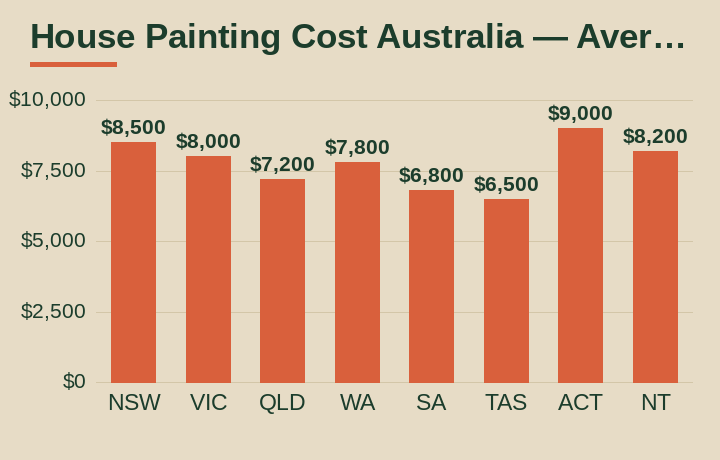
Prices vary state to state, mainly driven by labour rates, the cost of materials in remote areas, and how competitive the local market is. The figures below reflect professional painters doing a full repaint of an average three-bedroom home.
| State | Average Cost | Typical Range |
|---|---|---|
| NSW | $8,500 | $6,000 – $14,000 |
| VIC | $8,000 | $5,800 – $13,500 |
| QLD | $7,200 | $5,200 – $12,000 |
| WA | $7,800 | $5,500 – $13,000 |
| SA | $6,800 | $4,800 – $11,000 |
| TAS | $6,500 | $4,500 – $10,500 |
| ACT | $9,000 | $6,500 – $15,000 |
| NT | $8,200 | $5,800 – $14,000 |
Get free quotes from local providers in your area. No obligation.
The ACT consistently runs higher than the national average, largely due to tight labour supply and strong demand from both private and government renovation work. Darwin and Alice Springs prices spike when materials need freighting in. Tasmania remains the most affordable mainland state for painting labour.
House Painting Cost Calculator
Estimate professional painting costs for interior rooms or your home’s exterior. AUD, 2026 Australian pricing.
Estimates based on average Australian painter rates as of 2026 (typically $35–$55/hr or $15–$45/m² depending on the job). Actual quotes vary with the condition of the surfaces, number of coats, paint quality, ceiling height, access, and how much prep (filling, sanding, undercoating) is needed. Dark or feature colours and detailed trim work add cost. Always get 2–3 quotes.
Where the money actually goes
Labour is the biggest line item, typically 60–70% of any painting quote. A professional painter in Sydney’s inner west or Melbourne’s inner north charges $55–$75 per hour. In regional areas like Geelong, Toowoomba or Launceston, $40–$55 is more realistic. A two-person team painting a full three-bedroom interior might clock 25–35 hours total, which alone lands you at $2,750–$5,250 before materials.
Surface preparation is where costs blow out and where cowboys cut corners. Proper prep includes washing down walls, filling cracks and holes, sanding rough patches, and applying primer where needed. On a home that hasn’t been painted in a decade, prep can account for 30–40% of the total labour time. Skip prep and the paint will peel within two or three years. Worth the investment.
Paint quality matters more than most people realise. The difference between a budget $18-per-litre product and a premium Dulux Weathershield or Haymes Supertec is real. A three-bedroom interior might need 60–75 litres of wall paint across two coats, that’s a $400–$600 material difference between budget and premium. Premium paints generally need fewer coats and last longer, so the maths often favours quality. You can grab a quality interior wall paint yourself from Bunnings and supply it directly, which cuts out painter markup.
Storey count and access is the factor that catches people off guard. A single-storey home can mostly be painted from ladders. A two-storey requires either scaffolding or boom lift hire, typically $1,500–$4,000 extra depending on the home’s footprint and how long it’s needed. Some painters own their own equipment; others subcontract it. Ask upfront.
Colour change direction affects how many coats you need. Going from a mid-toned colour to white, or from dark charcoal to a light grey, often requires a tinted primer plus two finish coats instead of a standard two coats. That extra coat on a full exterior can add $800–$1,800 to the bill. Staying within a similar colour family keeps it simple.
Interior vs exterior: what’s included at each level
The cost breakdown changes significantly between interior and exterior work, and what’s included in a ‘standard’ job varies by painter. Here’s how the tiers typically stack up:
| Job Type | What’s Usually Included | Common Extras (charged separately) |
|---|---|---|
| Interior standard | Walls and ceilings, 2 coats, light prep, standard white trim | Doors, windows, feature walls, high-gloss finishes, wallpaper removal |
| Interior premium | Full prep, 2–3 coats, all trim included, colour consultation | Texture finishes, Venetian plaster, heritage colour matching |
| Exterior standard | Walls, fascia, gutters, 2 coats, basic prep | Roofs, fences, decks, major crack repair, scaffolding |
| Exterior premium | Full strip and prime where needed, 3 coats on high-wear areas, all surfaces | Renders, feature stonework, heritage compliance |
| Single room | Walls only, 2 coats, basic prep | Ceiling, trim, built-ins, furniture moving |
The ‘standard’ vs ‘premium’ distinction matters because a cheap quote often excludes prep, scaffolding, trim work and a third coat, all of which get added as variations. A detailed scope of work in the quote is your protection against this. If the quote doesn’t specify how many coats, which surfaces and what prep is included, ask before you sign anything.
If you’re also budgeting for other pet or home costs, it’s worth checking our breakdown of pet insurance costs in Australia, renovation budgets and ongoing ownership costs often compete for the same money.
Questions to ask before you book
Is the quote fixed price or an estimate?
Fixed-price quotes protect you from time blowouts. An estimate means the final invoice can be higher if the job takes longer than expected. For anything beyond a single room, push for a fixed scope and fixed price, and make sure variations (like extra prep time if they find water damage) are defined upfront.
How many coats are included, and what brand of paint?
Two coats is the industry minimum; some painters quote one coat to appear cheaper. Ask specifically. Also ask the paint brand and product line, there’s a real difference between a $18-per-litre house paint and a $42-per-litre premium product. Both might be described as ‘quality paint’ in a quote.
What prep work is included in the price?
This is where cheap quotes fall apart. Some painters include sanding, filling and spot-priming; others start applying paint on day one. Ask what their prep process is for a home of your type and age. If they can’t describe it in specific terms, that’s a red flag.
Is scaffolding included or extra?
If you have a two-storey home, scaffolding is almost always needed for the exterior. Some painters include hire costs in their quote; others add it as a separate line. The difference can be $1,500–$4,000. Get it confirmed in writing before you agree to anything.
Do you carry public liability insurance?
Any legitimate painter carries public liability insurance, minimum $5 million is standard in Australia. Ask for the certificate. If they hesitate, walk away. Damage to your property during a paint job on an uninsured contractor falls on you.
What’s the payment schedule?
Reputable painters typically ask for a small deposit (10–20%), progress payments mid-job and the remainder on completion. Anyone asking for more than 30–40% upfront before work starts is worth questioning. Never pay in full before the job is done.
Frequently asked questions about house painting cost
How much does it cost to paint a house interior in Australia?
Interior house painting in Australia typically costs $4,500–$9,000 for a standard three-bedroom home, or $25–$60 per square metre including labour and materials. A single room runs $400–$900 depending on size and ceiling height. Kitchens and bathrooms often cost more due to prep work around cabinetry and tiles.
How much does exterior house painting cost in Australia?
Exterior painting generally costs $6,000–$18,000 for a full repaint of an average Australian home. Per square metre, expect $20–$50. Two-storey homes cost more due to scaffolding requirements, which can add $1,500–$4,000 to the total. Surface condition matters a lot, if the paint is peeling or there’s significant prep work needed, expect the upper end of that range.
How long does it take to paint a house in Australia?
A full interior repaint of a three-bedroom home typically takes 3–5 days with a team of two painters. Exterior repaints usually take 4–7 days. Prep work, sanding, filling, priming, can add 1–2 days for homes in poor condition. Drying time between coats also affects the overall timeline.
Do I need to supply my own paint or do painters bring it?
Most Australian painters include paint in their quote, but some charge for labour only and expect you to supply materials. Always clarify upfront. If paint is included, ask which brand and sheen level, budget painters sometimes use cheaper products that look fine initially but don’t hold up. Dulux and Haymes are solid mid-range standards worth asking for specifically.
Is it cheaper to paint a house yourself in Australia?
DIY saves on labour (typically $35–$55 per hour per painter), but factor in equipment hire, primer, paint, masking tape, drop sheets and the time involved. For a three-bedroom interior, materials alone run $800–$1,500 for a competent DIYer. A decent extension roller for ceiling and high wall work is one investment that makes DIY painting significantly faster. That said, the finish quality rarely matches professional work, and prep mistakes can mean peeling within two years.
How to bring the cost down
- Get three quotes minimum. Painter pricing bounces around more than most trades. A $1,500–$3,000 gap between quotes for identical work is common. Read the scope carefully before comparing prices.
- Do your own prep. Sanding, filling holes and washing walls before the painter arrives can reduce labour hours by 20–30%. On a $7,000 job that’s up to $1,400 saved, ask the painter if they’ll reflect this in their price.
- Book in autumn or winter. Painters are busiest from September through January. Booking in May–July means better availability and, with negotiation, 10–15% off standard rates. Worth asking directly.
- Bundle interior and exterior together. One mob doing both at once saves on mobilisation and setup costs. Bundling typically saves $500–$1,500 compared to booking separate jobs months apart.
- Stay in the same colour family. A dramatic colour change adds at least one extra coat. Staying close to the existing shade can save $400–$900 in materials and labour on a full-house job.
- Supply your own paint from Bunnings. Painters apply a 20–40% markup on paint. Buying it yourself and handing it over can save $300–$700 on a full-house job. Just get the exact product spec from the painter first.
- Avoid scaffolding on partial jobs. If only specific areas need attention, ladder work might suffice. Targeted spot-treatments on the upper level rather than a full exterior repaint can cut costs significantly.
If you’re mid-renovation and thinking about pet costs alongside the house budget, our guides on what dog food actually costs in 2026 and monthly pet food costs Australia-wide might help with the full picture. And if a freshly painted home has you thinking about new pets, the real cost of a bearded dragon in Australia or a blue tongue lizard are worth a read before you commit.
For those with dogs or cats already in the home, worth noting that painting chemicals need proper ventilation, keep pets out of rooms being painted and for several hours afterwards. Our overview of cat ownership costs in Australia and dog walking services might be useful if you need to organise somewhere for your animals to be during the work.
The bottom line on house painting cost Australia: a realistic budget for a three-bedroom home is $5,000–$12,000 for a full interior or exterior repaint, with combined jobs running higher. Get three detailed quotes, confirm what’s included in writing, and don’t make your decision on price alone. A cheap painter who skips prep will have you calling someone else within three years. Spend the time upfront comparing properly, it’s genuinely worth it.
People Also Ask About House Painting Cost Australia
How much do painters charge per hour in Australia?
Most professional painters in Australia charge $45–$75 per hour for labour. In Sydney and Melbourne, $60–$75 is standard. In regional areas, $40–$55 is more common. Many painters prefer to quote by the job rather than by the hour, which is usually better for the homeowner as it removes the risk of time blowouts.
How many litres of paint do I need for a three-bedroom house?
A rough guide is 1 litre of paint per 10–12 square metres for interior walls with a smooth surface, assuming two coats. A standard three-bedroom home (around 180m² of wall area) needs 30–36 litres per coat, or 60–72 litres total. Textured walls, raw plaster or colour changes will increase consumption significantly.
Should I paint over existing paint or strip it back first?
If the existing paint is in good condition with no peeling or cracking, painting over it is fine with proper preparation. If paint is peeling in multiple spots, you’re better off stripping it back, the new coat will fail in the same places otherwise. Exterior timber surfaces generally benefit from a thorough strip and prime before repainting.
How often should you repaint the exterior of a house in Australia?
Most exterior paints have a service life of 8–15 years, but Australian conditions are harsh. Homes in Queensland or WA facing north or west may need repainting every 7–10 years due to UV exposure. Homes in cooler, damper climates like Hobart or the ACT might get 12–15 years from a quality coat. Fading, chalking or peeling are your trigger points to start planning.
What questions should I ask a painter before accepting a quote?
Related Cost Guides
Recommended Products for House Painting Cost Australia
If you’re tackling this yourself, here are some products from Amazon Australia that can help:
The most important ones: Does the quote include all prep work? What brand of paint is being used, and how many coats? Is scaffolding or equipment hire extra? What’s the payment schedule? And do they carry public liability insurance? A painter who can’t answer these clearly is one to avoid, and a quote that doesn’t specify these details isn’t a quote you should accept.
This guide contains affiliate links. We may earn a small commission from qualifying purchases at no extra cost to you.