
Fascia and soffit replacement cost australia sits between $35 and $120 per linear metre, with the national average for a full single-storey house landing around $5,500–$8,000 all up. That range is wide because material choice, roof access and the extent of any underlying rot all shift the number considerably. According to the Housing Industry Association, labour costs for carpentry and roofline work have risen steadily since 2023, so quotes from a couple of years ago are no longer reliable.
Fascia and soffit replacement in Australia typically costs $35–$120 per linear metre, with most homeowners spending $3,500–$12,000 for a full house. Timber runs cheaper at $35–$65/lm but needs repainting; UPVC and Colorbond sit higher at $70–$120/lm but last longer. Labour, roof pitch and access difficulty are the biggest variables.
The job sounds straightforward. In practice, it rarely is. Gutters come off, rotten rafter tails occasionally show up behind the boards, and scaffold hire adds to the bill if the home’s two storeys. Worth knowing before you start calling tradies.
What you’ll typically pay across Australia
Prices vary noticeably by state, driven by labour rates, tradie availability and local material costs. The table below shows 2026 installed rates per linear metre for a standard fascia and soffit replacement (timber or UPVC, single-storey access).
| State | Average Cost (per lm) | Typical Range (per lm) |
|---|---|---|
| NSW | $85 | $65 – $120 |
| VIC | $80 | $60 – $115 |
| QLD | $75 | $55 – $110 |
| WA | $82 | $60 – $118 |
| SA | $72 | $50 – $105 |
| TAS | $70 | $48 – $100 |
| ACT | $88 | $68 – $122 |
| NT | $90 | $70 – $125 |
Get free quotes from local providers in your area. No obligation.
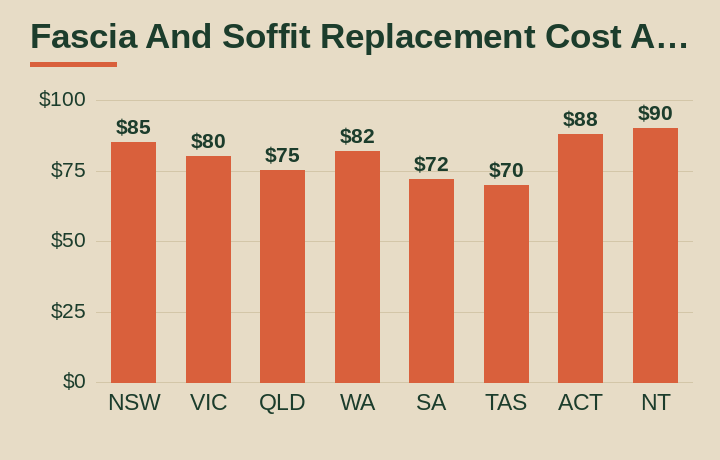
The ACT and NT premiums reflect smaller tradie pools and higher travel costs. Queensland’s relatively lower rates reflect more competition in the roofing and carpentry trades, though specialist roofline contractors in inner Brisbane still charge Sydney-comparable rates.
Where the money actually goes: what drives the price
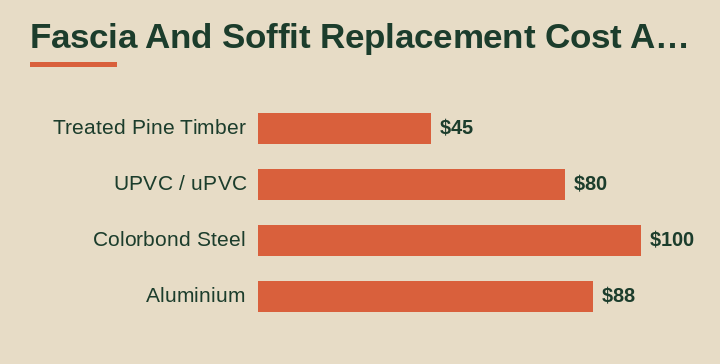
Material choice is the single biggest variable. Treated pine timber runs $35–$55 per linear metre installed and is widely available at Bunnings and trade suppliers. It takes paint well but needs repainting every 8–12 years. UPVC (uPVC) sits at $65–$95/lm installed, requires no painting, and handles moisture better, which matters in North Queensland and the NT. Colorbond steel fascia and soffit sits at $80–$120/lm installed and is the premium option. It’s the most durable in Australian conditions but the hardest to cut and fit on complex rooflines.
Roof access and height matter more than most homeowners expect. A standard single-storey job in Penrith or Geelong costs noticeably less than the same job on a double-storey Victorian terrace in Surry Hills, where ladder access is awkward and scaffold may be mandatory. Scaffold hire typically adds $600–$1,800 to a job, and some inner-city councils require it regardless of the tradie’s preference.
Linear metres involved scales the cost obviously, but it also affects the per-metre rate. Smaller jobs (under 20 linear metres) attract a minimum call-out premium because the tradie’s setup time is fixed regardless of how much board they replace. Expect to pay a $350–$500 minimum even for a short run. Full-house jobs over 60 linear metres often negotiate a lower per-metre rate.
Extent of rot and structural damage is the surprise cost. Rotten rafter tails discovered once the boards come off are charged as variations, typically $150–$400 per affected section. A house in Hobart’s North or coastal WA that hasn’t had roofline maintenance in 20 years might have four or five sections. That’s an extra $800–$2,000 appearing mid-job. Ask the tradie to do a tap test and visual inspection before quoting, not during.
Guttering replacement at the same time adds cost but usually saves overall. Since the gutter has to come off to replace the fascia anyway, bundling new guttering adds only the material cost plus about 20% extra labour. Doing it separately later means a second access setup charge. If your gutters are over 15 years old, the maths almost always favour doing both at once. You can see how this ties into broader roof maintenance costs that compound over time.
Material comparison: what you’re actually buying
The table below compares the three main fascia and soffit materials on the metrics that matter for Australian homeowners.
| Material | Installed Cost (per lm) | Lifespan | Maintenance Required | Best For |
|---|---|---|---|---|
| Treated Pine Timber | $35 – $55 | 15–25 years | Repaint every 8–12 yrs | Budget installs, heritage homes |
| UPVC / uPVC | $65 – $95 | 30–40 years | Wipe down only | Low-maintenance, humid climates |
| Colorbond Steel | $80 – $120 | 40–50 years | Nil in most climates | New builds, coastal, fire zones |
| Aluminium | $70 – $105 | 35–45 years | Minimal, check joins | Coastal areas, salt air exposure |
Timber still dominates older Australian homes because it’s what was there originally. But Choice Australia’s building materials research consistently finds that low-maintenance alternatives pay for themselves within 10–15 years when repainting costs are factored in. The UPVC vs timber decision is mostly a maths question, not a preference one.
For those considering broader roofline upgrades, it’s worth checking Colorbond re-roofing costs to understand the full picture before committing to just a fascia job.
If you’re doing DIY patching rather than full replacement, exterior wood filler designed for fascia repairs can extend the life of partially rotted timber boards by several years before full replacement becomes unavoidable.
Questions to ask before you book
Is this quote based on linear metres or a fixed total?
Some tradies quote a fixed price; others quote per linear metre and bill on what’s actually replaced. The second approach can produce a higher final bill if more rot is discovered. Ask for a fixed quote wherever possible once the tradie has done a proper on-site inspection.
Does the price include guttering removal and reinstallation?
The gutters almost always need to come off to replace the fascia. Some tradies include this in the rate; others charge separately. The difference can be $400–$900 on a full-house job. Get it specified in writing before work starts.
What happens if you find rot behind the boards?
Ask this upfront and get a clear answer on the variation rate per section. Tradies who hedge on this question are often the ones who hit you with large variation bills later. A fair tradie will give you a per-section rate for rafter tail repairs before the job starts.
Will you need scaffolding and who organises it?
For double-storey homes, scaffold is usually required for insurance and safety reasons. Some tradies include scaffold hire in their quote; others treat it as a separate client cost. Scaffold for a full house hire runs $900–$2,200 for the period needed. Confirm whose responsibility it is.
Is the product you’re using UV-stabilised for Australian conditions?
This matters specifically for UPVC products. Cheaper imported UPVC can yellow and become brittle within 10–15 years in Queensland or WA sun. Ask the tradie to name the product brand and check it carries an Australian climate warranty of at least 20 years.
Are you a licensed builder or carpenter?
In most Australian states, fascia and soffit replacement is structural carpentry work requiring a builder’s licence, not just a handyman’s ticket. An unlicensed operator may void your home insurance if something fails. Check the licence number against your state’s building regulator database before signing anything.
A real-world scenario
Take Marcus, a homeowner in Newtown, Sydney. His 1960s weatherboard has 68 linear metres of fascia and soffit. The existing timber was original, showing soft spots in three sections. He got three quotes ranging from $5,200 to $8,900 for full timber replacement. The cheapest quote excluded guttering reinstallation and scaffold; the mid-range quote at $6,800 included both and specified UV-treated pine with two coats of exterior paint.
He went with the mid-range tradie. During the job, two rafter tails came up rotten, charged at $220 per section, adding $440 to the total. Final bill: $7,240. He’s budgeting another $1,800 in 10 years for repainting. Had he chosen UPVC at a $9,100 quote, he’d eliminate those repainting cycles. The maths over 25 years actually favour UPVC, but the upfront figure was the sticking point.
Frequently asked questions
How much does fascia and soffit replacement cost in Australia?
Most Australian homeowners pay $35–$120 per linear metre for fascia and soffit replacement. A full house job typically runs $3,500–$12,000 depending on the material chosen, roof height and access difficulty. Timber is cheapest upfront; Colorbond and UPVC cost more but need less maintenance.
Can I replace fascia and soffit myself in Australia?
Technically yes for single-storey homes if you’re confident working at height, but most tradies strongly recommend using a licensed builder or carpenter. Incorrect installation causes water ingress behind gutters, which is far more expensive to fix later. DIY suits minor repairs, not full replacements.
How long does fascia and soffit replacement take?
A standard single-storey home takes one to two days for a two-person crew. Double-storey homes with complex rooflines can take three to four days. Scaffolding setup and removal adds half a day at each end if required.
Does fascia replacement include guttering?
Usually not automatically. Many tradies will quote fascia and guttering together since the gutter often needs to come off anyway, but you need to ask. Budget an extra $25–$60 per linear metre if you’re replacing gutters at the same time, which is usually worth doing.
What is the cheapest fascia material in Australia?
Treated pine timber is the cheapest option at $35–$55 per linear metre installed. It takes paint well and is widely available, but it does need repainting every 8–12 years and is vulnerable to rot in humid climates like Queensland and the Northern Territory.
How to bring the cost down
- Combine fascia, soffit and guttering in one job. Getting all three done at once cuts labour costs significantly since scaffolding and access setup is the biggest time expense. Bundling can save $800–$2,000 compared to scheduling separate jobs. This is especially relevant if you’re already looking at roof replacement costs and can consolidate the whole roofline.
- Choose UPVC over timber for long-term savings. UPVC costs $15–$25/lm more upfront but eliminates repainting costs ($1,500–$4,000 per cycle) over its 30-plus year lifespan. The maths favour UPVC for most homeowners within 10 years. A good set of UPVC fascia boards from a reputable supplier can also reduce material markup if you supply your own.
- Get three written quotes on the same spec. Prices for this job vary enormously between tradies. Three quotes on an identical scope often reveal a $1,500–$3,000 spread. Don’t accept the first number you’re given, especially if you’re in a metro area with decent tradie competition.
- Schedule in autumn or winter for better rates. Roofing trades are quieter April through July. Some carpenters and builders offer 5–10% discounts for off-peak bookings, which saves $300–$800 on a full-house job.
- Do a proper rot assessment before finalising your quote. Ask the tradie to inspect behind existing boards before locking in a price. Discovering rotten rafters mid-job adds $150–$400 per affected section as variation costs. Knowing upfront avoids bill shock and lets you budget accurately.
- Avoid scaffold if the house is single-storey. Scaffold hire adds $600–$1,800 to a job. For single-storey homes, a tradie with proper ladders and stabilisers shouldn’t need it. Ask specifically whether scaffold is included or whether it’s genuinely necessary for your property.
If you’re planning broader renovations alongside this work, it’s worth understanding what related jobs like a home extension or a garage conversion add to your overall project scope, since builders doing larger structural work often include roofline repairs as part of the broader quote.
Comparing the data compiled for this guide, the pattern that stood out was how often homeowners under-budget for fascia and soffit work by focusing on the material cost per metre without accounting for guttering, rot variations and scaffold. The realistic all-up number for a standard Australian home is $5,000–$9,000, not the $2,500–$3,500 figure that often circulates on forum threads. The Australian Bureau of Statistics construction cost data for 2026 confirms that labour costs for structural carpentry trades remain among the fastest-rising components of home maintenance budgets.
For context on adjacent home improvement costs, it’s also useful to see how fascia and soffit work compares to a full bathroom renovation or a laundry renovation in terms of value and disruption. Roofline work is less glamorous but arguably more urgent: rotted fascia leads to water ingress that damages wall framing, ceiling linings and insulation. Deferring the job rarely saves money.
People Also Ask About Fascia and Soffit Replacement Cost Australia
Is fascia board replacement covered by home insurance in Australia?
Generally no, not for general wear, rot or age-related deterioration. If damage was caused by a storm or a falling tree, most comprehensive home insurance policies will cover the repair minus your excess. Check your PDS carefully and photograph damage immediately after a weather event before starting repairs.
How do I know if my fascia boards need replacing rather than just repainting?
Press a screwdriver gently into the timber at several points along the board. If it sinks in with little resistance, the wood is rotten and needs replacing, not painting. Soft spots, visible cracking along the grain, or boards that have bowed away from the roofline are all signs replacement is overdue.
What is the difference between fascia and soffit boards?
The fascia is the vertical board running along the roof edge that your gutters attach to. The soffit is the horizontal board underneath the eave that closes the gap between the fascia and the wall. Both are part of the roofline system and typically replaced together since they usually deteriorate at a similar rate.
How long do UPVC fascia and soffit boards last in Australia?
Quality UPVC roofline products are rated for 30–40 years in Australian conditions. In high-UV states like Queensland and WA, some cheaper UPVC products can yellow or become brittle within 15–20 years. Specify UV-stabilised UPVC and ask the supplier for an Australian climate warranty.
Do I need council approval to replace fascia and soffit boards in Australia?
Related Cost Guides
Recommended Products for Fascia And Soffit Replacement Cost Australia
If you’re tackling this yourself, here are some products from Amazon Australia that can help:
Like-for-like replacement of fascia and soffit boards is generally considered routine maintenance and doesn’t require council approval in most Australian states. However, if you’re changing the roofline profile or adding new eaves, a building permit may apply. Check with your local council if in doubt, especially in heritage overlay areas.
This guide contains affiliate links. We may earn a small commission from qualifying purchases at no extra cost to you.