
Colorbond fencing cost australia is one of the more searched home improvement questions, and with good reason. Steel fencing is now the default choice for most new residential builds and renovations, but quotes vary wildly depending on who you call. According to the Housing Industry Association, fencing and landscaping are among the most common post-build upgrade costs Australian homeowners face, and prices have risen noticeably since 2023.
Colorbond fencing cost Australia sits between $75 and $220 per linear metre fully installed in 2026. A standard 1.8m-high fence on flat ground averages $110–$150 per metre. For a typical suburban block needing 40 metres of fencing, budget $4,400–$6,000 all up.
In 2026, you’re looking at $75–$220 per linear metre fully installed. That wide range isn’t vague, it reflects real differences in panel height, soil conditions, site access and where in Australia you live. This guide breaks all of that down so you know what to expect before you call a single fencer.
What you’ll typically pay in 2026
The most common setup, a 1.8m-high Colorbond fence on flat suburban ground, runs $110–$150 per linear metre installed in most capital cities. That includes panels, posts, rails, concrete footings and labour. Materials alone sit around $50–$85 per metre; the rest is labour and site costs.
For a standard suburban block needing 40 metres of new fencing, the total installed cost lands around $4,400–$6,000. Larger properties or taller fences push that number up fast. A 2.1m fence on the same 40-metre run might cost $5,600–$7,200.
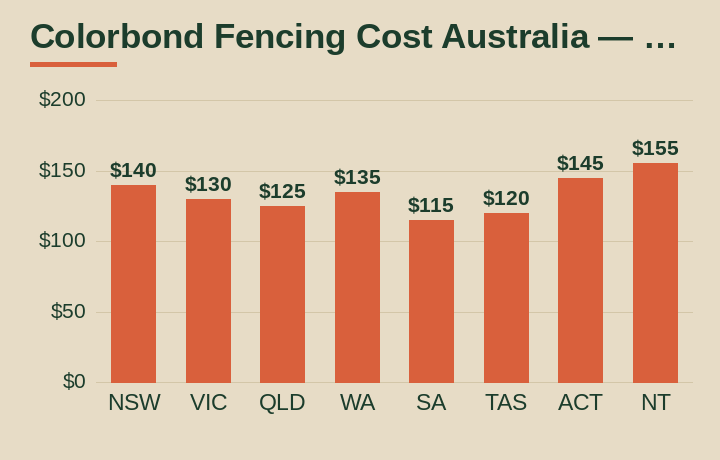
| State | Average Cost (per linear metre) | Typical Range |
|---|---|---|
| NSW | $140 | $105 – $210 |
| VIC | $130 | $95 – $195 |
| QLD | $125 | $90 – $185 |
| WA | $135 | $100 – $200 |
| SA | $115 | $85 – $175 |
| TAS | $120 | $88 – $180 |
| ACT | $145 | $110 – $215 |
| NT | $155 | $115 – $220 |
Get 3 free quotes from local providers in your area. No obligation.
The jump from standard 1.8m to privacy 2.1m is worth it if you back onto a busy path or have a pool requiring fencing under state regulations. The security grade is rarely necessary for residential use, it’s mostly for commercial yards or high-value properties in areas with genuine security concerns.
Questions to ask before you book
Is your quote supplied and installed, or supply only?
Some fencers quote materials only and add labour separately. Others give an all-in rate. Make sure you’re comparing apples with apples across quotes. A $95 per metre supply-only quote plus $45 per metre labour is actually more expensive than a $130 per metre installed quote from someone else.
What happens if you hit rock or concrete footings?
Old properties often have buried concrete stumps or rock ledges that aren’t visible until the first post hole goes in. Ask whether their quote covers this or if rock work is billed as an extra. The answer tells you how much risk you’re carrying.
Who is responsible for council approvals?
Some fencing companies handle the permit process; most don’t. If your fence height or placement needs approval, clarify who lodges the application and who pays the fee. Assuming your fencer handles it when they don’t can delay the job by weeks.
What’s included in the post footings?
Post depth and concrete mix vary significantly. A fencer using 600mm-deep posts in sandy soil is cutting corners compared to one using 900mm posts in concrete for the same quote. Ask specifically: what depth are the posts set, and what’s the concrete mix?
Is the Colorbond steel branded BlueScope?
There are cheaper imported steel panels that look similar but don’t carry BlueScope’s warranty or the same corrosion resistance. Legitimate Colorbond uses BlueScope-manufactured steel. If your fencer can’t confirm this, ask for the product spec sheet before signing anything.
What’s your timeline, and do you have a deposit policy?
Good fencers book out 3–6 weeks ahead. A fencer available immediately might be telling you something. Also, a deposit of 10–20% is reasonable; a demand for 50% upfront is a red flag. According to Choice Australia’s advice on hiring tradespeople, deposits above 30% for residential work are outside normal industry practice.
How to bring the cost down
- Get at least three written quotes. Prices vary by $25–$50 per metre for identical jobs. On a 40-metre run, that’s up to $2,000 you’d leave on the table by accepting the first quote.
- Split the cost with your neighbour. Under boundary fence legislation in most Australian states, adjoining owners share the cost of a dividing fence. If your neighbour agrees, you could halve the bill. Worth a conversation before you book anyone.
- Remove the old fence yourself. Demolition and disposal adds $200–$600 to most quotes. A hired skip bin from a local waste company typically costs $250–$350, and a weekend’s work saves you the rest.
- Book in the quieter season. Fencing work slows down in autumn and winter. Some operators will negotiate 10–15% off to keep the crew busy. That’s $440–$900 back on a $6,000 job.
- Stick to standard Colorbond colours. Monument, Woodland Grey and Surfmist are widely stocked and come without the premium some suppliers charge for limited-edition finishes. You can check the full current range and Colorbond-matched touch-up paint is also available for scratches post-install.
- Handle your own gating hardware. If you’re adding a simple pedestrian gate, buying the frame kit separately and having the fencer install a pre-built unit can save $80–$150 over a custom-built gate.
For context on how fencing fits into broader pet-friendly home setups, it’s worth checking what dog walking costs in Australia if you’re fencing a yard specifically for a dog, a secure yard can reduce how often you need a walker.
FAQs about Colorbond fencing cost Australia
How much does Colorbond fencing cost per metre in Australia?
Installed Colorbond fencing costs $75–$220 per linear metre in 2026, depending on panel height, terrain and your state. The most common 1.8m height on flat ground averages $110–$150 per metre in most cities.
Is Colorbond fencing cheaper than timber?
Upfront, Colorbond is often comparable to or slightly more expensive than treated pine, typically $20–$40 per metre more. Over 10–15 years though, you save significantly on maintenance. No painting, no oiling, no replacing rotted boards. Most homeowners find it better value long-term, particularly in wet climates like Brisbane’s outer suburbs or coastal NSW.
How long does Colorbond fencing last in Australia?
A properly installed Colorbond fence lasts 20–30 years in most Australian conditions. BlueScope backs the steel with warranties up to 10 years on paint and 10–15 years on perforation. Coastal properties near salt air may see degradation earlier unless you specifically use the marine-grade Colorbond product, which is available but costs roughly 15% more.
Do I need council approval for a Colorbond fence?
It depends on height and location. Most states allow fences up to 1.8m on rear and side boundaries without a permit. Front fences and anything taller typically need council approval. Check with your local council before you book, approval can add 2–6 weeks to your timeline and a fee of $150–$400 in most jurisdictions.
Can I install Colorbond fencing myself?
Yes, in most states DIY is legal for residential fences under 1.8m. BlueScope panels and posts are available through Bunnings and steel merchants. That said, post alignment is harder than it looks, especially on sloped ground, and mistakes are expensive to fix. Most DIYers save $30–$60 per metre but spend a full weekend on a 20-metre run. If you’re considering it, also budget for concrete, a post hole digger and the time to do it properly.
For more on pet-related home costs that often accompany a new yard fence, see our guides on dog training costs in Australia and dog daycare pricing if your backyard upgrade is pet-motivated. And if you’re budgeting broadly for a new home setup, our pet insurance cost breakdown, dog food cost breakdown and monthly pet food costs are worth a read alongside this.
Colorbond fencing cost australia will keep creeping up as labour and steel prices rise, so if you’re on the fence (yes, literally), getting quotes locked in now rather than waiting another 12 months is probably the smarter move. Get three quotes, confirm what’s included, ask the hard questions above, and don’t hand over more than 20% as a deposit before work starts.
People Also Ask About Colorbond Fencing Cost Australia
What is the cheapest Colorbond fence colour in Australia?
Standard colours from BlueScope’s core range, think Woodland Grey, Surfmist and Monument, are priced the same at retail and generally cost fencers less to source than limited-edition or heritage tones. Sticking to a mainstream colour won’t save you a fortune, but it does avoid the $8–$15 per metre premium that some suppliers charge for special finishes.
How many panels do I need for a 30-metre Colorbond fence?
Standard Colorbond panels are 2.4 metres wide, so a 30-metre fence needs roughly 13 panels, plus posts. You’ll want to add one extra panel to account for corner cuts and overlap. Your fencer will calculate this precisely once they’ve measured the site.
Does Colorbond fencing add value to a property in Australia?
Yes, a well-installed Colorbond fence generally adds value, particularly for buyers with kids or pets who want a secure yard. Real estate agents in Melbourne and Brisbane regularly cite boundary fencing as a positive in buyer inspections. The return isn’t dollar-for-dollar, but a clean, low-maintenance fence is rarely a negative in a sale.
Can Colorbond fencing be installed on a sloped block?
Yes, but it costs more. On sloped ground, installers use either a stepped or sloped panel method. Stepped fencing is more common and easier to install, but leaves triangular gaps at the base. Sloped installation requires custom cutting and takes longer. Expect to add $20–$40 per metre for significant slope, more if the terrain is steep or rocky.
What’s the difference between Colorbond and Zincalume fencing?
Related Cost Guides
Recommended Products for Colorbond Fencing Cost Australia
If you’re tackling this yourself, here are some products from Amazon Australia that can help:
Both are BlueScope steel products. Zincalume has a zinc-aluminium alloy coating and a silver-grey appearance, it’s mainly used in rural and agricultural settings where paint finish isn’t a priority. Colorbond adds a polymer paint layer over the Zincalume base, giving you colour options and better aesthetics. For residential use, Colorbond is the standard choice, and the price difference is minor.
This guide contains affiliate links. We may earn a small commission from qualifying purchases at no extra cost to you.