The cost of a bearded dragon is one of those topics where the purchase price is genuinely misleading, as I know from keeping them. According to Animal Medicines Australia’s 2025 Pets in Australia report, reptiles are now one of the fastest-growing pet categories in the country, and bearded dragons are consistently the most popular species kept. The problem: most first-time owners walk into it expecting a cheap, low-maintenance pet and then spend $2,000+ before the lizard has eaten its third meal.
In a hurry? Skip straight to our live Australian reptile electricity cost calculator → Drag the sliders for a price that fits your pet.
Bearded dragon cost Australia: purchasing a bearded dragon runs $80 to $600 depending on morph and breeder, but first-year ownership typically costs $1,800 to $3,500 once you factor in enclosure setup, UVB lighting, vet checks and food. Ongoing annual costs settle around $600 to $1,200 after that.
Prices updated July 2026 from current Australian sources.
| Cost | Typical range | Notes |
|---|---|---|
| Purchase | $80 to $600 | Depends on morph and breeder |
| First year (including setup) | $1,800 to $3,500 | Enclosure, UVB lighting, vet checks, food |
| Ongoing per year | $600 to $1,200 |
The dragon itself is cheap; the enclosure, UVB lighting and heating are where the real spend is. A reptile keeper licence is required in most states.
Sources (July 2026): PetRescue, Adopt a pet, RSPCA Australia, Animal Medicines Australia, Pets in Australia 2025, Pet Shop Direct
The animal itself might cost $100 to $250. The enclosure, lighting, heating, substrate, supplements, vet check and state licence? That’s where the real money goes. This breakdown covers everything you’ll actually pay in 2026, with specific figures for each state.
I keep a bearded dragon myself, so rather than leave this as a list of prices I wrote up my exact setup, what it cost and what I would change, which came to around $900 rather than the $500 minimum quoted here. The three pieces of gear worth getting right first are the enclosure, the thermostat and the UVB lighting.
What you’ll typically pay in 2026
The bearded dragon cost in Australia breaks into three phases: the purchase price, the initial setup (one-off), and ongoing annual costs. Most guides focus on the first number and underplay the other two.
Here’s a realistic picture for a single adult bearded dragon setup:
- Purchase price: $80 to $600 (standard morph to rare morph)
- Enclosure and equipment (one-off): $600 to $1,800
- Reptile keeper licence: $42 to $65 depending on state
- Initial vet check: $65 to $130
- Annual ongoing costs: $600 to $1,200 (food, supplements, electricity, bulb replacements, vet)
Total first-year spend typically lands between $1,800 and $3,500. Subsequent years are considerably lighter, assuming no major vet bills.
Bearded dragon cost by state
Costs vary by state mainly due to vet pricing, licence fees and the availability of local breeders. Reptile specialist vets in Sydney (Surry Hills, Newtown) and inner Melbourne charge a meaningful premium over equivalents in Brisbane, Adelaide or Hobart. Regional areas often have fewer specialist options, which can push vet costs up even if the general cost of living is lower.
| State | Average Annual Cost | Typical Range |
|---|---|---|
| NSW | $1,050 | $850 to $1,350 |
| VIC | $980 | $800 to $1,280 |
| QLD | $870 | $700 to $1,100 |
| WA | $920 | $740 to $1,180 |
| SA | $840 | $680 to $1,080 |
| TAS | $890 | $720 to $1,120 |
| ACT | $1,010 | $820 to $1,300 |
| NT | $810 | $650 to $1,040 |
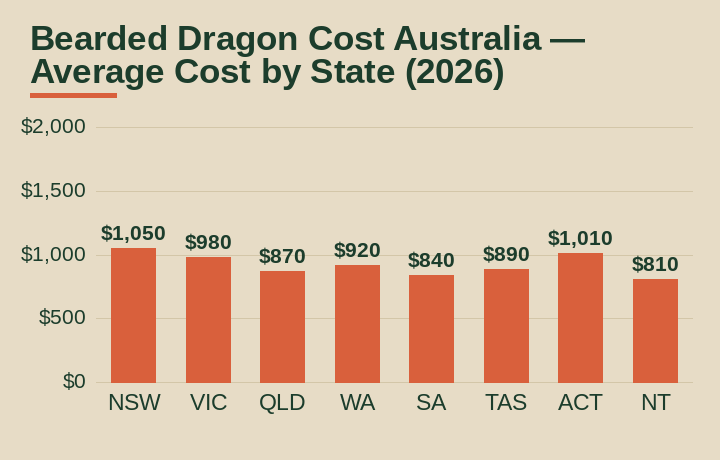
These figures are ongoing annual costs after setup. NSW and the ACT sit highest, largely due to vet fees. Queensland and the NT are the most affordable states for routine ownership. The MoneySmart guide on getting a pet is worth a read if you’re budgeting for a first exotic pet, it covers the full-lifetime cost framing that catches a lot of buyers off guard.
Setup cost breakdown: what’s included and what’s extra
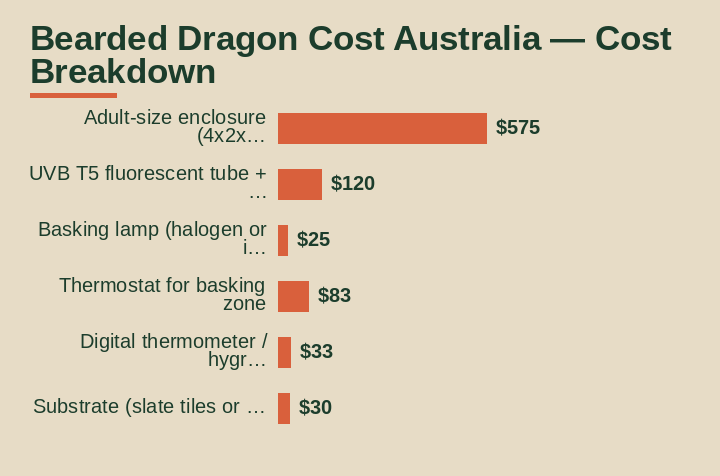
The enclosure setup is where most new owners blow their budget. Here’s what you need versus what’s genuinely optional in 2026.
| Item | Essential or Optional | Typical Cost |
|---|---|---|
| Adult-size enclosure (4x2x2 ft) | Essential | $350 to $800 |
| UVB T5 fluorescent tube + fixture | Essential | $80 to $160 |
| Basking lamp (halogen or incandescent) | Essential | $15 to $35 |
| Thermostat for basking zone | Strongly recommended | $45 to $120 |
| Digital thermometer / hygrometer | Essential | $20 to $45 |
| Substrate (slate tiles or paper towel) | Essential | $0 to $60 |
| Hides and decor (logs, rocks) | Optional but useful | $30 to $100 |
| Food and water dishes | Essential | $10 to $30 |
| Calcium + vitamin supplements | Essential | $20 to $40 |
| Reptile keeper licence | Essential (all states) | $42 to $65 |
Skip the loose sand substrate, it’s a vet bill waiting to happen if your dragon accidentally ingests it. Slate tiles from Bunnings ($20 to $40) are a better choice and easier to clean. If you want to compare the one-off cost of pet accessories versus ongoing bills, the pattern is similar across most pet categories.
Where the money actually goes: cost factors explained
Morph and breeder reputation
A standard wild-type or classic bearded dragon from a Brisbane or Adelaide breeder costs around $80 to $150. Fancy morphs, citrus, hypomelanistic, leatherback, zero, can push to $400 to $600, and rare translucent or witblit morphs from specialist breeders in NSW sometimes list for $800+. The morph price is a one-off, but breeder quality also affects health, and a healthier animal means fewer vet bills down the track. Worth paying a bit more upfront.
Enclosure size and quality
A common mistake is buying a small starter tank thinking the dragon will “grow into a bigger one later.” You’ll just end up buying twice. An adult bearded dragon needs a 4x2x2 foot enclosure minimum. A quality commercial glass terrarium of that size runs $450 to $800. A DIY timber build from Bunnings materials costs $180 to $300 and actually retains heat better. The cost difference between budget and specialist pet setups is a recurring theme across exotic pet ownership.
Lighting and electricity
UVB lighting is the single most important ongoing equipment cost. A quality T5 HO UVB tube runs $45 to $90 and needs replacing every 6 to 12 months regardless of whether it still glows visibly. A UVB T5 lighting kit for bearded dragons is one of the items worth buying new rather than second-hand, degraded UVB output causes metabolic bone disease, which is both distressing and expensive to treat. Electricity adds roughly $120 to $200 per year running basking lamps and UVB tubes 10 to 12 hours a day.
Food and supplements
Adult bearded dragons eat roughly 70% vegetables and 30% live insects. Live feeders (dubia roaches, crickets, black soldier fly larvae) cost $20 to $40 per month from reptile suppliers or online. Fresh greens, rocket, endive, butternut pumpkin, add another $15 to $25 per month. Then there are supplements: calcium dusting powder for reptiles should be applied to insects 3 to 4 times per week, with a multivitamin powder 1 to 2 times per week. Budget $15 to $25 every two months for supplements. Juveniles eat significantly more insects (closer to 60 to 70% protein), so food costs are higher in the first 12 months.
Veterinary care
This is where the budget can really move. A routine check-up at a reptile-experienced vet costs $65 to $130 in most cities. In inner Sydney (say, a reptile vet in Surry Hills or Newtown) or inner Melbourne, expect the upper end of that or beyond. Treatment for common issues tells a different story: parasites and worms require faecal testing ($55 to $90) plus treatment ($80 to $160). Metabolic bone disease from poor UVB is a multi-visit situation costing $300 to $700+. Respiratory infections can hit $200 to $400 to properly diagnose and treat. Annual check-ups are strongly recommended, catching problems early is much cheaper than treating advanced illness. For context on how reptile vet costs compare to other pets, see our breakdown of pet vaccination costs across species in Australia.
Licence and legal compliance
Every state requires a reptile keeper licence to legally own a bearded dragon. NSW’s Basic Reptile Keeper licence costs $55 to $65 and covers most common species. Victoria’s Wildlife Licence runs $42. Queensland’s Recreational Wildlife Licence is $52.40. WA, SA, TAS and the ACT all have their own permit systems with similar pricing. The NT is slightly more relaxed but still requires registration. These are annual or multi-year fees, so factor them into ongoing costs. Buying from an unlicensed source is illegal and risks purchasing a sick or wild-caught animal.
Products Worth Considering
Some practical picks from Amazon Australia for this part of pet ownership (these are affiliate links):
Questions to ask before you commit
Does the breeder provide a vet health certificate?
Reputable breeders will have animals vet-checked before sale. A health certificate costs the breeder $65 to $100, so those who provide one are demonstrating genuine care. Without it, you’re taking on unknown health risk from day one.
How old is the animal, and has it been feeding regularly?
Juveniles that haven’t established strong feeding habits can be difficult and expensive to rehabilitate. Ask specifically what feeders the dragon has been eating and how frequently. A dragon that hasn’t eaten in two weeks before sale is a warning sign.
What UVB equipment are they currently using?
A good breeder or previous owner should know the brand and wattage of the UVB tube in use. If they can’t tell you, the husbandry may be substandard. The answer also tells you what your dragon is accustomed to, which matters for the transition to your setup.
What’s the policy if the animal gets sick in the first 30 days?
Not all sellers offer this, but quality breeders often provide a short health guarantee or will work with you if a serious illness presents immediately post-sale. No reputable breeder is offended by this question.
Is the enclosure and equipment being sold separately, and at what price?
Second-hand setups from owners rehoming their dragon can save $300 to $700 on equipment. Ask for photos of the UVB tube (to assess age and brand), check the thermostat works, and inspect for cracks or contamination. A used setup in good condition is fine; a setup with a broken thermostat or mystery substrate is not.
Are you registered as a licensed reptile keeper or breeder?
Ask for their licence number. In NSW, VIC and QLD this is verifiable with the relevant state wildlife authority. If they’re hesitant to provide it, walk away. Buying from an unlicensed seller puts you in breach of your state’s wildlife legislation too.
How to bring the cost down
- Buy from a breeder, not a pet store. Breeders typically charge $80 to $200 for standard morphs; pet stores often list the same animals at $250 to $350. You also get more accurate health history.
- Build the enclosure yourself. A DIY 4x2x2 timber vivarium from Bunnings materials runs $180 to $300, roughly $200 to $500 less than commercial glass tanks. It retains heat better and lasts longer.
- Set up a dubia roach colony. The colony costs $40 to $60 to start and produces enough feeders within 3 to 4 months to eliminate your monthly live feeder expense of $20 to $40. Worth the initial effort for long-term owners.
- Grow your own leafy greens. Rocket, mustard greens and dandelion greens grow easily in a pot. A $3 to $4 seed packet from Bunnings covers weeks of salad and cuts your fresh food bill significantly.
- Find a reptile vet before you need one urgently. Emergency after-hours reptile consults can run $200 to $350. Having a trusted reptile-experienced vet already in your contacts means you’re calling ahead during business hours rather than rushing to emergency clinics.
- Buy UVB bulbs before they expire, not after. Replacing a bulb before it fully degrades prevents health issues. Buying in pairs online saves $15 to $25 versus single-unit retail.
If you’re also weighing up the ongoing cost of vet care across multiple pets, it’s worth comparing specialist pet treatment costs in Australia and understanding what’s covered versus what you’ll pay out of pocket. And if you’re considering moving with your reptile interstate, interstate pet transport costs are worth understanding before you plan a move.
Thinking about what training or socialisation costs look like for other pets? The puppy school cost breakdown gives a useful comparison for how first-year pet ownership costs stack up across species.
Bearded dragon cost Australia honestly catches a lot of people off guard, the lizard is cheap, the lifestyle isn’t. If you’re going in with eyes open about the $1,800 to $3,500 first-year spend and the ongoing $600 to $1,200 per year, a well-kept beardie is genuinely rewarding. Cut corners on UVB or husbandry and the vet bills will find you. Get the setup right from the start and the ongoing costs are very manageable. For those also considering other pets, compare what dog boarding costs in Australia look like versus the self-contained cost of reptile keeping, it’s an interesting contrast.
Questions We Get Asked Most
How much does a bearded dragon cost to buy in Australia?
A standard bearded dragon from a reputable breeder costs $80 to $250. Morphs (colour and pattern variations) push that to $300 to $600, and rare translucent or zero morphs can exceed $800. Pet store prices often sit in the $150 to $300 range for common variants.
Do I need a licence to own a bearded dragon in Australia?
Yes, in most states. NSW requires a Basic Reptile Keeper licence ($55 to $65), Victoria requires a Wildlife Licence ($42), and QLD requires a Recreational Wildlife Licence ($52.40). WA, SA, TAS and the ACT all have their own permit systems. The NT is comparatively relaxed but still has requirements. Always buy from a licensed keeper or breeder, wild-caught reptiles cannot legally be kept as pets.
What does a bearded dragon cost to feed per month?
Expect to spend $40 to $80 per month on food for an adult bearded dragon. That breaks down to roughly $20 to $40 on live insects (dubia roaches, crickets) and $15 to $30 on fresh vegetables, salad greens and occasional fruit. Juveniles eat more insects proportionally, which can push costs slightly higher during the first 12 months.
How much do bearded dragon vet bills cost in Australia?
A standard reptile vet check-up runs $65 to $130 per visit. If your dragon needs treatment for parasites, respiratory infection or metabolic bone disease, you’re looking at $150 to $500+ depending on the diagnosis. Reptile-specialist vets charge more than general practices, in Sydney and Melbourne, that premium is real. Annual check-ups are strongly recommended.
Is pet insurance available for bearded dragons in Australia?
Very few mainstream insurers cover reptiles in Australia. Some exotic pet insurance products exist, but read the exclusions carefully, many exclude pre-existing conditions and common reptile illnesses. Most bearded dragon owners self-insure by keeping $500 to $1,000 set aside as an emergency fund rather than paying premiums for limited cover.
What Else People Ask
Can you buy a bearded dragon at Petbarn in Australia?
Petbarn does sell bearded dragons in some stores, typically pricing them at $180 to $300 for standard morphs. Stock varies by location and season. Breeders generally offer better value, more morph selection, and more detailed health history, but Petbarn is a legitimate source if you verify the animal’s condition before purchase.
How long do bearded dragons live, and how does that affect total cost?
Bearded dragons live 8 to 12 years in captivity with good care. At $600 to $1,200 per year in ongoing costs after setup, you’re looking at a total lifetime spend of $6,000 to $14,000 or more. Factor that in before committing, this is a decade-plus relationship, not a short-term pet.
What is the cheapest state to own a bearded dragon in Australia?
Queensland and South Australia tend to have the lowest combined costs, largely due to lower vet pricing in regional areas and competitive reptile breeder markets. NSW and Victoria are the most expensive states, with higher licence fees and significantly pricier specialist reptile vets in Sydney and Melbourne.
Do bearded dragons need a heat lamp and a UVB lamp separately?
Yes, they need both. A basking lamp (a simple incandescent or halogen globe works) provides the heat zone of 38 to 42°C, and a separate UVB T5 or T8 fluorescent tube provides the UV spectrum essential for calcium metabolism. Combo bulbs exist but generally don’t produce sufficient UVB for a full enclosure, a dedicated UVB strip is worth the extra $40 to $60.
Are bearded dragons expensive compared to other reptiles to own in Australia?
Mid-range, compared to other commonly kept reptiles. Blue-tongue lizards and common skinks are cheaper to house and feed. Larger pythons like coastal carpets cost more in enclosure size and feeding. Bearded dragons sit in the middle, higher lighting and supplementation requirements than some lizards, but no live rodent feeding costs like snakes.
Related Cost Guides
This guide contains affiliate links. We may earn a small commission from qualifying purchases at no extra cost to you.