What most people underestimate with dog training cost Australia figures isn’t the per-session rate, it’s how many sessions you’ll actually end up booking. A single class looks cheap. Six months of working through a reactivity issue with a behaviourist doesn’t. When I researched current prices across the sources below, the gap between what new owners budget and what they end up spending was the loudest pattern in the data.
Dog training cost Australia ranges from $45-$80 per group class to $120-$220 per private in-home session in 2026. Board-and-train programs run $1,800-$4,500 for two to three weeks. Puppy preschool through a vet usually sits between $150-$280 for a four to six week course.
Group puppy classes start around $45 a session in 2026. Private in-home trainers charge $120-$220. Board-and-train programs sit between $1,800 and $4,500 for a two to three week stay. According to Canstar Blue’s pet services research, training is one of the most underspent categories relative to need, particularly in the first year. MoneySmart’s pet ownership guidance flags training as a recurring cost worth building into the household budget from day one.
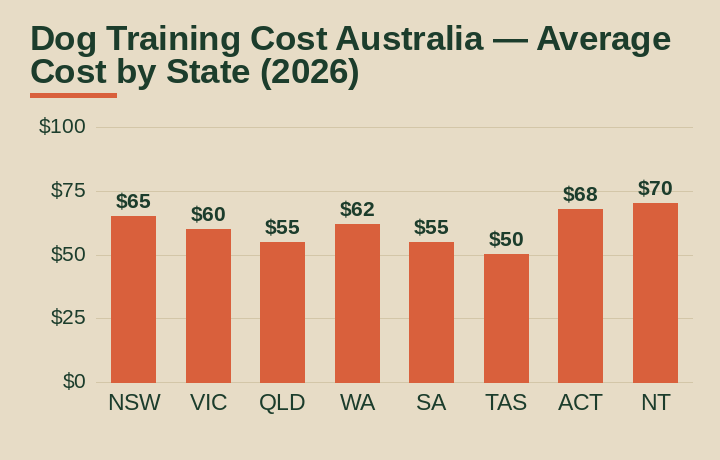
| State | Average Cost (group class) | Typical Range |
|---|---|---|
| NSW | $65 | $50 to $85 |
| VIC | $60 | $45 to $80 |
| QLD | $55 | $45 to $75 |
| WA | $62 | $50 to $80 |
| SA | $55 | $45 to $70 |
| TAS | $50 | $40 to $65 |
| ACT | $68 | $55 to $85 |
| NT | $70 | $55 to $90 |
Prices updated July 2026 from current Australian sources.
| Type | Average | Typical range |
|---|---|---|
| Group class (per session) | $60 | $45-$85 |
| Group obedience course (about 6 weeks) | $300 | $250-$360 |
| Private one-on-one (per session) | $170 | $120-$250 |
| Board-and-train (per week) | $2,500 | $1,800-$3,500 |
| Day-training (per visit) | $110 | $80-$140 |
Sydney and inner Melbourne sit at the top of these ranges; regional areas are lower. Trainers often add a $20-$50 travel fee for clients outside their usual zone. Board-and-train is the priciest option because your dog stays with the trainer full time.
Sources (July 2026): Airtasker (AU), How Much Does Dog Training Cost, AllBreeds (AU), How Much Does Dog Training Cost, Master of Puppies (Gold Coast), Dog Training Cost
Why dog training cost varies so much
The format matters more than anything else. A trainer running 8 dogs in a hall has a per-dog cost of maybe $15. The same trainer driving to your house in Surry Hills is burning 90 minutes for one client. That gap explains most of the price spread.
Trainer qualifications and method. A Delta-accredited trainer or someone with a Certificate IV in Companion Animal Services charges $140-$220 per private session. Self-taught trainers without credentials run $80-$120. The qualified ones aren’t always better, but for behaviour cases they almost always are. Vet behaviourist referrals sit higher again at $300+ per consult.
Format. Group classes: $45-$85 per session. Private in-home: $120-$220. Board-and-train: $1,800-$4,500 for 14-21 days. Day-training (trainer takes the dog for a few hours at their facility): $80-$140 per visit. Online programs: $50-$300 for full courses, sometimes with optional live calls.
Location and travel. Inner-city Melbourne and inner-west Sydney trainers tack on $20-$40 travel fees for clients outside their main zone. In regional WA or far north QLD, expect a flat travel surcharge of $50+. Geelong, Toowoomba and Hobart’s North all sit roughly 15-25% below their nearest capital for equivalent service.
The problem you’re trying to solve. Basic puppy obedience: cheap, predictable. Lead-pulling, recall, sit-stay. A reactive dog who lunges at every other dog on the footpath? You’re looking at 6-10 sessions minimum with a qualified behaviourist, often more. Separation anxiety cases regularly run past $2,000 total. A 10-metre long line and consistent daily practice between sessions cuts that number meaningfully.
Breed and age. Working breeds like Border Collies, Kelpies and Malinois need more sessions to channel their drive, not because they’re stupid (they’re the opposite) but because they need a job. Older rescue dogs with established habits typically take 30-50% more sessions than puppies starting fresh.
What’s included versus what costs extra
Most quoted prices are for the session itself. The add-ons add up fast, and trainers don’t always volunteer them upfront. Worth asking before you book.
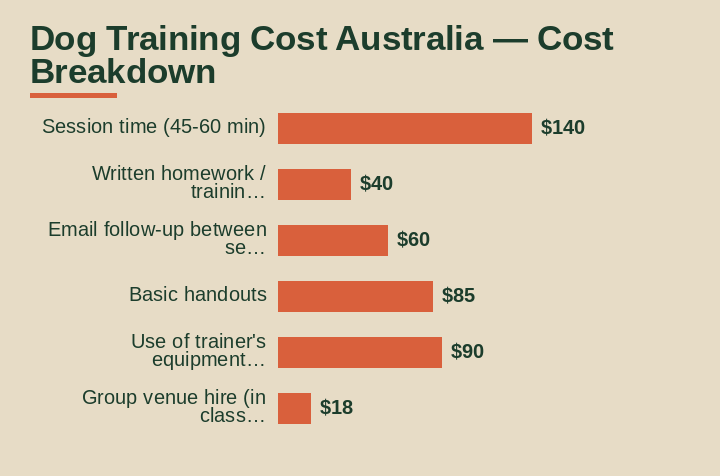
| Usually included | Usually extra | Typical add-on cost |
|---|---|---|
| Session time (45-60 min) | Initial behaviour assessment | $80-$200 |
| Written homework / training plan | Travel beyond a set radius | $20-$60 per visit |
| Email follow-up between sessions | Phone or video check-ins | $40-$80 per call |
| Basic handouts | Detailed written reports | $50-$120 each |
| Use of trainer’s equipment in-session | Recommended gear you keep | $30-$150 |
| Group venue hire (in class fee) | Park permit fees (some councils) | $10-$25 |
Questions to ask before you book
What method do you use, and what happens if my dog gets it wrong?
You want to hear about reward-based or positive reinforcement methods. If the trainer talks about ‘corrections’, prong collars or e-collars as a first-line tool, walk away. Modern qualified trainers in Australia don’t lead with aversives, and the RSPCA position on this is clear.
What are your actual qualifications?
‘Years of experience’ isn’t a qualification. Ask for Certificate IV in Companion Animal Services, Delta Institute accreditation, or Pet Professional Guild Australia membership. For serious behaviour cases, ask whether they work alongside a vet behaviourist.
How many sessions do you think this will take?
A good trainer will give you a realistic range after assessing your dog. ‘It depends’ is fair for behaviour cases, but they should still ballpark it. If they promise a fix in one session for a complex issue, they’re overselling.
Is travel included in the quoted rate?
For in-home training, this is the most common surprise charge. Get it confirmed in writing. A $150 session can become $190 once travel’s added on.
Do you offer package pricing?
Most trainers discount 10-20% on 5 or 10-session bundles. Worth asking even if it’s not advertised. Saves $100-$300 over the course of training.
What happens between sessions?
You want clear homework and ideally some form of check-in. If they hand you a session and disappear until next week, the price isn’t justified. The best trainers send brief written summaries and answer quick questions by text or email.
Products Worth Considering
Here are a few products from Amazon Australia that pet owners find useful (these are affiliate links):
Vet-run puppy preschool ($150-$220) is the safest cheap option before full vaccinations. After that, council obedience clubs at $80-$150 per term beat anything else on price and add real-world distraction practice.
Frequently asked questions
Is group training or private training better value?
Group classes are better value for basic obedience and socialisation, usually $45-$80 a session. Private is worth the extra money for reactivity, anxiety, or specific behaviour problems where you need one-on-one attention.
How many sessions does a dog actually need?
Most puppies do well with a 4-6 week preschool course plus an intermediate block. Adult dogs with behaviour issues often need 6-10 private sessions spread over two to three months, sometimes more for serious reactivity.
Are board-and-train programs worth $3,000+?
They can fast-track basic obedience, but the results only stick if you keep up the training at home. If you won’t follow through, you’re throwing money away. They suit working owners who genuinely struggle to find consistent time. Compare against standard boarding rates when you’re working out the maths.
Does pet insurance cover dog training?
Standard pet insurance doesn’t cover general training. A few premium policies offer a small behaviour consultation benefit (usually $200-$500 a year) if a vet refers you to a qualified behaviourist for a diagnosed condition. Finder’s pet insurance comparison is worth a look before assuming you’re covered.
What qualifications should a dog trainer have?
Look for membership of the Pet Professional Guild Australia or the Delta Institute, plus a Certificate IV in Companion Animal Services. Avoid anyone selling ‘guaranteed results’ or pushing prong collars and e-collars as a first option.
How to bring the cost down
The single best money-saving move isn’t finding a cheaper trainer. It’s putting in the work between sessions so you need fewer of them. Five minutes of practice, three times a day, will beat one weekly hour-long class every time.
- Start with group classes, not private. A six-week group course at $300 covers the same basics as three private sessions at $500+.
- Book through a vet-run puppy preschool. Vet clinics often subsidise classes. Expect $150-$220 for four weeks versus $250-$300 at standalone schools.
- Buy a class pack instead of one-offs. Most trainers discount 10-20% on bundles. Saves $50-$150.
- Use council-run obedience clubs. Volunteer-led clubs charge $80-$150 for an 8-10 week term. Quality varies but the value is unbeatable.
- Train daily at home between sessions. A good Treat pouch and a clicker turn every walk into a training opportunity, and you’ll need fewer paid sessions overall.
- Combine training with day care. Some day cares run mid-day training sessions for $25-$40 extra, cheaper than a separate booking.
- Look at online programs for foundations. Reputable Australian online courses run $50-$300 and work well for basic obedience if you’re disciplined.
Worth noting. The trainers I’d actually book are usually not the cheapest. They’re the ones who explain their method clearly, set realistic expectations, and don’t oversell results. If you’re budgeting for a new puppy, build in $400-$700 for a full first-year training plan and you’ll be in the ballpark. For behaviour cases, double that. The honest summary on dog training cost Australia wide in 2026: pay for quality once, do the homework between sessions, and you’ll spend less than people who chase the cheapest rate and end up booking twice as many.
More Common Questions
How much does it cost to train a reactive dog in Australia?
Reactivity work usually requires a qualified behaviourist, not a general trainer. Expect $250-$400 for an initial assessment and $150-$250 per follow-up. Most cases need 6-10 sessions, so budget $1,500-$2,500 total.
Can I claim dog training on tax in Australia?
Only if the dog is a legitimate working animal, like a farm dog or a registered assistance dog used for work. The ATO won’t accept pet training as a deduction. Service dog handlers should check current ATO guidance for their specific situation.
How much does NDIS-funded assistance dog training cost?
Fully trained assistance dogs from accredited providers cost $30,000-$50,000+. The NDIS will fund this in some plans where it’s deemed reasonable and necessary, but approval is far from automatic and waitlists run two to three years.
Is online dog training as effective as in-person?
For basic obedience and puppy foundations, online courses ($50-$300) work surprisingly well if you’re disciplined. For reactivity, aggression, or anxiety, you genuinely need someone watching your dog’s body language in real time.
What’s the cheapest way to socialise a puppy in Australia?
Related Cost Guides
This guide contains affiliate links. We may earn a small commission from qualifying purchases at no extra cost to you.
Recommended next: Dog cost calculator · Puppy school cost