
Pet food costs per month in Australia vary wildly depending on what you’re feeding and who you’re feeding it to. A small cat on budget kibble might cost $50 a month, while a large dog on premium raw food can easily hit $400. Most Australian owners land somewhere between $100 and $250 per month per pet. Working in a pet store, the pattern I see is that people either overspend on the marketing or underspend on the quality, and the sweet spot is usually somewhere in between.
Pet food cost per month Australia averages $80-$150 for cats and $120-$300 for medium dogs. Budget dry food runs $50-$80 monthly, premium brands $150-$250, and raw or prescription diets $200-$400+. Large breed dogs easily hit $300-$400 per month on quality food.
Prices updated July 2026 from current Australian sources.
| Pet and diet | Typical monthly cost | Notes |
|---|---|---|
| Cats | $80 to $150 / month | |
| Medium dogs | $120 to $300 / month | |
| Budget dry food | $50 to $80 / month | |
| Premium, raw or prescription | $150 to $400+ / month |
Large breed dogs easily hit $300 to $400 per month on quality food. Sydney and Melbourne run slightly higher due to delivery logistics.
Sources (July 2026): Petbarn, Pet Circle, Animal Medicines Australia, Pets in Australia 2025
Around Sydney and Melbourne, prices run slightly higher due to delivery logistics. Regional areas sometimes see better pricing at rural produce stores, but you’re trading selection for savings. Let’s break down what you’ll actually spend across different scenarios.
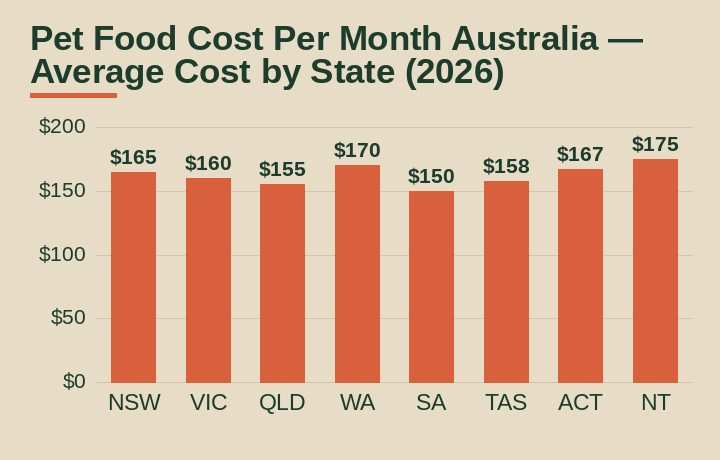
| State | Average Cost (Medium Dog) | Typical Range |
|---|---|---|
| NSW | $165 | $120 to $280 |
| VIC | $160 | $115 to $270 |
| QLD | $155 | $110 to $260 |
| WA | $170 | $125 to $290 |
| SA | $150 | $110 to $250 |
| TAS | $158 | $115 to $265 |
| ACT | $167 | $120 to $275 |
| NT | $175 | $130 to $295 |
What Determines Your Pet Food Cost Per Month Australia?
Pet size and breed: A Chihuahua needs roughly 200-300g of food daily while a German Shepherd requires 400-600g. That size difference translates directly to cost, small breeds cost $60-$100 monthly, medium dogs $120-$200, and large breeds $200-$350. Giant breeds like Great Danes can push past $400 on quality food.
Food type and format: Dry kibble is the most economical at $3-$8 per kilo for decent brands. Wet food runs $8-$15 per kilo. Raw feeding (whether pre-made or DIY) sits around $6-$12 per kilo but requires larger volumes. Freeze-dried premium options hit $20-$35 per kilo. Your choice here matters more than brand loyalty.
Brand quality tier: Budget supermarket brands (Pedigree, Whiskas, Dine) cost $1.50-$3 per kilo. Mid-range specialist brands (Advance, Eukanuba, Royal Canin) run $5-$9 per kilo. Premium options (Black Hawk, Ivory Coat, Taste of the Wild) sit at $8-$14 per kilo. Ultra-premium and imported brands reach $12-$18 per kilo. Check ingredients, some expensive brands aren’t actually better quality.
Life stage and health needs: Puppies and kittens need nutrient-dense food and eat more frequently, expect to pay 20-30% more during growth phases. Senior pets often need specialised diets that cost $180-$300 monthly. Pets with allergies, kidney disease, or digestive issues require prescription formulas from vets at similar premium pricing.
Where you buy matters: Coles and Woolworths offer convenience but limited selection. Petbarn and PetStock provide mid-range pricing with frequent sales. Online retailers like PetCircle and Budget Pet Products undercut physical stores by 15-25%. Buying direct from brands (like Black Hawk) sometimes offers subscription savings. A large airtight food storage container helps if you’re buying bulk online to maximise per-kilo savings.

Recommended Products for Pet Food Cost Per Month Australia
If you’re tackling this yourself, here are some products from Amazon Australia that can help (these are affiliate links):
Your pet food cost per month Australia ultimately reflects your priorities, convenience versus cost, health versus budget. Most Australian pet owners find a sweet spot around $120-$180 monthly per pet by choosing mid-to-premium brands and shopping smart. Whatever you spend, consistency matters more than constantly chasing the latest trend. Pick quality food your pet thrives on, then stick with it.
Frequently Asked Questions About Pet Food Cost Per Month Australia
How much should I budget monthly for dog food in Australia?
Budget $120-$200 monthly for a medium dog on quality food. Small dogs need around $80-$120, while large breeds typically require $200-$300. Premium or prescription diets push this to $250-$400 monthly. Your pet food cost per month Australia depends heavily on size and brand choice.
Is wet food or dry food cheaper for pets?
Dry food is significantly cheaper, typically 60-70% less expensive per meal than wet food. A cat eating only wet food costs around $150-$200 monthly versus $60-$90 on dry kibble. Most owners mix both to balance nutrition and budget.
Are premium pet food brands worth the extra cost?
Premium brands often mean fewer vet bills long-term. Better ingredients lead to healthier coats, fewer digestive issues, and better weight management. You’ll also feed less volume since quality food is more nutrient-dense. The extra $50-$80 monthly often pays off.
How much does raw dog food cost per month?
Raw feeding costs $200-$350 monthly for medium dogs, sometimes hitting $400+ for large breeds. Pre-made raw patties or DIY meat/bone/organ blends both sit at this range. It’s roughly double the cost of premium kibble but supporters cite health benefits.
Do subscription pet food services save money?
They can save 10-15% versus buying the same brand in stores, plus you avoid impulse purchases. Services like PetCircle and Mad Paws offer auto-delivery discounts. You’ll typically pay $100-$180 monthly with subscriptions for medium dogs versus $120-$200 buying retail.
Smart Ways to Reduce Pet Food Cost Per Month Australia
- Buy in bulk during sales: Petbarn and PetStock regularly run 20-30% off sales on large bags. A 20kg premium bag at 25% off saves you $25-$40 per purchase. Stock up when prices drop, saves $150-$200 yearly.
- Mix wet and dry strategically: Feed mostly dry kibble with a scoop of wet food as a topper. You’ll cut costs by 40-50% versus all-wet feeding while keeping meals appealing. This drops monthly spend from $180 to around $110 for cats.
- Use loyalty programs properly: Petbarn’s Friends for Life and PetStock’s VIP programs offer points that convert to $10-$20 vouchers every few months. Consistent shopping at one retailer saves $80-$120 annually through rewards.
- Buy store brands from specialist retailers: PetCircle and Budget Pet Products house brands match quality of mid-tier brands at 30% less. You’re looking at $90-$120 monthly versus $130-$160 for equivalent branded food. Test one bag first.
- Measure portions accurately every time: Overfeeding by even 20% wastes $15-$25 monthly. Use a measuring scoop and follow package guidelines strictly. This single habit saves $180-$300 yearly across multiple pets.
- Split large breed bags with other owners: 20kg bags offer better per-kilo pricing but spoil if opened too long. Split with a neighbour who has the same breed, you both save 15-20% versus buying smaller bags. Organise through local Facebook pet groups.
Cost Breakdown by Pet Type and Diet
Small dogs (under 10kg): Budget brands $50-$70 monthly, mid-range $80-$110, premium $120-$150. Toy breeds are efficient eaters. Most do well on 150-250g daily.
Medium dogs (10-25kg): Budget $70-$100, mid-range $120-$170, premium $180-$240. This covers breeds like Beagles, Cocker Spaniels, and Staffies. Daily intake runs 300-450g depending on activity level.
Large dogs (25-45kg): Budget $110-$150, mid-range $180-$250, premium $270-$350. Labradors, Golden Retrievers, and German Shepherds sit here. They need 450-600g daily. Raw feeding this size costs $250-$350 monthly.
Giant breeds (45kg+): Even budget food runs $150-$200 monthly. Premium hits $300-$450. Great Danes, Mastiffs, and St Bernards consume 600-800g daily. These dogs make pet food cost per month Australia calculations challenging on any budget.
Cats (all sizes): Budget dry food $40-$60, mid-range $70-$100, premium $110-$150. Wet-food-only diets cost $120-$200. Most cats need 200-300g daily. Senior cats on prescription kidney diets run $140-$220 monthly.
Brand Comparison for Monthly Costs
Here’s what you’ll actually spend on popular Australian brands for a 20kg dog:
Budget tier: Pedigree ($85/month), Optimum ($92/month), Purina One ($98/month). Available everywhere. Ingredients are okay but heavy on grains and by-products.
Mid-range specialist: Advance ($135/month), Royal Canin ($145/month), Eukanuba ($140/month). Better protein sources and targeted nutrition. Vets often recommend these.
Premium Australian: Black Hawk ($165/month), Ivory Coat ($170/month), Meals for Mutts ($160/month). Higher meat content and grain-free options. Made locally with Australian ingredients where possible.
Premium imported: Taste of the Wild ($180/month), Canidae ($185/month), Orijen ($220/month). Top-tier ingredients but expensive. Worth it if your dog has allergies or sensitivities.
Raw and fresh: Big Dog Raw ($280/month), Proudi Raw ($265/month), Lyka fresh meals ($320/month). Highest quality but requires freezer space and careful handling. Proper nutrition shows in coat quality within weeks.
State-by-State Shopping Tips
NSW: Harris Farm and About Life stock premium brands with regular sales. Sydney’s inner west has multiple independent pet stores undercutting chains by 10-15%. Check Alexandria and Marrickville.
Victoria: Melbourne’s Pet Stock stores price-match competitors. Footscray and Richmond have produce stores selling bulk pet mince cheaper than pre-packaged raw. Bunnings Warehouse surprisingly stocks decent mid-range brands.
Queensland: Brisbane’s Produce stores along the southside offer bulk-buy options. Tropical climates mean you need smaller bags more frequently to avoid spoilage, factor this into cost calculations. Focus on turnover speed.
WA: Perth prices run 5-10% higher due to freight. Online ordering from eastern states still works out cheaper even with postage for orders over $80. Total Pets Warehouse in Malaga offers wholesale pricing to public.
SA and TAS: Independent rural suppliers often beat city chain pricing. Adelaide’s Pasadena Foodland stocks premium brands. Hobart owners should check Produce to the People for bulk meat options if raw feeding.
Hidden Costs Beyond the Bag
Don’t forget these additions to your pet food cost per month Australia:
Treats and training rewards: Add $15-$40 monthly depending on training intensity. High-value training treats cost more but you use less volume. Budget brands work fine for casual rewards.
Supplements: Joint supplements for large breeds run $35-$60 monthly. Omega-3 oils cost $20-$35 per bottle lasting 2-3 months. Probiotics add another $25-$45 monthly for digestive issues.
Storage solutions: Proper airtight containers prevent spoilage and pest issues. One-time cost of $30-$80 but saves money long-term by keeping bulk food fresh longer.
Dental chews: Quality dental treats cost $25-$50 monthly but reduce vet dental cleaning bills ($400-$800 per procedure). The maths works out if you’re consistent. Check our guide on pet dental cleaning costs for comparison.
Honestly, once you factor treats, supplements, and occasional vet-prescribed diets during illness, your actual monthly spend runs 20-30% higher than just food bags. Plan for this buffer.
When Premium Food Actually Saves Money
Better food means feeding less volume. A 20kg dog might need 500g daily of budget food versus 350g of premium. Over a month, that’s 15kg versus 10.5kg consumed. If budget costs $4/kg and premium $9/kg, you’re comparing $60 versus $94.50 monthly, only $34.50 difference.
Plus premium food typically results in smaller, firmer stools (less waste to clean), shinier coats (fewer grooming visits), and better weight management (avoiding obesity-related vet costs). The Australian Veterinary Association notes that diet quality significantly impacts long-term health outcomes.
If premium food prevents just one ear infection ($150-$300 vet visit) or reduces allergy issues requiring medication ($80-$200 monthly), it pays for itself. Look at yearly costs, not just monthly bags.
DIY and Raw Feeding Economics
Raw feeding costs vary wildly based on your approach:
Pre-made raw patties: $8-$12 per kilo from brands like Big Dog or Proudi. A 20kg dog needs 400-500g daily, so roughly $240-$360 monthly. Convenient but expensive.
DIY whole prey model: Buying chicken frames, beef heart, and organ meat from butchers runs $4-$7 per kilo. Same 20kg dog costs $120-$210 monthly. Requires research and prep time. Check ACCC guidelines on pet food handling.
BARF (Bones and Raw Food): Mixing raw meat with vegetables and supplements sits between pre-made and DIY, around $6-$9 per kilo. Monthly cost $180-$270 for medium dogs. More balanced than pure meat diets.
Raw feeding demands freezer space and daily prep. If you value convenience, the time investment might not justify the $50-$80 monthly savings versus premium kibble.
Multi-Pet Household Calculations
Feeding multiple pets changes the economics. Bulk buying becomes essential:
Two medium dogs on premium food: $300-$400 monthly combined (versus $360-$480 buying individually). Three cats on mid-range food: $180-$250 monthly (versus $210-$300 individually).
With multiple pets, switching to online subscription services makes sense. PetCircle’s auto-delivery saves 10% and free shipping over $49. For households spending $250+ monthly, that’s $300-$360 yearly savings just on logistics.
Different pets need different foods, don’t feed dog food to cats (lacks taurine) or vice versa. Factor this into your pet food cost per month Australia planning. Keeping multiple pets healthy requires proper species-appropriate nutrition.
Age-Specific Feeding Costs
Puppies (under 12 months): Need 2-3x the calories per kilo of body weight versus adults. Premium puppy food costs $10-$15 per kilo. A growing Labrador pup might need 600-800g daily, that’s $180-$360 monthly. Growth phases are expensive but temporary.
Adult dogs (1-7 years): Most cost-efficient phase. Maintenance diets run $120-$200 monthly for medium dogs on quality food. Active working dogs need more calories, budget accordingly.
Senior dogs (7+ years): Reduced calorie needs but often require joint supplements or prescription diets. Expect $150-$280 monthly including food and supplements. Kidney and heart diets push this to $200-$350.
Kittens: Tiny appetites but frequent meals. Premium kitten food runs $80-$120 monthly. They eat more per kilo than adult cats but weigh less overall.
Senior cats (10+ years): Often develop kidney issues requiring prescription diets at $140-$220 monthly. Regular senior formulas cost $90-$140. Factor this into lifetime pet ownership costs.
Seasonal Price Variations
Pet food pricing shifts throughout the year:
January sales: Major retailers clear stock, expect 20-30% off premium brands. Stock up if you have storage space.
Easter and Christmas: Prices stay steady but shops run out of popular sizes. Buy early to avoid paying premium for smaller bags.
End of financial year (June-July): Businesses clear old stock before new financial year. Online retailers offer deeper discounts than physical stores.
Black Friday/Cyber Monday: Growing in Australia. PetCircle and Amazon usually offer 15-25% off. Worth waiting for if your current bag lasts until late November.
Time your bulk purchases around these sales and your pet food cost per month Australia drops by $20-$40 monthly on average across the year.
Prescription Diet Reality Check
If your vet prescribes Hills Prescription Diet or Royal Canin Veterinary, brace yourself. These cost $180-$350 monthly depending on condition and pet size.
You can’t substitute regular food, prescription formulas target specific health issues. Kidney diets have restricted protein and phosphorus. Digestive formulas use hydrolysed proteins. Urinary diets adjust pH levels.
Some conditions require lifelong prescription feeding. A 25kg dog with kidney disease on Hills k/d costs roughly $220 monthly. That’s $2,640 yearly just for food. Pet insurance rarely covers ongoing food costs, only acute vet visits.
Ask your vet if there’s a comparable non-prescription option once the condition stabilises. Sometimes you can switch back to regular senior food after 6-12 months.
Online vs In-Store Economics
Online advantages: PetCircle, Budget Pet Products, and Pet.com.au undercut retail by 15-25%. Free shipping over $49-$79. Subscribe-and-save adds another 10% off. Delivery to your door saves time and petrol.
In-store advantages: Immediate availability. Sales staff can advise on suitable options. Easier returns if your pet refuses the food. Petbarn’s Friends for Life points system offers rewards.
Hybrid approach: Research and trial new foods in-store, then buy bulk online once you know your pet likes it. Use in-store for emergency top-ups between deliveries.
For pet food cost per month Australia calculations, online wins for regular purchases but stores are handy for flexibility. Most owners settle into a hybrid pattern.
The Grain-Free Question
Grain-free pet food costs 20-30% more than regular formulas. A 15kg bag of regular Black Hawk runs $110 versus $145 for grain-free. Monthly difference for a medium dog: $30-$50.
Recent research questions whether grain-free is necessary or even beneficial for most pets. The Australian Veterinary Association notes concerns about grain-free diets and heart disease in dogs.
Only go grain-free if your pet has diagnosed grain allergies (rare) or your vet specifically recommends it. Don’t spend extra based on marketing hype. Most pets digest grains perfectly fine.
People Also Ask About Pet Food Cost Per Month Australia
How much does grain-free pet food cost in Australia?
Grain-free formulas typically cost 20-30% more than regular kibble. Expect $140-$220 monthly for a medium dog on grain-free versus $110-$170 for standard premium food. Brands like Taste of the Wild and Canidae dominate this segment. Nutritionists debate whether grain-free is actually necessary for most pets.
Do cats or dogs cost more to feed monthly?
Dogs cost significantly more, a medium dog runs $120-$200 monthly while a cat averages $70-$120. Large dogs can hit $300+ monthly. Cats eat less volume and most do fine on mid-range brands. Even premium cat food rarely exceeds $150 monthly unless you’re feeding multiple cats.
How much do prescription pet diets cost?
Veterinary prescription diets run $180-$350 monthly depending on condition and pet size. Hills Prescription Diet and Royal Canin Veterinary are the main options. Kidney, urinary, and digestive formulas all sit in this range. You’ll need a vet prescription and can’t substitute with regular food.
Is freeze-dried pet food more expensive than raw?
Freeze-dried costs even more than raw, around $280-$450 monthly for medium dogs. It’s convenient since it doesn’t need refrigeration, but you’re paying a premium for that convenience. Most owners use it as a topper or treat rather than a complete diet due to cost.
How often should I change my pet’s food brand?
Don’t switch unless there’s a health reason. Most pets do best staying on one quality brand long-term. Frequent switching can cause digestive upset and makes it harder to track what works. If you must switch, transition gradually over 7-10 days by mixing old and new food.
Related Cost Guides
This guide contains affiliate links. We may earn a small commission from qualifying purchases at no extra cost to you.