
Owning a snake costs more than most first-timers expect. It’s not just the snake. By the time you’ve sorted a licence, built out an enclosure with proper heating and lighting, sourced your first feeders and booked a vet check, you’re looking at $800 to $2,500 before your new animal has eaten its third meal. According to Animal Medicines Australia’s 2025 Pets in Australia report, reptile ownership is growing steadily, but so is the number of owners who underestimate setup costs and end up overwhelmed.
Snake ownership cost Australia typically runs $800 to $2,500 in the first year once you factor in the snake itself, enclosure, heating, lighting and a reptile vet visit. Ongoing annual costs sit around $400 to $900 for food, electricity, substrate and licence renewals. Carpet pythons and children's pythons are the most affordable entry points; diamond pythons and green tree pythons cost significantly more.
Prices updated July 2026 from current Australian sources.
| Cost | Typical range | Notes |
|---|---|---|
| First year | $800 to $2,500 | Snake, enclosure, heating, lighting, reptile vet |
| Ongoing per year | $400 to $900 | Food, electricity, substrate, licence renewal |
Carpet and children’s pythons are the most affordable entry points; diamond and green tree pythons cost significantly more. A reptile keeper licence is required, see our reptile licence cost guide.
Sources (July 2026): Animal Medicines Australia, Pets in Australia 2025, PetRescue, Adopt a pet, RSPCA Australia
This guide breaks down exactly where the money goes, what varies by state and what you can reasonably cut back on without compromising your snake’s welfare.
What you’ll typically pay in 2026
The honest answer is: it depends on what species you choose and how seriously you take the setup. A bare-minimum children’s python setup can be done for around $450 to $700. A proper coastal carpet python enclosure with quality heating, thermostat, lighting and décor is more like $1,200 to $1,800 before you buy the snake.
Ongoing costs after that first year settle down considerably. Most keepers report spending $400 to $900 per year on food, electricity, substrate and licence renewal. That’s less than most people spend on a dog, but it’s not free.
| State | Average First-Year Cost | Typical Range |
|---|---|---|
| NSW | $1,400 | $750 to $2,600 |
| VIC | $1,500 | $800 to $2,800 |
| QLD | $1,200 | $600 to $2,400 |
| WA | $1,350 | $700 to $2,500 |
| SA | $1,250 | $650 to $2,300 |
| TAS | $1,600 | $900 to $2,900 |
| ACT | $1,450 | $780 to $2,700 |
| NT | $1,100 | $580 to $2,200 |
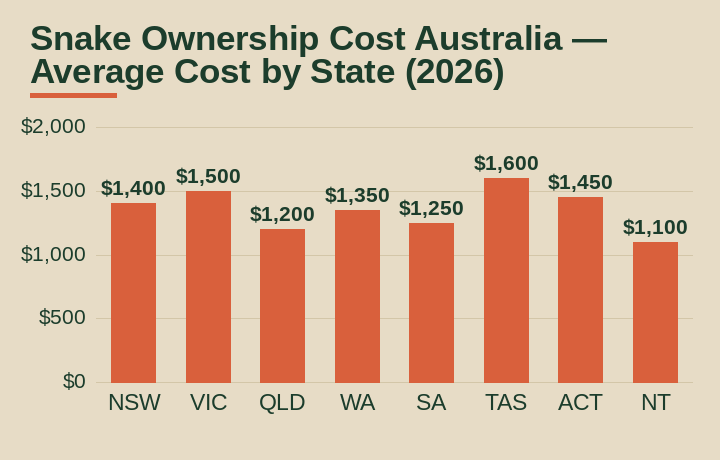
Tasmania sits at the higher end largely because of heating costs, cold winters mean your heat mat and ceramic emitter run longer and harder. The NT is cheaper partly because ambient temperatures reduce heating load, and the cost of living in Darwin skews differently to Sydney or Melbourne.
Where the money actually goes
Reptile keeper’s licence
Every state and territory requires a valid licence before you can legally acquire a snake. Prices and categories differ significantly. Queensland charges around $35 to $55 for a basic keeper’s licence; Victoria charges $105 for the equivalent. NSW sits at $60 to $80 depending on the licence category. The ACT and SA fall in the $50 to $75 range. Processing times vary too, some states issue licences within a week; others take four to six weeks, which matters if you’ve already picked out a snake.
Don’t skip this step. Keeping a snake without a licence in Australia attracts heavy fines, and in some states authorities have the power to seize the animal immediately.
The snake itself
Australian native pythons must be purchased from a licensed breeder or pet shop. You can’t legally import exotic species like ball pythons. Prices for captive-bred hatchlings run:
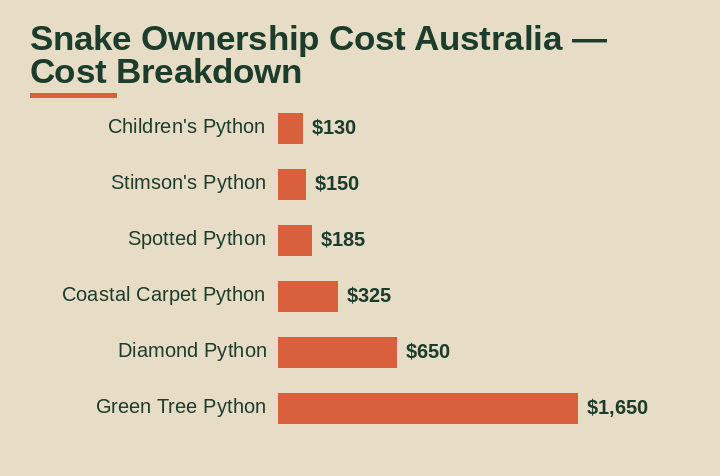
- Children’s python: $80 to $180
- Stimson’s python: $100 to $200
- Spotted python: $120 to $250
- Carpet python (coastal): $200 to $450
- Diamond python: $400 to $900
- Green tree python: $800 to $2,500+ (and they’re not beginner-friendly)
Morphs, snakes bred for unusual colour or pattern, cost significantly more. An albino carpet python might fetch $600 to $1,500. Interesting to look at. Questionable value unless you plan to breed.
Enclosure and setup
This is where most new keepers get caught out. A 4ft enclosure suitable for an adult carpet python costs $300 to $600 for a decent-quality unit. Add a heat mat ($40 to $80), ceramic heat emitter or basking globe ($25 to $60), a quality reptile thermostat ($45 to $90), UVB lighting ($50 to $120), hides ($30 to $70), water bowl, substrate and some basic décor, you’re at $600 to $1,100 in hardware before you’ve bought the snake.
Going cheap on the enclosure is a false economy. Flimsy tanks without secure lids are an escape risk, and snakes that get out in rental properties tend to cause more drama than the entire cost of the hobby.
Heating and electricity
Snakes are ectotherms, meaning they rely entirely on external heat to regulate their body temperature. You need to maintain a thermal gradient inside the enclosure, typically 28 to 32°C on the warm end and 22 to 25°C on the cool end. In Hobart or Melbourne’s outer suburbs in winter, that means your heating runs almost constantly. In Brisbane or Darwin, far less.
A heat mat plus a 60W ceramic heat emitter on a thermostat adds roughly $8 to $20 per month to your electricity bill in warmer climates, and $18 to $35 in cooler southern states. Over a year, that’s $96 to $420. MoneySmart’s pet ownership guide consistently flags ongoing energy costs as one of the most underestimated expenses in exotic pet keeping.
Feeding
Australian pythons eat defrosted rodents. Most keepers use frozen mice and rats purchased from reptile suppliers. A hatchling carpet python eats one small mouse per week, roughly $2 to $3 per feed, or $100 to $155 annually. An adult coastal carpet eating medium rats runs $5 to $8 per feed, typically fortnightly, so $130 to $210 per year. A large diamond python eating adult rats weekly can cost $250 to $400 per year in food alone.
Buying frozen feeders in bulk online is the single easiest way to cut this cost. A box of 50 medium mice delivered is often $55 to $70, versus $2.50 to $3.50 per mouse bought individually at a pet shop.
Veterinary care
Reptile vets are not as common as dog and cat vets. In Sydney’s inner suburbs (Newtown, Surry Hills) or Melbourne’s inner east, you’ll find a few solid options. In regional areas, you might be driving 90 minutes each way. A standard reptile consult runs $80 to $150. Annual check-ups are sensible practice but not legally required. If something goes wrong, respiratory infection, mouth rot, inclusion body disease, you’re looking at $300 to $1,200 in diagnostics and treatment. See our breakdown of pet vaccination costs in Australia for context on how reptile vet costs compare to more common pets.
Standard pet insurance won’t cover snakes. Budget a $500 to $800 emergency fund and keep it there.
Species cost comparison
The species you choose has the biggest impact on both upfront and ongoing costs. Here’s a side-by-side comparison of the most commonly kept Australian pythons to help you make a realistic call.
| Species | Purchase Price | Enclosure Size Needed | Annual Feeding Cost | Difficulty Level |
|---|---|---|---|---|
| Children’s Python | $80 to $180 | 2 to 3 ft enclosure | $90 to $140 | Beginner |
| Stimson’s Python | $100 to $200 | 2 to 3 ft enclosure | $90 to $150 | Beginner |
| Spotted Python | $120 to $250 | 3 ft enclosure | $110 to $170 | Beginner |
| Coastal Carpet Python | $200 to $450 | 4 to 5 ft enclosure | $140 to $220 | Intermediate |
| Diamond Python | $400 to $900 | 5 to 6 ft enclosure | $180 to $300 | Intermediate |
| Green Tree Python | $800 to $2,500 | Tall arboreal setup | $160 to $280 | Advanced |
The green tree python looks incredible. It’s also defensive, stress-prone and genuinely not a good first snake. The cost reflects rarity, not ease of care.
Recommended Products for Snake Ownership Cost Australia
If you’re tackling this yourself, here are some products from Amazon Australia that can help (these are affiliate links):
Questions to ask before you commit
What licence category do I actually need?
Most states have tiered licence systems. Category 1 or Basic Keeper covers common species like children’s pythons and carpet pythons. If you want a diamond python or other restricted species, you may need a higher licence category, which takes longer to obtain and sometimes requires evidence of prior experience. Clarify this with your state wildlife authority before you fall in love with a specific snake.
Where will I source my feeders long-term?
Pet shops are convenient but expensive per feed. Reptile-specific online suppliers (Oz Reptiles, The Reptile Collective and similar) are cheaper but require planning and a dedicated freezer. Ask yourself whether you have freezer space before committing, some partners have opinions about this.
Is the enclosure escape-proof?
Snakes are extraordinary escape artists. Even a small gap around a lid, a loose power cord hole or a cracked seal is enough. Ask the seller or manufacturer exactly how the locks and seals work on any enclosure. If you’re buying second-hand, test every closure mechanism before the snake goes in.
Who is your nearest reptile vet, and what are their hours?
This genuinely matters. A sick snake on a Sunday night in Toowoomba is a different problem to one in inner Melbourne. Google your nearest reptile-experienced vet before you buy. If the nearest one is 2 hours away, that changes your emergency cost calculus.
What temperature range does this species require?
Different pythons need different gradients. Green tree pythons need very specific humidity and temperature setups. Diamond pythons are cool-climate snakes that do poorly in hot environments. Make sure the species suits your home conditions, or budget for climate control to compensate.
Have you handled snakes before?
First-time keepers who’ve never handled a snake sometimes find the reality different from the YouTube videos. Spend time at a reptile expo or with a keeper friend before buying. Some people handle a two-metre carpet python and immediately relax. Others don’t. Worth knowing before you’ve spent $1,200 on a setup.
How to bring the cost down
- Join a herpetological society, state-based reptile clubs like the Herpetological Society of Queensland or the Victorian Herpetological Society run expos, equipment swaps and member group buys. Membership typically costs $30 to $60 per year and regularly saves multiples of that in gear and advice.
- Buy second-hand enclosures, Facebook Marketplace and Gumtree are full of complete setups from keepers leaving the hobby. A $600 enclosure with all hardware can go for $150 to $250. Inspect the seals, locking mechanisms and test the thermostat before handing over cash.
- Start with a smaller species, a children’s python eats smaller prey, needs a smaller enclosure and costs less to heat. First-year all-in cost is typically $450 to $750. Compare that to $1,400 to $2,200 for a coastal carpet python setup.
- Buy frozen feeders in bulk, buying 50 mice at a time from a reptile supplier cuts per-feed cost by 30 to 40%. You need a dedicated freezer section, but the savings add up to $50 to $120 per year.
- Use a thermostat from day one, running heating without a thermostat overworks the equipment and wastes electricity. A $60 thermostat saves you more than that over a year in power costs and extends the life of your heat mat significantly.
If you’re comparing the cost of keeping a snake against other pet options, it’s worth reading our breakdown of dog boarding costs in Australia, sometimes the ongoing costs of conventional pets surprise people just as much. For those who already keep pets and are adding a snake, check what mobile pet vet services cost, as some do cover reptiles.
There’s also value in thinking about what other reptile-adjacent or exotic pet costs look like. Our guide on pet hydrotherapy costs and pet acupuncture pricing in Australia show how specialist care pricing works across the board, relevant if your snake ever needs physiotherapy post-surgery, which does happen with larger pythons.
Snake ownership cost Australia is manageable if you go in with accurate numbers. The first year is the expensive one. After that, most keepers find it genuinely affordable, a carpet python eating fortnightly and basking under a thermostat is one of the lower-maintenance pets you can own. The key is choosing the right species for your experience level, building the setup properly from the start and keeping a realistic emergency fund for the vet bills that will, eventually, happen. If you’re also considering other pets or services alongside snake keeping, our guides on dog vaccination costs, puppy school pricing and pet dental cleaning fees give a useful sense of what responsible pet ownership costs across the board.
FAQs about snake ownership cost Australia
Do I need a licence to own a snake in Australia?
Yes. Every state and territory requires a reptile keeper’s licence before you can legally own a snake. Fees range from around $35 in Queensland to $105 in Victoria. The application process also typically requires you to demonstrate you have appropriate housing set up before the licence is granted.
What is the cheapest snake to keep in Australia?
Children’s pythons and stimson’s pythons are generally the most affordable. You can pick up a captive-bred hatchling for $80 to $150, they stay small (under 1 metre), eat smaller prey and need a more modest enclosure. Setup costs for a children’s python are typically $400 to $700 all in.
How much does a reptile vet visit cost in Australia?
A standard consultation with a reptile-experienced vet runs $80 to $150 in most cities. More specialist work like imaging or surgery can push into the $400 to $1,200 range. Reptile vets are thinner on the ground outside major cities, so rural and regional owners sometimes face long drives or higher fees.
Can I feed my snake frozen mice from the supermarket?
Frozen feeder mice and rats are sold by specialist reptile suppliers and some pet shops, not from Coles or Woolworths. A bag of 10 frozen pinkie mice runs around $15 to $25; adult rats are $5 to $9 each. Most experienced keepers buy in bulk online and store them in a dedicated freezer to cut costs.
Is pet insurance available for snakes in Australia?
Standard pet insurance policies in Australia almost universally exclude reptiles. A small number of specialist exotic pet insurers do offer cover, but premiums are high relative to what you’re protecting and the excess structures often make claims borderline pointless. Most snake keepers self-insure by maintaining a dedicated emergency fund of $500 to $1,000.
People Also Ask About Snake Ownership Cost Australia
What ongoing costs should I budget for after the first year of snake ownership?
After the initial setup, annual costs typically run $400 to $900. The main ongoing expenses are frozen feeders ($100 to $250 per year depending on species size), electricity for heating and lighting ($80 to $200), substrate replacement ($40 to $80), licence renewal ($35 to $105 by state) and at least one vet check ($80 to $150). Budget at the higher end if your snake is large or lives in a cool climate where heating runs hard.
Are there snakes in Australia that are legal to own without a licence?
No. All native Australian snake species require a valid reptile keeper’s licence issued by your state or territory wildlife authority. There are no exemptions for ‘beginner’ species or hatchlings. Keeping a snake without a licence risks significant fines and seizure of the animal.
How much does it cost to set up a bioactive enclosure for a python?
A bioactive setup for a medium-sized python (carpet or coastal) runs $600 to $1,500 depending on enclosure size, plant selection and substrate depth. It costs more upfront than a basic setup but can reduce substrate replacement costs over time. It’s not necessary for beginners and adds complexity to humidity management.
How long do pet snakes live, and how does that affect total lifetime cost?
Most Australian pythons live 15 to 30 years in captivity. A carpet python that costs $400 to $600 to acquire and set up can accumulate $10,000 to $20,000 in lifetime feeding, vet and housing costs over a 20-year lifespan. That’s worth factoring in before you buy, it’s a long commitment, not a cheap hobby.
Can I breed my snake in Australia to offset costs?
Yes, but only if your licence class permits it, most states issue a separate or upgraded licence for breeding. Selling captive-bred hatchlings without the correct authorisation is illegal and can result in heavy fines. Even with the right licence, breeding requires additional enclosures, an incubator ($150 to $400) and more time than most beginners expect.
Related Cost Guides
This guide contains affiliate links. We may earn a small commission from qualifying purchases at no extra cost to you.