
Labrador desexing is one of those expenses most Lab owners know is coming but few actually budget for properly. Across the country in 2026, you’re looking at $320-$650 for a male castration and $450-$850 for a female spay, with the spread driven by weight, age, location, and what extras the clinic bundles in. According to the Animal Medicines Australia Pets in Australia 2025 report, Labradors remain one of the most popular breeds nationally, which means most suburban vets do this procedure regularly and price it competitively.
Labrador desexing cost Australia sits between $320 and $650 for males and $450 to $850 for females. The gap comes down to sex (spaying is abdominal surgery, castration isn't), your dog's weight, and whether you're in an inner-city clinic or a regional one. Budget a bit extra for pre-anaesthetic bloodwork if your Lab is older than five.
Prices updated July 2026 from current Australian sources.
| Procedure | Typical cost | Notes |
|---|---|---|
| Male (castration) | $320 to $650 | |
| Female (spey) | $450 to $850 | Abdominal surgery, costs more |
The price comes down to sex, your dog’s weight (Labs are large, so more anaesthetic) and whether you’re at an inner-city or regional clinic. Budget extra for pre-anaesthetic bloodwork if your Lab is older than five.
Sources (July 2026): National Desexing Network, RSPCA Australia, PetCloud, Vet prices in Australia
Female surgery costs more. Full stop. A spay (ovariohysterectomy) involves entering the abdominal cavity, longer anaesthetic time, and more post-op monitoring. A castration is comparatively straightforward. That’s not a marketing line from your vet, it’s just surgical reality.
What you’ll typically pay by state
Prices below are mid-range estimates for a healthy adult Labrador at a standard private clinic, excluding optional add-ons. Regional areas within each state skew lower; inner-city clinics skew higher.
| State | Average Cost (Male) | Average Cost (Female) |
|---|---|---|
| NSW | $490 | $680 |
| VIC | $480 | $660 |
| QLD | $420 | $590 |
| WA | $450 | $630 |
| SA | $395 | $560 |
| TAS | $380 | $540 |
| ACT | $510 | $710 |
| NT | $430 | $600 |
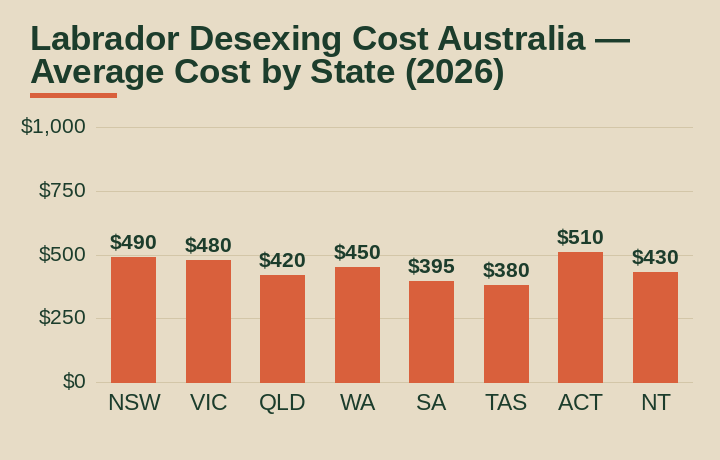
To put that in concrete terms: a male Lab desexing at a Surry Hills clinic in Sydney will often run $520-$580. The same procedure at a Penrith or Campbelltown vet is more likely $380-$440. In Brisbane’s inner suburbs like Newstead or West End, you’re looking at $450-$530 for a male. Head out to Toowoomba and that drops to $350-$420.
The budget option isn’t inferior surgery. Subsidised clinics and vet schools operate under qualified supervision and perform thousands of these procedures. The difference is throughput, waiting lists, and the level of pre/post-surgical pampering your dog receives. For a healthy young Lab with no complications, standard private or subsidised is genuinely fine. For an older dog or one with health issues, the mid-tier extras are worth paying for.
Questions to ask before you book
Is the quote itemised or all-in?
Some clinics quote a single figure that bundles everything; others quote the surgery alone and add items at checkout. Ask for a written list of what’s included. A $480 quote that covers IV fluids and bloodwork may be better value than a $420 quote that adds $180 in extras on the day.
Is pre-anaesthetic bloodwork optional or mandatory?
For a healthy Lab under three years, bloodwork is genuinely optional at most clinics. If a clinic insists it’s mandatory for a two-year-old dog with no health history, ask why. You’re looking for a medical reason, not just a revenue line. That said, for dogs over five or those with any cardiac or metabolic history, bloodwork before going under is sound medicine.
What pain relief is included, and for how long?
A single in-clinic pain injection wears off within hours. Labs recovering from abdominal surgery (spaying especially) need multi-day pain management. Ask whether take-home anti-inflammatory medication is included or extra, and how many days it covers. Missing this step affects recovery quality, not just comfort.
Who performs the surgery, and how many of these do they do per week?
You’re not being difficult asking this. A vet who performs five or six routine desexings per week has seen every variation the procedure throws up. A vet who does one per fortnight hasn’t. Experience matters with any surgical procedure. Worth knowing.
What’s the aftercare protocol if something goes wrong?
Most desexings go without incident. But ask anyway: does the clinic have after-hours emergency contacts, or will you be directed to an emergency centre? If you’re in a regional area, knowing this in advance saves panic at 11pm when your Lab won’t stop licking the wound.
Is there a surcharge if my dog is in season?
Yes, at most clinics. If your female Lab is cycling when you book, flag it immediately. Some vets prefer to wait until she’s out of season to reduce surgical risk and cost. Others will proceed with a surcharge. You want to know this before you turn up on the day.
Recommended Products for Labrador Desexing Cost Australia
If you’re tackling this yourself, here are some products from Amazon Australia that can help (these are affiliate links):
Yes, and it’s worth factoring into the overall cost calculation. Most Australian councils charge significantly lower annual registration fees for desexed dogs, often $40-$90 less per year than for entire animals. Over a dog’s lifetime that saving adds up to well over the cost of the procedure itself.
Frequently asked questions
How much does it cost to desex a male Labrador in Australia?
Castrating a male Labrador typically costs $320 to $650 across Australia. It’s a simpler procedure than spaying, so the lower price makes sense. Sydney and Melbourne clinics tend to sit at the higher end, while regional Queensland and SA clinics are often closer to the $320-$400 mark.
How much does it cost to spay a female Labrador?
Spaying a female Labrador (ovariohysterectomy) costs $450 to $850 at most Australian clinics. The higher cost reflects the abdominal surgery involved, the longer anaesthetic time, and the additional monitoring required. If your female is in season or pregnant, expect an additional $100-$200 surcharge.
What’s the best age to desex a Labrador in Australia?
Most Australian vets recommend desexing Labradors between six and nine months. Some recent research suggests waiting until 12-18 months for large breeds to allow fuller skeletal development. Talk to your vet about timing that suits your individual dog. There’s genuine debate on this, and your vet’s recommendation should factor in your Lab’s weight and growth trajectory.
Does pet insurance cover Labrador desexing?
Rarely. Most Australian pet insurance policies classify desexing as an elective procedure and exclude it from cover. A handful of comprehensive plans include a wellness component that subsidises routine procedures, but you’ll usually pay out of pocket. Check your Product Disclosure Statement carefully. See our breakdown of dog vaccination costs in Australia for another common out-of-pocket expense to plan for.
Are there low-cost desexing options in Australia?
Yes. RSPCA clinics, the Lost Dogs Home, and various council-subsidised programs offer significantly reduced rates, sometimes as low as $100-$200 for eligible owners. Wait times can be several weeks. Some vet schools also offer discounted procedures under supervised conditions. These are worth investigating if cost is a real barrier. Also worth reading: our broader dog desexing cost breakdown covers subsidised options across each state in more detail.
How to bring the cost down
- Use a subsidised or RSPCA clinic. If you’re eligible, the bill drops to $100-$250. Waiting lists exist but aren’t always as long as people assume. Ring first and ask. The RSPCA Australia website lists clinic locations and eligibility by state.
- Book early, while your Lab is still young. Weight-banded pricing means a six-month-old Lab still growing into its frame may fall into a cheaper surgical bracket than a full-grown 32kg adult. Ask your vet about their weight pricing structure before booking.
- Ask what’s optional. Pre-anaesthetic bloodwork on a healthy young Lab under three is genuinely optional at most practices. IV fluids are recommended but not always mandatory for low-risk cases. Asking directly, politely, is not unreasonable. Savings of $80-$180 are on the table.
- Get two or three itemised quotes. Ring clinics in your area and ask for a written quote for a female or male Labrador desexing, weight approximately X kilograms. Prices honestly bounce around by $150-$200 for identical procedures within the same suburb. Worth ten minutes of phone calls. You might also consider a mobile service comparison approach as a model for how to evaluate trade-offs in pet care pricing.
- Ask about payment plans. Vetpay, Humm, and in-house payment arrangements are available at many independent clinics. A $700 bill spread over four months at no interest is far more manageable than a lump-sum payment, and most vets would rather arrange it than lose a long-term client.
- Factor in council registration savings. Most Australian councils charge $40-$90 less per year for desexed dogs. Over a 12-year Lab lifespan, that’s $480-$1,080 in saved registration fees. The procedure more than pays for itself, which is worth remembering when the quote stings. Also see MoneySmart’s pet ownership cost overview for broader annual cost planning.
- Plan recovery supplies in advance. A soft recovery collar bought beforehand avoids the $25-$40 markup clinics charge for the same item. Same goes for a dog recovery onesie if your Lab hates the cone. Not a huge saving, but a useful one.
One more thing worth planning for alongside desexing: annual vaccination costs and dental cleaning are the two other big-ticket preventive care expenses for Lab owners. Budgeting for them at the same time as desexing gives you a realistic picture of what the first two years of Lab ownership actually costs.
Labrador desexing cost Australia sits at a reasonable mid-point for large breed dogs. It’s not cheap, but it’s a once-in-a-dog’s-lifetime expense that reduces long-term health risks and saves on council registration every single year. Do the quotes, ask the right questions, and don’t let a single sticker price put you off without checking whether a subsidised option is available in your area. If you’re also planning interstate travel with your dog post-surgery, check out pet transport interstate costs and overseas pet relocation costs for what comes next.
People Also Ask About Labrador Desexing Cost Australia
Does a Labrador’s colour affect the cost of desexing?
No. Chocolate, yellow, or black, the colour makes no difference to the procedure or the price. Weight is what matters to most vets when calculating anaesthetic dosage and surgical time, not coat colour.
How long does a Labrador take to recover from desexing?
Most Labradors are active again within 48-72 hours, but full internal healing takes 10-14 days. You’ll need to restrict running and jumping during that window. Female Labs recovering from spaying generally need a slightly longer rest period than males.
Will desexing change my Labrador’s personality?
Desexing reduces hormone-driven behaviours like roaming, mounting, and some aggression in males. It won’t alter your Lab’s core temperament or their enthusiasm for food, fetch, or your couch. Labs are famously food-motivated regardless of reproductive status.
Can I get my Labrador desexed at a vet school in Australia?
Yes. University of Melbourne, University of Queensland, Charles Sturt, and University of Adelaide all have teaching clinics that offer discounted veterinary procedures. Expect heavily supervised conditions, longer appointment times, and sometimes wait lists, but the quality of care is generally high.
Is there a council registration discount for desexed Labradors in Australia?
Related Cost Guides
This guide contains affiliate links. We may earn a small commission from qualifying purchases at no extra cost to you.