
Instant turf cost Australia is one of those things that catches people off guard. The per-metre price looks manageable in the nursery catalogue, then you add delivery, soil prep, laying labour and fertiliser, and a 120m² backyard starts looking like a $5,000–$7,500 project. According to MoneySmart’s home improvement budgeting resources, unexpected landscaping costs are one of the most common budget blowouts for Australian homeowners. So here’s what the real numbers look like across the country in 2026, before you order a single roll.
Instant turf cost Australia typically runs $8–$30 per square metre for supply only, or $25–$65 per square metre fully installed including soil preparation and labour. For an average 100m² backyard, expect to pay $2,500–$6,500 all up. Couch and buffalo varieties are the most affordable; Sir Walter and premium kikuyu sit at the higher end.
Supply-only turf runs $8–$30 per square metre depending on variety. Full installation, including soil preparation and laying, adds another $17–$35 per square metre on top. For the average Australian backyard, that’s $2,500–$6,500 all up. Larger properties or those needing significant earthworks can push well past $10,000.
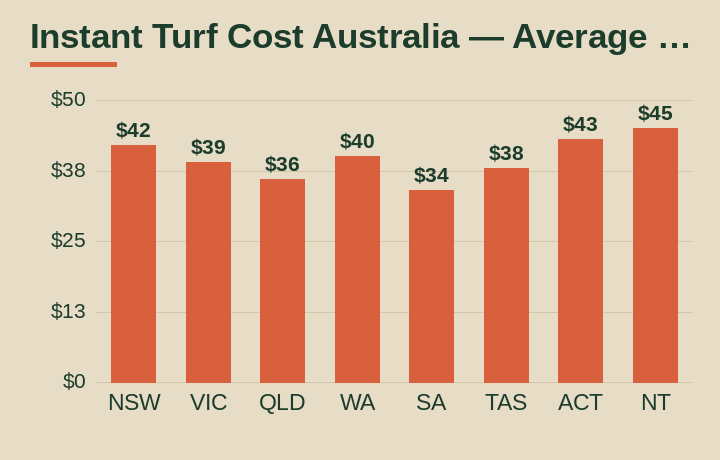
What this typically costs by state in 2026
Prices vary meaningfully across Australia, driven by local labour rates, soil conditions and how far turf farms are from urban centres. Inner-city installs in Sydney and Melbourne run higher than outer suburban or regional areas. These figures reflect fully installed costs including supply, soil preparation and laying for a standard residential lawn.
| State | Average Installed Cost (per m²) | Typical Range |
|---|---|---|
| NSW | $42 | $28 – $62 |
| VIC | $39 | $26 – $58 |
| QLD | $36 | $24 – $55 |
| WA | $40 | $27 – $60 |
| SA | $34 | $22 – $52 |
| TAS | $38 | $25 – $56 |
| ACT | $43 | $29 – $63 |
| NT | $45 | $30 – $68 |
Get 3 free quotes from local providers in your area. No obligation.
Sir Walter buffalo is the most popular choice in Australia for a reason. It handles most conditions, looks good year-round and doesn’t turn into a maintenance nightmare like kikuyu can. The premium over basic couch is real, but for a 100m² lawn you’re talking $400–$600 more in supply cost, usually worth it.
Where the money actually goes
Grass variety and quality is the starting point. Common couch at $8–$10/m² sounds like a bargain until you realise it needs full sun and goes dormant and brown in winter across most of southern Australia. Sir Walter at $18–$24/m² stays green longer, handles 70% shade and roots faster after laying. For a 150m² lawn, that’s a $1,500–$2,100 difference in supply cost, but reckon in the long-term maintenance savings and it narrows considerably.
Soil preparation is consistently the most underestimated cost. If your soil is clay-heavy (common in Melbourne’s outer suburbs like Frankston and Pakenham) or sandy (Perth’s coastal suburbs from Scarborough to Cottesloe), you need to amend it before laying. Rotary hoeing and levelling runs $4–$10/m² in labour. Adding a 75mm layer of blended turf underlay or quality topsoil costs another $3–$6/m². Skip this step and you’re looking at patchy establishment within 3 months.
Labour and laying adds $12–$22 per square metre for a professional crew. A two-person team can typically lay 100–150m² per day on a prepared surface. In Sydney’s inner suburbs like Newtown or Surry Hills, where access is tight and parking costs money, expect to pay at the upper end. Outer suburban Brisbane landscapers in areas like Ipswich or Redcliffe are noticeably cheaper. Labour honestly bounces around depending on how busy the tradie calendar is.
Delivery and logistics is a real cost people miss. Turf rolls weigh 15–25kg each and can’t sit in the sun for long. Most farms charge $80–$250 for delivery depending on quantity and distance, with a minimum order typically around 20–30m². If you’re in a regional area more than 60km from a turf farm, delivery alone can add $300–$500 to the quote.
Area size and shape matters more than most quotes let on. A simple rectangular 100m² lawn is straightforward. A curved garden bed with multiple obstacles, steps or slopes takes longer to measure, cut and fit, which means more waste (typically 10–15% extra material) and more labour time. For complex shapes, add 10–20% to your material estimate. A good tip: get a lawn roller for bedding in new turf if you’re doing this yourself, since proper contact with the soil is critical for root strike.
Questions to ask before you book a turf installer
Is your quote for supply and installation, or supply only?
Many online turf calculators show supply-only prices. So do some landscaper quotes at first glance. Get clarity upfront on whether the figure includes delivery, soil prep, laying and any waste disposal. The all-in number is the only one that matters for your budget.
What soil preparation is included?
This is where budgets blow out. Some installers include basic levelling; others charge separately for rotary hoeing, topsoil supply, amendment with gypsum or lime, and grade levelling. Ask for a line-by-line breakdown so you can see exactly what’s covered. If you’re on clay, poor drainage prep will cost you the turf within a year.
Do you guarantee establishment?
A reputable installer will stand behind their work for at least 14–28 days. Some offer a 60-day establishment guarantee if you follow their watering instructions. Ask what’s covered and what voids it. No guarantee usually means they’re not confident in either the product or their prep work.
What variety are you supplying, and from which farm?
A quote for “buffalo turf” covers a lot of ground, including varieties from $12/m² all the way to $26/m². Ask for the brand name (Sir Walter, Palmetto, Sapphire, etc.) and the farm source. Reputable turf farms harvest and deliver fresh; some middlemen hold stock that’s past its best. Day-old turf vs three-day-old turf can mean the difference between fast establishment and weeks of struggling patches.
How will you handle edges and obstacles?
Garden bed edges, concrete paths, tree roots and irrigation heads all create off-cuts and extra fitting time. Ask if waste is included in the material estimate or charged separately. A good landscaper will already have accounted for 10–15% wastage in a complex yard, if they haven’t, that’s a red flag.
When can you actually start?
Turf goes down fast, but good landscapers book weeks out in peak season. If someone can start tomorrow in spring, it might mean they’re not in demand for a reason. Ask about their current workload and whether they can commit to a specific start date, delays cause turf to sit on rolls past its useful life.
How to bring the cost down without wrecking the result
- Buy direct from a turf farm. Cutting out the landscape supplier middleman saves $3–$7/m². Most turf farms within 50km of major cities sell direct to the public. A 100m² order saves $300–$700 this way. Search “[your suburb] turf farm” rather than “turf supplier” to find the farms.
- Prepare the soil yourself. Rotary hoe hire from Kennards or Total Tools runs $120–$200 for a weekend. A landscaper charges $500–$1,200 for the same work on a 100m² yard. It’s physically tiring but genuinely manageable for most people. YouTube has solid tutorials specific to Australian soil types.
- Lay in autumn. Landscapers are flat out from September to January. March to May is quieter, and competition for work brings quotes down $3–$6/m². Turf still establishes well in autumn in most states, though it takes a few weeks longer.
- Combine orders with neighbours. Most farms discount above 200m². Two neighbours combining orders splits the delivery cost and can knock $2–$4/m² off supply. On two 100m² lawns, that’s $400–$800 saved between two households.
- Get a soil test first. A basic soil pH test costs $20–$40 at Bunnings or via a mail-in kit. It tells you whether you actually need the $400–$900 topsoil upgrade your landscaper is quoting, or just some lime or gypsum at $15–$30 a bag. A soil pH test kit is a genuinely useful first step before committing to anything.
- Match the variety to your actual conditions. Laying cheap couch in a shaded yard, or not installing basic irrigation in Perth’s dry climate, guarantees a re-lay within 3 years. The right grass the first time is always cheaper long-term. If you’re thinking about the ongoing cost of a lawn, monthly pet costs and garden maintenance are worth budgeting together for a complete picture of household running costs.
Frequently asked questions
How much does instant turf cost per square metre in Australia?
Supply-only turf costs $8–$30 per square metre depending on grass variety. Budget couch varieties start around $8–$12/m², while Sir Walter buffalo and premium kikuyu run $18–$30/m². Add $17–$35/m² for professional laying and soil preparation on top of that.
Is it cheaper to lay turf yourself or hire someone?
DIY saves roughly $15–$25 per square metre in labour, which adds up to $1,500–$2,500 on a typical 100m² lawn. The trade-off is physical effort, turf rolls weigh 15–25kg each, soil prep is hard work, and poor preparation leads to patchy establishment. For areas under 50m², DIY is genuinely manageable. Above that, the cost-saving argument weakens fast.
What type of turf is cheapest in Australia?
Common couch (Cynodon dactylon) is consistently the cheapest, running $8–$14 per square metre for supply. Kikuyu is also affordable at $10–$16/m². Both are drought-tolerant once established but don’t handle shade well. If you have significant shade, you’ll need to spend more on a shade-tolerant variety like Palmetto or Shade-Master buffalo.
Does the price of turf include delivery and installation?
Almost never, unless explicitly quoted that way. Most turf farms and landscape suppliers quote supply-only prices. Delivery adds $80–$250 depending on distance and order size. Installation labour is a separate quote again. Always ask for a fully itemised quote covering supply, delivery, soil prep, laying and any soil amendment costs.
How long does instant turf take to establish in Australia?
Most varieties root in within 2–4 weeks during warmer months. Summer installs in Queensland or northern WA establish faster. Winter installs in Victoria or Tasmania can take 6–10 weeks. During establishment, turf shouldn’t be walked on heavily or mowed until roots resist a gentle tug, usually around 3 weeks.
People Also Ask About Instant Turf Cost Australia
Can I lay instant turf over existing lawn?
You can, but it’s rarely a good idea. Laying over dead or sparse grass leaves an uneven surface and the old material can harbour disease and pests that kill the new turf. Most landscapers will kill off and remove the old lawn first, add $3–$8 per square metre for chemical treatment and scalping.
What time of year is best to lay turf in Australia?
Spring and early summer are ideal in most states, as warmth accelerates root establishment. In Queensland and the Northern Territory, the build-up season (November–February) can stress new turf with heat, so late dry season installs work better. In Victoria and Tasmania, avoid laying in winter frosts.
How much topsoil do I need before laying turf?
A minimum of 100mm of good-quality topsoil gives turf the best start. For sandy or clay-heavy soils, you may need to bring in blended topsoil at $60–$95 per cubic metre. A standard 100m² lawn needing 100mm of fresh soil requires roughly 10 cubic metres, budget $600–$950 for the soil alone, before delivery.
How long do turf rolls last once delivered?
Turf rolls should ideally be laid within 24–36 hours of delivery, especially in summer. In cooler months you might get 48 hours before the grass starts to yellow and root quality deteriorates. Never stack rolls in direct sun, keep them in a shaded area and keep them moist if there’s any delay.
Is Sir Walter buffalo worth the extra cost?
For most Australian backyards, yes. Sir Walter handles drought, moderate shade and heavy foot traffic better than cheaper couch varieties, meaning fewer replacements and less ongoing maintenance. The extra $6–$12 per square metre upfront pays for itself if you’re not re-laying in 3–5 years. It’s consistently the most popular variety sold in Australia for good reason.
Related Cost Guides
Recommended Products for Instant Turf Cost Australia
If you’re tackling this yourself, here are some products from Amazon Australia that can help:
Getting the instant turf cost Australia calculation right before you order saves real money. The per-metre sticker price is only part of the story, soil prep, delivery timing and variety choice are where most first-timers either get it right or spend double. If you’re budgeting other pet and home costs alongside this, check out our guides on dog food costs in Australia, dog walking rates and pet insurance pricing to plan the full household picture. And if you’re doing any garden work alongside the turf, the Australian Bureau of Statistics’ household expenditure data shows landscaping is one of the fastest-rising home improvement categories in 2026, so you’re far from alone in taking on this project.
This guide contains affiliate links. We may earn a small commission from qualifying purchases at no extra cost to you.