
The cost of a Burmese deserves a proper breakdown, not a single number. According to Animal Medicines Australia’s 2025 Pets in Australia report, cats are the second most popular pet in the country, and Burmese consistently rank among the priciest pedigree breeds to both purchase and maintain. The purchase price is just the start. The real number is what you spend over 15 to 18 years of a healthy Burmese life.
Burmese cat cost Australia sits between $1,200 and $3,500 to purchase from a registered breeder, depending on lineage and coat colour. Annual ongoing costs typically run $2,800 to $4,500 when you factor in food, vet care, insurance, grooming and accessories. Budget around $350 to $450 per month all in.
Prices updated July 2026 from current Australian sources.
| Cost | Typical range | Notes |
|---|---|---|
| Purchase (registered breeder) | $1,200 to $3,500 | Depends on lineage and coat colour |
| Ongoing per year | $2,800 to $4,500 | About $350 to $450 per month |
Burmese are a sociable, people-oriented breed. Budgeting for company (a second cat or enrichment) and routine vet care keeps them healthy and happy.
Sources (July 2026): PetRescue, Adopt a pet, RSPCA Australia, Adopt a pet, Animal Medicines Australia, Pets in Australia 2025
The MoneySmart pet ownership guide recommends budgeting holistically before committing to any pedigree animal. That’s sound advice here. A Burmese is an intelligent, social, sometimes demanding cat, and one with documented genetic health risks that can turn routine ownership into a significant ongoing expense if you’re not prepared.
NSW and VIC owners pay more largely because of higher vet consultation fees, $95 to $130 for a standard check-up in inner Sydney or Melbourne versus $70 to $95 in regional Queensland or Tasmania. Food costs are similar across states for anyone buying online, but litter prices can tick up in remote NT due to freight. If you’re in Surry Hills or Fitzroy, budget at the top of the NSW/VIC range without hesitation.
What’s included versus what costs extra
Most people budget for the obvious stuff, food, vet visits, and get caught out by the less visible costs. Here’s a realistic breakdown of what’s routine versus what tends to surprise first-time Burmese owners.
| Typically Included in Base Budget | Common Extras (Often Underbudgeted) |
|---|---|
| Premium wet and dry food ($90 to $130/month) | Dental cleaning under anaesthetic ($400 to $900) |
| Annual vet wellness check ($95 to $130) | Hypokalaemia treatment ($300 to $800 per episode) |
| Core vaccinations ($85 to $145/year) | Echocardiogram screening ($280 to $450) |
| Flea, tick and worming prevention ($180 to $260/year) | Specialist cardiologist referral ($250 to $500) |
| Litter and tray supplies ($35 to $60/month) | Microchipping if not done by breeder ($60 to $85) |
| Pet insurance ($40 to $75/month) | Emergency vet after-hours call-out ($180 to $350) |
| Scratching posts and basic toys ($100 to $200/year) | Behavioural consultation ($150 to $250) |
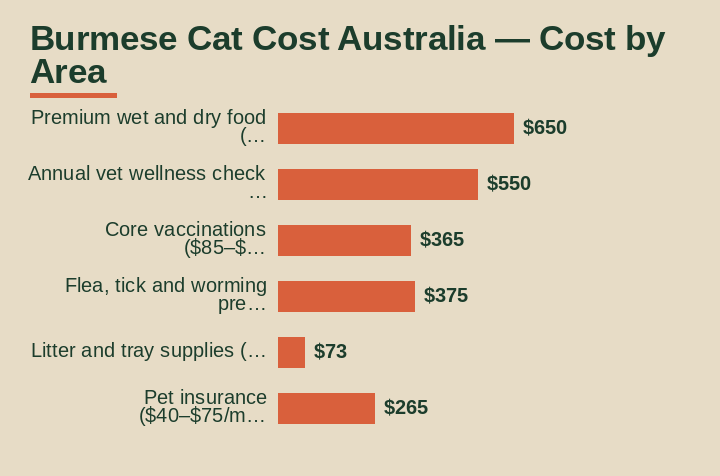
The dental cleaning line is the one that surprises people most. Burmese cats have a real tendency toward periodontal disease, some vets recommend a professional clean every 12 to 18 months for this breed. That’s a recurring cost that doesn’t appear in most generic ‘cat ownership’ calculators. The echocardiogram recommendation exists because hypertrophic cardiomyopathy (HCM) runs in the breed; reputable breeders test their lines, but annual screening is still sometimes recommended by cardiologists for adult cats.
Where the money actually goes, 5 factors that drive cost
Not all Burmese cats cost the same to own. Here’s what genuinely moves the needle.
1. Breed-specific health predispositions. This is the big one. Burmese cats carry a higher-than-average risk of hypokalaemia, HCM and diabetes compared to mixed-breed cats. A Burmese with hypokalaemia may need potassium supplementation long-term at $30 to $60 per month, plus quarterly vet monitoring. A diabetic Burmese can run $150 to $300 per month in insulin and testing supplies. These aren’t rare scenarios, they’re documented breed traits. The AVA has flagged rising vet costs as a genuine pressure point for pedigree cat owners, and Burmese owners tend to feel this more than most.
2. Diet quality. Cheap supermarket food keeps a Burmese alive. It doesn’t keep them thriving. This breed benefits substantially from high-protein, moisture-rich food to support kidney and urinary health, Hills Science Diet, Royal Canin Urinary, or equivalent costs $95 to $130 per month versus $40 to $60 for budget brands. The premium pays off in fewer vet visits. I’d call it a false economy to go cheap here. An automatic cat feeder can help manage portion control if your Burmese has a tendency to overeat, which is common in this breed.
3. Insurance tier chosen. Basic accident-only policies run $25 to $40 per month but won’t cover the breed’s known hereditary conditions. Comprehensive illness cover starts at $50 to $75 per month. The difference matters enormously for a breed like this. A single HCM diagnosis treated without insurance can reach $4,000 to $8,000 in specialist consultations, medication and ongoing monitoring. Check the policy’s definition of ‘hereditary condition exclusions’ carefully, some insurers exclude Burmese-specific conditions by name if they’re declared in the policy schedule.
4. Indoor-only versus outdoor access. Burmese cats kept entirely indoors (recommended, given their trusting nature and road risk) have lower flea and tick prevention costs and avoid most traumatic injury risk. Outdoor or semi-outdoor cats in Brisbane’s northern suburbs or Perth’s Fremantle fringe often accumulate higher parasite control costs and have significantly higher emergency vet visit rates. A secure cat door or enclosed catio adds $300 to $1,200 upfront but reduces ongoing risk costs substantially.
5. Location and vet choice. The consultation gap between an inner-city vet in Newtown or South Yarra versus a suburban practice in Penrith or Geelong is real, typically $25 to $40 per visit. That’s $100 to $160 per year for a cat with four routine visits. Over 15 years, you’re looking at a $1,500 to $2,400 difference just from which suburb you choose to register with. It doesn’t always justify the travel, but knowing the premium exists is useful.
Recommended Products for Burmese Cat Cost Australia
If you’re tackling this yourself, here are some products from Amazon Australia that can help (these are affiliate links):
Questions to ask before you commit to a Burmese kitten
Has the breeding pair been tested for HCM and hypokalaemia?
Reputable Burmese breeders test both parents via echocardiogram and genetic panels. Ask for documentation. A breeder who can’t produce health test results for both parents is a red flag, regardless of price.
What vaccinations are included in the purchase price?
Most registered breeders include the first F3 vaccination (sometimes F4 or F5 depending on lifestyle) in the kitten price. Confirm which ones, and when the next booster is due. If vaccinations aren’t included, factor $85 to $145 into your immediate costs. You can also check current pet vaccination costs in Australia to benchmark what you’re quoted.
Is the kitten already microchipped and registered?
In most Australian states, breeders are legally required to microchip before sale. Confirm it’s done and the microchip is registered to the breeder’s details for transfer to you. Re-registration costs $20 to $35 depending on your local council.
What food is the kitten currently eating?
Switching food abruptly causes digestive upset. A good breeder will give you a sample bag or list the exact brand and flavour. If you’re switching to a different premium brand, budget for a 2 to 3 week transition period using both foods together.
Does the breeder offer a health guarantee, and what does it cover?
Most registered breeders offer a 72-hour vet check guarantee and a longer period (12 to 24 months) against hereditary conditions. Get the terms in writing. A verbal “she’ll be right” isn’t a guarantee. The terms matter especially for a breed with documented genetic risks.
What does the purchase price actually include?
Some breeders include desexing, first vet check, microchipping and a pet insurance trial in the price. Others don’t. The difference in what’s bundled can be worth $400 to $700, which changes how competitive various breeders’ prices actually are. Always compare like for like. Also compare with how desexing costs compare across species if you’re weighing up pets.
How to bring the cost down without cutting corners
Buy food in bulk through an online retailer rather than weekly supermarket purchases. Premium wet food in 48-packs from PetCircle or VetShop Australia costs 15 to 20% less per unit than the same product bought individually at Woolworths or Coles. Over a year, that’s a genuine $200 to $350 saving with no quality compromise.
Get pet insurance on day one. Before the first vet visit, before any symptoms emerge. Burmese-specific conditions excluded due to pre-existing status are a recurring frustration for owners who delayed. Signing up at 8 to 12 weeks old locks in the cleanest possible policy.
Use nurse-only consultations for routine parasite prevention. A nurse appointment for flea, tick and worming treatment runs $25 to $35 at most vet clinics versus $75 to $95 for a standard consultation. For a task that takes five minutes, the consultation fee is genuinely unnecessary. Ask your vet explicitly about nurse appointments when booking. See also how this compares to keeping dog vaccination costs down for multi-pet households.
Handle grooming at home. Burmese cats have short, fine coats that genuinely don’t need professional grooming. A monthly brush takes 10 minutes and costs nothing beyond the initial purchase of a decent brush. Where you do need to spend is on professional dental cleaning, that’s the grooming expense that actually matters for this breed, and it’s not optional.
Weigh up mobile vet services for annual wellness checks. In some areas, mobile vets are competitive with suburban clinic fees and remove the stress of car travel, which matters for cats. Not always cheaper, but worth comparing in your area.
Burmese cat cost Australia is genuinely manageable if you go in with open eyes. The purchase price, the breed health risks, the food quality requirements, none of it is hidden information. Owners who budget $350 to $450 per month and get solid pet insurance from day one typically don’t get surprised. Those who cut corners on either tend to regret it within three years. Worth knowing before you fall in love with a kitten photo.
Frequently asked questions about Burmese cat cost Australia
How much does a Burmese cat cost to buy in Australia?
From a registered ANBF or CCCA breeder, expect to pay $1,200 to $3,500. Show-quality or rare colour variants (like lilac or platinum) sit at the top of that range. Unregistered kittens sold privately can appear cheaper at $600 to $900, but you lose health guarantees and genetic screening.
What are the annual running costs for a Burmese cat?
Most Burmese owners spend $2,800 to $4,500 per year once you add up quality food, annual vet check-ups, vaccinations, flea and worming treatments, pet insurance, litter, and the occasional toy or scratching post replacement. It works out to roughly $350 to $450 per month.
Is pet insurance worth it for a Burmese cat?
Honestly, yes. Burmese cats are predisposed to hypokalaemia (low potassium), hypertrophic cardiomyopathy and diabetes mellitus. A single hospitalisation for any of these can run $2,500 to $6,000. Insurance at $40 to $75 per month pays for itself quickly if something serious happens.
Do Burmese cats need professional grooming?
Not regularly. Their short, satin-like coat is low-maintenance and doesn’t mat. A monthly brush at home is sufficient. Where costs do add up is dental cleaning, Burmese are prone to periodontal disease, so factor in professional dental work every 1 to 2 years. For context on what grooming costs look like across breeds, see our cat grooming cost breakdown.
Are Burmese cats more expensive to own than other breeds?
The purchase price is higher than domestic moggies but comparable to other pedigree breeds like Ragdolls or Persians. The bigger cost difference is in health care, their known genetic predispositions mean vet bills can trend higher than the average mixed-breed cat. Pet insurance softens this considerably. You can also use an interactive puzzle feeder to keep this highly intelligent breed stimulated without spending heavily on entertainment.
People Also Ask About Burmese Cat Cost Australia
How much does it cost to desex a Burmese cat in Australia?
Desexing a female Burmese (spey) typically costs $280 to $480 in major cities, while desexing a male (castration) runs $180 to $320. Prices are higher in Sydney and Melbourne inner suburbs. Most registered breeders require kittens to be desexed before sale or include it in the purchase price.
What health problems do Burmese cats have that affect ownership costs?
Burmese cats have known predispositions to hypokalaemia (low blood potassium causing muscle weakness), hypertrophic cardiomyopathy (heart disease), diabetes mellitus, and periodontal disease. These conditions can mean recurring specialist vet visits costing $300 to $800 per episode. Pet insurance is strongly recommended for this breed.
Can I find a Burmese cat cheaper through rescue in Australia?
It’s rare but possible. Breed-specific rescues occasionally rehome adult Burmese cats at adoption fees of $150 to $350. The Burmese Cat Club in your state is the best starting point. Expect the cat to be older (3+ years) and potentially with an unknown health history, which affects insurance options.
How much does Burmese cat food cost per month in Australia?
A quality diet for a Burmese cat, mixing premium wet food with high-protein dry kibble, runs $80 to $140 per month depending on brands and whether you buy in bulk. Budget brands cost less upfront but often lead to higher vet bills long-term for this breed, which is prone to urinary and kidney issues.
Is it cheaper to own a Burmese cat in regional Australia than in Sydney or Melbourne?
Vet consultation fees in regional areas are often 10 to 20% lower than Sydney or Melbourne inner suburbs. Food and litter costs are similar or slightly higher in remote regions due to freight. The biggest saving in regional areas is if you purchase locally from a regional breeder, where prices can be $200 to $400 less than city breeders.
Related Cost Guides
This guide contains affiliate links. We may earn a small commission from qualifying purchases at no extra cost to you.