
Solar panel installation cost Australia-wide has dropped sharply over the past decade, but that doesn’t mean every quote you get is a good deal. In 2026, a standard 6.6kW residential system runs roughly $3,500–$7,500 installed after the federal STC rebate, according to the Solar Choice national price index. The catch is that ‘standard’ covers a wide range of panel quality, inverter brands and installer competence. So the cheap quote and the expensive quote can both be for a 6.6kW system and deliver very different outcomes.
Solar panel installation cost Australia typically runs $3,500–$7,500 for a standard 6.6kW system after the federal STC rebate. Larger 10–13kW systems hit $8,000–$14,000+. Battery storage adds another $8,000–$15,000 on top. Prices vary by state, installer quality and whether you're in a metro or regional area.
Australia has one of the highest household solar uptake rates in the world. According to the Clean Energy Council, more than 3.7 million Australian homes now have rooftop solar. That means the industry is mature, the rebate structure is established and most of the early-adopter risk is gone. What hasn’t gone away is the variation in installer quality and the confusion around what’s actually included in a quote.
What solar actually costs in 2026
The most popular system size for Australian homes is 6.6kW of panels paired with a 5kW inverter. That’s not arbitrary, it’s the largest system you can connect to a single-phase grid connection in most states without additional approvals. For a typical family household using 20–25kWh per day, it’ll cover 70–90% of daytime consumption.
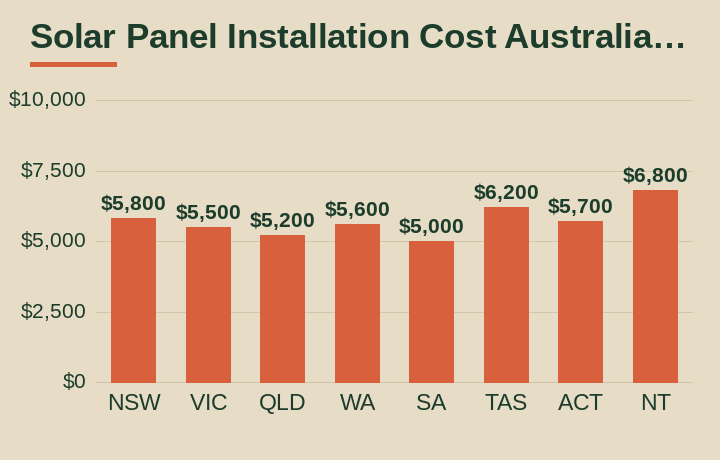
Prices below are post-rebate installed costs for a standard 6.6kW system with mid-range panels and a reputable inverter brand (think Fronius, SolarEdge or Sungrow, not the cheapest no-name option).
| State | Average Cost | Typical Range |
|---|---|---|
| NSW | $5,800 | $4,500 – $7,500 |
| VIC | $5,500 | $4,200 – $7,200 |
| QLD | $5,200 | $3,800 – $6,800 |
| WA | $5,600 | $4,300 – $7,000 |
| SA | $5,000 | $3,700 – $6,500 |
| TAS | $6,200 | $5,000 – $8,000 |
| ACT | $5,700 | $4,500 – $7,200 |
| NT | $6,800 | $5,500 – $9,000 |
Get free quotes from local providers in your area. No obligation.
Tasmania and the NT run higher because of lower installer competition, higher logistics costs and fewer accredited installers. A quote in Hobart’s North will look noticeably different to one in Brisbane’s inner suburbs. Not always because of the panels, often just because of margin and availability.
Solar Panel Installation Cost Calculator
Estimate the installed cost of a rooftop solar system by size and quality, after the federal STC rebate. AUD, 2026 Australian pricing.
Estimates are installed costs after the federal STC rebate (the upfront discount most installers apply automatically), based on Australian 2026 pricing. Prices vary by your state, roof type and pitch, switchboard upgrades, and whether you add a battery (batteries are not included here and typically add $8,000–$15,000). Some states offer additional rebates or interest-free loans. Always get 3 quotes from CEC-accredited installers.
Where the money actually goes
Understanding what drives these prices makes it easier to know where you can push back and where you can’t.
System size
Every additional kilowatt of capacity adds roughly $500–$900 to the installed cost. A 10kW system typically runs $7,000–$11,000; a 13kW system pushes $10,000–$14,500. The relationship isn’t perfectly linear, there are economies of scale in labour, since the installer is already on your roof regardless, but materials scale fairly predictably. Most households in Sydney’s inner west or Melbourne’s eastern suburbs are well-served by 6.6–10kW. Bigger isn’t always better if your roof orientation limits daily generation.
Panel brand and quality
This is where the real variation hides. Budget panels from lesser-known manufacturers might cut $800–$1,500 off the quote, but a panel that degrades faster or carries a warranty from a company with no Australian presence is a risk you’re carrying for 25 years. Tier-1 panels, think Jinko, LG (where stock remains), REC or Canadian Solar, cost more upfront. For a 6.6kW system, the difference between entry-level and premium panels is typically $600–$1,200. That’s real money, but so is a panel replacement in year eight. Use a solar monitoring system to catch any early underperformance regardless of which brand you choose.
Inverter type
The inverter converts DC from your panels into AC your home can use. A standard string inverter (Fronius, SMA, Goodwe) is the cheapest option and works fine if your roof has minimal shading. Expect $900–$1,500 for a quality 5kW string inverter. Microinverters or optimisers (Enphase, SolarEdge) add $800–$2,000 to the system cost but perform significantly better on shaded or multi-orientation roofs. If a salesperson pushes microinverters on an unshaded north-facing roof, ask them to justify the cost, it’s often unnecessary.
Roof type and complexity
A standard pitched metal or tile roof in reasonable condition adds nothing to the quote. Things get expensive with flat roofs (which need racking frames, add $500–$1,500), steep roofs, multi-storey homes, or heritage-listed properties. Tile roofs are slower to work on than metal; if your installer quotes the same price for both, they’re either absorbing the cost or cutting corners somewhere. A concrete tile roof in a two-storey Penrith home might add $600–$900 to labour compared to a single-storey colorbond in Geelong.
Battery storage
Adding battery storage is a separate financial decision to installing solar. The most common residential option in 2026 remains the Tesla Powerwall 3 (around $12,000–$15,000 installed) or a BYD HVM battery at $9,000–$13,000 depending on capacity. Smaller entry-level batteries like the Sungrow SBR run $7,500–$10,000. The payback period on batteries in most Australian states is currently 10–14 years, longer than many product warranties. Battery storage makes more financial sense in SA and QLD, where feed-in tariffs have dropped significantly and evening self-consumption matters more. If you’re primarily motivated by bill reduction, solar-only is usually the smarter first step. You can always add a battery later, and prices are still falling.
System size vs. cost: what you’re comparing
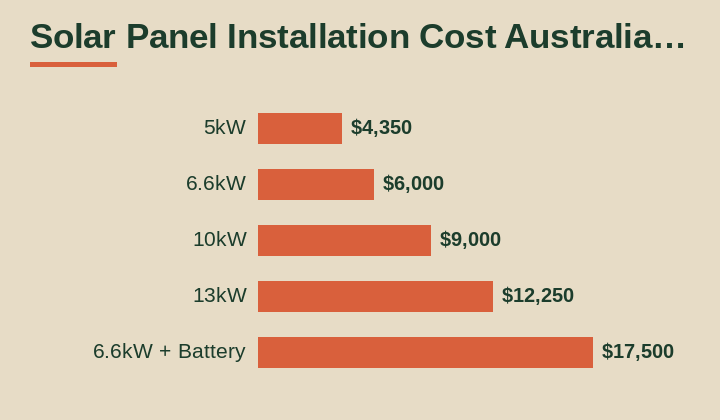
Here’s a practical breakdown so you can see how the numbers scale. These are mid-range post-rebate installed costs for a typical metro home in NSW or VIC in 2026.
| System Size | Estimated Installed Cost | Typical Daily Generation | Best Suited To |
|---|---|---|---|
| 5kW | $3,200 – $5,500 | 18 – 22 kWh | Small households, 1-2 people |
| 6.6kW | $4,500 – $7,500 | 24 – 30 kWh | Average family, most common choice |
| 10kW | $7,000 – $11,000 | 36 – 45 kWh | Large households, EV charging |
| 13kW | $10,000 – $14,500 | 47 – 60 kWh | High consumption, large roofs |
| 6.6kW + Battery | $13,000 – $22,000 | 24 – 30 kWh + storage | Evening users, blackout-prone areas |
The 6.6kW system dominates for a reason, it hits the sweet spot of cost, output and grid connection limits. That said, if you’re planning to charge an electric vehicle at home or run ducted air conditioning heavily, sizing up to 10kW often pays off within 5–7 years.
Questions to ask before you book
Is this quote fully installed, including grid connection?
Some quotes exclude the cost of the export meter, network application fee or electrical switchboard upgrade. These can add $300–$1,200 to the final bill. Ask specifically: “Is the quote I’m looking at the total amount I’ll pay, or are there extras after installation?”
Who actually does the installation, your team or a subcontractor?
Many solar companies quote the job and then subcontract the physical installation to whoever’s available. That’s not always bad, but it does mean the person on your roof isn’t accountable to the business that sold you the system. Ask who the accredited installer is and check their CEC accreditation directly at the Clean Energy Council website.
What’s the product warranty and who backs it in Australia?
A 25-year panel warranty from a company with no Australian office is functionally worthless. Push for the name of the Australian importer or distributor and ask: “If this panel fails in year 10, who do I call?” The answer tells you a lot about how seriously the installer takes post-sale accountability.
How does shading on my roof affect your design?
A competent installer will ask about trees, chimneys, neighbouring buildings and seasonal shade patterns. If they don’t ask and just quote on total roof area, that’s a red flag. Shading can cut system output by 20–40% in bad cases, which completely changes the payback calculation.
What feed-in tariff am I likely to get, and does that affect your recommendation?
Feed-in tariffs vary by retailer and state, and they’ve dropped considerably since the early solar days. In NSW, most sit at $0.05–$0.08 per kWh in 2026. That changes how aggressively you should size the system. An installer who recommends a 13kW system to a household on a low feed-in tariff without discussing self-consumption is prioritising their margin, not your return.
What happens if I have a problem three years after installation?
Ask directly. Good installers have a clear process: a service department, documented fault procedures and a realistic response time. Vague answers like “we’ll sort it out” aren’t good enough for a $6,000 purchase. You want a named contact and a service lead time.
How to bring the cost down
- Get at least three written quotes from CEC-accredited installers. Prices vary by $1,500–$3,000 for the same system. Don’t accept a verbal quote, you want panel brands, inverter model and warranty terms in writing.
- Book in the quieter months. May through July is slower for installers across most of Australia. You’ll get faster scheduling and sometimes a $300–$600 reduction just for filling a gap in their diary.
- Check state incentive programs before signing anything. Victoria’s Solar Homes Program and SA’s rebate rounds have eligibility requirements that can be voided if you’ve already contracted with an installer. Five minutes of research before signing could save $500–$1,400.
- Right-size the system. A 6.6kW system that’s well-positioned on a north-facing unshaded roof will outperform a 10kW system on a compromised roof. Don’t pay for capacity you can’t use. Check your last 12 months of electricity bills to understand your actual daily consumption before accepting any sizing recommendation. If you’re serious about tracking usage, a home energy monitor plugs into your switchboard and gives you the real picture.
- Delay the battery. If you’re budget-constrained, install the solar system first and add battery storage in 2–3 years when prices are likely to be lower. Most quality inverters are battery-ready from day one.
For more context on the ongoing cost of pet-free home maintenance, check out our breakdown of monthly pet food costs if you’re also managing household budget across multiple categories. And if you’re thinking about the broader financial picture of home ownership, MoneySmart’s household budget tools are genuinely useful for modelling solar payback alongside other costs.
FAQs about solar panel installation cost Australia
How much does a 6.6kW solar system cost in Australia in 2026?
A 6.6kW solar system costs $3,500–$7,500 installed in most Australian states after the federal STC rebate. NSW and VIC tend to sit in the $4,500–$7,000 range; QLD and SA are often slightly cheaper at $3,800–$6,500. The spread comes down to panel brand, inverter quality and installer margin.
What government rebates are available for solar panels in Australia?
The federal Small-scale Technology Certificate (STC) scheme is the main rebate, it’s applied at point of sale, so you never see the full pre-rebate price. It reduces the cost by $2,000–$4,500 depending on system size and your location zone. Some states run additional incentives: Victoria has the Solar Homes Program offering interest-free loans; SA has had rebate rounds but supply is inconsistent. Check the Clean Energy Council’s current incentives page for what’s active in your state.
Is it worth adding a battery to my solar system?
Honestly, the maths are tight in 2026. A Tesla Powerwall 3 runs $12,000–$15,000 installed, and most households take 10–12 years to recoup that through savings. If you’re on a good feed-in tariff or use a lot of power in the evening, the case is stronger. If your main goal is bill reduction, a larger solar system without a battery often delivers better return on investment.
How long does solar panel installation take?
Most residential installations take one day, sometimes two for larger systems. The actual roof work is usually 4–6 hours. The wait is in the paperwork, network approval, metering and grid connection can take 2–6 weeks after installation before you’re actually exporting to the grid.
Can I claim solar installation on my taxes?
Not directly for homeowners, solar panels on your primary residence aren’t tax-deductible. However, if you run a business from home or the property is an investment, you may be able to claim depreciation under the ATO’s small business depreciation rules. Check with your accountant rather than your solar salesperson on this one.
Solar panel installation cost Australia-wide is genuinely one of the better value-for-money home upgrades you can make in 2026, but only if you go in with realistic expectations, compare quotes properly and don’t let a pushy salesperson upsell you into a system or battery you don’t need yet. The fundamentals are solid. The savings are real. Just do the homework before you sign.
People Also Ask About Solar Panel Installation Cost Australia
Does solar panel installation cost more in regional Australia than in cities?
Yes, typically 10–20% more. Installers in regional areas have higher travel costs and fewer competitors to keep prices honest. A 6.6kW system that costs $5,500 in Brisbane’s inner suburbs might run $6,500–$7,000 in Toowoomba or Cairns Northern Beaches. Always get a local installer quote alongside a metro one if you can.
How much does it cost to add solar panels to an existing system?
Adding panels to an existing system costs $1,200–$3,500 depending on how many panels you’re adding and whether your inverter can handle the extra capacity. If the inverter needs upgrading, budget another $1,500–$2,500. It’s rarely a simple bolt-on, get an inspection first.
What’s the cheapest solar system you can legally install in Australia?
The minimum viable grid-connected solar system is around 2kW, which runs $2,000–$3,000 installed. But this is rarely worth doing, the economics only make sense for very small households or renters with limited roof access. Most installers won’t quote below 5–6kW because the margin isn’t there for them either.
Do solar panels affect home insurance premiums in Australia?
Sometimes, yes. Solar panels increase the rebuild value of your home, which can nudge premiums up slightly. Some insurers also want the installation certified and will ask for paperwork. Tell your insurer before and after installation, failing to declare can void a claim. It’s worth a five-minute phone call.
How long do solar panels actually last in Australian conditions?
Related Cost Guides
Recommended Products for Solar Panel Installation Cost Australia
If you’re tackling this yourself, here are some products from Amazon Australia that can help:
Most quality panels carry a 25-year performance warranty and will still produce 80–85% of their rated output at the end of it. Australian UV and heat do degrade panels faster than cooler climates, so panels facing west in Queensland will age faster than north-facing panels in Hobart. Inverters typically need replacing after 10–15 years, which adds $1,500–$2,500 mid-life.
This guide contains affiliate links. We may earn a small commission from qualifying purchases at no extra cost to you.