
Retaining wall cost australia honestly bounces around more than almost any other landscaping job. You can spend $180 per linear metre on a simple treated pine sleeper wall in Penrith, or you can spend $1,200+ on an engineered natural stone wall in Paddington or Mosman. Same function; wildly different price. According to the Australian Bureau of Statistics, residential landscaping and drainage work has seen consistent cost increases since 2022, and retaining walls are no exception.
Retaining wall cost australia typically runs $180–$450 per linear metre for timber or basic block walls, and $500–$1,200+ per linear metre for engineered concrete or natural stone. A standard 10-metre timber wall runs $2,500–$5,500 installed; a concrete block wall of the same length costs $6,000–$12,000. Material choice, wall height, soil conditions, and council permits are the biggest variables.
The average Australian homeowner getting a mid-range concrete block or timber sleeper wall installed in 2026 is looking at $280–$550 per linear metre all-in. That includes labour, drainage aggregate, and basic hardware. It does not include council permit fees, which can add another $500–$2,500 depending on your local council’s requirements and wall height.
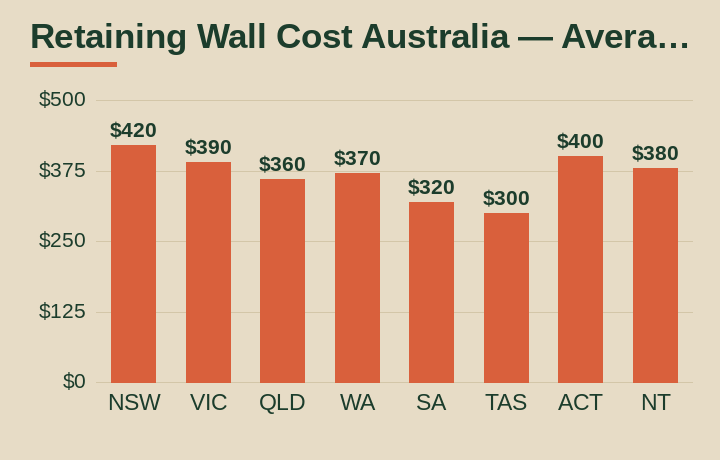
What this typically costs by state in 2026
Labour rates and material costs vary meaningfully across Australia. Sydney and Melbourne are consistently the most expensive markets. Perth and Darwin sit in the middle. Regional Queensland and SA tend to be cheaper if you can find a tradie who’s not booked out.
| State | Average Cost (per linear metre) | Typical Range |
|---|---|---|
| NSW | $420 | $220 – $1,100 |
| VIC | $390 | $200 – $980 |
| QLD | $360 | $190 – $900 |
| WA | $370 | $195 – $950 |
| SA | $320 | $180 – $820 |
| TAS | $300 | $175 – $750 |
| ACT | $400 | $210 – $1,000 |
| NT | $380 | $200 – $920 |
Get 3 free quotes from local providers in your area. No obligation.
Wall height changes everything. A 600mm timber sleeper wall is simple. A 1.5-metre wall in the same material needs deeper post holes, more structural support, and often an engineer’s sign-off. Labour on a 1.5-metre wall can be double that of a 600mm wall even though the linear metre count is identical. If you’re comparing quotes, always check whether they’re quoting the same height.
Soil conditions and site access are where budgets get blown. Rocky ground means excavation costs jump 30–60%. A narrow side access to a rear garden in a terrace suburb (think Balmain or Fitzroy) means materials get carried by hand, adding $800–$2,000 to labour. Sloping sites with poor drainage need extra ag-pipe, drainage aggregate, and sometimes geotextile fabric, all billed extra. Ask for an itemised quote and check whether drainage is included or added on.
Council permits and engineering reports can add meaningful cost. In NSW, retaining walls over 600mm near a boundary typically require a DA or complying development certificate. In Victoria, the threshold is often 1,000mm. A building permit runs $500–$1,500 depending on council. If the wall is over 1.2 metres or in an area with known soil issues, some councils require a geotechnical or structural engineer’s report, which adds another $800–$2,500. For a budget, this matters. Skip the permit where it’s required and you risk a removal order. Not worth it. MoneySmart’s home renovation advice consistently flags hidden approval costs as one of the most common budget surprises for homeowners.
Labour rates by location aren’t subtle. Around Sydney’s inner west and eastern suburbs, experienced landscaping crews charge $75–$110 per hour per person. In outer Brisbane or Adelaide’s southern suburbs, the same quality of work runs $55–$80 per hour. A two-person crew on a full-day job is $1,100–$1,760 in Sydney versus $880–$1,280 in Adelaide. Over a two-day build, that’s a $500–$1,000 difference in labour alone before materials enter the picture.
If you’re weighing up total pet ownership costs alongside home renovation budgets, it’s worth checking what ongoing expenses look like, including things like monthly pet food costs in Australia, to understand your full household spend before committing to a big landscaping project.
Questions to ask before you book
Is drainage included in your quote?
Ag-pipe, drainage aggregate, and geotextile fabric are often listed as exclusions in landscaping quotes. A wall without proper drainage will fail faster, regardless of material. If drainage isn’t explicitly included, ask what it costs and get it added. Typically $30–$80 per linear metre extra for a proper drainage run.
Will you handle the council permit, or is that on me?
Some contractors handle permits as part of their service; others quote wall construction only and leave the approval paperwork to you. The difference matters for your timeline and total cost. Permit preparation by a private certifier can add $800–$2,000 to the project if your contractor doesn’t include it. Clarify this upfront.
Do you provide an engineer’s certification if required?
Walls over 1 metre high, walls on steep slopes, or walls near structures often require structural sign-off in Australia. Ask whether the contractor can arrange this or whether you’ll need to engage a structural engineer separately. A structural engineer’s report costs $800–$2,500 depending on complexity.
What’s the footing depth and post specification?
For timber sleeper walls, ask what diameter posts they’re using and how deep they’re going into the ground. The common failure point is undersized posts at shallow depth. A 1-metre-high wall needs 100mm x 100mm posts at minimum 900mm–1,200mm depth. If a contractor is vague on this, that’s a red flag.
Is there a warranty on your work?
Reputable landscaping contractors offer 12–24 months on workmanship. Some offer longer on materials. Get it in writing. A wall that leans within 2 years has a drainage or footing problem, and you want recourse. Also check the contractor holds current public liability insurance, at least $5 million.
What’s excluded from this quote?
Ask them to name specifically what’s not included: rubbish removal, excavated soil disposal, permit fees, drainage materials, backfill. Landscaping quotes regularly exclude $500–$2,000 in site costs that clients don’t discover until the invoice arrives. Choice Australia’s tradie guide recommends always asking for a written exclusions list before signing off on any quote.
FAQs about retaining wall cost australia
Do I need council approval for a retaining wall in Australia?
In most states, retaining walls over 600mm–1,000mm in height require a development application or building permit. The exact threshold varies by council. NSW and QLD generally trigger approval requirements at 600mm for walls near boundaries; VIC is often 1,000mm. Check with your local council before starting any build, because unapproved walls can result in mandatory removal orders.
How long does a retaining wall last?
Treated pine sleeper walls typically last 15–25 years depending on soil drainage and moisture exposure. Hardwood sleepers can go 25–40 years. Concrete block, besser block, and engineered concrete walls can last 50+ years if built correctly with proper drainage. Stone walls are essentially indefinite if the base is sound. Drainage is the single biggest factor in longevity regardless of material. You can use drainage geotextile fabric behind the wall to reduce hydrostatic pressure and extend its lifespan significantly.
What’s the cheapest type of retaining wall in Australia?
Treated pine sleeper walls are generally the cheapest installed option at $180–$280 per linear metre for walls up to 1 metre high. For DIY, interlocking concrete blocks (like Baines or Lego-style garden blocks) from Bunnings cost as little as $60–$120 per linear metre in materials only, though they’re only suitable for low, non-load-bearing situations.
Can I build a retaining wall myself in Australia?
Yes, for walls under 600mm you can legally DIY in most states without a permit. Treated pine sleeper walls and interlocking block walls are the most manageable for owner-builders. Anything over 1 metre, or any wall near a boundary, on a slope, or retaining significant soil load, should be built by a licensed contractor. Getting it wrong means wall failure, which can damage neighbouring property and create legal liability. If you do go DIY, a manual post hole digger makes setting timber posts considerably easier.
How much does a 10-metre retaining wall cost in Australia?
A 10-metre treated pine sleeper wall at 800mm–1,000mm height costs around $2,500–$4,500 installed. The same length in concrete block runs $6,000–$11,000 depending on height and complexity. Natural stone at 10 metres can be $12,000–$20,000 or more. These estimates include labour, drainage aggregate, and basic hardware but exclude council permit fees.
How to bring the cost down without cutting corners
- Get three quotes minimum. Landscaping quotes vary 30–40% on identical jobs. On a $10,000 wall, that spread saves you $3,000–$4,000. Don’t accept the first number you’re given.
- Choose treated pine if aesthetics are secondary. It does the same structural job as hardwood or stone for walls under 1 metre, at roughly half the cost. Paint or stain it if you want a better look.
- DIY low walls where permitted. Interlocking concrete blocks from Bunnings at $60–$120 per metre in materials are genuinely suitable for garden edging walls under 600mm. No permit, no contractor.
- Do your own site prep. Clear the vegetation, remove debris, organise a skip bin. You’re saving $300–$800 in labour before the contractor even starts the job.
- Book in autumn or winter. Landscapers are far busier from September through November. Quotes tighten up considerably when they’re not turning away work. A quieter June booking can save 10–15% compared to peak spring rates.
- Bundle with other outdoor work. If you’re also doing garden beds, paving, or drainage, combining it into one job means a single site mobilisation and often a better rate on the whole lot. Contractors sometimes discount $500–$1,500 on bundled jobs just to keep the crew busy.
- Don’t skip drainage. The $400–$800 you spend on proper ag-pipe and drainage aggregate is the difference between a 20-year wall and a 5-year rebuild. This is the one area not to economise.
If you’re managing a broader renovation or landscaping budget, it helps to see these projects alongside other property-related costs. For those with pets involved in the household, understanding dog walking costs in Australia or dog daycare pricing gives you a fuller picture of where money goes. And if you’re making decisions about which improvements actually add value, the same discipline applies whether you’re spending on pets or property.
For total home project budgeting, the Housing Industry Association publishes annual data on residential construction costs, which is useful context for understanding why landscaping labour rates have moved the way they have since 2023.
The bottom line on retaining wall cost australia: expect to pay $180–$280 per linear metre for a no-frills treated pine build, $350–$700 for concrete block, and $700–$1,200+ for stone or engineered concrete. Get three quotes, check what’s excluded, confirm permit requirements with your council before signing anything, and budget an extra 10–15% for site-specific surprises. Walls that are done properly once don’t need to be done again for 20–50 years. That’s worth spending a bit more upfront to get right.
People Also Ask About Retaining Wall Cost Australia
How much does a limestone retaining wall cost in Australia?
Limestone retaining walls cost $400–$900 per linear metre installed depending on the type of limestone (reconstituted vs natural), wall height, and site access. Natural limestone is at the higher end; reconstituted limestone blocks (popular in WA and SA) sit around $400–$650/m. They’re durable and look good but cost roughly double a treated pine sleeper wall.
Is a gabion wall cheaper than a concrete retaining wall?
Gabion walls (wire cages filled with rock) typically cost $350–$700 per linear metre installed, which is cheaper than poured concrete ($600–$1,200/m) but more expensive than timber sleepers. They’re a decent mid-range option, drain well naturally, and have an industrial aesthetic that suits some properties. The wire cage can eventually rust, so stainless or galvanised mesh is worth the extra cost.
Do retaining walls add value to a property in Australia?
A functional, well-built retaining wall can add value by making sloped land usable for gardens, entertainment areas, or vehicle parking. However, buyers also look for quality: a crumbling or leaning wall will be flagged in building inspections and can reduce sale price or require a price reduction. The value-add depends entirely on the wall being well-built and properly drained.
Who is responsible for a retaining wall between two properties in Australia?
Retaining wall responsibility between neighbours is a common dispute. Generally, the party whose land is being retained (i.e. the higher ground) is responsible for maintaining the wall. But local council rules and specific easements can change this. If a boundary wall fails and damages a neighbour’s property, legal liability can follow. The Dividing Fences Act in most states doesn’t cover retaining walls, so disputes often end up in NCAT or VCAT.
How long does it take to build a retaining wall in Australia?
Related Cost Guides
Recommended Products for Retaining Wall Cost Australia
If you’re tackling this yourself, here are some products from Amazon Australia that can help:
A typical 10-metre timber sleeper wall takes 1–2 days for a two-person crew once materials are on site. A concrete block wall of similar length takes 2–4 days due to footing curing time. Natural stone walls take longer, often 3–5 days, because of the fitting and placement work involved. Council permits, if required, can add 2–8 weeks before work even begins.
This guide contains affiliate links. We may earn a small commission from qualifying purchases at no extra cost to you.