
Concrete driveway cost australia runs from $65 to $150 per square metre in 2026, but that range is almost meaninglessly wide until you factor in what you’re actually getting. According to the Housing Industry Association, residential concrete work remains one of the most consistently quoted renovation items in Australia, and one of the most variable. A plain broom-finish slab in Toowoomba is a very different proposition to a double exposed aggregate driveway in Sydney’s inner west.
Concrete driveway cost Australia sits between $65 and $150 per square metre in 2026. A standard double driveway (around 50m²) typically lands between $4,500 and $9,000 installed. Decorative finishes like exposed aggregate or stencilled concrete push prices to $100–$150/m² or more.
This guide breaks down real prices by state, finish type and site complexity. No fluff.
What you’ll typically pay across Australia in 2026
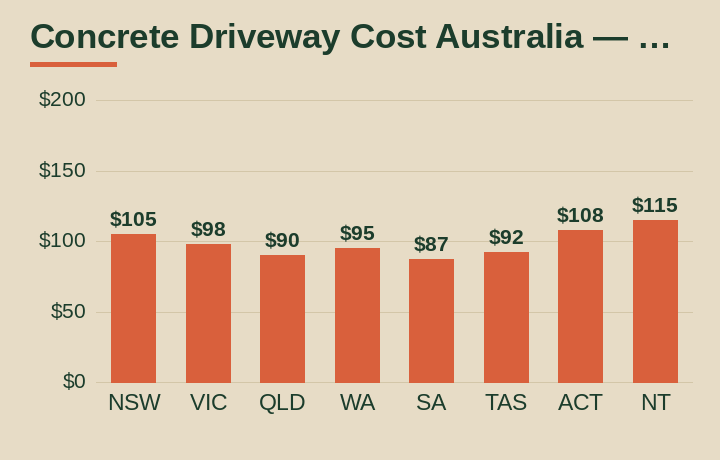
The state you’re in matters. Labour costs, concrete supply chains and permit requirements all vary, which means a driveway that costs $7,000 in Brisbane might run $9,500 for the same spec in Sydney. Here’s the current picture by jurisdiction for a standard plain concrete driveway installation:
| State | Average Cost (per m²) | Typical Range (per m²) |
|---|---|---|
| NSW | $105 | $80 – $145 |
| VIC | $98 | $75 – $135 |
| QLD | $90 | $70 – $125 |
| WA | $95 | $72 – $130 |
| SA | $87 | $65 – $115 |
| TAS | $92 | $68 – $120 |
| ACT | $108 | $82 – $148 |
| NT | $115 | $88 – $155 |
Get 3 free quotes from local providers in your area. No obligation.
Exposed aggregate is the most popular choice in suburban Australia for a reason. It’s slip-resistant, hides dirt and tyre marks well, and sits in a reasonable price range. If you’re only replacing a rear or side driveway that nobody sees, plain broom finish does the job without the premium. Stencilled concrete looks great fresh but needs more maintenance to keep the sealer in good shape.
Where the money actually goes
Site preparation and ground conditions
This is the factor most quotes gloss over. Rocky ground, tree roots or poor drainage can add $1,500–$3,500 to the prep cost before a drop of concrete is poured. A level block in Geelong with a clean gravel base is a completely different job to a sloped, tree-rooted site in Hobart’s North. Always ask your concreters what the prep will involve once they inspect the site, the initial quote often assumes easy conditions.
Slab thickness
Standard residential driveways are quoted at 100mm. If you regularly park a caravan, boat trailer or dual-cab ute, 125mm is worth the extra. The price difference is roughly $8–$14/m² for that additional 25mm of concrete. On a 50m² driveway, that’s $400–$700, cheap insurance against cracking under load.
Reinforcement (mesh vs rebar)
Basic residential slabs typically use steel mesh (SL72 or SL82). If your soil is reactive clay, common in parts of Melbourne’s outer east and Adelaide’s suburbs, your concreters may recommend rebar (steel bar reinforcement) instead. Rebar adds roughly $15–$25/m² but provides far better crack resistance in ground that moves seasonally. Choice Australia notes that skipping reinforcement on reactive soils is one of the most common and costly mistakes homeowners make in residential construction.
Access and site logistics
Narrow access between houses, sloped blocks or tight city lots mean the ready-mix truck can’t get close. The concreters then use a concrete pump, which adds $600–$1,400 to the job. In suburbs like Surry Hills, Fitzroy or Fremantle’s heritage streets, this is almost guaranteed. In suburban Cairns Northern Beaches or outer Perth, you’ll rarely pay it.
Council permits and kerb crossings
Connecting your driveway to the street requires a council crossing permit in virtually every Australian council area. This costs $150–$500 for the permit itself. If you need a new or widened kerb crossing (the concrete ramp from the gutter to your property line), that’s an additional $800–$2,500 depending on the council. Some councils do the crossing work themselves; others let your concreters do it. Check before you sign a contract.
Questions to ask before you book
Is the quote fixed price or a rough estimate?
This is the most important question you can ask. Some concreters quote a per-m² rate and then add “subject to site conditions.” That phrasing can turn a $6,000 job into an $8,500 one. Push for a fixed price once they’ve inspected the site in person.
What’s included in site preparation?
Does the quote include removal of old concrete or asphalt? What about base compaction, grading and edge forming? These can each add $800–$2,000 if they’re not priced in. Get it itemised in writing.
What concrete mix strength are you using?
For driveways, you want minimum 25MPa (megapascals). Some cheaper quotes use 20MPa to cut costs. It’s a meaningful difference in durability. A good concreters will tell you without being asked; a less experienced one will change the subject.
Who actually pours the concrete, you or a subcontractor?
Some concreting companies quote the job and then send a subcontractor crew who may not have seen the site. Ask directly: “Will you be on site during the pour, or will it be a sub?” The answer tells you a lot about accountability if something goes wrong.
Does the quote include saw-cutting control joints?
Control joints are the planned saw cuts that prevent random cracking. They should be cut within 12–24 hours of the pour. Some quotes leave them out. Without them, you’re rolling the dice on your slab cracking across the middle. It typically adds $3–$8/m² to include them. Worth every cent.
What’s the warranty, and is it in writing?
Most professional concreters offer a 5–7 year structural warranty. Get it in writing. Ask specifically what voids it (e.g. heavy vehicle loading beyond spec). Verbal warranties are worth nothing if they move interstate.
Common mistakes that cost homeowners money
- Accepting the first quote: Prices honestly vary by 30–40% between operators for the same job. One quote is not enough data to commit to a $7,000 spend.
- Ignoring drainage design: A driveway that slopes toward the house instead of away from it causes waterproofing problems that are expensive to fix later. Make sure your concreters discuss fall direction and stormwater disposal before they start forming up.
- Choosing finish based on looks alone: Polished and honed concrete looks stunning but shows every oil stain and requires more upkeep. Exposed aggregate is genuinely lower-maintenance for a working driveway.
- Skipping the sealer: An unsealed concrete driveway stains faster, absorbs moisture and degrades sooner in freeze-thaw conditions (relevant for ACT and alpine VIC). Sealing every 3–5 years is the single best maintenance step you can take.
If you’re also thinking about ongoing home service costs or planning other property improvements, it’s worth understanding how trades price their work more broadly. For example, the same labour-and-materials pricing structure applies to things like professional services and ongoing maintenance costs where getting multiple quotes is equally important.
You can use an expansion joint foam backing rod along boundary edges before the pour, it’s a simple step that helps the slab flex without cracking against walls or existing structures.
According to MoneySmart, home renovation projects consistently go over budget when homeowners don’t account for site prep, permits and contingencies. Budget an extra 15% on top of any concrete driveway quote as a contingency. You’ll probably need at least some of it.
For related home ownership costs, it’s also worth checking what other recurring household expenses look like if you’re planning a renovation budget. And if you’re weighing up the full picture of home costs, the monthly cost breakdowns across different categories on this site can help you plan.
Frequently Asked Questions
How much does a concrete driveway cost per square metre in Australia?
Plain concrete runs $65–$90/m², exposed aggregate sits at $90–$130/m², and stencilled or coloured concrete comes in at $100–$150/m² or above. These are installed prices including labour and materials.
How long does a concrete driveway last?
A properly installed concrete driveway lasts 25–40 years with basic maintenance like sealing every 3–5 years and prompt crack repair. Cheap mixes or skipped site prep cuts that lifespan significantly.
Do I need a permit to pour a concrete driveway in Australia?
It depends on your council. Most residential driveways connecting to the street require a council permit and a crossing approval, typically $150–$500. Skip this and you risk being asked to remove it at your own cost.
Is concrete or asphalt cheaper for a driveway?
Asphalt is cheaper upfront at $25–$50/m², but it needs resealing every 3–5 years and has a shorter lifespan. Concrete costs more initially but wins on total cost over 20+ years for most Australian climates.
How long does concrete take to cure before I can drive on it?
You can walk on it after 24 hours and park a normal car after 7 days. Full structural strength takes around 28 days. Don’t let heavy vehicles like trucks or caravans on it before then.
People Also Ask About Concrete Driveway Cost Australia
Can I pour a concrete driveway myself in Australia?
Technically yes for small sections, but a full driveway is genuinely hard to DIY well. Concrete needs to be ordered in a ready-mix truck, poured and finished within about 90 minutes, and levelled properly before it sets. One bad pour and you’re paying for removal. Most people underestimate how physically demanding and time-critical it is.
What thickness should a concrete driveway be in Australia?
Standard residential driveways should be 100mm (10cm) thick for normal passenger vehicles. If you’re parking a caravan, boat trailer or heavy SUV regularly, ask for 125mm. Going thinner to save money is a false economy, thin slabs crack faster under load.
How much does it cost to remove an old concrete driveway in Australia?
Demolition and removal of an old concrete driveway typically costs $50–$80/m² on top of the new installation price. A 50m² double driveway removal can add $2,500–$4,000 to the total job. Some concreting companies bundle this in; always ask.
Does a concrete driveway add value to a home in Australia?
A neat, well-finished concrete driveway does improve street appeal and can contribute to resale value, particularly in suburban markets. Exposed aggregate finishes tend to look more premium to buyers. According to realestate.com.au insights, street appeal is one of the most consistently cited factors in buyer first impressions.
How do I stop my concrete driveway from cracking?
Control joints (saw cuts at regular intervals) are the main crack-prevention measure, they give the concrete somewhere planned to expand and move. Good site prep, correct concrete mix strength (minimum 25MPa for driveways), and proper curing all reduce cracking risk. Sealing every 3–5 years also slows moisture damage.
Related Cost Guides
Recommended Products for Concrete Driveway Cost Australia
If you’re tackling this yourself, here are some products from Amazon Australia that can help:
If you’re comparing concrete driveway cost australia with other home improvement expenses, the key takeaway is this: get a fixed price from a concreters who inspects the site in person, factor in permits and site prep, and don’t choose a finish based purely on the cheapest per-m² rate. The difference between a driveway that lasts 35 years and one that’s cracking in eight often comes down to decisions made at the quoting stage, not the pour.
This guide contains affiliate links. We may earn a small commission from qualifying purchases at no extra cost to you.