
Reptile licence cost South Australia is something a lot of people research after they’ve already fallen in love with a beardie at a friend’s place or spotted a carpet python at a reptile expo. The licence fees themselves aren’t enormous, but the full cost picture is more involved than a single annual payment. This guide covers what you’ll actually pay in 2026, what the different categories mean, and where people commonly trip up.
Reptile licence cost South Australia starts at $63.50 per year for a basic Category 1 basic reptile keeper licence. Higher categories covering pythons, monitors and venomous species run $108 to $195 or more annually. These fees are paid to the SA Department for Environment and Water, and you'll need separate fees for each licence category you hold.
Prices updated July 2026 from current Australian sources.
| Permit category | Annual fee | What it covers |
|---|---|---|
| Category 1 (Basic) keeper | $63.50 / year | Basic, beginner-friendly reptiles |
| Higher categories | $108 to $195+ / year | Pythons, monitors and venomous species |
Fees are paid to the SA Department for Environment and Water. You need a separate fee for each licence category you hold, and the permit fee does not include the enclosure, heating or the animal.
Sources (July 2026): SA Dept for Environment and Water, Keep and sell native animals, SA Dept for Environment and Water, Keeping categories
South Australia requires any person keeping a native reptile to hold a current reptile keeper licence issued under the National Parks and Wildlife Act 1972, administered by the SA Department for Environment and Water (DEW). You can’t buy a bearded dragon on Saturday and apply for a licence on Monday. You need the licence first. That timing catches a lot of first-time keepers off guard.
What you’ll typically pay for a reptile keeper licence in SA
SA structures its reptile keeper licences by category, with each category covering a progressively more complex group of species. The fees below reflect 2026 rates. DEW reviews these annually, so small adjustments are common.
| State | Average Cost | Typical Range |
|---|---|---|
| NSW | $110 | $55 to $200 |
| VIC | $50 | $40 to $80 |
| QLD | $93 | $56 to $150 |
| WA | $95 | $60 to $160 |
| SA | $108 | $63.50 to $195 |
| TAS | $75 | $50 to $120 |
| ACT | $90 | $60 to $145 |
| NT | $60 | $40 to $110 |
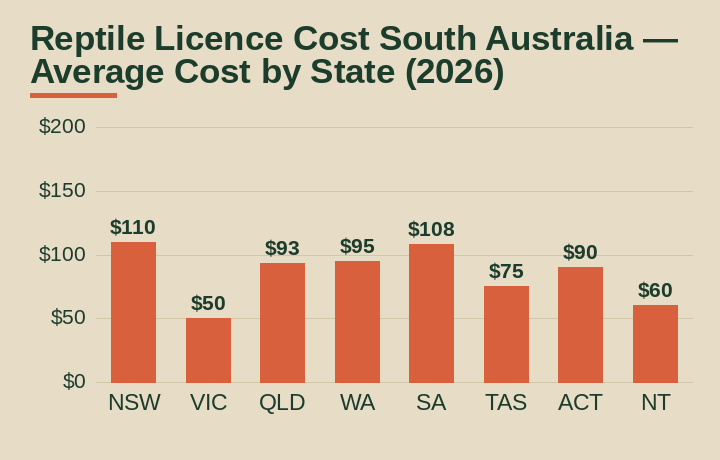
SA sits roughly in the middle of the national range. Victoria is notably cheaper for entry-level licences, while NSW and WA can run higher for higher-category species. If you’re comparing before a potential interstate move, these differences matter over a five-year keeping career.
If you want a children’s python and a bearded dragon, you’ll need both a Category 1 and a Category 2 licence. That’s $63.50 + $108 = $171.50 per year. A lot of keepers don’t plan for this when they start and get hit with the upgrade cost midway through their first year.
Where the money actually goes (and why prices vary)
Licence category and species complexity
The biggest fee driver is simply which category you hold. A Category 1 licence at $63.50 reflects lower administrative oversight, while Category 3 and 4 licences involve more scrutiny, potential facility inspections, and greater record-keeping obligations. A keeper with coastal carpet pythons in Glenelg North is subject to considerably more regulatory attention than someone with two bearded dragons in Mawson Lakes.
Multiple category holdings
Each category is a separate annual fee. A keeper who holds Category 1, 2 and 3 simultaneously is paying $63.50 + $108 + $155 = $326.50 per year in licence fees alone, before any animal or husbandry costs. It adds up faster than people expect. Be deliberate about which categories you actually need.
Concession eligibility
SA does offer concession pricing at roughly 50% of the standard rate for eligible holders (pensioner concession card, health care card). A Category 1 concession holder pays approximately $31.75 per year. If you’re eligible and don’t claim the concession, you’re simply leaving money on the table. Check the DEW fee schedule at application time.
Late renewal penalties
This is the one that catches experienced keepers, not just beginners. If your licence lapses and you continue keeping reptiles, you’re technically unlicensed. Re-application can involve additional administrative fees of $30 to $50, and in some cases DEW requires a fresh enclosure inspection. Set a reminder six weeks before expiry. Worth doing.
Enclosure compliance costs
DEW can inspect your premises as part of a new application or a complaint follow-up. A non-compliant enclosure doesn’t just delay your approval, it can trigger a failed inspection fee and require you to resubmit. A compliant starter enclosure costs more upfront than a cheap DIY setup, but it won’t cost you the application process. Enclosures for Category 3 species (like large monitors) need to meet considerably higher security standards, which adds real cost.
Questions to ask before you book (or apply)
What category licence do I actually need for the species I want?
Don’t assume. The SA DEW species list is updated periodically, and a species that was Category 1 a few years ago might have moved. Check the current DEW schedule before applying, not a forum post from 2022. Getting this wrong means a wasted application fee and a delay of 4 to 8 weeks.
Does the seller have a current SA keeper licence?
You should only acquire reptiles from a licensed keeper or licensed dealer. Ask to see their licence number and request a transfer notice (Form N7 or equivalent). If they can’t provide this, walk away. Acquiring an animal from an unlicensed source puts your own licence at risk.
Has the enclosure been set up and verified as compliant before applying?
DEW can inspect before approving your application. Having your enclosure ready and correctly set up speeds things up. Ask your supplier or a herpetological society member to check it against DEW’s published requirements before you submit, not after.
Are there any ongoing record-keeping requirements I need to prepare for?
SA licence holders must maintain acquisition and disposal records for all animals. Ask DEW what format is acceptable and whether digital records are permitted. Getting a system in place from day one beats scrambling to reconstruct records later.
What happens if I want to rehome or sell an animal later?
You can only transfer a licensed reptile to another licensed keeper in SA. Ask the person you plan to eventually sell to whether they hold a current licence for the relevant category. A transfer to an unlicensed person is an offence, even if you do it in good faith.
Is the species I want legal to keep in SA at all?
Not every reptile is on the SA permitted list. Some species are restricted regardless of licence category. If you’ve seen a species at an expo interstate, it may not be legally keepable in SA. Verify with DEW directly, or check against the Australian Veterinary Association’s resources on exotic and native species keeping.
Recommended Products for Reptile Licence Cost South Australia
If you’re tackling this yourself, here are some products from Amazon Australia that can help (these are affiliate links):
Common mistakes that cost SA reptile keepers money
- Buying the animal before the licence arrives. You cannot legally possess the animal until the licence is current. People buy, then apply, and end up in a grey area that can attract fines. The wait is annoying but the alternative is worse.
- Applying for the wrong category. A Category 1 application won’t cover a children’s python. If you’re caught keeping a Category 2 species on a Category 1 licence, you’re unlicensed for that animal, full stop. Fines can hit $2,500 or more per animal.
- Ignoring the transfer notice requirement. Every time a reptile changes hands between licensed keepers, a transfer notice is required. Many private sales skip this step. DEW can and does audit keeper records.
- Letting the licence lapse without noticing. Annual renewal sounds obvious, but it slips. Use calendar alerts. Also note that annual pet health costs like vaccinations are worth scheduling at the same time to keep all renewals on your radar.
Reptile licence cost South Australia is genuinely modest compared to the overall cost of keeping reptiles properly. The $63.50 to $195 annual fee is rarely the budget-breaker. What trips people up is the combination of application timing, category errors, and the upfront enclosure and equipment spend. MoneySmart’s pet ownership guide is worth reading before committing to any pet, reptiles included. If you’re also considering other pet expenses, our breakdowns on dog boarding costs, pet vaccination fees, and mobile vet costs give a broader picture of what responsible pet ownership actually runs in Australia. Get the licence sorted first, get the enclosure right, and the rest follows.
Frequently asked questions about reptile licence cost South Australia
How much does a reptile licence cost in South Australia?
A Category 1 basic reptile keeper licence costs $63.50 per year. Category 2 licences (covering species like blue-tongue lizards and some pythons) are around $108 annually. Category 3 and above, which cover larger pythons, monitors and some elapid snakes, run $155 to $195 or more. These are the standard 2026 fee tiers set by SA’s Department for Environment and Water.
Can I keep a bearded dragon without a licence in SA?
No. Bearded dragons (Pogona vitticeps) are native animals under the National Parks and Wildlife Act and require a reptile keeper licence in South Australia. You’ll need at minimum a Category 1 licence before acquiring one legally.
How long does it take to get a reptile licence in SA?
Processing times through DEW can take 4 to 8 weeks, sometimes longer during peak periods. Apply well before you plan to purchase your animal, keeping a reptile without a current licence is an offence and fines can exceed $2,500.
Can I keep venomous snakes on a basic SA reptile licence?
No. Venomous elapid snakes require a higher-category licence (Category 4 or above in SA) and are generally restricted to experienced keepers or professional herpetologists. The application process for these categories is more involved and may require demonstrated experience or facility inspections.
Do I need to renew my reptile licence every year in SA?
Yes. SA reptile keeper licences are issued annually and must be renewed before expiry. Failing to renew on time means you’re technically keeping wildlife unlicensed, which carries significant penalties. Set a calendar reminder about 6 weeks before your expiry date to allow processing time.
People Also Ask About Reptile Licence Cost South Australia
What reptiles can I keep on a Category 1 licence in South Australia?
Category 1 in SA covers a range of common, hardy species including bearded dragons, shingleback lizards (bobtails), eastern bluetongue lizards, and some smaller skinks. It’s the entry-level licence and the most affordable at $63.50 per year. The full species list is published by SA’s Department for Environment and Water and is updated periodically.
What happens if I keep a reptile without a licence in South Australia?
Keeping a native reptile without a current licence in SA is an offence under the National Parks and Wildlife Act 1972. Penalties can reach several thousand dollars per animal, and the reptile may be seized. Inspectors from DEW do conduct compliance checks, including following up on private sales and social media listings.
Do I need a separate licence for each reptile I own in SA?
No, your reptile keeper licence in SA covers all animals of the permitted category (or categories) you hold. However, you must maintain accurate records of every animal you acquire, transfer or lose, including dates, species, and source. The licence is category-based, not per-animal.
Can I take my licensed reptile interstate from South Australia?
Interstate movement of reptiles requires permits in both the state you’re leaving and the state you’re entering. A SA keeper licence doesn’t automatically allow movement into Victoria or Queensland. You’ll need to check the specific interstate permit requirements with each state’s wildlife authority before travelling. See our notes on interstate pet transport costs if you’re planning a move.
Is there a junior or concession discount on SA reptile keeper licences?
SA does offer concession pricing for eligible holders (Centrelink health care card holders, pensioners). The concession rate is generally around 50% of the standard fee, bringing a Category 1 licence down to approximately $31.75 per year. Check the DEW fee schedule directly when applying as rates are reviewed annually.
Related Cost Guides
This guide contains affiliate links. We may earn a small commission from qualifying purchases at no extra cost to you.