Groodle prices are one of those searches where the range is genuinely enormous, and the gap between $1,500 and $5,500 isn’t random. According to the Animal Medicines Australia 2025 Pets in Australia report, dog ownership continues to grow, and hybrid breeds like the Groodle remain among the most popular choices for Australian families. That demand keeps prices firm.
Groodle price Australia sits between $1,500 and $5,000 for a puppy from a registered breeder, with most buyers paying $3,000 to $4,000 for a standard or medium Groodle. Toy and miniature Groodles from health-tested lines regularly hit $4,500 to $5,500. Avoid anything under $1,200, it almost always signals a puppy mill or untested breeding stock.
Prices updated July 2026 from current Australian sources.
| Source | Typical price | Notes |
|---|---|---|
| Standard or medium Groodle (registered breeder) | $3,000 to $4,000 | What most buyers pay |
| Toy and miniature (health-tested lines) | $4,500 to $5,500 | |
| Overall range | $1,500 to $5,000 |
Avoid anything under $1,200, it almost always signals a puppy mill or untested breeding stock. Health testing of the parents is the thing to ask about.
Sources (July 2026): Dogzonline, ANKC registered breeder listings, PetRescue, Adopt a pet, Animal Medicines Australia, Pets in Australia 2025
Most buyers land somewhere between $3,000 and $4,200 for a standard-size Groodle from a breeder who does basic health testing. The $5,000+ end is real but earns it, usually through multigenerational health panels, MDBA registration and a waiting list measured in months. The sub-$1,500 end is where things get murky.
What You’ll Typically Pay in 2026
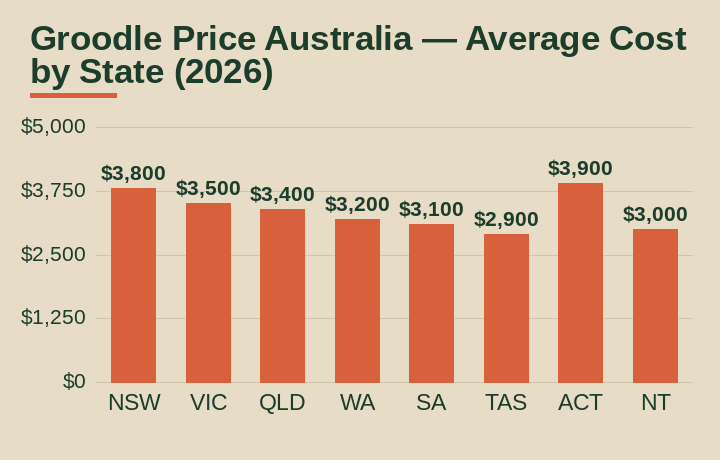
Prices vary significantly by size, generation, state and breeder reputation. Here’s a realistic overview. Toy Groodles are the most expensive category nationwide. Standard Groodles offer the best value per dog in most states. The ACT and NSW premiums reflect higher breeder operating costs and demand from city buyers.
| State | Average Cost | Typical Range |
|---|---|---|
| NSW | $3,800 | $2,500 to $5,500 |
| VIC | $3,500 | $2,200 to $5,200 |
| QLD | $3,400 | $2,000 to $5,000 |
| WA | $3,200 | $1,800 to $4,800 |
| SA | $3,100 | $1,800 to $4,500 |
| TAS | $2,900 | $1,500 to $4,200 |
| ACT | $3,900 | $2,800 to $5,500 |
| NT | $3,000 | $1,800 to $4,500 |
These are purchase prices only. They don’t include transport (relevant if your preferred breeder is interstate), microchipping, initial vet check or council registration. Pet vaccination costs in Australia add another $150 to $350 in the first year alone, and that’s before you factor in desexing.
What’s Included and What Costs Extra
Reputable breeders bundle a surprising amount into the purchase price. Budget sellers often strip these out, which is part of how they reach a lower headline number. Before you compare two prices, check what’s actually in the box.
| What’s Typically Included | Common Extras (Not Always Included) |
|---|---|
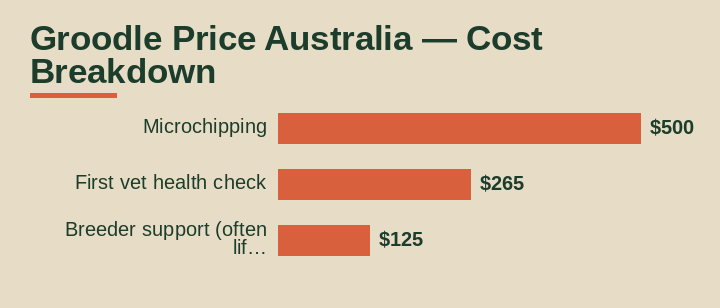
| Microchipping | Interstate transport ($300 to $700) |
| First vet health check | Puppy school enrolment ($180 to $350) |
| Vaccination record (C3 or C5) | Pet insurance first month |
| Desexing contract or deposit | Starter kit (collar, lead, crate) |
| Breeder support (often lifetime) | Council registration fee ($50 to $200) |
| Basic health guarantee (usually 2 years) | DNA or extended health panel results |
Some premium breeders include a puppy pack with food samples, a vet referral letter and a toy or blanket that smells like the litter. Sounds trivial, but the blanket genuinely helps with the first few nights. Budget sellers skip all of it. The difference in total first-year cost between a “cheap” and “expensive” Groodle often narrows once you add up what you’d otherwise buy separately.
Speaking of first-year budgets, don’t forget dog desexing costs in Australia, which run $250 to $600 depending on size and state. Most breeders require it under contract.
Where the Money Actually Goes
Understanding what you’re paying for makes the premium breeders easier to evaluate. Each of these factors has a real dollar impact.
Size and generation
Standard Groodles (25 to 35 kg) are consistently the cheapest size category, $2,000 to $4,000 in most states. Mini Groodles (10 to 15 kg) sit $500 to $1,000 higher. Toy Groodles (under 7 kg) are the outlier: $4,500 to $6,000 is common from health-tested breeders in Sydney and Melbourne, because the breeding is harder to get right and demand from apartment dwellers is intense.
Generation matters too. An F1 Groodle (first-generation cross) from a well-regarded Queensland breeder might be $2,800. An F1b or multigenerational from the same state, with documented low-shedding history, runs $3,800 to $4,500. The predictability of coat type and allergy-friendliness is what buyers are paying for.
Health testing depth
A breeder who does only basic vet checks might price at $2,000 to $2,500. A breeder running full panels, OFA hip and elbow certifications, progressive retinal atrophy DNA tests, heart clearances and von Willebrand’s disease panels on both parents, typically charges $3,500 to $5,000. That testing costs the breeder $800 to $1,500 per breeding pair per year. It’s not padding; it’s a genuine cost passed on to buyers.
The Australian Veterinary Association has noted that genetic health issues in poorly-bred dogs are a growing driver of expensive vet bills. Paying more upfront for tested lines genuinely reduces the odds of a $6,000 hip surgery at age four.
Breeder location and operating costs
A breeder running a small kennel in rural Victoria or regional Queensland has lower overheads than one operating near Sydney’s inner suburbs. That shows in pricing. An equivalent puppy from a Toowoomba breeder might be $3,000; the same quality from a breeder in the Hills District of Sydney is $3,800 to $4,200. Neither is ripping you off. Rent, feed and vet costs are simply different.
If you’re buying from interstate, factor in interstate pet transport costs of $300 to $700. Sometimes the cheaper out-of-state puppy ends up costing the same as buying local.
Demand and waiting lists
Groodles are still one of Australia’s most searched dog breeds in 2026. Quality breeders rarely discount because they don’t need to, demand exceeds supply. A 12-month waiting list is normal for the top breeders in NSW and VIC. Buyers in a hurry often end up paying more for whoever has puppies available now, which isn’t always the safest choice.
Coat colour and markings
This one’s partly market-driven. Apricot and cream Groodles attract a 10 to 15% premium over chocolate or black in some breeder pricing. Phantom or parti-coloured Groodles can command $500 to $800 extra. There’s no health or temperament basis for this, it’s purely aesthetic demand. If colour isn’t important to you, asking specifically for non-premium colours can save real money.
Recommended Products for Groodle Price Australia
If you’re tackling this yourself, here are some products from Amazon Australia that can help (these are affiliate links):
Questions to Ask Before You Book
Can I see the health certificates for both parents?
This is the single most important question. Ask for OFA or PennHIP results for hips, DNA test results for breed-specific conditions, and current eye clearances. A reputable breeder will have these on file and share them without hesitation. Vague answers like “the vet says they’re healthy” aren’t the same thing.
What generation is this litter and why?
Ask the breeder to explain the cross and what that means for coat type and shedding. If they can’t tell you whether it’s F1, F1b or multigenerational, that’s a gap in knowledge that matters for allergy households. The answer also tells you a lot about how seriously they approach their breeding programme.
How many litters does each female produce per year?
Responsible breeders rest their females between litters, typically one, maximum two litters per year. More than that suggests a volume operation rather than a careful one. It’s a fast way to screen for puppy mills without asking directly.
What support do you offer after purchase?
Quality breeders offer lifetime breeder support, meaning you can call or message them with questions at age six months or age six years. Some offer a return or rehoming clause if your circumstances change. Cheap sellers rarely offer anything. That post-purchase support has real value if you’re a first-time dog owner.
Is the price GST-inclusive and what does it cover?
Some breeders quote ex-GST on deposits. Others bundle transport into the price without mentioning it separately. Ask for a written breakdown of exactly what $X buys and when the balance is due. This avoids surprises at pickup, especially if you’re buying interstate.
Can I visit the puppy and meet the parents on-site?
Any breeder who won’t let you visit, or offers only video calls while delivering puppies to a car park, is a hard no. Meeting the mother especially tells you a lot about the likely temperament of the pups. Scam operations and puppy mills routinely refuse on-site visits. Don’t make exceptions to this rule.
How to Bring the Cost Down
The headline price for a Groodle is relatively fixed if you’re committed to buying from a reputable breeder. There’s not much room to negotiate on puppy price. The savings are mostly in timing, size selection and the ongoing costs that follow.
Choosing a standard Groodle over a toy or mini is the fastest way to reduce purchase price. The size preference is often emotional rather than practical, many people discover a standard Groodle suits their lifestyle just as well as a mini, at $1,000 to $1,500 less. Worth reconsidering honestly before you commit.
Rescue and rehoming networks are genuinely worth checking. Sites like PetRescue list Groodles periodically, often adult dogs being rehomed due to owner circumstances. Adoption fees run $300 to $600. You skip the puppy chaos phase entirely, and these dogs are usually desexed, vaccinated and microchipped already. If the idea of not having a puppy isn’t a dealbreaker, this is the best value option by far.
For ongoing grooming, investing in a quality slicker brush and learning basic brushing technique at home can stretch professional grooming appointments from every 6 weeks to every 8 to 10. A Groodle that arrives at the groomer tangle-free costs less per visit too. Mobile grooming vs salon costs are worth comparing, mobile groomers occasionally undercut salons for doodle breeds.
Pet insurance is a cost, not a saving, but taken out before your first vet visit, it can prevent the worst-case scenario of a $6,000 to $10,000 specialist bill wiping out years of savings. MoneySmart’s pet ownership guide has a useful breakdown of how to factor insurance into total pet ownership costs. Compare policies before your puppy turns 12 weeks old for the broadest coverage options.
Puppy school is another cost that’s worth paying rather than skipping. A well-socialised Groodle is less likely to develop anxiety or reactivity issues that cost significantly more to address later. Puppy school costs in Australia run $180 to $350 for a full course, reasonable given what’s at stake behaviourally.
Groodle price Australia reflects genuine variation in what breeders invest, in health testing, in time, and in the support they offer after the sale. Paying $3,500 to $4,500 for a well-bred Groodle from a transparent breeder with documented health clearances is fair value for what’s included. Paying $1,200 for a puppy from someone who won’t let you visit is a gamble. The puppies look identical at eight weeks old. The difference shows up at age two or three when the vet bills arrive.
Frequently Asked Questions
Why do some Groodles cost $5,000 or more?
Premium pricing reflects multi-generational health testing (hips, elbows, eyes, heart, DNA panels), ANKC or MDBA registration, strong temperament lines, and the breeder’s reputation for support after purchase. You’re also paying for the waiting list, quality breeders often have 6-12 month queues.
What’s the difference between F1, F1b and F2 Groodles in terms of price?
F1 Groodles (first-generation Golden Retriever x Poodle) are often the cheapest at $1,800 to $3,000. F1b (backcross to Poodle) and multigenerational Groodles tend to cost more, $3,000 to $5,000, because they’re more reliably low-shedding and often better suited to allergy sufferers. Breeders charge for that predictability.
Are cheap Groodles (under $1,500) ever legitimate?
Occasionally. Rescue organisations sometimes rehome adult Groodles for $300 to $600 and those can be genuine value. A puppy under $1,500 from a private seller is a red flag, ask for health test certificates, vet records and the right to inspect the breeding premises. If any of those are refused, walk away.
What ongoing costs should I budget for after buying a Groodle?
Groodles need professional grooming every 6 to 8 weeks, which runs $80 to $150 per session depending on size. Annual vet bills, vaccinations, heartworm and flea prevention, food and pet insurance can add $3,000 to $5,000 per year. The purchase price is genuinely just the beginning.
Is a Groodle the same as a Goldendoodle?
Yes, for practical purposes. Groodle is the common Australian name for the Golden Retriever x Poodle cross. Goldendoodle is the American term. Some Australian breeders use both interchangeably. There’s no breed standard difference between them.
People Also Ask About Groodle Price Australia
How much does it cost to groom a Groodle in Australia?
Groodle grooming runs $80 to $150 per session depending on size and coat condition. A standard Groodle in Sydney’s inner suburbs (Newtown, Surry Hills) will cost $100 to $150, while the same dog in outer Brisbane or regional SA typically runs $75 to $100. Groodles need grooming every 6 to 8 weeks, so budget $700 to $1,400 annually just for coat maintenance. See our breakdown of cat and dog grooming costs for full comparisons.
What health problems do Groodles commonly have?
Hip and elbow dysplasia, progressive retinal atrophy and certain heart conditions are the main concerns inherited from both parent breeds. A reputable breeder will provide OFA or PennHIP certificates for hips, eye clearances and DNA panel results. Without those documents, you’re gambling on the pup’s long-term health, and specialist vet bills can easily exceed $5,000. Pet dental cleaning costs are another recurring expense owners often underestimate.
How long is the wait for a Groodle puppy in Australia?
Reputable breeders typically have waiting lists of 6 to 18 months. Demand spiked sharply during 2020 to 2021 and hasn’t fully settled. If a breeder has puppies available immediately with no waiting list, that’s worth questioning. It might just be good timing, or it might mean demand has dropped for a reason.
Is a Groodle a recognised breed in Australia?
No. Groodles are a designer crossbreed, not recognised by the ANKC (Australian National Kennel Council). They can be registered with the MDBA (Master Dog Breeders and Associates) or similar hybrid registries, but these carry different standards to ANKC registration. Some responsible breeders operate under these alternative bodies and do excellent health testing regardless.
What’s the difference between a mini Groodle and a toy Groodle?
Toy Groodles are bred using a Toy Poodle parent and typically weigh under 7 kg at maturity. Mini (or miniature) Groodles use a Miniature Poodle and generally reach 10 to 15 kg. Standard Groodles use a Standard Poodle and can reach 25 to 35 kg. The smaller the size, the higher the price tends to be, toy Groodles regularly sell for $4,500 to $6,000 from health-tested breeders. If you’re interested in how ongoing pet costs stack up, our page on dog boarding costs in Australia is worth reading before you commit.
Related Cost Guides
This guide contains affiliate links. We may earn a small commission from qualifying purchases at no extra cost to you.