
French Bulldog prices are one of the more confusing corners of the pet market right now. Prices honestly bounce around from $1,800 for a sketchy Gumtree listing to $15,000 for a lilac fluffy from a boutique breeder in Melbourne’s inner east. According to Animal Medicines Australia’s 2025 Pets in Australia report, French Bulldogs remain one of the most popular companion breeds in the country, which keeps demand (and prices) stubbornly high.
French Bulldog price Australia typically runs $3,500 to $8,500 for a standard pet-quality puppy from a registered breeder. Rare coat colours (lilac, merle, fluffy) push prices to $10,000-$15,000+. Adopting from a rescue costs $400-$900 but availability is limited.
Prices updated July 2026 from current Australian sources.
| Source | Typical price | Notes |
|---|---|---|
| Standard pet-quality puppy (registered breeder) | $3,500 to $8,500 | |
| Rare coat colours (lilac, merle, fluffy) | $10,000 to $15,000+ | |
| Rescue adoption | $400 to $900 | Limited availability |
Prices well below the pet-quality range often signal a backyard breeder or puppy farm. Always ask for health testing and registered-breeder paperwork.
Sources (July 2026): Dogzonline, ANKC registered breeder listings, PetRescue, Adopt a pet, Animal Medicines Australia, Pets in Australia 2025
The range is wide because ‘French Bulldog’ covers a lot of ground. Standard fawn or brindle pet-quality puppies from registered breeders sit in one bracket. Rare-colour dogs from heavily marketed ‘designer’ breeders sit in a completely different one. This guide breaks down what’s actually driving the numbers.
What French Bulldogs typically cost in 2026
A pet-quality puppy from an ANKC-registered breeder will generally run $3,500-$6,500 across most states. Show-quality or breeding-quality dogs from champion lines push that to $8,000-$12,000. Rare colour variations like lilac, merle, blue and ‘fluffy’ (long-coat) add another $2,000-$5,000 on top of whatever the base price would otherwise be.
Rescue adoption is the other option. French Bulldog-specific rescues in Australia charge $400-$900, which covers desexing, vaccinations and microchipping that have already been done. Availability is genuinely limited though, these dogs move fast.
| State | Average Cost (pet quality) | Typical Range |
|---|---|---|
| NSW | $5,200 | $3,800 to $9,500 |
| VIC | $5,000 | $3,500 to $9,000 |
| QLD | $4,700 | $3,200 to $8,500 |
| WA | $5,500 | $4,000 to $10,000 |
| SA | $4,400 | $3,200 to $7,500 |
| TAS | $4,200 | $3,000 to $7,000 |
| ACT | $5,100 | $3,800 to $9,000 |
| NT | $5,800 | $4,200 to $10,500 |
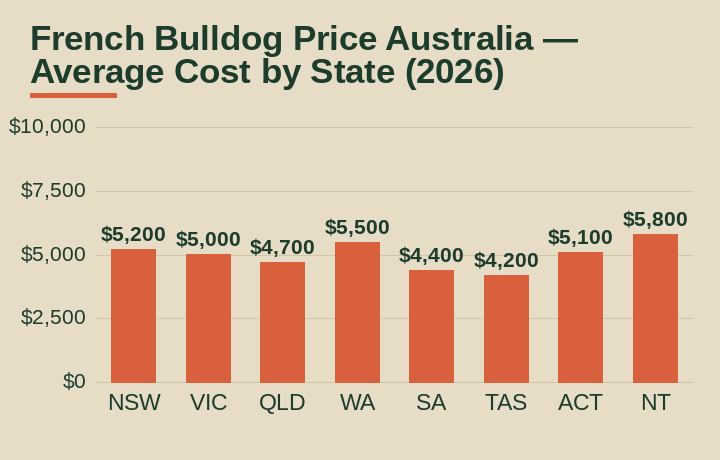
WA and NT prices sit higher partly because there are fewer registered breeders and freight costs from eastern states get factored in when supply is thin. If you’re in Perth or Darwin and want a Frenchie from a reputable breeder, expect to pay a premium or wait longer.
The rescue price looks attractive, but spots are rare. The unregistered tier looks like a bargain until the vet bills start. Most buyers end up in the pet-quality registered bracket, which is probably the right call for anyone who just wants a healthy companion.
Why French Bulldog prices vary so much
Five factors genuinely move the price. Each of them matters.
1. Breeding costs are unusually high for this breed. French Bulldogs almost always require artificial insemination (because their conformation makes natural mating difficult) and caesarean sections to deliver (because the puppies’ large heads can’t pass through the dam’s narrow pelvis). A single AI procedure runs $500-$1,500. A planned C-section with a vet on standby costs $1,500-$3,500. Breeders producing two litters per year can spend $5,000-$8,000 on reproduction costs alone, before any other expenses. That gets priced into every puppy.
2. Health testing changes the cost base. Responsible breeders test both parents for hereditary conditions: BOAS grading, hemivertebrae screening via X-ray, DNA tests for hereditary cataracts and degenerative myelopathy. A full panel costs $800-$1,800 per dog. Breeders who skip this testing can price puppies $1,000-$2,000 lower and still turn a profit. That’s why a $2,500 Frenchie and a $5,500 Frenchie can both exist. The question is what corners were cut.
3. Coat colour is a marketing lever, not a health signal. Standard fawn, brindle or pied French Bulldogs from reputable breeders run $3,500-$6,500. The same breeder’s ‘rare’ lilac or isabella puppy from the same litter might be listed at $9,000-$13,000. The colour difference is cosmetic. In the case of merle, there are genuine health concerns when bred irresponsibly. The Australian Veterinary Association has flagged that demand for extreme traits in brachycephalic breeds continues to drive welfare problems.
4. Location affects price by 20-30%. Inner-city breeders in Surry Hills, Fitzroy or Paddington typically charge more than breeders in Toowoomba, Geelong or regional SA, even controlling for quality. Overheads are higher, demand from higher-income buyers is stronger, and the market will bear it. If you’re flexible about travelling a couple of hours, regional breeders often offer comparable quality for $800-$1,500 less.
5. Waitlist position and breeder reputation add a premium. A breeder with a 12-month waitlist and a track record of healthy, well-socialised litters can charge $1,500-$2,500 more than a comparable breeder who always has puppies available. That waitlist itself is a signal, it means existing customers keep coming back and referring others. Genuinely good breeders don’t need to advertise heavily.
Questions to ask before you commit
Can I see the health certificates for both parents?
You want to see actual documentation: BOAS grading results, hemivertebrae X-ray reports, and DNA panel certificates. Not ‘the parents have been health tested’ as a verbal assurance. If a breeder can’t produce paperwork, assume it doesn’t exist.
What does the registration include, and is it limited or main?
Limited registration means the puppy can’t be registered for showing or breeding (offspring can’t be registered). Main registration allows both. If you’re buying a pet, limited registration is standard and appropriate. Be suspicious if a breeder offers main registration to a first-time buyer at a standard price, that’s sometimes used to attract buyers who then on-sell puppies themselves.
How many litters has the dam had, and how often?
A healthy dam should have no more than 3-4 litters in her lifetime and shouldn’t be bred back-to-back. More than that and you’re looking at a high-volume operation that’s prioritising output over the mother’s welfare. High-volume breeding correlates with stressed, under-socialised puppies.
What’s the socialisation protocol before the puppy leaves?
Frenchies should be exposed to different sounds, surfaces, people and animals before 8 weeks. Ask specifically what the breeder does. Vague answers like ‘they’re house-raised’ aren’t enough. Puppies who leave without proper early socialisation are harder to train and more likely to develop anxiety. Pair this with a good puppy school program once they arrive home.
What’s your refund or return policy if a vet finds a problem at the first check-up?
Reputable breeders offer at least a 72-hour vet check clause. Some offer broader health guarantees. If a breeder refuses to discuss this, that tells you something about their confidence in the puppy’s health.
Is the listed price all-inclusive, or are there add-ons?
Some breeders quote a base price then add microchipping, first vaccination, vet check, worming and puppy packs as separate line items. That $3,800 listing can easily become $4,600 by the time you collect. Get the full out-the-door cost in writing. Also factor in that you’ll be spending on ongoing vaccinations and health check-ups from the moment the puppy’s home.
Recommended Products for French Bulldog Price Australia
If you’re tackling this yourself, here are some products from Amazon Australia that can help (these are affiliate links):
How to bring the cost down without cutting corners
The single best move is choosing a standard colour. Fawn, brindle or pied French Bulldogs from the same reputable breeder cost $2,000-$5,000 less than their lilac or fluffy siblings. The dog doesn’t know what colour it is. The health profile is the same. The colour premium is entirely market-driven.
Going for a female puppy is usually more expensive than a male. If you’re buying on limited registration purely as a companion, a male from a health-tested litter gives you the same dog for $500-$1,500 less. Worth thinking about honestly.
Pet insurance from week one is genuinely money well spent on this breed. Frenchies have elevated rates of spinal surgery (IVDD), soft palate correction and skin infections. A single spinal procedure costs $6,000-$12,000. Insurance at $110-$160 per month hurts, but it’s far better than a $9,000 bill you weren’t expecting. The MoneySmart pet ownership guide flags this breed specifically as one where insurance has a strong financial case.
For day-to-day health, dental cleaning costs and annual vaccination schedules should both be in your budget from year one. Skipping either tends to create more expensive problems later. And since Frenchies need vet attention more frequently than average, having a local vet you trust matters more with this breed than most.
One underrated option: consider whether boarding costs fit your lifestyle. Frenchies are not great in kennels due to their breathing sensitivity and temperature regulation issues. Many owners end up paying for in-home pet sitting instead, which costs more. Know this before you buy.
If you’re weighing up ownership costs more broadly, also look at what desexing costs for this breed. Frenchie desexing, particularly females, often requires more careful anaesthetic management due to their airway anatomy, which pushes costs $100-$300 above a standard-breed desex.
Finally, consider a cooling mat suited to brachycephalic breeds before your first Australian summer with a Frenchie. These dogs struggle in heat, and aircon dependency is real. A good cooling mat reduces the thermal load and is one of those purchases that’s genuinely worth the $30-$80.
The purchase price is genuinely just the beginning. Annual costs include food ($800-$1,400), vet check-ups and vaccinations ($350-$600), insurance ($1,080-$2,160), grooming ($200-$400), and incidentals like toys and accessories ($300-$600). Then there are the unpredictable costs: Frenchies have higher-than-average rates of spinal surgery, soft palate correction and skin fold infections, which can each cost $2,000-$8,000 when they occur. Some owners also explore pet acupuncture or hydrotherapy for spinal management, which add further to the annual total.
Frequently asked questions about French Bulldog price Australia
Why are French Bulldogs so expensive in Australia?
French Bulldogs almost always require artificial insemination to breed and caesarean sections to deliver, since their narrow hips prevent natural birth. Those vet costs alone can run $3,000-$5,000 per litter. Add DNA health testing, microchipping, vaccinations, ANKC registration and the breeder’s time, and the price stacks up fast even before profit is considered.
What’s the difference between ANKC-registered and unregistered French Bulldogs?
An ANKC-registered puppy comes from a breeder who is accountable to their state canine council, has agreed to a code of ethics, and has (in theory) health-tested the parents. Unregistered breeders have no such oversight. You’re not automatically getting a healthier puppy from a registered breeder, but you do have a complaints pathway if something goes wrong.
Are rare-colour French Bulldogs worth the extra money?
Honestly, for most buyers, no. Colours like lilac, merle and fluffy carry price tags of $8,000-$15,000 but don’t come with better health outcomes. The merle gene in particular is associated with eye and hearing problems when bred irresponsibly. The colour premium is driven by market demand, not by any practical benefit to the dog.
How much does it cost to own a French Bulldog annually?
Budget at least $3,500-$5,500 per year beyond the purchase price. This covers food, vet check-ups, insurance (which runs higher for Frenchies due to their health profile), grooming, toys and incidentals. Unexpected vet bills for spinal or respiratory issues can easily add another $2,000-$8,000 on top in a bad year.
Can I find a French Bulldog puppy for under $2,000 in Australia?
You can, but you probably shouldn’t. Prices that low almost always indicate a puppy farm, backyard breeder or an animal imported through grey channels. These puppies frequently arrive with undetected health issues that cost far more to treat than the savings on the purchase price. If the price seems too good, dig deeper before handing over money.
People Also Ask About French Bulldog Price Australia
Do French Bulldogs from interstate breeders cost less?
Sometimes. Breeders in regional QLD or SA occasionally list puppies $500-$1,000 below Sydney or Melbourne prices, partly because their cost of living is lower. But you’ll need to factor in freight if you’re not travelling to collect, which adds $350-$700. And buying interstate makes it harder to visit the premises and see the parents in person, which is a real trade-off. Check our breakdown of interstate pet transport costs if you’re seriously considering this route.
What health tests should a French Bulldog breeder do before selling a puppy?
At minimum: BOAS (brachycephalic obstructive airway syndrome) grading on the parents, spine X-rays to check for hemivertebrae, and DNA testing for hereditary cataracts and degenerative myelopathy. Reputable breeders will provide certificates. If a breeder can’t produce these, that’s a red flag regardless of price. A dog DNA and health screening kit can give you a secondary check on a puppy’s genetic background after purchase.
How long is the wait for a French Bulldog puppy from a registered breeder in Australia?
Expect 6-18 months on a waitlist for a reputable ANKC-registered breeder. The most sought-after breeders close their waitlists entirely between litters. If a breeder has puppies available immediately with no waitlist, that’s worth investigating, high-volume operations rarely prioritise health testing.
Are female French Bulldogs more expensive than males?
Yes, typically by $500-$1,500. Females are priced higher because they can be used for breeding, so buyers (including backyard breeders) are willing to pay more. If you’re buying a pet on limited registration and have no interest in breeding, a male is usually the better value option.
What ongoing costs should I budget for a French Bulldog beyond the purchase price?
Related Cost Guides
This guide contains affiliate links. We may earn a small commission from qualifying purchases at no extra cost to you.