Dachshund vet costs are one of the more loaded topics in pet ownership, because this breed comes with a specific medical risk that can turn a $100 consult into a $10,000 emergency almost overnight. According to the Animal Medicines Australia 2025 Pets in Australia report, Australians own more than 6.7 million dogs and annual vet spending is climbing. For dachshund owners, that trend is particularly sharp. The breed’s long spine and short legs make intervertebral disc disease (IVDD) a near-constant financial risk, and most owners aren’t financially prepared when it hits.
Dachshund vet cost Australia typically runs $65-$150 for a standard consult. Annual preventive care sits around $400-$800 per year. The real budget risk is IVDD (intervertebral disc disease), the breed's most common serious condition, where surgery can cost $6,000-$12,000.
Prices updated July 2026 from current Australian sources.
| Service | Typical cost | Notes |
|---|---|---|
| Standard consultation | $65 to $150 | Per visit |
| Annual preventive care | $400 to $800 / year | Vaccinations, heartworm, flea and worm |
| IVDD surgery (if needed) | $6,000 to $12,000 | The breed’s most common serious condition |
The everyday costs are modest, but intervertebral disc disease (IVDD) is the real budget risk for Dachshunds. Pet insurance or a dedicated savings buffer is worth considering for this breed.
Sources (July 2026): PetCloud, Vet prices in Australia, Forbes Advisor Australia, Vet fees in Australia, RSPCA Australia
Routine care is manageable. IVDD is not. That distinction is the whole story.
These figures cover a standard annual consult, core vaccinations, and basic parasite prevention. They don’t include dental work, IVDD-related care, or any diagnostics beyond a physical exam. A dachshund owner in Surry Hills or Fitzroy will almost certainly pay closer to the top of their state’s range. In Toowoomba, Hobart’s North, or regional SA, you’ll typically land in the lower half.
A real-world dachshund vet scenario
Meet a three-year-old standard dachshund in Brisbane’s inner suburbs. His owner pays $87 per routine consult twice a year, $145 for the C5 vaccination, and around $320 annually on flea, tick, and heartworm prevention bought in bulk online. That’s roughly $860 per year with no incidents.
Then at age five, he starts showing signs of back pain. The local vet charges $87 for the initial consult, prescribes anti-inflammatories ($65) and recommends strict rest. Two weeks later, no improvement. Referral to a specialist neurologist: $295 for the consult plus $1,850 for an MRI. Grade 3 IVDD confirmed. Surgery: $7,200. Post-op physiotherapy over 8 weeks: $960.
Total IVDD episode cost: approximately $10,457. That’s not unusual. It’s closer to typical.
For anyone considering mobile vet services for a dachshund, be aware that IVDD emergencies almost always require a specialist referral centre with MRI capability, which mobile vets can’t provide.
Dachshund vet costs by service type
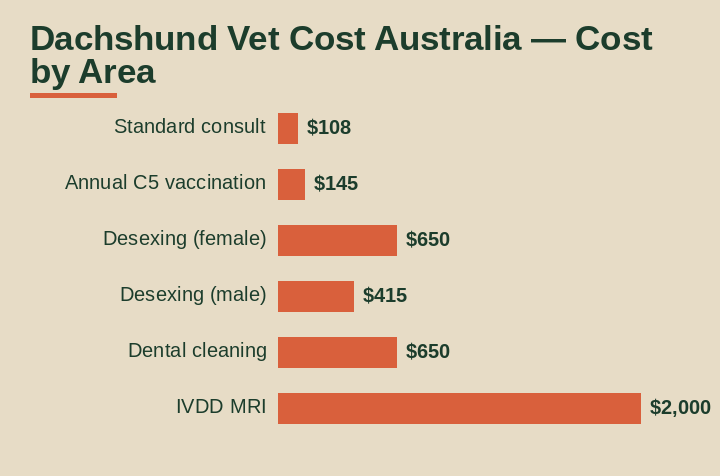
Routine care and specialist care are completely different financial categories. Here’s how the main service types compare, so you can budget for both the normal year and the bad one.
| Service | Typical Cost (AUD) | Notes |
|---|---|---|
| Standard consult | $65 to $150 | Higher in inner-city clinics |
| Annual C5 vaccination | $110 to $180 | C3 only is $85 to $160 |
| Desexing (female) | $450 to $850 | Higher for females due to complexity |
| Desexing (male) | $280 to $550 | See also: dog desexing costs in Australia |
| Dental cleaning | $400 to $900 | Requires anaesthetic; dachshunds prone to dental disease |
| IVDD MRI | $1,500 to $2,500 | Specialist referral centres only |
| IVDD surgery | $6,000 to $12,000 | Depends on severity and number of discs |
| Conservative IVDD management | $300 to $1,500 | Rest, meds, physio for mild cases only |
| Physiotherapy (post-IVDD) | $600 to $1,500 | 6-12 sessions typical |
| Hydrotherapy | $65 to $120 per session | Excellent for spinal recovery; see pet hydrotherapy costs |
Where the money actually goes: what drives dachshund vet costs
The IVDD risk is breed-specific and expensive
Around 25% of dachshunds will experience clinically significant IVDD at some point in their lives. That’s not a scare stat, it’s from veterinary neurology literature, and it’s why dachshund vet bills are in a different financial league from most small dog breeds. A Grade 4-5 case requiring emergency surgery and rehab can genuinely cost $12,000-$15,000 all in. The Australian Veterinary Association has noted that cost pressure is one of the main reasons owners delay treatment, which often worsens outcomes for IVDD specifically.
Location within Australia
A specialist vet neurologist consult in Paddington, Sydney runs $310-$380. The same referral in Adelaide or Hobart typically costs $240-$290. Regional Australia has fewer specialist centres altogether, which means some owners face travel costs on top of vet bills. In Darwin or regional NT, accessing a specialist neurologist often means flying to a capital city. Factor that in.
Standard vs miniature dachshund
The size difference matters less than most people expect. Surgical fees are set by procedure complexity, not body weight. Where it does affect cost is in medication dosing and, slightly, in anaesthetic calculations. The difference is rarely more than $50-$100 on a large bill. Both varieties carry the same IVDD risk profile.
Dental disease susceptibility
Dachshunds are prone to periodontal disease. Many owners don’t budget for dental cleaning because it feels optional until the dog is in pain. At $400-$900 per clean under anaesthetic, skipping it for three years and then needing extractions ($150-$300 per tooth on top of the clean) gets expensive fast. Pet dental cleaning costs in Australia are worth understanding before the bill arrives. Buying enzymatic dental chews for dogs regularly can meaningfully slow plaque build-up between cleans.
Age and life stage
Puppies cost more in year one. Three vaccination visits, microchipping, parasite prevention, desexing, and the initial health checks can total $900-$1,600 before the first birthday. Senior dachshunds (seven-plus) typically need more frequent check-ins and are more likely to face IVDD or other age-related conditions. The relatively cheap middle years (roughly ages two to five) are actually the best time to build a vet savings fund or lock in pet insurance.
Recommended Products for Dachshund Vet Cost Australia
If you’re tackling this yourself, here are some products from Amazon Australia that can help (these are affiliate links):
Questions to ask before you book
Does your clinic have experience with dachshund IVDD specifically?
Not all general vets see enough dachshunds to be confident diagnosing early-stage IVDD. Ask directly whether the vet has experience with the breed. Early identification of Grade 1-2 IVDD, treated conservatively, can avoid the need for surgery entirely. Missing it costs far more later.
At what point would you refer me to a specialist neurologist?
Understand this before any back symptoms appear. Most general vets will refer at Grade 2-3, but the threshold varies. Knowing the answer in advance avoids a frantic conversation during an emergency. It also helps you plan financially for a potential $8,000-$12,000 specialist pathway.
Is your quote for a consult or does it include diagnostics?
A $90 consult and a $90 consult plus X-rays are very different bills. Always ask what’s included in the quoted amount before agreeing to anything. X-rays alone run $180-$350 in most Sydney and Melbourne clinics.
Do you offer payment plans or work with VetPay?
Asking this before a crisis means you know your options. VetPay and Humm are the two most common vet financing options in Australia. Confirming your clinic accepts them before an emergency is the kind of boring preparation that genuinely matters at 11pm on a Sunday.
What preventive steps do you recommend specifically for this breed?
A good vet should mention ramp use, weight management, and harness-over-collar as standard dachshund advice without being prompted. If they don’t mention any breed-specific prevention, that tells you something about whether they’re experienced with the breed.
How does this clinic handle after-hours emergencies?
IVDD episodes can escalate overnight. Sudden paralysis in a dachshund is a time-sensitive emergency. Know in advance whether your clinic has after-hours cover or whether you’ll be directed to a 24-hour emergency centre (where fees are 30-60% higher than standard). For ongoing care, understanding the annual vaccination schedule and cost also helps with long-term budgeting.
Common mistakes that cost dachshund owners more
- Waiting on pet insurance. Many owners plan to “get around to it” and then a back episode strikes at age four before any policy is in place. IVDD then becomes a pre-existing condition and is excluded from cover permanently. Buy it as a puppy or don’t count on it for back issues.
- Letting them jump off furniture without a ramp. The landing impact of a 20cm jump repeated hundreds of times is cumulative disc stress. dachshund furniture ramps cost $50-$120. That’s trivially cheap compared to surgery. Most specialist neurologists consider ramp use essential for the breed.
- Skipping annual dental checks. “No visible problems” is not the same as “no dental disease”. A vet who lifts the lip and actually looks is your best defence against a bill that’s three times larger in two years. Ask for it to be included in every annual check.
- Using a collar instead of a harness. Neck pressure from a collar transfers force to the cervical spine with every tug. A well-fitted harness distributes the load across the chest instead. This is a $30-$60 fix. Refer to pet acupuncture costs if your dachshund is already managing chronic back pain, as it’s increasingly used as an adjunct therapy.
Dachshund vet cost Australia genuinely is higher risk than most breeds, and the numbers above aren’t designed to alarm you, they’re designed to help you plan. The owners who come through an IVDD episode without financial disaster are almost always the ones who got insurance early, built a vet savings buffer, and knew the questions to ask before a crisis hit. Get the ramp. Get the harness. Get the insurance before symptoms show. And if you’re also thinking about grooming or boarding costs for your dachshund, see our breakdown of dog boarding costs across Australia for a sense of the full annual ownership picture.
Frequently asked questions about dachshund vet costs
How much does IVDD surgery cost for a dachshund in Australia?
IVDD spinal surgery typically costs $6,000-$12,000 at a specialist referral centre in Australia. The range depends on the severity of the disc herniation, whether one or multiple discs are involved, and which city you’re in. Sydney and Melbourne specialist clinics tend to sit at the higher end.
What is the average annual vet cost for a dachshund in Australia?
A healthy dachshund with no major issues will cost most owners $400-$800 per year in routine vet care, including annual vaccinations, parasite prevention, and one or two consults. Add dental cleaning ($400-$900) every year or two and that average climbs. If IVDD strikes, annual costs can exceed $10,000 in a bad year.
Does pet insurance cover dachshund back problems?
Yes, most comprehensive pet insurance policies cover IVDD treatment including surgery, provided it’s not listed as a pre-existing condition and the policy was in place before symptoms appeared. This is one of the strongest arguments for insuring a dachshund early, ideally as a puppy before any back issues emerge. MoneySmart’s pet ownership cost guide has a useful overview of how to assess whether pet insurance is worth it for your situation.
Can a dachshund with IVDD recover without surgery?
Mild IVDD cases (Grade 1-2) are often managed with strict cage rest, anti-inflammatories, and physiotherapy, which can cost $300-$1,500 total. Grades 3-5 typically require surgery for the best chance of recovery. A specialist neurologist will grade the severity via MRI (itself $1,500-$2,500) before recommending the path.
How often should a dachshund see the vet?
At minimum, once a year for a health check and vaccinations. Many dachshund vets suggest twice-yearly checks from age seven onwards given the breed’s back and dental susceptibility. Puppies need three visits in the first year for their vaccination schedule. If you’re also thinking about what pet vaccinations cost across Australia, that’s worth reading alongside this.
People Also Ask About Dachshund Vet Cost Australia
What age do most dachshunds develop back problems?
IVDD most commonly appears in dachshunds between three and seven years of age, though it can occur earlier or later. Standard dachshunds tend to be affected slightly younger than miniature dachshunds. This is why many vets recommend starting twice-yearly check-ins from around age five.
Is a specialist neurologist more expensive than a regular vet for IVDD?
Yes, significantly. A general vet will handle the initial consult ($65-$150) and basic pain management, but an MRI and surgery require referral to a specialist veterinary neurologist. Specialist consult fees start around $250-$350, before imaging or procedures. The total specialist pathway for Grade 3-5 IVDD typically runs $7,000-$12,000 all in.
How much does physiotherapy cost for a dachshund after IVDD surgery?
Post-surgical physiotherapy for dachshunds typically runs $80-$150 per session, and most rehabilitation programmes involve 6-12 sessions over 6-10 weeks. Total rehab costs sit around $600-$1,500. Hydrotherapy sessions, excellent for spinal recovery, cost $65-$120 per session separately.
Are miniature dachshunds cheaper to treat than standard dachshunds?
Not meaningfully. Specialist surgical fees are driven by procedure complexity rather than dog size. An MRI costs roughly the same regardless of whether the dachshund weighs 4kg or 9kg. Where size matters slightly is in anaesthetic drug dosing, but the difference in cost is minor, usually under $50.
What vaccinations do dachshunds need in Australia and what do they cost?
Dachshunds need a core C3 vaccination (distemper, hepatitis, parvovirus), typically costing $85-$160 per year at a private vet. Many owners also add the C5 (which adds kennel cough coverage) for $110-$180, particularly if their dog uses boarding facilities. Puppy vaccination schedules require three visits and cost $180-$400 in the first year total.
Related Cost Guides
This guide contains affiliate links. We may earn a small commission from qualifying purchases at no extra cost to you.