
The reptile licence fee in Western Australia is lower than most people expect, but the licence fee itself is only part of the picture. According to the Australian Veterinary Association, reptile ownership has grown steadily across Australia, and WA is no exception. Getting legal is straightforward. Getting properly set up is where the real spend happens.
Reptile licence cost Western Australia starts at $25 for a Class 1 keeper licence, rising to $100+ for Class 3 or dealer/breeder licences. Annual renewal fees apply. You'll also need to budget for an approved enclosure and registration of individual animals, which adds to the overall cost.
Prices updated July 2026 from current Australian sources.
| Licence class | Fee | What it covers |
|---|---|---|
| Class 1 keeper licence | from $25 | Beginner-friendly species |
| Class 2 keeper licence | around $50 to $80 | More advanced species |
| Class 3 / dealer or breeder | $100+ | Specialist keeping, dealing or breeding |
WA fauna licences are issued by DBCA under the Biodiversity Conservation Act. Renewal fees apply and an inspection fee may be charged. Individual animals must also be registered, and the licence does not cover the enclosure or the animal itself.
Sources (July 2026): DBCA Western Australia, Fauna Licences
In 2026, a basic Class 1 keeper licence from the Department of Biodiversity, Conservation and Attractions (DBCA) costs $25 per year. That covers common species like blue-tongue lizards and Children’s Pythons. Higher licence classes cost more, and if you want to breed or exhibit animals, you’re looking at additional endorsements and fees. The MoneySmart pet ownership guide notes that ongoing costs are what catch new owners off guard, and reptile keeping is no different.
What you’ll typically pay for a reptile licence in WA
The DBCA sets licence fees under the Biodiversity Conservation Act 2016, and they’re reviewed periodically. Here’s how the classes break down in 2026. Class 1 covers the most commonly kept species and is where most hobbyists start. Class 2 and 3 cover progressively rarer or more regulated fauna, including some of WA’s more impressive python and skink species.
A standard keeper licence doesn’t include a breeder or dealer endorsement. Those are separate and cost more. Also worth knowing: there’s an application fee on top of the annual licence fee for first-time applicants, typically $20-$30 extra.
| State | Average Annual Licence | Typical Range |
|---|---|---|
| NSW | $55 | $50 to $90 |
| VIC | $45 | $40 to $85 |
| QLD | $50 | $45 to $100 |
| WA | $40 | $25 to $150 |
| SA | $35 | $25 to $80 |
| TAS | $30 | $25 to $65 |
| ACT | $45 | $40 to $80 |
| NT | $35 | $25 to $70 |
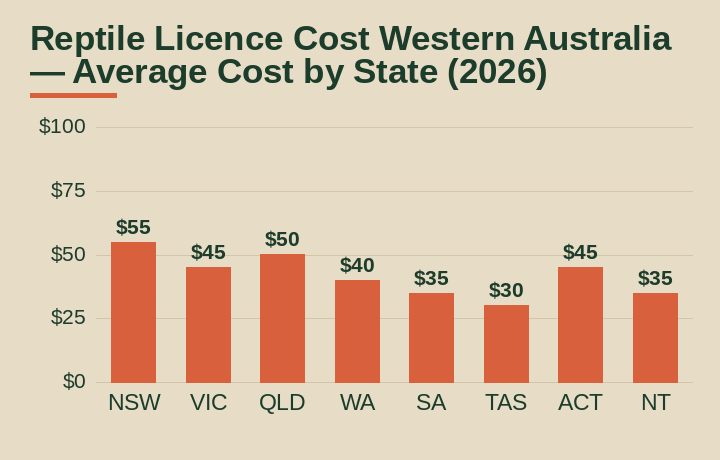
WA’s fees sit in the middle of the national range. NSW and QLD tend to run slightly higher for equivalent class licences, while SA and TAS are marginally cheaper. The real variation comes from licence class rather than state of residence.
Most hobby keepers in WA sit at Class 1 or Class 2. Class 3 is for serious enthusiasts and typically requires demonstrable experience. Jumping straight to a Class 3 application without a track record isn’t impossible, but it’s slower and more likely to attract scrutiny from the DBCA.
Where the money actually goes beyond the licence fee
The $25 licence fee is genuinely just the start. Here’s what actually drives the total cost of getting set up as a reptile keeper in WA in 2026.
Enclosure and heating: A proper escape-proof enclosure for a blue-tongue lizard or medium-sized python costs $350-$800 for a commercial unit. Add a quality thermostat (around $65-$120), a UVB basking light kit for reptiles ($80-$150), substrate and hides, and you’re looking at $500-$1,100 before you’ve bought the animal. In Perth’s northern suburbs like Joondalup or Clarkson, a few reptile specialty shops stock everything, but you’ll pay retail prices. Online is usually cheaper.
The animal itself: Prices honestly bounce around. A captive-bred Children’s Python from a licensed breeder in the Perth metro area typically runs $80-$180. Blue-tongue lizards vary wildly: $120-$350 depending on colour form and whether it’s from a breeder or a pet shop. Western Blue-tongues (an iconic WA endemic) sit at the higher end. If you’re looking at a larger python species on a Class 2 or 3 licence, expect $400-$1,200+ for the animal alone.
Vet care: Reptile vets are not everywhere in WA. In regional areas like Kalgoorlie or Broome, your options are very limited. In Perth you have more choices, but reptile-experienced vets in suburbs like Osborne Park or Cannington still charge a premium. An initial health check runs $85-$150. If your animal needs more than a check-up, costs climb fast. Worth checking out what a mobile pet vet costs in Australia if you’re in a regional area.
Ongoing feed and maintenance: A blue-tongue lizard eating prepared food (leafy greens, fruit, wet dog food) costs around $15-$25 per month to feed. A snake eating frozen rodents runs $20-$40 per month depending on species and feeding frequency. Not a huge expense, but it adds up over a 15-20 year lifespan.
Pet insurance: Most standard pet insurance policies exclude reptiles. Specialist exotic pet insurance exists but isn’t cheap. Worth researching, especially if you’re investing $500+ in a higher-class species. You might also want to look at alternative therapies available for pets as some reptile owners do explore holistic vet options.
Questions to ask before you commit
Which licence class do I actually need for the species I want?
Don’t assume. The DBCA website lists species by class, but some listings are ambiguous. Contact the DBCA directly to confirm before you apply. Getting the wrong class means either re-applying (and paying again) or being locked out of the species you wanted.
Has this animal been legally sourced?
When buying from a breeder or pet shop, ask to see documentation showing the animal was bred in captivity from licensed stock. Wild-caught reptiles are illegal to buy or sell in WA. If the seller can’t provide paperwork, walk away. You don’t want to be holding an illegally obtained animal when your licence is inspected.
What enclosure inspection does the DBCA require, and when?
Some applications require an enclosure to be in place before the licence is granted. Others don’t inspect until after approval. Clarifying this upfront saves you buying a $700 enclosure only to find you can’t get the animal until it’s inspected. Ask the DBCA whether your application class triggers a pre-approval inspection.
Is the breeder on the DBCA’s public register?
The DBCA maintains a public register of licensed fauna dealers and breeders in WA. Buying from a registered source protects you legally and usually means the animal has been kept in proper conditions. Buying off Facebook from an unregistered seller is a false economy. Fines for receiving illegally traded fauna can exceed $10,000.
What records am I required to keep once licensed?
WA keepers are required to maintain records of all fauna held, including acquisition source, dates and any transfers or deaths. Ask the DBCA exactly what format they require. Some keepers use a simple spreadsheet; others use dedicated herpetology apps. Getting this right from day one is much easier than reconstructing records at renewal time.
Can my current rental or strata property legally house a reptile?
Your licence being approved doesn’t mean your landlord or body corporate has to allow it. In WA, tenants generally need written permission to keep pets, and some strata by-laws prohibit reptiles outright. Sort this out before you spend money on an enclosure. It’s a more common issue than people realise.
Recommended Products for Reptile Licence Cost Western Australia
If you’re tackling this yourself, here are some products from Amazon Australia that can help (these are affiliate links):
How to bring the reptile licence cost down in WA
Start with a Class 1 species. The $25 fee versus the $100+ for a Class 3 licence is an obvious saving, but it goes beyond the licence itself. Class 1 species like blue-tongue lizards and Children’s Pythons are hardier, eat cheaper food, and are more forgiving of minor husbandry errors. For first-time keepers, this really matters. You can always apply to upgrade your licence class later once you’ve built up experience and the DBCA can see your track record.
Build rather than buy your enclosure. A timber and mesh enclosure built to DBCA specifications can cost as little as $150-$250 in materials from Bunnings, compared to $500-$800 for a commercial unit. It needs to be escape-proof and thermally suitable, but there’s no requirement to buy branded reptile furniture. Plenty of experienced WA keepers have been using homemade setups for years.
Source your animal from a licensed breeder, not a pet shop. As mentioned above, breeders typically charge $80-$200 less for the same species and provide far better background on the animal. Check the DBCA public register, or ask in WA reptile keeping forums where reputable breeders are well known. If you’re also factoring in transport, see what interstate pet transport actually costs before buying from interstate.
Buy second-hand equipment where it makes sense. Heat mats, reptile thermometers and humidity monitors, tongs and feeding equipment all turn up regularly on Facebook Marketplace from keepers who’ve exited the hobby. Test everything before relying on it. A failed thermostat that cooks your animal is a vet bill (or worse) that dwarfs the $30 you saved.
Renew on time. Letting your licence lapse means re-applying as a new applicant, which can trigger the application fee again. It may also put you in a grey area legally while you wait for renewal to process. Set a reminder for 6 weeks before expiry. Simple.
If you’re adding a reptile to a household that already includes other animals, it’s worth factoring in broader pet costs. Check out real dog vaccination costs in Australia, pet dental cleaning fees, or what puppy school costs if the reptile’s joining a mixed household. And according to Animal Medicines Australia’s 2025 Pets in Australia report, reptiles are among the fastest-growing pet categories nationally, so the DBCA’s systems are seeing more applications than ever. Apply early and apply with a complete dossier. That’s the single best way to get your reptile licence cost Western Australia sorted without delays.
Frequently asked questions about reptile licence cost Western Australia
How much does a reptile keeper licence cost in Western Australia?
A Class 1 keeper licence costs $25 per year. Class 2 licences run around $50, and Class 3 or specialised licences (including dealer and exhibitor licences) range from $80 to $150+ annually. Fees are set by the Department of Biodiversity, Conservation and Attractions and reviewed periodically.
Do I need a licence to keep a blue-tongue lizard in WA?
Yes. Blue-tongue lizards are classified as Class 1 fauna in Western Australia, so you do need a current keeper licence to legally keep one. The licence is inexpensive at $25 per year, but you still need to register the individual animal and meet enclosure requirements.
Can I keep a python in Western Australia?
Yes, pythons are available to licensed keepers in WA. Species like the Children’s Python and Stimson’s Python fall under Class 1, while larger or less common species may be Class 2 or 3. The licence class determines both the fee and the requirements for housing and record-keeping.
How long does it take to get a reptile licence in WA?
Processing times vary, but most straightforward applications are assessed within 4 to 8 weeks. Delays happen if your application is incomplete or your enclosure hasn’t been inspected yet. Applying online through the DBCA portal is the fastest route.
What happens if I keep a reptile without a licence in WA?
Keeping native fauna without a licence is an offence under the Biodiversity Conservation Act 2016 and can result in significant fines. Penalties can exceed $10,000 for individuals. The animals may also be seized. It’s genuinely not worth the risk.
People Also Ask About Reptile Licence Cost Western Australia
Can I keep an eastern bearded dragon in Western Australia without a licence?
No, you cannot. Bearded dragons (Pogona barbata) are native fauna and protected under the Biodiversity Conservation Act 2016. You must hold a current keeper licence in the appropriate class to legally own one in WA. Keeping one without a licence is an offence regardless of how the animal was obtained.
Do I need to register each reptile individually in Western Australia?
Yes, individual animal registration is required in addition to your keeper licence. Each reptile needs to be recorded on your licence, including its species, source and any identifying details. When you acquire or transfer an animal, you must update your records with the DBCA within a set timeframe, usually 14 days.
Can I breed reptiles on a standard keeper licence in WA?
A standard keeper licence does not automatically authorise breeding. If you intend to sell or transfer offspring, you’ll likely need a breeder or dealer endorsement, which costs more and involves additional conditions. Breeding purely for your own keeping is a grey area worth clarifying directly with the DBCA before your animals reproduce.
Are there any reptiles I can keep in WA without any licence at all?
No. All native reptiles in Western Australia are protected fauna and require a licence to keep. There is no ‘free’ category. Exotic (non-native) reptiles such as corn snakes or leopard geckos are illegal to keep in Australia under federal biosecurity laws, regardless of any state licence.
What enclosure standards does DBCA require for a reptile licence in WA?
The DBCA requires enclosures to be escape-proof, appropriate for the species’ size and thermal needs, and capable of maintaining suitable temperature gradients. Specific requirements vary by species class. Inspections may be required before or after your licence is granted. The DBCA publishes detailed enclosure guidelines on its website that are worth reading before you build or buy anything.
Related Cost Guides
This guide contains affiliate links. We may earn a small commission from qualifying purchases at no extra cost to you.