
What golden retriever desexing actually costs in Australia in 2026
Golden retriever desexing sits in a pretty wide band, and that range isn’t random. The gap between a $380 male desexing in regional Queensland and a $920 female spay at an inner-Sydney vet reflects real differences in procedure complexity, anaesthetic time, practice overheads, and post-op care. According to the Australian Veterinary Association’s cost pressures report, vet fees across Australia have risen noticeably over the past two years, and elective procedures like desexing haven’t been exempt.
Golden retriever desexing cost Australia sits between $350 and $950 in 2026. Males are cheaper at $350 to $550, while females cost $500 to $950 due to the more involved surgery. Prices vary by state, vet practice, and whether your dog is in season or overweight.
Prices updated July 2026 from current Australian sources.
| Procedure | Typical cost | Notes |
|---|---|---|
| Male (castration) | $350 to $550 | |
| Female (spey) | $500 to $950 | More involved surgery |
Prices vary by state, vet practice, and whether your dog is in season or overweight. As a large breed, Goldens need more anaesthetic, which lifts the cost above smaller dogs. Pre-anaesthetic bloods are usually extra.
Sources (July 2026): National Desexing Network, RSPCA Australia, PetCloud, Vet prices in Australia
As a rough baseline: male golden retrievers (castration) cost $350 to $550. Females (spay or ovariohysterectomy) cost $500 to $950. That’s the honest range you’ll encounter at mainstream vet practices in 2026. Outliers exist on both ends.
State-by-state desexing prices
Prices vary meaningfully by state, driven by vet labour costs, commercial rents, and local competition. The table below reflects standard vet clinic pricing for female golden retrievers (the more representative price point). Males will be roughly $150 to $250 less in each state.
| State | Average Cost (Female) | Typical Range |
|---|---|---|
| NSW | $780 | $580 to $950 |
| VIC | $750 | $560 to $920 |
| QLD | $680 | $480 to $850 |
| WA | $710 | $500 to $880 |
| SA | $650 | $450 to $820 |
| TAS | $620 | $420 to $780 |
| ACT | $790 | $600 to $950 |
| NT | $730 | $520 to $870 |
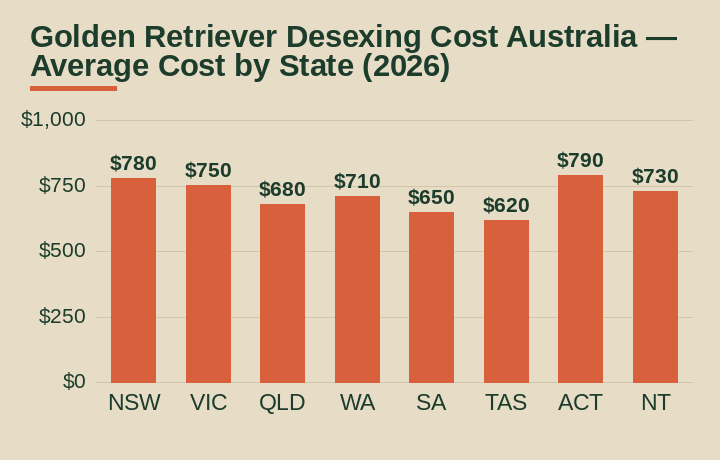
NSW and ACT sit highest, largely due to Sydney and Canberra’s commercial rent pressures. South Australia and Tasmania tend to be the most affordable. Queensland is competitive across the board, partly because there are more suburban vet practices and stronger price competition outside Brisbane’s CBD.
A real-world example: what one Sydney owner paid
A golden retriever owner in Newtown (inner-Sydney) recently had her 14-month-old female desexed at a local vet practice. Here’s what the invoice actually looked like:
- Pre-anaesthetic blood panel: $95
- Anaesthesia and monitoring: $180
- Surgical procedure (ovariohysterectomy): $460
- Pain relief injection and take-home medication: $75
- Recovery overnight stay: $90
- Total: $900
The same procedure at a vet in Penrith came in at $645 all-in, including bloods. Same breed, similar age. That’s a $255 difference for geography alone. Worth knowing before you book on convenience.
If you’re also budgeting for annual vaccination costs and thinking about the full first-year spend, the numbers add up fast for a large breed like a golden retriever.
Male vs female vs weight: what the price difference actually looks like
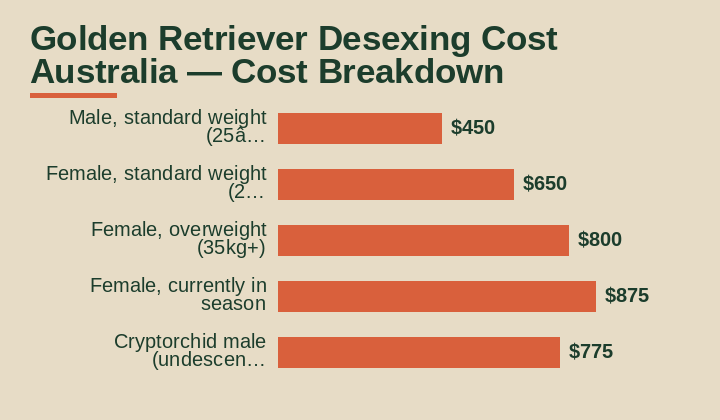
Beyond the state table, the two biggest pricing variables are sex and body weight. The table below shows typical 2026 pricing across both for golden retrievers specifically.
| Dog Type | Procedure | Typical Cost Range |
|---|---|---|
| Male, standard weight (25 to 34kg) | Castration | $350 to $550 |
| Female, standard weight (25 to 34kg) | Spay (OVH) | $500 to $800 |
| Female, overweight (35kg+) | Spay (OVH) | $650 to $950 |
| Female, currently in season | Spay (OVH), if vet proceeds | $700 to $1,050 |
| Cryptorchid male (undescended testicle) | Modified castration | $600 to $950 |
The cryptorchid surcharge is one people don’t see coming. If one or both testicles haven’t descended, the vet needs to locate and remove them abdominally, that turns a simple castration into something closer to a spay in terms of complexity and cost. Your vet should flag this at a pre-surgery consult.
Where the money actually goes
Understanding the cost breakdown makes it easier to assess whether a quote is reasonable or inflated.
The procedure itself: female is twice the work of male
Male castration involves two small incisions and takes 15 to 30 minutes under general anaesthesia. Female desexing (ovariohysterectomy) requires opening the abdominal cavity, locating and removing both ovaries and the uterus, and closing multiple tissue layers. It takes 45 to 75 minutes. That difference in time and complexity directly explains the price gap. A vet charging $550 for a female golden spay isn’t cutting corners, that’s genuinely a fair rate for a regional or suburban practice.
Anaesthesia is a significant cost component
For a large dog like a golden retriever (typically 27 to 34kg), anaesthetic drugs, IV fluids, and continuous monitoring by a vet nurse add $150 to $250 to the bill. Practices that charge less often have less extensive monitoring protocols. This is one area where I’d be cautious about chasing the lowest price, anaesthetic monitoring matters for large breeds.
Pre-anaesthetic blood testing
Not all vets include pre-anaesthetic bloods as standard; some offer it as an optional add-on at $75 to $120. For young healthy dogs, it’s technically optional. For goldens over 5 years, most vets strongly recommend it. Skipping it saves money but removes a safety check that catches things like borderline kidney function before the dog goes under anaesthetic.
Location and practice type
A vet clinic in Paddington or Fitzroy has significantly higher rent than one in Toowoomba or Fremantle’s outer suburbs. That overhead flows directly into pricing. You’ll pay 20 to 30% more at an inner-city practice than a comparable suburban or regional one. A 30-minute drive can save you $150 to $250 on this procedure.
Post-op care inclusions vary
Some practices include an overnight stay, follow-up check at 7 to 10 days, and take-home pain relief as standard. Others charge for each separately. A quote of $600 that includes all three might be better value than a quote of $520 with $150 in add-ons. Always ask what’s included. You might also want to factor in a soft recovery collar to keep your dog from interfering with the incision site during healing.
Recommended Products for Golden Retriever Desexing Cost Australia
If you’re tackling this yourself, here are some products from Amazon Australia that can help (these are affiliate links):
Questions to ask before you book
Is the pre-anaesthetic blood test included or extra?
Some clinics bundle it, others charge $75 to $120 separately. For a large breed golden, it’s worth having. Know whether it’s in the quote before you commit.
What happens if she’s heavier than estimated?
Weight affects anaesthetic dosing and procedure time. Some vets charge a flat rate regardless; others add a surcharge above a certain weight. Ask this specifically if your golden is on the larger side (35kg+), you don’t want a surprise on the invoice.
Is an overnight stay included, and is it necessary?
For straightforward desexings on young healthy dogs, many are discharged same day. Overnight stays add $70 to $120 but may be recommended for females with more complex recoveries. Understand what you’re paying for.
What pain relief is provided post-surgery?
A quality practice will send your dog home with 3 to 5 days of oral pain relief. If the quote doesn’t mention this, ask specifically. Going without adequate post-op pain management isn’t acceptable and is a sign to look elsewhere.
Is a follow-up check included in the price?
Most practices include a check at 7 to 10 days to inspect the incision and remove sutures if needed. Some charge separately ($45 to $80). Confirm this upfront.
What’s your policy if complications arise?
Rare but real. Ask what happens if your dog needs additional care post-surgery due to complications. Knowing the answer before you book tells you a lot about how that practice operates.
While you’re planning ahead, it’s also worth understanding what pet vaccinations cost in Australia so you can budget for the full first year.
Common mistakes to avoid
- Booking at the cheapest price without asking what’s included. A $380 quote that excludes bloods, pain relief and a follow-up visit can easily become $560 once you add everything back in. Compare full itemised costs, not headline prices.
- Desexing a female in season without understanding the risk and surcharge. Most vets won’t operate during season for good reason. If yours will, expect to pay $100 to $200 more and understand there’s elevated surgical risk involved.
- Waiting until your golden is significantly overweight. Obesity increases anaesthetic risk and some vets charge a surcharge above 35kg. Goldens have a real tendency toward weight gain, keeping her lean before the procedure is genuinely worth it, both medically and financially.
- Not budgeting for recovery supplies. You’ll need an E-collar or post-surgery recovery suit, and possibly a proper orthopaedic bed for the 10 to 14 day rest period. Add $50 to $120 to your budget for these.
If you’re thinking about the broader picture of dog ownership costs, our breakdown of dog boarding prices in Australia and puppy school costs are worth reading alongside this. They tend to cluster in the same period of a dog’s first 12 to 18 months.
For those also looking at general dog desexing costs across all breeds, that guide covers the full spectrum from small terriers to large breeds and is useful for comparison. And if you’re thinking about your golden’s longer-term health, pet dental cleaning costs are something worth factoring into your annual vet budget too.
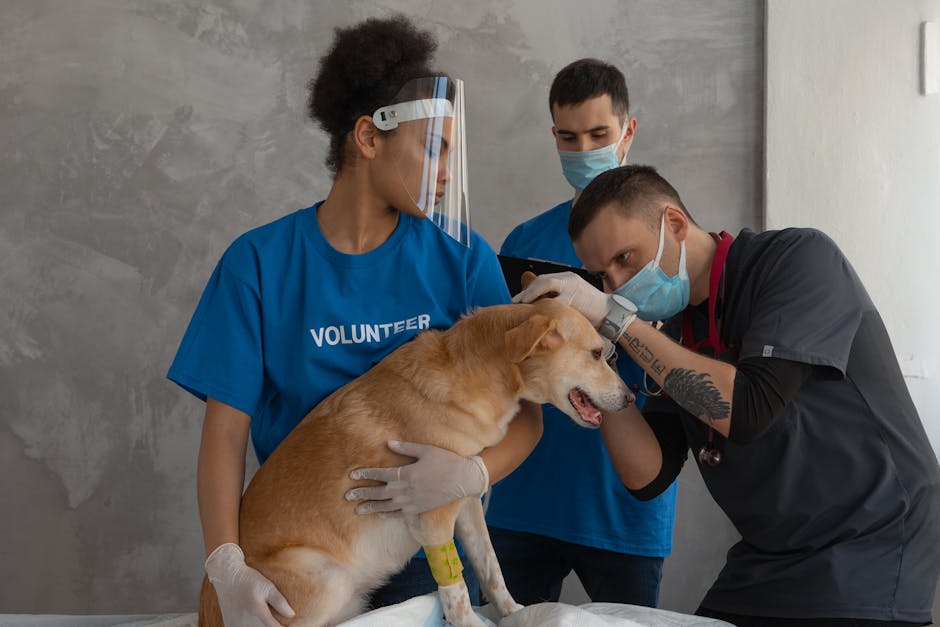
Golden retriever desexing cost Australia is one of those expenses where the price gap between providers is wide enough that a bit of research genuinely pays off. The procedure itself is standard and safe at any reputable clinic, the difference is mostly in what’s bundled, where the clinic is located, and whether you’re timing it well. Get two or three itemised quotes, ask the questions above, and you’ll be in a much better position to judge what’s fair value for your dog and your budget. For more on the ongoing costs of keeping a golden healthy, the mobile vet cost breakdown is worth a look if convenience matters to you.
FAQ: Golden Retriever Desexing Cost Australia
What is the average cost to desex a female golden retriever in Australia?
A female golden retriever desexing (spay) typically costs $500 to $950 in Australia in 2026. The higher price reflects the more complex abdominal surgery involved. Inner-city Sydney and Melbourne vets sit toward the top of that range; regional and suburban practices are usually $500 to $700.
Is it cheaper to desex a male or female golden retriever?
Male desexing (castration) is consistently cheaper because it’s a shorter, less invasive procedure. Expect $350 to $550 for a male golden retriever versus $500 to $950 for a female. The gap is roughly $150 to $300 at most practices.
What’s the best age to desex a golden retriever in Australia?
Many Australian vets now recommend waiting until 12 to 18 months for golden retrievers, particularly females. Research suggests early desexing before hormonal maturity may increase the risk of joint issues and certain cancers in the breed. Talk to your vet about timing specific to your dog.
Does pet insurance cover desexing costs in Australia?
Most Australian pet insurance policies exclude desexing as it’s considered an elective procedure. Some ‘wellness’ or ‘routine care’ add-ons may partially reimburse it, check the PDS carefully before buying. Don’t assume standard cover includes it.
Are there low-cost desexing options in Australia?
Yes. The RSPCA Australia and some council-run programs offer subsidised desexing, particularly for pensioners and low-income households. Vet school clinics (like those at University of Melbourne and University of Queensland) also offer desexing at reduced rates. These book out fast, so enquire early.
People Also Ask About Golden Retriever Desexing Cost Australia
Can I get Medicare or any government rebate for desexing my golden retriever in Australia?
There’s no Medicare rebate for pet procedures in Australia. However, some state and local government programs offer subsidised desexing vouchers for low-income households and pensioners. Check with your local council or the RSPCA in your state, as availability varies significantly by location.
How long does it take a golden retriever to recover from desexing?
Most golden retrievers are back to normal activity within 10 to 14 days. The first 48 to 72 hours require rest and minimal movement. The incision site should be monitored daily for redness or discharge. Vets typically recommend a check-up at 7 to 10 days to confirm healing is on track.
Will desexing change my golden retriever’s personality?
Desexing can reduce hormone-driven behaviours like roaming, marking and mounting, particularly in males. It doesn’t flatten a dog’s personality or energy levels in the way some owners fear. Golden retrievers are generally affectionate and sociable before and after the procedure.
Do golden retrievers gain weight after being desexed?
There is a real metabolic change after desexing that can lead to weight gain if feeding habits don’t adjust. Golden retrievers are already prone to obesity, so speaking to your vet about switching to a lower-calorie maintenance diet after surgery makes sense. It’s very manageable with portion control.
Is it safe to desex a golden retriever if she’s currently in season?
Most vets strongly advise against it. Operating on a dog in season carries a higher risk of bleeding due to increased blood supply to the reproductive organs. The standard recommendation is to wait at least 8 to 12 weeks after the season ends. Some vets will charge a surcharge if the procedure goes ahead anyway.
Related Cost Guides
This guide contains affiliate links. We may earn a small commission from qualifying purchases at no extra cost to you.