Dog obedience training sits anywhere between $25 for a weekend group class and $300 or more for a single private session with a specialist trainer. That’s a wide gap, and what you actually need to spend depends on your dog, your suburb, and what you’re trying to fix. According to Animal Medicines Australia’s 2025 Pets in Australia report, around 6.9 million dogs are kept as pets across Australia, and demand for training services has grown steadily as owners take behavioural issues more seriously.
Dog obedience training cost Australia typically runs $25 to $75 per group class or $80 to $300 per private session. A standard six-week beginner course costs $150 to $350. Board-and-train programs sit between $800 and $2,500 per week depending on the trainer and your dog's size.
The MoneySmart pet ownership guide flags training as one of the recurring costs new dog owners underestimate. It’s not a one-off expense for most people, especially if you’re starting with a puppy. Here’s what prices actually look like across the country in 2026.
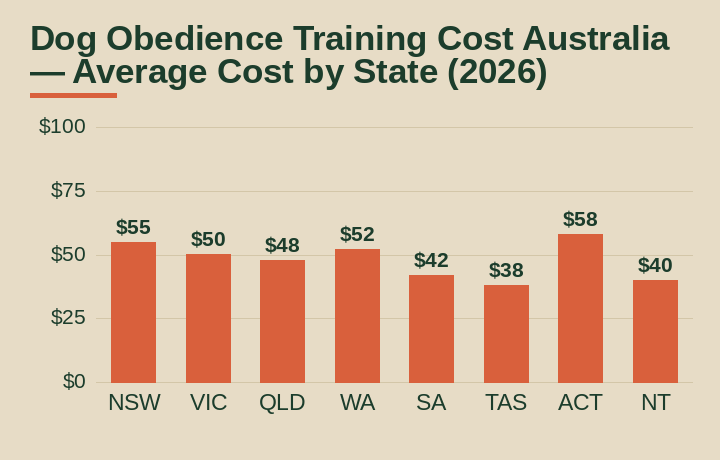
Dog Obedience Training Costs by State (2026)
Prices updated July 2026 from current Australian sources.
| Training type | Typical cost | Notes |
|---|---|---|
| Group class | $25 to $75 / class | |
| Private session | $80 to $300 / session | |
| Six-week beginner course | $150 to $350 | |
| Board-and-train (per week) | $800 to $2,500 |
Group classes are the best value for basic obedience. Board-and-train costs the most and suits specific behaviour goals rather than everyday training.
Sources (July 2026): Airtasker AU, How much does dog training cost, Mad Paws
| State | Average Group Class | Typical Range (Private) |
|---|---|---|
| NSW | $55 | $110 to $280 |
| VIC | $50 | $100 to $270 |
| QLD | $48 | $95 to $260 |
| WA | $52 | $105 to $275 |
| SA | $42 | $85 to $230 |
| TAS | $38 | $75 to $195 |
| ACT | $58 | $120 to $300 |
| NT | $40 | $80 to $210 |
That board-and-train range is wide. A week with a certified trainer in Sydney’s inner west who takes only three dogs at a time runs about $2,000 to $2,500. A suburban kennels-plus-training setup in Adelaide might charge $800 to $1,100 for the same timeframe. The results aren’t necessarily proportional to the price.
Why prices vary so much
Trainer qualifications matter more than most people realise, and they’re not regulated. There’s no mandatory licensing for dog trainers in Australia. Anyone can print business cards and start charging. Trainers with a Certificate IV in Companion Animal Services or Delta Society Australia accreditation typically charge more, but the gap between a $90 and a $250 session often comes down to whether the person actually knows what they’re doing.
Dog size and breed affects cost less than you’d think in group classes, but it matters in private sessions. A trainer working with a 45kg Rottweiler needs different equipment and more physical management than a Cavoodle. Larger breeds sometimes attract a $20 to $40 surcharge in private sessions. Border Collies and working breeds can also take more sessions due to their complexity.
The specific problem you’re trying to fix is the biggest cost driver in private training. Teaching ‘sit’ and ‘stay’ to a well-socialised puppy? That’s straightforward. Addressing leash reactivity, aggression toward other dogs, or separation anxiety? That’s behaviour modification territory, not basic obedience, and it costs accordingly. Expect to pay $150 to $300 per session with a qualified behaviourist for serious cases. You can also check what emergency vet costs look like if behaviour problems escalate to injury.
Location within Australia plays a real role. Metro areas have more trainers competing for business, which keeps group class prices relatively stable. Regional areas often have one or two options, and if demand outstrips supply, prices sit higher despite lower overall cost of living. Worth checking whether any local obedience clubs run community classes, these are often $15 to $35 per session and run by experienced volunteers.
Class size and format affect the value you’re getting. A group class with eight dogs and two trainers is worth more than a class with fifteen dogs and one trainer. Ask before you book. Private sessions conducted in your home cost $20 to $40 more per session than those held at a training facility, but the home environment can be genuinely useful for dogs whose issues are location-specific. For a comparison of mobile versus facility-based services more broadly, see our breakdown of mobile vs salon pricing in Australia.
Picking up a set of high-value training treats before your first session makes a noticeable difference. Dogs stay engaged longer when the reward is worth working for. Don’t show up with dry kibble.
Recommended Products for Dog Obedience Training Cost Australia
If you’re tackling this yourself, here are some products from Amazon Australia that can help (these are affiliate links):
Look for Certificate IV in Companion Animal Services (a nationally recognised vocational qualification), Delta Society Australia membership, or PPGA (Professional Pet Dog Trainers Australia) accreditation. Membership with the Pet Industry Association of Australia is another reasonable indicator. Trainers who rely solely on ‘years of experience’ without any formal credential are harder to assess, and in a completely unregulated industry, that’s a genuine risk worth taking seriously.
Frequently Asked Questions
How much does a six-week dog obedience course cost in Australia?
Most six-week beginner courses run $150 to $350 for group classes. Private six-week packages cost considerably more, typically $480 to $1,200 depending on the trainer’s experience and your location.
Is private dog training worth the extra cost?
For dogs with specific behavioural issues like reactivity, aggression or severe anxiety, private training is often necessary, not just preferable. Group classes aren’t always the right environment when a dog is already overwhelmed. For a well-socialised puppy learning basic commands, group classes are fine and much cheaper.
What’s the difference between obedience training and behaviour modification?
Obedience training teaches commands like sit, stay, heel and recall. Behaviour modification addresses problems like aggression, separation anxiety or resource guarding. Behaviour modification is more complex, takes longer, and costs more. Expect $150 to $300 per session with a qualified behaviourist. If your dog’s health is contributing to their behaviour, it’s also worth knowing what pet acupuncture costs in Australia for pain-related behaviour changes.
Do dog trainers in Australia need to be licensed?
No. There’s currently no mandatory licensing for dog trainers in Australia. Anyone can call themselves a dog trainer. Look for trainers with Delta Society Australia certification, a Certificate IV in Companion Animal Services, or membership with the Pet Industry Association of Australia. These qualifications actually mean something.
At what age should I start obedience training?
Puppies can start basic obedience from 8 weeks of age. Puppy preschool typically accepts dogs from 8 to 16 weeks. The earlier, the better for socialisation. Older dogs absolutely can be trained too, it just sometimes takes more patience and consistency. Check our rundown of puppy school costs in Australia if you’re at that early stage.
How to bring the cost down
- Choose group classes over private sessions. For most dogs with no serious behavioural problems, group classes deliver comparable results at a fraction of the cost. $25 to $75 per session versus $80 to $300 is a real difference over a six-week course.
- Do the homework between sessions. Trainers charge for time, not outcomes. Dogs that practise daily make faster progress and need fewer paid sessions. Ten minutes of consistent practice at home is worth more than any single session in isolation.
- Book a course package, not casual sessions. Most trainers offer a discount when you commit to a course upfront. The per-session saving is usually $15 to $30. Ask before you start.
- Check council-run or RSPCA classes. Some councils and RSPCA branches run subsidised obedience classes for $15 to $35 per session. Quality varies, but the basics are well covered. Check your local council’s website or the RSPCA Australia site for upcoming programs.
- Start with puppy preschool, not private training. A four-week puppy preschool course costs $150 to $250 and covers socialisation plus basic commands. The same content in private sessions would run $400 to $600. Start there and move to private sessions only if specific issues emerge later.
- Combine a book with fewer sessions. A good training reference costs $20 to $40 and covers the theory your trainer will explain in week one. Pair it with home practice using a 10-metre training lead for recall work between sessions, and you’ll get more out of fewer paid classes.
- Check trainer qualifications before paying premium rates. Some trainers charge $250+ per session without any formal credentials. A properly qualified trainer charging $110 to $130 often delivers better results. Credentials to look for: Certificate IV in Companion Animal Services, Delta Society Australia, or PPGA accreditation.
If your dog’s behaviour is affecting their health or you’re dealing with chronic anxiety, it’s also worth considering whether a mobile vet visit could help rule out an underlying medical cause before you invest heavily in training. Pain and illness drive a lot of behaviour problems that no amount of obedience work will fix.
For related ongoing pet care costs, see what dog boarding costs in Australia if you need somewhere for your dog to stay while you travel, or check dog vaccination costs to keep the rest of your budget on track.
The honest take: dog obedience training cost Australia is something most owners get wrong in their initial budget. They either underspend on a single group class and expect miracles, or overspend on intensive private sessions for a puppy that would have been fine in a group class. Know what your dog actually needs, verify the trainer’s qualifications, and build in time to practise at home. That combination beats any expensive package on its own.
People Also Ask About Dog Obedience Training Cost Australia
Can I train my dog myself instead of paying a trainer?
Yes, for basic obedience. Sit, stay, down, come and leash manners are all teachable at home using positive reinforcement. YouTube channels, books and apps can take you a long way for under $50. You’ll need patience and consistency. For behavioural problems like aggression or anxiety, self-training often makes things worse and a professional is worth every cent.
Does pet insurance cover dog obedience training costs?
Standard pet insurance policies in Australia don’t cover obedience training. Some comprehensive policies include behavioural consultations with a qualified veterinary behaviourist if a vet refers you, but this is uncommon. Check your policy’s Product Disclosure Statement carefully if this matters to you.
How many training sessions does a dog typically need?
For basic obedience, most dogs make solid progress in six to eight group sessions if owners practise between classes. For behavioural issues, expect eight to twelve or more sessions, sometimes ongoing. Every dog is different, and a trainer who promises a fixed number of sessions without meeting your dog first is overselling.
Is board-and-train worth the cost in Australia?
Board-and-train programs (where your dog lives with the trainer for one to four weeks) can be effective for intensive obedience, but the results vary enormously with the trainer’s skill. Costs run $800 to $2,500 per week. The bigger risk is that behaviours trained without you present don’t always transfer well back home. Ask trainers how they handle the handover phase. It’s also worth factoring in how this compares to standard dog boarding rates to understand what you’re paying for the training component specifically.
What qualifications should I look for in an Australian dog trainer?
Related Cost Guides
This guide contains affiliate links. We may earn a small commission from qualifying purchases at no extra cost to you.