
Reptile licensing in Victoria catches a lot of first-time keepers off guard. It’s not just one flat fee. You’re looking at a tiered system based on species category, the number of animals you hold, and whether you’re a private keeper or operating commercially. According to the Australian Veterinary Association, reptiles are now among the fastest-growing pet categories in Australia, which means more people are navigating this licensing process than ever before.
Reptile licence cost Victoria starts at $36.90 for a Category 1 Wildlife Controller licence and scales up from there depending on category and number of species. Most private keepers pay $36.90 to $83.80 per year. Commercial operators and those keeping higher-category reptiles pay significantly more.
Prices updated July 2026 from current Australian sources.
| Licence category | Typical annual fee | Who it suits |
|---|---|---|
| Category 1 (Basic) private keeper | $36.90 / year | First-time keepers of basic species |
| Higher private keeper categories | $36.90 to $83.80 / year | Keepers holding more or higher-category species |
| Commercial or advanced licences | Significantly higher | Dealers and commercial operators |
Victorian wildlife licence fees are set by DEECA and indexed each year under the Monetary Units Act. Fees shown are for private keepers; the exact amount depends on your category and how many species you hold. The licence fee does not cover the enclosure, heating or the animal.
Sources (July 2026): Service Victoria, Wildlife Licence, DEECA, Fees and charges, vic.gov.au, Private wildlife licences
Victoria’s wildlife licensing is administered by the Department of Energy, Environment and Climate Action (DEECA, formerly DELWP). The fees are set by regulation and reviewed periodically. The figures in this guide reflect 2026 rates. Prices honestly bounce around slightly each financial year, so double-check the current schedule on the DEECA website before you apply.
Victoria sits roughly in the middle of the pack. Western Australia is the most expensive for private keepers, partly because of the administrative complexity of their licensing system. Queensland is generally competitive, but their category structure is different, so direct comparison isn’t always apples to apples.
Victorian licence tiers: what each category costs
This is where most guides fall short. They quote the base fee and leave it there. But the fee you pay depends entirely on which licence category your chosen reptile falls under. Here’s a direct comparison of the main private keeper tiers.
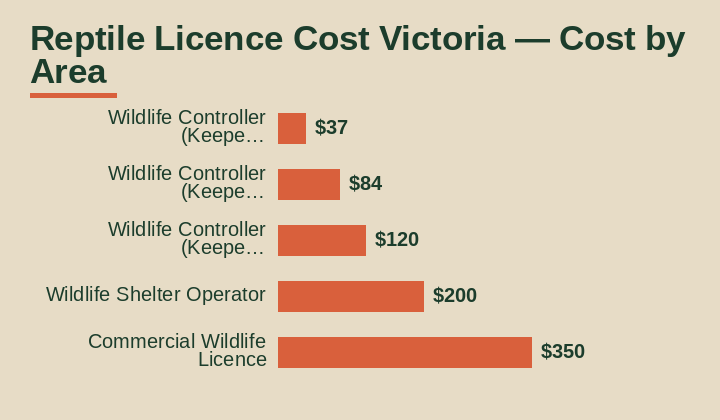
| Licence Type | Annual Fee | Typical Species Covered |
|---|---|---|
| Wildlife Controller (Keeper), Cat 1 | $36.90 | Blue-tongue lizards, water dragons, skinks |
| Wildlife Controller (Keeper), Cat 2 | $83.80 | Pythons, monitors (goannas) |
| Wildlife Controller (Keeper), Cat 3 | $120+ | Higher-risk or less common species |
| Wildlife Shelter Operator | $200+ | Rescue and rehabilitation animals |
| Commercial Wildlife Licence | $350+ | Dealers, breeders selling commercially |
If you want to keep a bearded dragon (Category 1) and a carpet python (Category 2), you’ll need licences covering both. That’s $36.90 plus $83.80 per year at minimum, totalling around $121 before any admin charges.
Where the money actually goes: what drives reptile licence fees
Species category is the biggest cost driver. Victoria classifies native wildlife on a scale that reflects the conservation risk and complexity of keeping each species. Category 1 animals like eastern blue-tongue lizards and eastern water dragons are considered lower-risk for both the keeper and the species. Category 2 and above, which covers pythons like carpet pythons, woma pythons, and monitors, require more oversight. A keeper in Geelong holding only a blue-tongue pays $36.90. Add a carpet python to the collection and you’re up to $83.80 just for the category bump, before any other costs.
Number of species categories held affects the total annual outlay, though Victoria doesn’t typically charge per individual animal at the private keeper level. It’s the category tiers that stack. Holding animals across three categories could push your annual licence fees above $200 with ease.
Application vs renewal fees differ slightly. First-time applications sometimes attract a small processing component above the standard annual rate. Renewals are generally straightforward if your records are current. Missing your renewal deadline is the main way this blows out. If your licence lapses, you’re back to a fresh application, which takes longer and costs more.
Enclosure compliance costs aren’t technically part of the licence fee, but they’re part of the real cost of getting licensed. DEECA requires proof of appropriate housing before a licence is issued. A suitable enclosure for a carpet python, including a quality reptile enclosure, heating, and substrate, can run $300-$600 before your licence is even approved. That’s the cost that surprises most first-time applicants in areas like Reservoir or Frankston.
Annual wildlife returns are compulsory. Every licensed keeper in Victoria must submit a wildlife return each year listing all animals held, acquired, or disposed of. There’s no separate fee for this, but failing to lodge on time can trigger penalties. Set a reminder. Missing it is entirely avoidable.
Questions to ask before you commit to getting licensed
Which category does my chosen species fall under?
DEECA’s online species search tool lets you check before you apply. Getting this wrong and applying for the wrong category means paying again for the correct one. Confirm whether your specific species (not just the common name) is Category 1, 2, or 3 before lodging anything.
Do I need separate licences for each species category?
Yes, in practice. If you want to keep both a blue-tongue lizard (Cat 1) and a carpet python (Cat 2), you’ll need to hold appropriate authorisation for both categories. Some licence types cover multiple categories; confirm with DEECA whether a single application can capture everything you need.
What enclosure documentation will DEECA ask for?
Applications require photos of your enclosure setup demonstrating appropriate heating, lighting, and hide spaces. Inspectors look for species-specific requirements, not just a basic tank. A carpet python enclosure has different requirements to a skink setup. Ask DEECA exactly what photos they need before you go to the trouble of submitting.
Will I need a compliance inspection before the licence is issued?
Not always, but DEECA can conduct unannounced inspections of licensed keepers at any time. Some first-time applicants in metro Melbourne have reported a pre-approval visit. Being prepared for one from day one means you won’t need to scramble later.
What record-keeping system does DEECA expect?
You’re required to maintain records of all acquisitions, disposals, deaths, and breeding outcomes for animals on your licence. There’s no mandated format, but a simple logbook works fine. Ask DEECA if a digital record (spreadsheet or app) is acceptable in your case, as this varies slightly by officer.
Are there restrictions on where I can source my animals?
Yes. Animals must be acquired from licensed sources only. Verbal assurances don’t count. Ask for the seller’s licence number and the transfer documentation. If a seller can’t produce these, walk away. The cost of acquiring an illegally sourced animal is far higher than the licence fee itself.
Recommended Products for Reptile Licence Cost Victoria
If you’re tackling this yourself, here are some products from Amazon Australia that can help (these are affiliate links):
Cheaper alternatives worth knowing
- Start with Category 1 only. A bearded dragon or blue-tongue lizard licence costs just $36.90 per year. Gain experience, build your record-keeping habits, and add a python later. You’re not saving money by jumping straight to a Category 2 licence before you’re ready.
- Buy from licensed private keepers, not pet shops. Private keeper-to-keeper transfers are often $100-$300 cheaper per animal than retail, with the same legal documentation. Check Gumtree’s reptile classifieds or the Victorian Herpetological Society’s noticeboard. MoneySmart’s pet ownership guide also notes that sourcing from established keepers reduces the chance of welfare issues that create vet bills down the track.
- DIY your enclosure within reason. Custom-built plywood enclosures are legal and significantly cheaper than glass terrariums for larger species. A DIY enclosure for a carpet python can cost $120-$200 in materials versus $400-$600 retail. Just ensure dimensions and ventilation meet DEECA requirements before you build, not after.
- Join a reptile keeping club. The Victorian Herpetological Society runs seminars, licence workshops, and has members who can help you avoid application mistakes. Membership is around $40-$55 per year. Compare that to paying for a rejected application twice.
- Get a combined licence if eligible. If you’re planning to keep both lizards and pythons long-term, ask DEECA whether a combined or upgraded licence costs less than two separate category licences. The admin around this changes periodically, and the answer isn’t always obvious from the website.
- Use proper lighting from the start to avoid compliance failures. UVB lighting for reptiles is a basic welfare requirement. Retrofitting after an inspection failure costs more than buying correctly the first time.
If you’re weighing up the ongoing annual costs of reptile ownership more broadly, our breakdowns on pet vaccination costs in Australia and mobile vet costs for pets are worth reading before you commit. Reptile vet care isn’t as cheap as people assume, and exotics vets in Melbourne’s inner suburbs charge a premium.
For context on what other ongoing pet costs look like, the rundown on pet acupuncture pricing shows just how quickly specialist care escalates. And if you’re considering moving interstate with your reptile later, our interstate pet transport cost breakdown covers what that process actually involves.
The reptile licence cost Victoria is genuinely one of the more affordable parts of keeping reptiles legally in this state. The $36.90 base fee is reasonable. The real costs sit elsewhere: appropriate enclosures, specialist vet care, ongoing compliance, and the time it takes to do paperwork properly. If you’re serious about keeping reptiles, factor all of that in before you focus too hard on the licence fee itself. And if you’re also looking at costs for other pets, our overview of dog boarding costs across Australia and the breakdown of pet hydrotherapy pricing give you a sense of what responsible pet ownership costs at different ends of the spectrum.
Frequently asked questions about reptile licence cost Victoria
How much does a reptile licence cost in Victoria?
A basic Wildlife Controller (Keeper) licence in Victoria costs $36.90 per year for Category 1 species. Fees increase with the licence category, reaching $83.80 or more for higher-category animals. Commercial operators and wildlife shelters pay additional tiers.
What reptiles can I keep on a basic Victorian licence?
A Category 1 licence covers many common species including blue-tongue lizards, eastern water dragons, and some skink species. Snakes and pythons generally fall under Category 2 or higher and require a separate or upgraded licence.
Do I need a licence to keep a bearded dragon in Victoria?
Yes. Bearded dragons (Pogona barbata and Pogona vitticeps) are classed as Category 1 wildlife in Victoria. You need a Wildlife Controller (Keeper) licence, which costs $36.90 per year, before you can legally keep one.
How long does it take to get a reptile licence in Victoria?
Processing times vary. DEECA typically takes 4 to 8 weeks from application submission to licence issue. Delays happen when enclosure photos or supporting documents are missing, so submit everything in one go.
Can I keep a snake in Victoria without a licence?
No. All native snakes, including common pythons like the Stimson’s python and Children’s python, are protected wildlife in Victoria. Keeping them without a valid licence is illegal and can result in significant fines.
People Also Ask About Reptile Licence Cost Victoria
Can I keep a wild-caught reptile in Victoria if I have a licence?
No. Victorian wildlife licences only authorise you to keep legally acquired captive-bred animals. Taking reptiles from the wild is a separate and serious offence under the Wildlife Act 1975, regardless of licence status. All animals must come from a licensed source and be listed on your annual wildlife return.
What happens if I keep a reptile in Victoria without a licence?
Keeping protected wildlife without a valid licence in Victoria is an offence under the Wildlife Act 1975. Penalties can include fines of up to $18,000 for individuals and potential confiscation of the animals. Officers from DEECA do conduct inspections and the fines are enforced.
Do reptile licences in Victoria cover interstate travel with my animal?
Not automatically. Moving reptiles interstate requires permits from both the origin and destination state’s wildlife authority. If you’re relocating to Victoria from Queensland or NSW, contact DEECA directly about the transfer process before you move. Costs vary by state but expect $50-$150 in additional permit fees.
Is a Victorian reptile licence valid if I move to another state?
No. Wildlife licences are state-specific. If you move from Victoria to another state, you’ll need to apply for a new licence in that state. You’ll also need to notify DEECA and arrange a legal transfer or export permit for your animals. Each state has different application fees and categories.
Can children or minors hold a reptile licence in Victoria?
No. Applicants must be at least 18 years old to hold a wildlife licence in Victoria. Minors living in a household with a licensed adult keeper are covered under that licence for the animals listed on it, but cannot hold their own licence or be the primary keeper of record.
Related Cost Guides
This guide contains affiliate links. We may earn a small commission from qualifying purchases at no extra cost to you.