A python is one of those pets that catches a lot of first-time keepers off guard on cost. The animal itself is often the cheapest part. According to Animal Medicines Australia’s 2025 Pets in Australia report, reptiles are one of the fastest-growing pet categories in the country, and pythons sit squarely at the centre of that trend. The trouble is most people budget for the snake and forget the enclosure, the heating, the vet, and the licence.
Python cost Australia ranges from around $200 for a common Children's python to $2,500+ for a sought-after Woma or Stimson's python from a specialist breeder. Add $500 to $1,200 for a proper enclosure setup and ongoing costs of roughly $600 to $1,200 per year for food, vet visits and electricity. Budget at least $1,000 to $2,000 all-in before your snake arrives home.
Prices updated July 2026 from current Australian sources.
| Cost | Typical range | Notes |
|---|---|---|
| Common Children’s python | from $200 | |
| Sought-after (Woma, Stimson’s) | $2,500+ | From a specialist breeder |
| Enclosure setup | $500 to $1,200 | |
| Ongoing per year | $600 to $1,200 | Food, vet, electricity |
You also need a reptile keeper licence in most states, see our reptile licence cost guide. Budget at least $1,000 to $2,000 all in before your snake comes home.
Sources (July 2026): PetRescue, Adopt a pet, RSPCA Australia, Animal Medicines Australia, Pets in Australia 2025, Pet Shop Direct
This breakdown covers what you’ll actually pay in 2026, from purchase price through to annual running costs, across all eight states and territories.
What you’ll typically pay for a pet python in 2026
Purchase prices range more than people expect. A common Children’s python from a licensed breeder in regional Queensland might cost $200 to $250. The same species at a Sydney pet shop in Newtown or Surry Hills could be $350 to $400 with no additional value. A sought-after Woma python or a high-colour carpet python morph from a specialist breeder? Expect $1,200 to $3,000.
The species and colour morph drive most of the variation. Locality also matters: breeders in capital cities tend to charge more simply because their overheads are higher. In regional areas like Toowoomba or Geelong, prices honestly run 15 to 25% lower than inner-city equivalents.
| State | Average Cost (purchase) | Typical Range |
|---|---|---|
| NSW | $550 | $220 to $2,800 |
| VIC | $520 | $200 to $2,600 |
| QLD | $480 | $200 to $2,500 |
| WA | $510 | $220 to $2,700 |
| SA | $470 | $195 to $2,400 |
| TAS | $490 | $210 to $2,200 |
| ACT | $530 | $230 to $2,600 |
| NT | $460 | $190 to $2,100 |
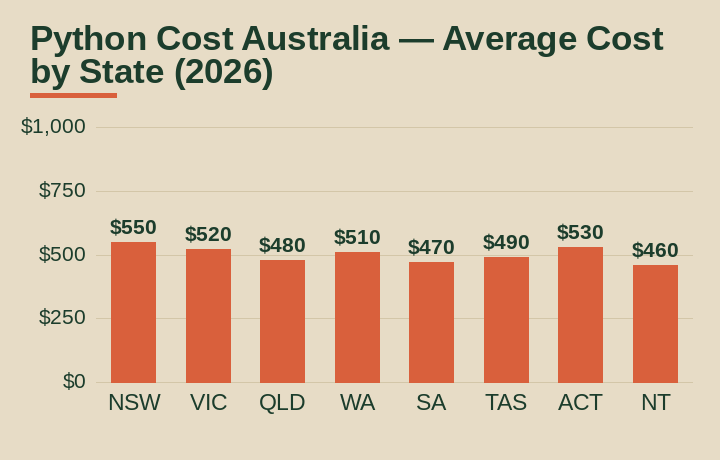
These are purchase prices for captive-bred animals from licensed breeders. Pet shop prices run higher. Rare morphs and adult proven breeders can exceed these ranges considerably.
What’s included and what’s extra when buying a python
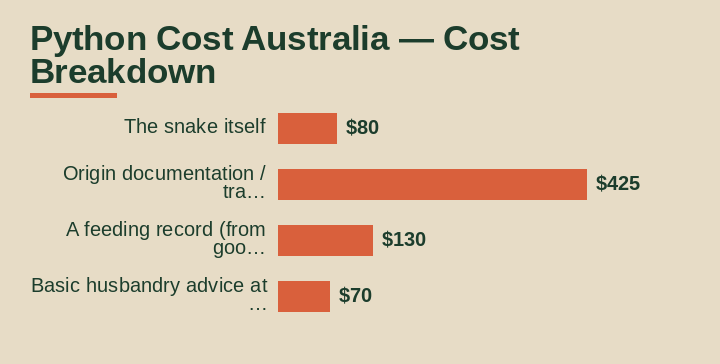
When you buy a python from a reputable breeder, you’re generally getting the animal and documentation of its legal origin. That’s about it. Everything else is on you. This table shows what’s standard and what costs extra.
| Typically Included | Typically Extra (and rough cost) |
|---|---|
| The snake itself | Reptile keeper’s licence ($40 to $120 depending on state) |
| Origin documentation / transfer paperwork | Enclosure ($150 to $700) |
| A feeding record (from good breeders) | Heat mat or lamp and thermostat ($80 to $180) |
| Basic husbandry advice at point of sale | Hides, water bowl, decor ($40 to $100) |
| Substrate (paper towel, aspen, cypress mulch) ($20 to $60) | |
| First vet check ($80 to $150) | |
| Initial food supply ($20 to $40) |
Getting your setup right before the snake arrives saves a lot of stress. A juvenile python placed in an enclosure without a functioning thermostat and proper thermal gradient will stop eating within days. The equipment isn’t optional.
Where the money actually goes: 5 factors that shape python cost Australia
Species and colour morph
This is the biggest driver of purchase price. A standard carpet python (Morelia spilota) runs $300 to $700, while a Jaguar or Axanthic morph of the same species can reach $1,500 to $2,500. Children’s pythons and Spotted pythons are the entry-level options at $200 to $350. Woma pythons sit in the $800 to $1,800 range depending on the breeder. Water pythons are affordable ($200 to $400) but have a reputation for being more difficult to handle for beginners.
Breeder versus pet shop
Pet shops in Parramatta or Northbridge typically charge 30 to 60% more than licensed breeders for the same species. A Stimson’s python from a breeder might be $250; the same animal with a tag at a pet shop is $380 to $420. The breeder option also gives you feeding history, which matters more than people realise, a snake that’s refused food for two months before you buy it is a problem you’ve just inherited.
Enclosure size and heating requirements
A Children’s python can live happily in a 60cm x 45cm enclosure its whole life. A coastal carpet python needs 120cm x 60cm as an adult, sometimes larger. Bigger enclosures cost more to buy and more to heat. In southern states like Victoria and Tasmania, running a heat lamp and under-tank heater through winter adds $150 to $300 to your annual electricity bill. In Darwin or Cairns Northern Beaches, your heating costs are negligible. A quality thermostat for your snake’s enclosure is non-negotiable, it prevents burns and overheating.
Veterinary care availability
Not every vet treats reptiles. In regional SA or inland Queensland, you might drive 90 minutes to reach a vet with genuine reptile experience. In Melbourne’s inner suburbs or Sydney’s North Shore, you’ll pay more per consult ($150 to $250) but you’ll have options. A basic wellness check runs $80 to $180 nationally, but if your python develops a respiratory infection or mites, the treatment bill starts at $200 and can run to $600+. It’s worth checking the Australian Veterinary Association’s vet finder before you commit to keeping a python in your area, know where you’d take a sick animal before you have one.
Licence and legal requirements
Every keeper needs a reptile licence. NSW charges around $60 for a two-year Reptile Keeper Licence. Victoria charges $37.20 for a basic Wildlife Licence. Queensland’s reptile keeper licence starts at $65. These aren’t huge costs individually, but they’re recurring, and keeping a python without one risks fines that are anything but small. Check the RSPCA Australia for a starting point on regulations if you’re unsure where to begin.
Recommended Products for Python Cost Australia
If you’re tackling this yourself, here are some products from Amazon Australia that can help (these are affiliate links):
Questions to ask before you buy a python
When did it last eat, and what did it eat?
This is the most important question most buyers forget to ask. A snake that hasn’t fed in four weeks before you buy it may continue refusing food in a new environment for weeks more. Ask for a feeding log. Good breeders keep one. If they can’t tell you the last three meals, that’s a red flag worth taking seriously.
Has it been treated for mites or parasites?
Mites are common in reptile collections and spread easily between animals. A mite infestation you bring home will require treating both the snake and completely stripping and disinfecting the enclosure, costs around $150 to $250 in product and labour time. Ask directly. If the breeder hesitates, walk away.
Is this animal captive-bred, and do you have the paperwork?
In Australia, all legally kept pythons must be captive-bred and documented. If a seller can’t provide a legal transfer form or origin paperwork, you’re potentially buying wildlife that was taken illegally. The fines for possessing an undocumented reptile run into the thousands.
What enclosure setup is this animal currently in?
Knowing the current temperature gradient, humidity and enclosure size helps you replicate conditions at home. A dramatic environmental change triggers feeding strikes and stress. A good breeder will tell you the hot spot temperature (usually 32 to 35°C for most pythons) and the cool side (24 to 27°C). If they can’t tell you this, their husbandry is probably not up to scratch.
What’s this species’ temperament like as an adult?
Juvenile pythons of any species look similar and handle comparably. Adults are a different story. Some localities of carpet python remain defensive and bitey for years. Water pythons have a reputation for being highly strung. Ask about the temperament of the specific animal and its parents if possible. A breeder who handles their animals regularly will give you an honest answer.
Is there a health guarantee or return policy?
Reputable breeders will offer a short window (usually 7 to 14 days) to return an animal if a vet identifies a pre-existing health issue. This isn’t a legal requirement, but it’s a sign of a responsible operation. No guarantee at all isn’t necessarily a dealbreaker, but it should make you more thorough with pre-purchase questions.
How to bring the cost down
Buy from a licensed breeder directly. I’ve already mentioned this but it genuinely saves money, particularly in Queensland and NSW where the breeder scene is active and competitive. A Children’s python from a breeder at a reptile expo in Brisbane runs $200 to $280. The same animal in a pet shop in Fortitude Valley is $360 to $420. That’s $100+ saved on day one, before you’ve bought a single item of equipment.
Feed frozen, not live. Bulk-buying frozen feeders from an online reptile supplier cuts food costs significantly. A bag of 50 small mice costs $45 to $60 delivered; buying them individually at a pet shop runs $4 to $6 each. For a Children’s python eating every 10 days, that’s a saving of $100+ per year. If you want to make it even more convenient, bulk frozen feeder mice delivered to your door are available through online reptile suppliers and some pet food marketplaces.
Join a reptile keeping community before you buy anything. The Herpetological Society of Queensland, the Victorian Herpetological Society and various online communities on Facebook have second-hand gear available constantly. People upgrade their setups and sell perfectly functional thermostats, enclosures and heat mats for 30 to 50% of retail. A setup that costs $700 new can often be assembled for $300 to $400 with a bit of patience.
For related pet ownership costs that often surprise new keepers, the MoneySmart pet ownership guide offers a useful framework for budgeting total annual costs, not just the purchase price.
Consider a smaller species. This advice sounds obvious but it’s ignored constantly. A Children’s python eats less, needs less space, costs less to heat and handles just as well as a carpet python for most people’s purposes. If you’re on a tight budget, start small. You can always add a larger species later when your setup and budget are established.
Keep up with annual vet checks. Catching a respiratory infection or parasite load early costs $80 to $150 to treat. Leaving it until the snake is visibly unwell costs $300 to $800 or more, and sometimes you lose the animal entirely. This is also a good time to ask your vet about other preventative pet health costs that might catch you off guard.
When you’re weighing up python cost Australia across everything, the purchase price is genuinely the easy part. A $250 Children’s python can cost you $800 to $1,000 in the first year once you factor in the enclosure, heating, licence and first vet visit. That’s not an argument against keeping one, pythons make excellent, low-maintenance pets for the right person, but going in with clear expectations means fewer nasty surprises. If you’re also comparing costs across different pet types, our guides on puppy school prices, dog desexing costs and pet hydrotherapy give a useful sense of where reptile keeping sits in the broader pet ownership cost spectrum.
Frequently Asked Questions
Do I need a licence to keep a python in Australia?
Yes. Every Australian state and territory requires a reptile keeper’s licence before you can legally own a python. Costs and categories vary: in NSW a basic Reptile Keeper Licence runs around $60 for two years, while Queensland’s costs depend on the class of reptile. Apply through your state’s wildlife or environment agency before purchasing.
How much does a carpet python cost in Australia?
A captive-bred carpet python from a licensed breeder typically costs $300 to $700 in 2026, depending on locality, colour morph and age. Coastal carpet pythons at the lower end; Irian Jaya and Jungle morphs push toward $500 to $800 or more.
What do pythons eat and how much does it cost to feed them?
Pythons eat whole prey, mice, rats and occasionally rabbits depending on size. A Children’s python eating small mice costs around $3 to $6 per feed every 10 to 14 days. A large carpet python eating medium rats costs $8 to $15 per feed weekly or fortnightly. Annual food costs typically run $100 to $350, less if you buy frozen feeders in bulk.
What are the ongoing costs of owning a python in Australia?
Budget $600 to $1,200 per year for a typical pet python. This covers food ($100 to $350), electricity for heating and lighting ($150 to $300), annual vet check ($80 to $180), substrate replacement ($50 to $100) and licence renewal (varies by state). Unexpected vet bills for illness or injury can push annual costs considerably higher.
How much does a python vet visit cost in Australia?
A standard reptile vet consultation in Australia costs $80 to $180 depending on the clinic and city. Specialist reptile vets in Sydney or Melbourne can charge $150 to $250 for a consult. Procedures like X-rays, parasite treatment or surgery add considerably to the bill, often $300 to $800+.
People Also Ask About Python Cost Australia
Are pythons expensive to keep compared to other pets in Australia?
Compared to dogs and cats, pythons are relatively cheap to maintain once the setup is done. A typical python costs $600 to $1,200 per year all up, while the Australian Veterinary Association notes dogs average $1,600 to $3,000 annually when you account for food, vet care and grooming. The upfront enclosure cost is the main hurdle for new reptile keepers. For context on what other pets cost, see our breakdown of dog boarding costs in Australia and cat grooming prices to see how pythons compare on ongoing expenses.
Can I legally buy a wild-caught python in Australia?
No. Wild-caught native reptiles cannot be sold or kept as pets in Australia. All legally kept pythons must be captive-bred and sourced from a licensed breeder, with documentation proving their origin. Buying or selling wildlife without appropriate permits carries serious criminal penalties under state and federal legislation.
How much does it cost to set up a python enclosure in Australia?
A basic but functional setup for a juvenile python costs $300 to $600: enclosure ($150 to $350), heat mat or heat lamp and thermostat ($80 to $150), hides and decor ($40 to $80) and substrate ($20 to $50). A proper adult enclosure with better heating and more space runs $600 to $1,200. Don’t cut corners on the thermostat, it’s the most important piece of equipment. You can also check how other pet setup costs compare if you’re fitting out a home for multiple animals.
What is the cheapest python to buy in Australia?
Children’s pythons (Antaresia childreni) and Stimson’s pythons are consistently the most affordable, with captive-bred animals available for $200 to $350 from licensed breeders. They’re also smaller and easier to manage, making them a sensible first python for new keepers. Spotted pythons are similarly priced and available.
Do pythons need insurance in Australia?
Pet insurance for reptiles exists in Australia but is not widely taken up. A handful of providers offer exotic pet or reptile cover, typically costing $15 to $40 per month. Whether it’s worth it depends on your appetite for risk: a major veterinary procedure for a python can cost $500 to $2,000, so insurance makes more sense the more you’ve spent on the animal itself. See our look at mobile pet vet costs for a sense of what veterinary services typically run outside a clinic setting.
Related Cost Guides
This guide contains affiliate links. We may earn a small commission from qualifying purchases at no extra cost to you.