
The price of a British Shorthair is one of the first things people search when they fall for that round-faced, plush-coated look. And the short answer is: they’re not cheap. From a registered breeder in 2026, you’re looking at $1,800 on the low end and $4,500 or more for sought-after colours. According to Animal Medicines Australia’s 2025 Pets in Australia report, cats remain the second most popular pet in the country, and demand for pedigree breeds like the British Shorthair has kept prices consistently high.
British Shorthair price Australia typically runs $1,800 to $4,500 from a registered ANCATS or ACF breeder in 2026. Blue and lilac coloureds sit mid-range around $2,200 to $3,000, while rare colourpoints and golden shaded kittens push toward $3,500 to $4,500. Rescue adoption is available for $150 to $400 if you're not set on a pedigree kitten.
Prices updated July 2026 from current Australian sources.
| Source | Typical price | Notes |
|---|---|---|
| Registered ANCATS or ACF breeder | $1,800 to $4,500 | |
| Blue and lilac colours | $2,200 to $3,000 | Mid-range |
| Rare colourpoint or golden shaded | $3,500 to $4,500 | |
| Rescue adoption | $150 to $400 | If you are not set on a pedigree kitten |
Buy from a registered ANCATS or ACF breeder for health-tested kittens and proper paperwork. Rescue is a much cheaper option if pedigree isn’t essential.
Sources (July 2026): PetRescue, Adopt a pet, RSPCA Australia, Adopt a pet, Animal Medicines Australia, Pets in Australia 2025
This isn’t a breed you’ll find discounted at a backyard sale without some serious red flags attached. The pricing reflects genuine breeding costs, genetic health testing, and a limited pool of reputable breeders spread across a large country. Here’s exactly what you’ll pay, and what actually drives the number.
What You’ll Typically Pay in 2026
British Shorthair kittens in Australia sit in a fairly predictable band once you’re dealing with registered breeders. Pet-quality kittens from mainstream colours start around $1,800 to $2,200. Show-quality kittens or rare colour varieties can push well past $4,000. The table below gives a realistic picture by state, based on advertised prices from ANCATS and ACF registered breeders in early 2026.
| State | Average Cost | Typical Range |
|---|---|---|
| NSW | $2,900 | $2,200 to $4,500 |
| VIC | $2,800 | $2,100 to $4,200 |
| QLD | $2,500 | $1,900 to $3,800 |
| WA | $2,700 | $2,000 to $4,000 |
| SA | $2,400 | $1,800 to $3,600 |
| TAS | $2,200 | $1,800 to $3,200 |
| ACT | $2,850 | $2,200 to $4,000 |
| NT | $2,600 | $2,000 to $3,800 |
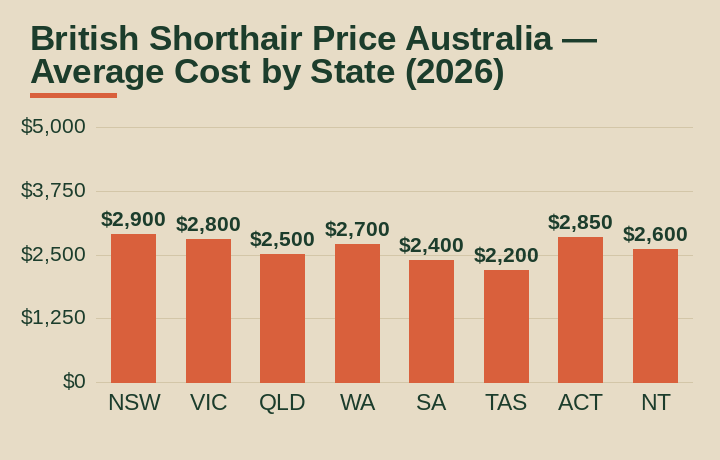
NSW and ACT command the highest prices, largely due to operating costs for breeders in Sydney and Canberra. Queensland and South Australia are noticeably cheaper, which is why interstate purchases are common despite the logistics.
Where the Money Actually Goes
A lot of people see $2,500 for a kitten and assume someone’s making a killing. The reality is more complicated. Here are the factors that genuinely move the price.
Coat Colour and Pattern
Blue (grey) British Shorthairs are the breed’s most iconic colour and the most commonly available. A blue kitten in Sydney typically costs $2,000 to $2,800. But golden shaded and golden chinchilla variants are genuinely rare and time-consuming to breed selectively, those push to $3,500 to $4,500. Colourpoints (which resemble a Ragdoll-British Shorthair hybrid in colouring) sit around $2,800 to $3,800. Lilac and cinnamon are harder to find and priced accordingly at $3,000 to $4,200. If you just want a pet and aren’t fussed on colour, blue or black saves you real money.
Show Quality vs Pet Quality
Breeders grade kittens within the litter. A show-quality kitten has the conformation, coat density, and facial structure to compete. Those kittens cost $3,000 to $4,500 and usually aren’t desexed before sale. Pet-quality kittens from the same litter might have slightly less extreme facial features or a coat that’s not quite show-dense. They cost $1,800 to $2,600 and are typically sold desexed. For most buyers, pet quality is the right call. The cat looks identical to the average eye.
Breeder Reputation and Testing
Reputable breeders invest seriously in health screening. Hypertrophic cardiomyopathy (HCM) is a real risk in British Shorthairs, and cardiac screening via echocardiogram costs breeders $300 to $600 per cat per round. Blood group testing, PKD screening, and genetic panels add to that. A breeder doing it properly is spending $800 to $1,500 per breeding pair in annual testing. That cost flows through to the kitten price, and it should. The Australian Veterinary Association has flagged rising ownership costs as a real pressure point, and buying from a health-tested breeder is one of the best ways to control long-term vet bills.
Location and Breeder Density
You’ll pay more in inner-Sydney suburbs or Melbourne’s inner east than in regional Queensland or outer Adelaide. Breeders in Newtown or Fitzroy have higher overheads than someone running a small cattery in Toowoomba or the Adelaide Hills. The price gap between an inner-city NSW breeder and a regional SA breeder can be $400 to $700 for essentially the same kitten. Add interstate freight ($300 to $600 for a kitten courier) and the savings often disappear, but it’s worth comparing.
Inclusions at Sale
What comes with the kitten changes the real-value calculation. A thorough breeder typically includes: microchipping, first vaccination, vet health certificate, registration papers, desexing (for pet kittens), a starter pack of food, and often a short-term health guarantee. A cut-price listing might include only the kitten. Breaking down what a typical $2,500 kitten actually covers in costs: microchip ($30), vaccination ($80), vet check ($75), desexing ($200 to $350), registration ($80 to $120). That’s $500 to $650 in inclusions before the breeder covers food, stud fees, litter costs, and time. It adds up.
Kitten Quality vs Colour: What You’re Actually Paying For
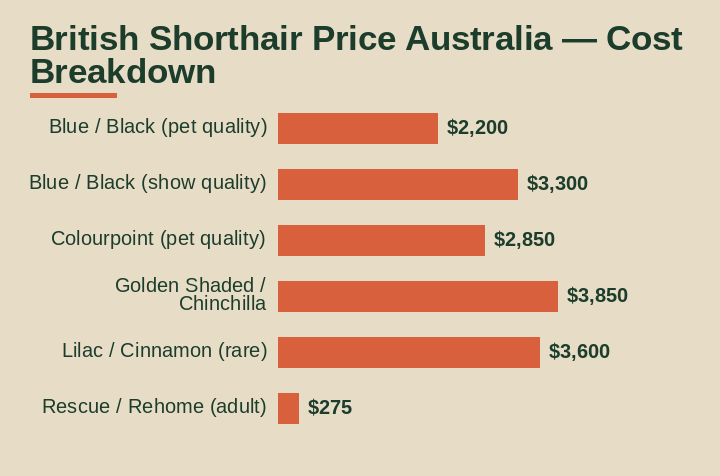
This table is useful if you’re deciding between colour options or quality tiers and want a straight comparison.
| Type | Typical Price Range | Desexed at Sale? | Show Eligible? |
|---|---|---|---|
| Blue / Black (pet quality) | $1,800 to $2,600 | Usually yes | No |
| Blue / Black (show quality) | $2,800 to $3,800 | No | Yes |
| Colourpoint (pet quality) | $2,500 to $3,200 | Usually yes | No |
| Golden Shaded / Chinchilla | $3,200 to $4,500 | Varies | Varies |
| Lilac / Cinnamon (rare) | $3,000 to $4,200 | Varies | Varies |
| Rescue / Rehome (adult) | $150 to $400 | Usually yes | No |
For most people buying a companion cat, a blue or black pet-quality kitten is the sweet spot. You get the breed’s temperament and look without paying the rare-colour premium. Show-quality kittens make sense if you’re entering competitions, but for couch companionship, the difference is marginal.
Recommended Products for British Shorthair Price Australia
If you’re tackling this yourself, here are some products from Amazon Australia that can help (these are affiliate links):
Questions to Ask Before You Commit
Can I see the HCM echocardiogram results for both parents?
This is the most important health question for British Shorthairs. HCM is hereditary and can be expensive or fatal. A responsible breeder will have recent cardiac screening documentation (within the last 12 to 24 months) for both the sire and dam. If they can’t produce it, walk away.
Which body is the kitten registered with, and can I verify it?
ANCATS and ACF registrations are verifiable. Ask for the registration number and confirm it with the body directly. Unregistered kittens sold as ‘purebred’ are a common scam, especially on Facebook Marketplace and Gumtree. Registration is not a guarantee of quality, but it at least means the breeder is accountable to someone.
What vaccinations has the kitten received, and when is the next due?
Kittens typically receive their first vaccination at 8 weeks and a second at 12 weeks. If a breeder is selling at 10 to 12 weeks, confirm the vaccine schedule so you know what’s outstanding. You’ll need to budget for the remaining kitten vaccination costs before full protection kicks in.
Is the kitten already desexed, or is there a desexing clause?
For pet-quality kittens, most reputable breeders in Australia either desex before sale or include a binding clause in the contract requiring desexing by a certain age. Clarify this upfront. If you’re buying undesexed, cat desexing costs typically add another $150 to $300 to your budget shortly after purchase.
What’s your policy if the kitten develops a genetic health condition?
Reputable breeders usually offer a health guarantee covering genetic conditions for 1 to 2 years. Get this in writing. Understand exactly what the remedy is: replacement kitten, partial refund, or contribution to vet costs. Vague verbal assurances aren’t worth much.
How are kittens socialised before leaving the cattery?
British Shorthairs are known for being calm and adaptable, but early socialisation with humans, other pets, and household noises matters a lot. Ask about daily handling, whether they’re raised underfoot in a home environment, and exposure to children if that’s relevant to your household. A kitten raised in an isolated cage for 12 weeks will take longer to settle.
How to Bring the Cost Down
- Choose blue or black over a rare colour, you’ll save $400 to $1,200 instantly, with no difference in temperament or health.
- Ask about pet-quality kittens from show litters, these sell for $200 to $500 less than siblings and are genetically identical. The difference is minor conformation details that only a judge would notice.
- Consider adopting an adult British Shorthair, rescue and rehoming groups occasionally have purebreds for $150 to $400. Check RSPCA, breed-specific Facebook groups, and PetRescue. You’ll skip the kitten chaos, which is genuinely underrated. A settled adult cat is also cheaper to board long-term than an anxious kitten.
- Get pet insurance immediately, before your first vet visit. HCM diagnosis closes most insurance doors. Premiums of $35 to $75 per month look expensive until you’re facing a $5,000 cardiology bill. See MoneySmart’s guidance on pet ownership costs for a realistic budget framework.
- Buy food in bulk on subscription, British Shorthairs do well on breed-specific formulas. Buying a 4kg bag on subscription from Petbarn versus a 400g bag weekly saves roughly $200 per year. An interactive puzzle feeder also slows their eating, which reduces the risk of obesity-related vet costs later.
- Budget for dental care from the start, British Shorthairs are prone to dental issues. Starting tooth-brushing habits early and scheduling annual check-ups avoids the much higher cost of professional pet dental cleaning down the track.
The british shorthair price Australia is genuinely high by international standards, and that’s unlikely to change while demand stays strong and breeder numbers stay limited. The best advice I can give: budget the full first-year cost (purchase plus setup plus food plus vet care), not just the kitten price. That first year typically runs $4,500 to $7,500 all up. If that’s workable, a British Shorthair is a genuinely low-maintenance, calm companion that suits apartments and busy households alike. Just buy from a registered breeder, ask for the health testing documentation, and don’t let a great-looking Gumtree listing convince you to cut corners on this one.
FAQs About British Shorthair Price Australia
How much does a British Shorthair kitten cost in Australia?
From a registered breeder, expect to pay $1,800 to $4,500 depending on colour, gender, and pedigree quality. Blue British Shorthairs are the most common and typically cost $2,000 to $2,800. Rare colours like golden shaded or colourpoint push the price to $3,500 to $4,500.
Why are British Shorthairs so expensive in Australia?
Breeding costs are high in Australia. Registered breeders invest in genetic health testing, vaccination, microchipping, desexing, and ANCATS or ACF registration. Many imported bloodlines from the UK or Europe add to the initial cost. There are also far fewer active breeders than demand warrants, which keeps prices elevated.
Are there cheaper British Shorthairs available in Australia?
Yes, but buyer beware. Unregistered or backyard-bred British Shorthairs do appear on Gumtree or Facebook Marketplace at $800 to $1,200. The risk is unknown health history, potential genetic conditions like hypertrophic cardiomyopathy (HCM), and no breeder support. It looks cheaper upfront but can cost far more in vet bills down the track.
Do British Shorthair breeders in Australia desex kittens before sale?
Most registered breeders in Australia sell pet-quality kittens already desexed, or include a desexing clause in the contract. If you’re purchasing a show or breeding kitten, desexing is not done by the breeder. Always confirm what’s included in the price before signing anything.
What ongoing costs should I budget for after buying a British Shorthair?
Budget around $2,000 to $3,500 per year for a British Shorthair in Australia. That covers premium food ($600 to $900/yr), annual vaccinations ($90 to $180), regular vet check-ups, and pet insurance ($400 to $900/yr). British Shorthairs are prone to HCM and obesity, so vet costs can be higher than average if issues arise. A quality deshedding brush is also worth having, despite their name, British Shorthairs shed heavily in spring and regular brushing cuts down on hairballs. You might also want to look at professional cat grooming costs if brushing at home becomes a battle.
People Also Ask About British Shorthair Price Australia
Is it cheaper to buy a British Shorthair in Queensland or Victoria?
Queensland breeders tend to price slightly lower than Sydney or Melbourne, with typical kitten prices around $1,900 to $3,200 in QLD versus $2,200 to $4,000 in NSW and VIC. The difference reflects cost of living and breeder competition. That said, transport costs for interstate purchases can close the gap quickly, so factor in $300 to $600 for kitten freight before assuming QLD is a bargain.
How long is the wait list for a British Shorthair kitten in Australia?
Most reputable Australian breeders have wait lists of 3 to 12 months. Demand outstrips supply significantly, particularly for blue and golden shaded kittens. Breeders producing rare colours like lilac or cinnamon often have waits exceeding 12 months, so if you’re set on something specific, start your search early and be prepared to wait.
Can I import a British Shorthair kitten from the UK to Australia?
Technically yes, but the process is expensive and lengthy. Between export health certificates, quarantine requirements, and airfreight, importing a single kitten from the UK typically costs $4,000 to $8,000 on top of the purchase price. For most buyers, sourcing locally is far more practical. If you do pursue it, check what overseas pet relocation actually costs before committing.
What’s the difference between ANCATS and ACF registered British Shorthairs?
Both ANCATS (Australian National Cats) and ACF (Australian Cat Federation) are recognised Australian registering bodies for pedigree cats. A kitten registered with either body means the breeder is accountable to an organisation with a code of ethics. Neither is definitively ‘better’ than the other. The quality of the individual breeder matters far more than which body they’re affiliated with.
Do British Shorthairs have any health issues that affect long-term costs?
Yes, and it’s worth knowing before you buy. Hypertrophic cardiomyopathy (HCM) is the main concern, it’s a hereditary heart condition that can require ongoing medication and specialist cardiology visits costing $300 to $600 per consultation. Reputable breeders cardiac-screen their breeding cats annually. Ask for recent echocardiogram results before committing. If you want to understand the broader picture of ongoing pet health costs, the Australian Veterinary Association publishes useful guidance on breed-specific health management.
Related Cost Guides
This guide contains affiliate links. We may earn a small commission from qualifying purchases at no extra cost to you.