
Pet sitting cost Australia sits between $25 and $95 per visit or night in 2026, depending on whether you want a quick drop-in, an overnight stay or full house-sitting with pet care folded in. That’s a wide spread, and the gap between the cheap end and the premium end usually comes down to insurance, sitter experience and how inner-city you live.
Pet sitting cost Australia typically runs $25-$45 per drop-in visit, $55-$95 per overnight stay at your home, and $35-$75 per night for house-sitting with pet care included. Rates climb in inner Sydney and Melbourne, and drop in regional areas. Multiple pets usually add $5-$15 each.
Prices updated July 2026 from current Australian sources.
| Service | Typical price | Notes |
|---|---|---|
| Drop-in visit | $25 to $45 per visit | Feeding, toileting, a short play |
| Overnight stay at your home | $55 to $95 per night | Sitter stays overnight |
| House-sitting with pet care | $35 to $75 per night | Sitter lives in while you travel |
Rates climb in inner Sydney and Melbourne and drop in regional areas. Multiple pets usually add $5 to $15 each per visit or night, and public holidays attract a surcharge.
Sources (July 2026): Pawshake Australia, Mad Paws, PetCloud
When I researched current rates across Mad Paws, Pawshake, local Facebook groups and a handful of independent sitters, the pattern that stood out was how much postcode matters. A 30-minute cat visit in Newtown was quoted $42; the same visit in Penrith came in at $28. According to MoneySmart’s household budget data, pet care is one of the line items Australians underestimate most when planning holidays.
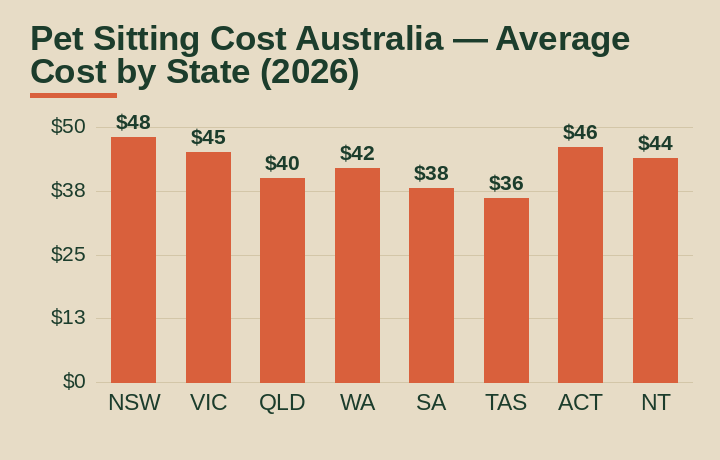
| State | Average Cost | Typical Range (per visit/night) |
|---|---|---|
| NSW | $48 | $28 to $95 |
| VIC | $45 | $28 to $90 |
| QLD | $40 | $25 to $80 |
| WA | $42 | $26 to $82 |
| SA | $38 | $25 to $75 |
| TAS | $36 | $25 to $70 |
| ACT | $46 | $30 to $88 |
| NT | $44 | $28 to $80 |
Why pet sitting cost Australia varies so much
The price you’re quoted reflects four or five very specific things. Not just “location and service type”, that vague answer hides the real drivers.
Visit type and duration. A 30-minute drop-in averages $35. Stretch it to 60 minutes and it jumps to $50-$65. An overnight stay where the sitter sleeps at your house typically runs $75-$95 in Sydney and Melbourne, $55-$70 in Adelaide and Hobart. The hourly equivalent works out cheaper for overnights, which is why families with anxious dogs lean that way.
Number and type of pets. One cat, one fee. Two cats add $8-$12. A cat and a dog can add $15-$20 because the dog needs walking on top of feeding. Reptiles, birds and fish are often charged at lower rates ($20-$30) because the visit’s quicker, but only if the sitter’s comfortable handling them.
Sitter type and insurance. A platform-vetted sitter from Canstar Blue-rated services like Mad Paws comes with public liability cover, police checks and a review system, and charges $35-$50 per drop-in. A neighbour’s teenager doing it for cash sits at $15-$25 but carries zero protection if your dog escapes or gets injured.
Location. Inner-Sydney suburbs (Surry Hills, Newtown, Bondi) and inner-Melbourne (Fitzroy, Richmond, South Yarra) run 20-30% above the state average. Outer suburbs like Penrith, Frankston or Ipswich track closer to the lower bound. Regional towns are cheaper still, but supply gets thin during school holidays.
Special requirements. Medication administration adds $5-$10 per visit. Diabetic cats requiring insulin injections often attract a $15-$20 surcharge because of the precision involved. Reactive dogs needing solo walks rather than group walks bump rates by 25-40%. A Pet camera with treat dispenser can sometimes reduce the need for extra visits if your dog just needs reassurance rather than hands-on care.
What you get at each price tier
The cheap end and the premium end aren’t the same service with different stickers on them. They genuinely differ. Here’s how the three common tiers actually compare.
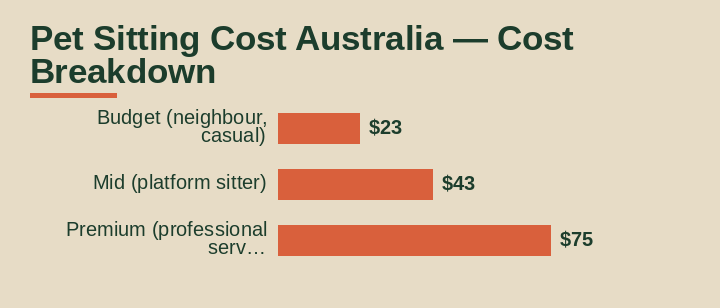
| Tier | Price Range | What’s Included |
|---|---|---|
| Budget (neighbour, casual) | $15 to $30 per visit | Feeding, water top-up, basic check. No insurance, no formal updates, no backup if they cancel. |
| Mid (platform sitter) | $30 to $55 per visit | Feeding, walking, play time, photo updates, $1M public liability, vet transport if needed. |
| Premium (professional service) | $55 to $95 per visit/night | Overnight stays, medication, multiple pets, key collection, plant watering, post-visit reports, backup sitter cover. |
For most owners with a single healthy pet and a long weekend away, mid-tier is the sweet spot. Premium earns its keep for medical pets, multi-pet households, or trips over two weeks where things genuinely go wrong sometimes.
Questions to ask before you book
Are you insured, and what does the cover include?
Listen for “public liability through [platform name]” or “my own pet business insurance.” Vague answers about “being careful” mean no cover. A dog bite claim without insurance can run into tens of thousands.
What’s your backup plan if you get sick?
Professional sitters have a buddy system or platform-backed cover. Casual sitters often don’t. Mid-trip cancellation with no backup is the single most stressful pet-sitting scenario.
Do you send photo or video updates, and how often?
Standard mid-tier service is one update per visit. Premium often does video. If updates matter to you (and they should for anxious pets), confirm before booking, not after.
How do you handle medication, and is there a surcharge?
Pills hidden in food are usually included. Insulin injections, ear drops or fluid therapy almost always attract a fee. Get the figure in writing.
What’s your cancellation and refund policy?
Plans change. A sitter charging 50% for cancellations within 7 days is reasonable. One charging 100% with 30 days’ notice is not. School-holiday bookings often have stricter terms.
Can you meet my pet before the first booking?
A meet-and-greet, usually free or $10-$15, is non-negotiable for dogs. Cats are more forgiving. If a sitter refuses to meet beforehand for a week-long dog booking, walk away.
Recommended Products for Pet Sitting Cost Australia
If you’re tackling this yourself, here are some products from Amazon Australia that can help (these are affiliate links):
How to bring the cost down
- Switch overnights for drop-ins where possible. Two daily visits at $35 each costs $70. An overnight is $85-$95. Saves $15-$25 per day, multiplied across a fortnight that’s $200+.
- Try a house-sitting swap site. Aussie House Sitters and MindMyHouse connect travelling sitters with homes needing pet care, no money changes hands. Best for trips of 2+ weeks. Sample saving: $600 over a two-week holiday.
- Use automation to cut visit count. A timed feeder and a Large capacity pet water fountain means one daily check instead of two for cats. Saves $25-$40 per day on longer trips.
- Book outside school holiday peak. Christmas and July rates climb 15-25%. Travel in February, May or September if you can flex.
- Use platform credit and referral codes. Mad Paws and Pawshake regularly offer $20-$30 off first bookings, and refer-a-friend credit stacks.
- Consider boarding for short single-pet trips. Compare with rates from guides like Sydney dog boarding, Brisbane boarding or Perth kennel prices. For one dog over a weekend, kennels often win on price.
- Negotiate longer stays. Many sitters discount 10-15% for stays over 10 days. Just ask.
Pet sitting cost Australia vs other options
Worth comparing before you commit. Boarding kennels run $45-$70 per dog per night with limited individual attention. Doggy daycare with overnight extension hits $80-$120. In-home pet sitting beats both for multi-pet households and for cats, who genuinely hate kennels.
If your dog needs grooming before or after a trip, factor that in too, our breakdowns on Sydney grooming rates, Perth grooming and Adelaide grooming give realistic numbers. And if your sitter spots something off health-wise, you might be looking at a vet consultation or pet blood test on top.
Common pet sitting cost mistakes
Assuming the quote covers extras. Key collection ($10-$20), plant watering ($5-$10), bin runs ($5) and mail collection are often line-item extras, not freebies. Ask up front.
Booking last minute. Sub-48-hour bookings attract 20-30% surge pricing on most platforms. School holidays make this worse.
Skipping the meet-and-greet. A bad pet-sitter match wastes the whole fee. The free 20-minute meeting saves the booking.
Paying cash without a written agreement. No paper trail means no recourse. Even casual sitters should agree to a one-page email confirming dates, fees and emergency contacts.
Bottom line: pet sitting cost Australia in 2026 sits between $25 and $95 depending on how much hand-holding your pet needs and where you live. Mid-tier platform sitters at $35-$50 per visit are where most owners land, and that’s usually the right call. Book early, ask the right questions, and you’ll spend less than the holiday flights cost.
Frequently asked questions
How much does a pet sitter charge per visit in Australia?
A standard 30-minute drop-in visit runs $25-$45 in 2026. Insured, police-checked sitters from agencies sit at the top of that range, while neighbourhood sitters found on local Facebook groups often charge $20-$30.
Is pet sitting cheaper than boarding kennels?
For one pet over a short trip, kennels at $45-$70 per night can be cheaper. For two or more pets, or stays over a week, in-home pet sitting usually works out better value and far less stressful for the animals.
Do pet sitters charge extra for multiple pets?
Yes. Most charge an additional $5-$15 per extra pet per visit or per night. Some cap the surcharge at two extras, which matters if you’ve got three cats or a multi-dog household.
Are pet sitters insured in Australia?
Professional sitters through platforms like Mad Paws or Pawshake carry public liability insurance up to $1 million. Casual sitters often don’t, so confirm cover before handing over keys, especially for dogs with reactivity issues. Choice Australia recommends checking insurance documentation directly rather than taking a sitter’s word for it.
What’s the difference between drop-in visits and house sitting?
Drop-ins are short visits (usually 30 minutes, 1-3 times daily) where the sitter feeds, walks and checks on your pet. House sitting means the sitter lives at your place for the duration, which costs more but gives your pet near-constant company.
People Also Ask About Pet Sitting Cost Australia
How much should I tip a pet sitter in Australia?
Tipping isn’t expected in Australia like it is in the US. A genuine thank-you, a positive review and a small gift card ($20-$50) for longer stays is more than enough. Repeat business is the real tip.
Can I claim pet sitting as a tax deduction?
Generally no, pet care is a personal expense. The narrow exception is if your pet is a working animal (a farm dog, an assistance animal) or if you run a registered pet-related business. Check with a tax agent for your specifics.
How long can a cat be left with just drop-in visits?
Most healthy adult cats handle one drop-in per day for trips up to a week. Kittens, senior cats, and any cat on medication need twice-daily visits minimum. Diabetic cats need 12-hour insulin spacing, which dictates the schedule.
Do pet sitters look after birds, reptiles or fish?
Some do, but it’s a specialist skill. Expect to pay $30-$60 per visit for reptiles or birds because of the handling knowledge required. Fish are usually cheapest, often $20-$30 for a quick feed and tank check.
What happens if my pet gets sick while the sitter is there?
Reputable sitters carry your vet’s details and have written permission to seek treatment up to an agreed limit (usually $500-$1,000). You’re responsible for the vet bill. Always leave emergency funds or an authorised credit card detail.
Related Cost Guides
This guide contains affiliate links. We may earn a small commission from qualifying purchases at no extra cost to you.