
Ask most people what a cat costs and they’ll picture the adoption fee. It’s the ongoing stuff that catches you out. Speaking from having had a cat myself, adoption is the easy part. It’s the surprise bills, like a $480 dental clean a few months in, that catch you sideways.
Cat ownership cost Australia sits at $400-$2,500 upfront (adoption, desexing, microchip, starter gear) then $1,800-$3,500 every year for food, litter, vet care and insurance. Premium pedigree cats and city vets push that yearly figure closer to $4,500.
Prices updated July 2026 from current Australian sources.
| Cost | Typical range | Notes |
|---|---|---|
| Upfront | $400 to $2,500 | Adoption, desexing, microchip, starter gear |
| Ongoing per year | $1,800 to $3,500 | Food, litter, vet care, insurance |
| Pedigree cats or city vets | up to $4,500 / year |
Adopting a healthy moggie keeps both the upfront and ongoing costs at the lower end. Pedigree cats and inner-city vet fees push the yearly figure up.
Sources (July 2026): Animal Medicines Australia, Pets in Australia 2025, RSPCA Australia, Adopt a pet, PetRescue, Adopt a pet
When I researched current prices across vet clinics, shelters and pet retailers for this guide, the pattern was clear. The upfront figure most people quote ($300 or so) is roughly a third of what you’ll actually spend in year one. According to Animal Medicines Australia’s pet ownership research, cat owners consistently underestimate annual costs, and the gap between budget and reality usually shows up in the vet aisle. MoneySmart’s pet ownership page backs this up.
What you’ll typically pay for cat ownership cost Australia in 2026
Yearly running costs sit between $1,800 and $3,500 for a single healthy indoor cat. Upfront costs (adoption, desexing, basic gear) add $400-$2,500 depending on whether you go shelter or breeder. Vet bills are the wild card.
Here’s the state-by-state breakdown of annual running cost, based on routine vet fees, food, litter and mid-tier insurance.
| State | Average Annual Cost | Typical Range |
|---|---|---|
| NSW | $2,650 | $1,950 to $3,800 |
| VIC | $2,500 | $1,850 to $3,600 |
| QLD | $2,350 | $1,750 to $3,400 |
| WA | $2,450 | $1,800 to $3,500 |
| SA | $2,200 | $1,650 to $3,200 |
| TAS | $2,150 | $1,600 to $3,100 |
| ACT | $2,700 | $2,000 to $3,900 |
| NT | $2,550 | $1,900 to $3,700 |
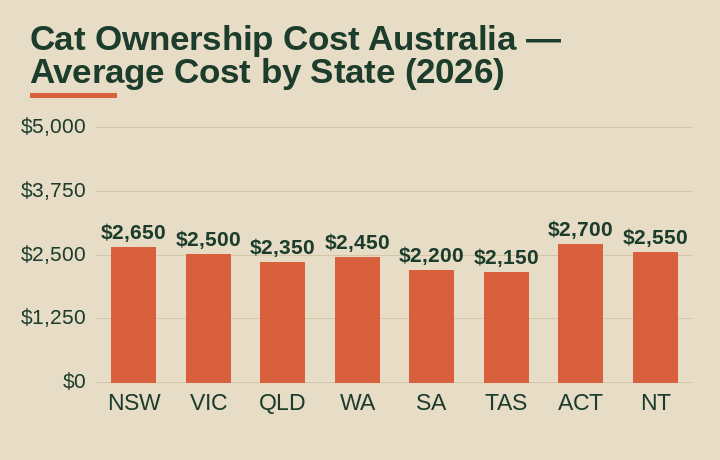
Sydney and Canberra sit at the top because vet fees and rent (which clinics pass on) run higher. Adelaide and Hobart come in cheaper for the same reasons in reverse.
A real Melbourne first-year breakdown
Take a Footscray shelter adoption like Sienna’s. Here’s what year one actually looked like, line by line:
- RSPCA adoption (desexed, microchipped, F3 vaccinated, vet checked): $220
- Council registration (lifetime, desexed): $58
- Hard-sided carrier, two bowls, bed, scratching post, litter tray: $180
- First month’s food and litter starter: $95
- Year of dry food (Royal Canin Indoor, 4kg bags from PetCircle): $480
- Year of wet food sachets (3 a week): $310
- Year of clumping litter (15kg bulk bags): $290
- Annual booster + health check: $185
- Parasite prevention (Revolution Plus, online): $190
- Unscheduled dental clean and one extraction: $580
- Pet insurance (accident + illness, $200 excess): $480
Total: $3,068. No emergencies. No pedigree premium. Just a normal year with one moderate vet surprise. That’s where most first-time owners land.
Breakdown by cat type and lifestyle
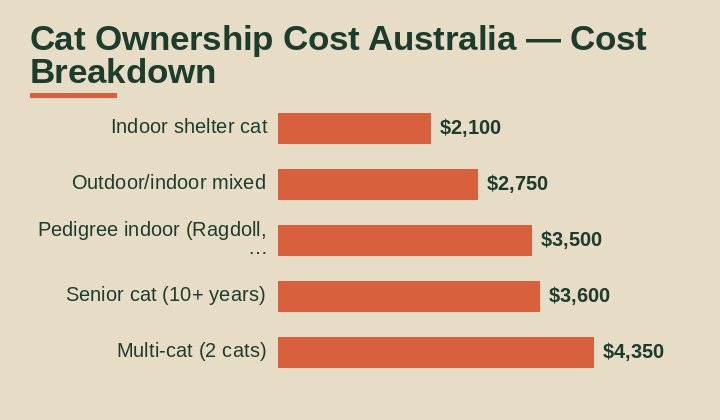
Costs swing hard depending on whether you’ve got a shelter moggie or a Ragdoll, and whether they go outside. Below is what each scenario typically runs annually.
| Cat Type | Annual Cost | Main Cost Drivers |
|---|---|---|
| Indoor shelter cat | $1,800 to $2,400 | Standard food, litter, basic vet |
| Outdoor/indoor mixed | $2,300 to $3,200 | Higher vet bills, more parasite cover |
| Pedigree indoor (Ragdoll, British Shorthair) | $2,800 to $4,200 | Premium food, grooming, breed-specific vet |
| Senior cat (10+ years) | $2,700 to $4,500 | Dental, blood work, prescription diet |
| Multi-cat (2 cats) | $3,200 to $5,500 | Doubled food and litter, some shared gear |
The takeaway: an indoor shelter cat is genuinely the cheapest companion animal in Australia after a goldfish. A pedigree senior with dental issues is closer to dog territory.
Where the money actually goes
Vet care and the dental tax
Routine vet visits aren’t the problem, it’s dentals. By age 5, around 70% of cats need a scale and polish under anaesthetic, which runs $400-$700 at a standard suburban clinic. Add extractions ($80-$250 each) and an older cat’s mouth can cost you $1,800 in a single morning. A Brisbane Northside clinic quoted me $540 for a clean with no extractions; a Surry Hills inner-Sydney clinic was $720 for the same procedure.
Food quality and bag size
Premium wet food pouches average $1.80-$2.40 each. Three a day = $1,970 a year. Switch to one wet meal and dry food kibble for the rest and you’re at $780. A 4kg bag of mid-tier dry food lasts a single cat 4-6 weeks and works out around $0.18 per meal.
Litter habits
Clumping clay is cheapest per kg but heavy. Crystal litter lasts longer but costs more upfront. Pine pellets sit in the middle. A single cat goes through roughly 15-20kg of clumping litter a month. Buying 15kg bags at Costco or in 30kg bulk online drops the annual cost from $440 to around $260.
Insurance vs self-insuring
Cat pet insurance averages $35-$55 a month for accident + illness with a $200-$500 excess. Over a 14-year cat lifespan, that’s $6,000-$9,000 in premiums. Whether it pays off depends entirely on one or two big claims, which is the whole point of insurance.
Location and clinic choice
Inner-Sydney and inner-Melbourne vet consults sit at $130-$160. The same consult in regional Toowoomba or Geelong runs $85-$110. Going through the Canstar Blue vet satisfaction research, the price gap between metro and regional clinics is consistently 25-35%, and bigger for surgery.
Recommended Products for Cat Ownership Cost Australia
If you’re tackling this yourself, here are some products from Amazon Australia that can help (these are affiliate links):
Questions to ask before you bring one home
Is this cat already desexed, microchipped and vaccinated?
Shelter cats almost always are; private sellers and Gumtree kittens often aren’t. Doing it yourself adds $250-$450 to year one. Get it in writing before money changes hands.
What’s the clinic’s emergency after-hours policy?
Some clinics partner with a 24-hour emergency hospital; others just say ‘go to the closest one’. Knowing this before you need it saves a 2am Google panic and tells you whether to budget for emergency consult fees of $250+.
What does the pet insurance policy actually exclude?
Bilateral conditions, dental disease, behavioural issues and pre-existing conditions are the usual exclusions. A policy that costs $30 a month but excludes the three things cats commonly get is worse than no insurance. Compare exclusions, not just premiums.
Does the breeder/shelter offer a health guarantee?
Registered breeders should give you a 4-6 week health guarantee plus genetic screening results for the breed’s common conditions (HCM for Ragdolls, PKD for Persians). No guarantee = walk away.
What food has the cat been eating?
Switching food abruptly causes diarrhoea, which means a vet visit. Get the brand and continue it for at least two weeks before transitioning, or budget $90 for an unnecessary consult.
Is the cat used to being alone during the day?
Adult shelter cats usually cope. Kittens under 6 months often don’t, which means either a second cat (doubled costs) or daycare/sitter fees of $25-$45 a day when you’re away.
Common mistakes that cost owners money
- Skipping pet insurance until something goes wrong. Pre-existing conditions are excluded forever. Sign up while the cat is healthy or don’t bother.
- Buying a designer cat tower instead of a $50 sisal post. Cats don’t care. Your wallet will.
- Free-feeding premium wet food. Obesity-related diabetes treatment runs $80-$150 a month for life. Portion control is free.
- Ignoring dental signs. A $580 dental at age 4 becomes a $2,200 full-mouth extraction at age 10. Annual checks catch it early.
- Buying parasite prevention at the vet counter. A 6-month Revolution Plus pack online costs 30% less than the same pack at the clinic.
How to bring the cost down without cutting corners
The save-money tips above are the practical ones. The biggest single lever is the food/litter combo, because it’s the only cost you pay every month for 15+ years. Get those two right and you’ll save more than any other decision.
Worth also looking into low-cost desexing clinics if you adopt a kitten that wasn’t already done. Choice Australia notes RSPCA Community Vet clinics in NSW, Queensland and Victoria charge concession card holders $90-$180 versus $250-$400 at a private clinic. Around half of states also subsidise microchipping through council programs.
If you’re getting a kitten rather than adult cat, check out our guide to other small pet ownership costs for comparison, or our Sydney vet consultation pricing guide if you’re metro-based. For specific medical procedures we’ve also covered pet blood test costs, X-ray pricing and allergy testing. If you’re in Sydney specifically and looking at desexing, our Sydney cat desexing breakdown shows clinic-by-clinic pricing.
The realistic cat ownership cost Australia works out to around $200 a month once you average it all out, with year one running closer to $3,000 because of the gear and setup. Adopt smart, insure early, buy litter and food in bulk, and you’ll keep that figure honest for the next 15 years. Skip those four steps and the same cat will cost you double.
Frequently asked questions
How much does it cost to own a cat per year in Australia?
Most owners spend $1,800-$3,500 per year on food, litter, routine vet care, parasite prevention and pet insurance. Pedigree cats or those needing dental work can push past $4,500.
What’s the cheapest way to get a cat in Australia?
Adopting from RSPCA, Cat Protection Society or local council pounds runs $150-$280 and includes desexing, microchipping and first vaccinations. Buying a pedigree kitten through a registered breeder can hit $1,500-$3,500 before vet work.
Is pet insurance for cats worth it in Australia?
If you’ve got savings to cover a $4,000-$8,000 emergency surgery, you can skip it. If not, accident-only cover at around $25-$45 a month is sensible. A blocked bladder or hit-by-car bill alone will wipe out two years of premiums.
How much does a vet visit cost for a cat?
A standard consult runs $85-$140 across most of Australia, with vaccinations adding $90-$160 on top. Emergency or after-hours consults start at $250 and climb fast.
Do indoor cats really cost less than outdoor cats?
Generally yes. Indoor cats have fewer fight wounds, abscesses and car accident bills, and lower flea/tick treatment needs. You’ll save $200-$600 a year on average vet costs, though you’ll spend a bit more on enrichment toys and scratching posts.
People Also Ask About Cat Ownership Cost Australia
How much should I budget monthly for a cat in Australia?
Plan for $150-$290 a month covering food, litter, insurance and a portion of annual vet costs. Single-cat households at the lower end, multi-cat or pedigree households at the higher end.
What’s the most expensive part of owning a cat?
Unplanned vet bills, easily. A urinary blockage, dental extraction or cancer treatment can each hit $2,500-$8,000. Pet insurance or a dedicated savings buffer is the single most important financial decision after adoption.
Are two cats cheaper than one in the long run?
Not really. Litter, food and insurance roughly double, though some costs (toys, scratching posts, carriers if you’ve already got one) stay flat. Expect 70-85% of a second full cat budget on top of your first.
How much does cat dental work cost in Australia?
A scale and polish under anaesthetic runs $400-$700. Extractions add $80-$250 per tooth, and a full mouth dental for an older cat with gum disease can hit $1,500-$2,800.
Can I own a cat on the pension or Centrelink?
Yes, if you budget tightly. Stick to a shelter adoption, dry food, bulk litter and accident-only insurance and you can run a healthy indoor cat for $1,500-$1,900 a year. RSPCA Community Vet clinics offer subsidised desexing and vaccinations for concession card holders in several states.
Related Cost Guides
This guide contains affiliate links. We may earn a small commission from qualifying purchases at no extra cost to you.