
When your pet limps, struggles to breathe, or swallows something they shouldn’t, your vet will likely recommend an x-ray. Pet x-ray cost Australia varies wildly, a simple leg scan at your local clinic might run $180, while an emergency abdominal x-ray at 2am can hit $650. Location, timing, and what body part needs imaging all shift the price.
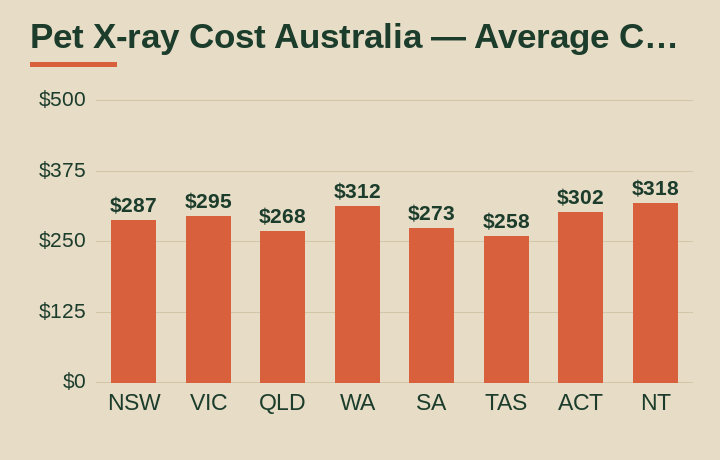
Pet x-ray cost Australia ranges from $150 to $600 per scan. Simple limb x-rays at standard vet clinics sit around $150-$250, while chest or abdominal scans requiring sedation cost $300-$450. Emergency after-hours x-rays can reach $600-$800. Multi-view scans or specialist imaging pushes prices higher.
Here’s what you’ll actually pay across Australia in 2026.
Prices updated July 2026 from current Australian sources.
| State/Territory | Average | Typical range |
|---|---|---|
| NSW | 0 | 0 to 0 |
| VIC | 0 | 0 to 0 |
| QLD | 0 | 0 to 0 |
| WA | 0 | 0 to 0 |
| SA | 0 | 0 to 0 |
| TAS | 0 | 0 to 0 |
| ACT | 0 | 0 to 0 |
| NT | 0 | 0 to 0 |
Costs vary significantly based on whether sedation or anaesthesia is required, the number of views taken, animal size, clinic type (GP vs specialist), and metro vs regional location; the consultation fee is usually charged separately on top of the x-ray fee.
Sources (July 2026): Dial A Vet, Cat X-rays in Australia price, Clare Valley Veterinary Services, Pricing (SA), Compare The Market, Dog X-ray Australia, PetCloud, Vet Prices in Australia 2025, Forbes Advisor AU, Vet Fees in Australia
What Determines Your Pet X-ray Cost Australia?
Body part being imaged: Simple limb x-rays cost less because they’re quick and rarely need sedation. A front leg scan runs $150-$220 at most clinics. Chest and abdominal x-rays need multiple angles and careful positioning, pushing costs to $280-$450. Spinal x-rays are the most expensive, $350-$600, because they require precise positioning and often sedation to keep your pet completely still.
Sedation requirements: Calm pets who’ll lie still don’t need sedation, saving you $80-$150. Anxious dogs, cats who panic, or painful injuries where movement hurts all require light sedation or anaesthesia. This adds medication costs, monitoring time, and recovery observation. Emergency situations where pets are already stressed almost always need sedation, which partly explains the higher after-hours prices.
Number of views needed: Vets rarely take just one x-ray. Two to three angles of the same area are standard, a fractured bone needs front and side views to assess alignment properly. Some practices charge per view ($75-$150 each), while others bundle 2-3 views of one body region into a flat fee ($220-$380). Abdominal investigations often need 4-5 views if vets are searching for foreign objects, which increases your total significantly.
Clinic type and location: Standard suburban vet clinics charge the lowest rates for routine x-rays during business hours. Specialist veterinary hospitals with board-certified radiologists cost 30-50% more but offer expert interpretation for complex cases. Emergency 24-hour clinics command premium pricing, you’re paying for access, not just the scan itself. Inner-city practices in Sydney’s CBD or Melbourne’s Southbank charge more than regional NSW or country Victoria for identical services. According to the Australian Veterinary Association, metropolitan areas consistently show higher imaging costs.
Digital vs traditional x-rays: Most Australian vet clinics now use digital radiography, which produces instant images and uses less radiation. The equipment costs more upfront, but running costs are lower since there’s no film or chemical processing. Despite this, digital x-rays often cost the same or slightly more than old film-based systems because practices are recouping their investment in modern technology. The benefit isn’t financial, it’s speed and image quality.
Additional services bundled in: The quoted x-ray price may or may not include the radiologist’s interpretation fee, digital image storage, or provision of images for your records. Some vets charge separately for a specialist to review complex scans ($45-$85), while others include basic interpretation. Always ask what’s covered in the quoted price to avoid surprise add-ons when you collect your pet.
Recommended Products for Pet X-ray Cost Australia
If you’re tackling this yourself, here are some products from Amazon Australia that can help (these are affiliate links):
Pet x-ray cost Australia in 2026 isn’t cheap, but it’s often the fastest path to diagnosis when your pet’s in trouble. Ring your regular vet first for non-emergencies to lock in the lowest rates, get comprehensive insurance before health issues appear, and don’t hesitate to ask about payment plans if an unexpected scan blows your budget. Your pet’s health matters more than the initial sticker shock.
Frequently Asked Questions About Pet X-ray Cost Australia
Does pet insurance cover x-ray costs in Australia?
Most comprehensive pet insurance policies cover x-rays when they’re medically necessary for diagnosing an illness or injury. You’ll typically need to pay the vet bill upfront, then claim the reimbursement minus your excess. Basic accident-only policies usually cover x-rays after injuries like broken bones, while illness coverage extends to diagnostic scans for things like respiratory problems or abdominal issues. Pre-existing conditions aren’t covered, so get insurance before your pet develops health problems. Routine preventive care like vaccinations keeps pets healthier and reduces the need for diagnostic imaging down the track.
How long does a pet x-ray take at the vet?
Simple x-rays take 10-15 minutes if your pet stays still. Anxious animals or complex positioning might need sedation, which adds 30-45 minutes for the medication to work and wear off enough for discharge. The actual imaging is quick, it’s the positioning and sometimes calming your pet that takes time. Emergency clinics often have longer wait times before the x-ray itself, especially on weekends. If you’re transporting an injured pet, use a sturdy pet carrier to prevent further injury during the trip.
Why are emergency pet x-rays more expensive?
After-hours vet clinics run with smaller staff, higher wages for overnight shifts, and maintain expensive equipment for fewer patients than daytime practices. You’re paying for immediate access to diagnostic imaging when regular vets are closed. Emergency clinics also handle higher-risk cases requiring more intensive monitoring. The convenience of 24/7 availability comes with a premium, typically 50-100% more than standard daytime rates. Emergency vet consultations add another $150-$250 on top of imaging costs.
Can I get a pet x-ray without a vet consultation?
No, you can’t walk into a vet clinic and request an x-ray without a consultation. Vets need to examine your pet first to determine if an x-ray is necessary and which body parts to image. This protects your pet from unnecessary radiation and ensures the right diagnostic approach. The consultation fee is separate from the x-ray cost, typically $65-$95 for a standard appointment or $150-$250 for emergency assessment.
How many x-rays will my pet need?
Most diagnostic situations require 2-3 x-ray views of the same area to give vets a complete picture. A broken leg might need front and side views, while chest x-rays often include left, right, and ventral positions. Some vets charge per view ($75-$150 each), while others bundle multiple views of one body area into a single fee ($200-$350). Complex cases like spinal injuries or abdominal masses may need 4-6 views across multiple areas. Keeping pets healthy with joint supplements for dogs may reduce injury risk as they age.
Smart Ways to Reduce Pet X-ray Cost Australia
- Visit during regular business hours: After-hours and weekend emergency x-rays cost 50-100% more than weekday appointments. If your pet’s condition isn’t critical, wait for your regular vet to open and save $200-$400 per scan.
- Ask if sedation is truly necessary: Sedation adds $80-$150 to your bill. Calm pets with simple fractures often don’t need it. Discuss whether you can help hold your pet still instead, especially for cooperative dogs and cats.
- Get comprehensive pet insurance early: Policies covering diagnostics reimburse 70-80% of x-ray costs after your excess. A $40-$60 monthly premium saves hundreds when your pet needs multiple scans. Buy before health issues develop.
- Request digital images for second opinions: Most clinics provide x-ray files on USB or email for $10-$20. This lets specialist vets review existing images instead of repeating scans, saving you another $300-$600 consultation and imaging fee.
- Compare prices between standard and emergency clinics: Ring 3-4 local vets and ask their x-ray rates before emergencies happen. Price differences of $100-$200 for the same scan are common. Know your cheapest nearby option for non-urgent imaging.
- Bundle x-rays with other procedures: If your pet needs dental work or desexing, x-rays done under the same anaesthetic cost less than separate appointments. You’ll save the consultation fee and potentially the sedation charge.
- Check university vet hospitals: Sydney University, Melbourne University and Murdoch University teaching hospitals offer x-rays at 20-30% below private clinic rates. Appointments take longer but savings reach $80-$150 per scan.
Hidden Costs That Inflate Your Bill
The x-ray itself is just the start. Consultation fees of $65-$250 come first, your vet won’t image without examining your pet. If results show something requiring follow-up, you’re looking at additional costs for blood tests ($85-$180), ultrasounds ($250-$450), or specialist referrals ($200-$350 just for the consultation). Medication prescribed after diagnosis, pain relief, antibiotics, anti-inflammatories, adds another $35-$120 depending on your pet’s size and treatment duration.
Some conditions need repeat x-rays to monitor healing. A broken bone might require check-up imaging at 2 weeks, 4 weeks, and 8 weeks post-injury. That’s three more x-rays at $150-$250 each if you’re lucky enough to avoid complications. Sedation for each follow-up scan adds further expense if your pet won’t cooperate.
Travel x-rays or mobile vet services exist but cost significantly more, $450-$750 for at-home imaging. They’re worth considering only for pets too stressed by car travel or those with severe injuries where movement causes pain.
When X-rays Lead to Specialist Referrals
Standard vets can identify obvious fractures, foreign objects, and major abnormalities. Subtle findings, slight bone density changes, early arthritis, or unusual soft tissue shadows, often need specialist radiologist review. Your vet might send digital images to a veterinary radiologist who charges $85-$150 for a written report, delivered within 24-48 hours.
If the specialist sees something concerning, you’ll likely get referred to a veterinary hospital with advanced imaging like CT scans ($800-$1,800) or MRI ($1,500-$3,200). These aren’t standard x-ray alternatives, they’re next-level diagnostics for complex cases. Pet insurance becomes crucial here because these investigations easily exceed $2,000 once you include consultations and follow-up care.
Specialist veterinary hospitals in Sydney’s North Ryde, Melbourne’s Werribee, or Brisbane’s Mount Gravatt charge premium rates but offer expertise general practices can’t match. Your regular vet will advise whether specialist input is necessary or if the x-ray findings are clear enough for them to manage treatment. Don’t skip the referral if recommended, misdiagnosis costs more long-term than upfront specialist fees.
Regional Price Variations Across Australia
Pet x-ray cost Australia shifts noticeably between capitals and regions. Inner Sydney and Melbourne practices charge top dollar, $320-$600 for standard x-rays, because of higher rents, wages, and operating costs. Head west to Penrith or south to Geelong, and the same scan drops to $180-$280.
Perth and Darwin sit at the expensive end nationally due to smaller markets and equipment import costs. A chest x-ray in Perth averages $340 compared to $265 in Adelaide. Northern Territory practices face even higher overheads with limited competition, pushing prices above mainland averages.
Brisbane and Gold Coast rates sit mid-range, while regional Queensland towns like Toowoomba or Cairns often undercut city prices by 15-25%. Tasmania’s smaller population means less competition but also lower overheads, Hobart vet clinics charge similar amounts to regional Victoria or NSW.
The Australian Competition and Consumer Commission doesn’t regulate vet pricing, so geographic variations reflect pure market forces. Ring around if you live near a capital city boundary, crossing into the next region sometimes saves $100-$150 for identical services.
Understanding Different X-ray Types
Not all x-rays cost the same because they’re not all equally complex. Standard radiographs for limbs, chest, or abdomen are the baseline, 2-3 views, minimal positioning difficulty, quick turnaround. These sit at the lower end of the pricing spectrum.
Contrast studies cost significantly more ($400-$750) because they involve injecting or feeding your pet a contrast agent that shows up on x-rays, then taking multiple images over 30-90 minutes. Vets use these to trace digestive issues, check for leaks after surgery, or map urinary blockages. The contrast material itself costs $60-$120, and the extended imaging time plus monitoring pushes total fees higher.
Dental x-rays are specialised and usually bundled with dental procedures under anaesthesia. Standalone dental radiography runs $180-$320 and requires specific equipment to image small tooth roots and jaw structures. Not all general practices have dental x-ray capability, you might need referral to a veterinary dentist.
Fluoroscopy is real-time x-ray imaging used during some surgeries or for swallowing studies. It’s rare in general practice and only available at specialist hospitals, costing $600-$1,200 depending on procedure length. Most pets never need this level of imaging.
People Also Ask About Pet X-ray Cost Australia
Are x-rays safe for pets or do they cause harm?
Pet x-rays use minimal radiation, about the same as a few days of natural background exposure. The diagnostic benefit far outweighs any theoretical risk, especially since vets only x-ray when medically necessary. Modern digital x-ray machines use even less radiation than older film-based systems. Pregnant animals require extra caution, but your vet will weigh the risks carefully in those situations.
What’s the difference between pet x-rays and ultrasounds?
X-rays show bones, teeth, and some organs clearly but struggle with soft tissue detail. Ultrasounds excel at imaging organs, detecting fluid, and checking pregnancies but can’t see through bone or air-filled spaces like lungs. Vets choose based on what they’re investigating, broken bones need x-rays, while abdominal masses often need ultrasound. Ultrasounds cost $250-$500, similar to complex x-rays.
Do all vet clinics have x-ray machines?
Most standard vet practices in Australian cities have digital x-ray equipment. Small rural clinics may refer complex cases to larger regional practices or mobile imaging services. Emergency animal hospitals always have x-ray capability. If your regular vet lacks imaging equipment, they’ll send you to a nearby clinic that does, sometimes with referral arrangements that reduce costs. Mobile vet services occasionally offer portable x-ray equipment but charge premium rates for the convenience.
How quickly do vets get x-ray results?
Digital x-rays appear on screen immediately, and your vet can discuss obvious findings like fractures right away during your appointment. Complex cases where vets want specialist radiologist review take 24-48 hours for a written report. Emergency clinics provide preliminary reads instantly but may send images to specialists for confirmation the next business day.
Can pet x-rays detect cancer?
X-rays can show bone cancer, some lung tumours, and masses large enough to change organ shape or position. They can’t detect early-stage cancers or distinguish between benign and malignant growths. Vets often combine x-rays with blood tests, ultrasounds, or biopsies for cancer diagnosis. Chest x-rays are standard for checking if cancer has spread to the lungs before surgery. Keeping detailed health records and maintaining regular vet check-ups helps catch problems earlier when treatment is less invasive and costly.
Related Cost Guides
This guide contains affiliate links. We may earn a small commission from qualifying purchases at no extra cost to you.