
Pet transport interstate cost is one of those things that surprises people, especially if they’ve never done it before. According to Animal Medicines Australia’s 2025 Pets in Australia report, around 69% of Australian households own a pet, which means a huge number of people face this decision every time they relocate. The prices honestly bounce around a lot depending on how you move your animal, how far, and how big it is.
Pet transport interstate cost in Australia typically runs $150 to $500 for road transport of a small pet over a medium distance, and $400 to $2,500+ for air freight depending on the animal's size and the route. A cat flying Sydney to Melbourne might cost $350 to $500 all in; a large dog from Perth to Brisbane can hit $1,800 to $2,500. The main variables are transport method (road vs air), pet size, crate requirements and any vet or health certificate fees on top.
Prices updated July 2026 from current Australian sources.
| Route or method | Typical cost | Notes |
|---|---|---|
| Road transport, small pet, medium distance | $150 to $500 | |
| Air freight (size and route dependent) | $400 to $2,500+ | |
| Cat, Sydney to Melbourne | $350 to $500 | |
| Large dog, Perth to Brisbane | $1,800 to $2,500 |
The main variables are the animal’s size, the route and whether you choose road or air. A travel crate and a pre-travel vet check are usually extra.
Sources (July 2026): Jetpets, Dogtainers
A short road transfer for a cat from Canberra to Sydney might cost $180 to $250. A large Labrador flying from Perth to Brisbane can run $1,800 to $2,500 all in once you factor in the IATA crate, handling fees and the cargo charge. That’s a wide spread. This guide breaks down exactly where the money goes and which options are actually worth it.
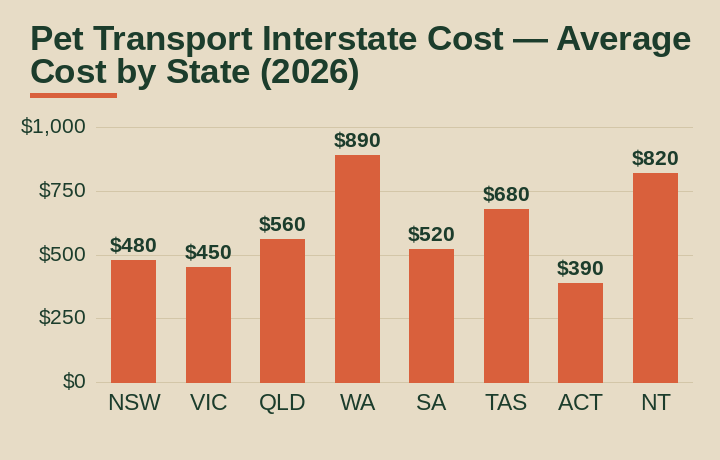
What pet transport interstate typically costs in 2026
| State | Average Cost | Typical Range |
|---|---|---|
| NSW | $480 | $180 to $1,800 |
| VIC | $450 | $160 to $1,700 |
| QLD | $560 | $220 to $2,100 |
| WA | $890 | $400 to $2,500 |
| SA | $520 | $200 to $1,900 |
| TAS | $680 | $350 to $1,600 |
| ACT | $390 | $160 to $1,400 |
| NT | $820 | $380 to $2,300 |
Rail is the underrated option for some routes. V/Line and NSW TrainLink allow pets in specific carriages on certain services, and the cost is low. The catch is that rail coverage is limited, you can’t use it for Perth, Darwin or most of Queensland, and you need to book well ahead. For anyone moving a dog along the Sydney to Melbourne corridor on a budget, it’s worth a look.
Air freight gets expensive fast for large breeds. A standard IATA-approved crate for a Great Dane or Rottweiler is a significant item in itself. See IATA-approved airline pet crates, buying your own rather than renting from the operator can save $80 to $150 per trip.
What drives the price variation
Distance and route competition matter enormously. Sydney to Melbourne is a competitive corridor, so you’ll find professional road transport for a medium dog at $350 to $500 with multiple operators quoting. Sydney to Darwin is not competitive at all. Fewer operators, longer haul, usually involves at least one air leg, and quotes start at $900 for a medium dog and go up from there.
Animal size is probably the most straightforward factor. Most operators price by crate size, which is determined by the animal. A domestic cat in a standard carrier fits under most pricing thresholds. A Standard Poodle needs a large IATA crate, typically 95cm x 63cm x 69cm, which bumps air freight costs significantly because airlines charge on volumetric weight. A large dog that physically weighs 30kg can have a volumetric weight over 60kg once the crate is measured.
Health certificate and vet prep costs are often forgotten in initial quotes. Most professional transport companies require a veterinary health certificate issued within 10 days of travel. That’s a vet visit at $60 to $120. Queensland has additional requirements around tick treatment declarations, which means a specific product application and paperwork. If you’re moving to or through QLD, factor in an extra $30 to $60 for tick treatment compliance.
Pickup and delivery vs depot drop makes a real difference too. Door-to-door interstate pet transport costs 20 to 35% more than depot-to-depot. A Sydney to Melbourne cat transport via depot might cost $220 to $280; door-to-door with the same company runs $320 to $400. If you can get yourself to and from a depot, you’ll save money. See also what’s involved in overseas pet relocation costs if an international move is on the cards, the complexity jumps considerably.
Time of year is a factor people underestimate. December to January and Easter school holidays push demand up sharply. Companies that are fully booked can effectively name their price. Booking in autumn or winter (think May to July) gives you better rates and more choice of operators.
Questions to ask before you book
Is the quote all-inclusive or does it exclude the crate and vet cert?
Some operators quote a base transport price that looks competitive, then add the crate hire ($80 to $150) and handling fees ($50 to $100) at checkout. Ask specifically: does this price include the crate, pickup, delivery and any handling charges? If not, get the full number before comparing.
Are you a licensed pet transport operator?
Interstate animal transport is regulated under state biosecurity and animal welfare legislation. A legitimate operator should be able to tell you their DAFF (Department of Agriculture, Fisheries and Forestry) compliance status and relevant state licences. If they can’t answer this confidently, move on.
What happens if my pet gets sick or injured in transit?
Ask specifically: do they have protocols for veterinary emergencies? Will they contact you immediately? Who pays for emergency vet costs during transport? Reputable operators have clear answers. Vague responses here are a warning sign, particularly for multi-day road journeys.
How many handler changes will my pet experience?
Some budget road transport services subcontract legs of the journey to different operators. Your pet could change hands twice between Sydney and Brisbane. More handler changes generally means more stress for the animal and more opportunity for miscommunication. A single-operator journey is worth paying slightly more for.
What check-in updates will I receive during transit?
Good operators provide at least once-daily updates on multi-day journeys, often with GPS location. Some send photos. If an operator offers no tracking or update protocol, that’s a gap you’ll feel acutely when your dog is somewhere on the Hume Highway and you haven’t heard anything for 18 hours.
What’s your policy on temperature extremes?
This is especially relevant for travel in and out of Darwin, WA and northern QLD during summer. Airlines have temperature embargoes that can delay or cancel pet freight at short notice. Road operators should have plans for high-temperature travel. Ask what happens if your booking falls during a heatwave, and whether there’s a refund or rescheduling policy.
Recommended Products for Pet Transport Interstate Cost
If you’re tackling this yourself, here are some products from Amazon Australia that can help (these are affiliate links):
Standard pet insurance policies in Australia don’t cover transport or relocation costs. These are considered owner expenses, not medical or accident events. Some premium policies cover emergency transport to a vet if your pet is injured while travelling, but that’s different from covering the cost of moving your pet interstate for a house move.
Frequently asked questions
How much does it cost to fly a dog interstate in Australia?
Flying a dog interstate typically costs $350 to $900 for small to medium breeds and $900 to $2,500 for large breeds. The price includes an IATA-approved crate, handling fees and the airline cargo charge. Routes with less competition (like Darwin to Hobart) cost more than the Sydney to Melbourne corridor.
Is road transport cheaper than air for interstate pets?
Generally yes. Road transport for a cat or small dog over a Sydney to Melbourne distance runs $200 to $450. Air freight for the same animal on the same route costs $350 to $600. The gap widens significantly for large dogs, where road is often $400 to $700 versus $900 to $2,500 by air. Road is slower but usually less stressful for the animal.
Do I need a health certificate for interstate pet transport?
Most professional pet transport companies require a veterinary health certificate issued within 10 days of travel. This typically costs $60 to $120 at your vet. Some states have additional biosecurity requirements, Queensland in particular is strict about ticks, so a tick treatment declaration is often mandatory.
Can I transport my pet myself to save money?
Yes, and many people do. Driving yourself with your pet costs essentially nothing beyond fuel and accommodation. The main consideration is journey length, Sydney to Perth is roughly 4,000 kilometres, which means multiple overnight stops. A professional service makes more sense for very long hauls or if you’re flying ahead. For mobile vet options to check your pet’s health before a long drive, that’s worth factoring in too.
How long does interstate pet transport take?
Air freight is usually same-day or next-day depending on the route. Road transport varies a lot: Sydney to Melbourne takes around 10 to 12 hours, Sydney to Brisbane around 12 to 14 hours, and Sydney to Perth can take 4 to 6 days with overnight stops built in. Most companies provide daily updates on road journeys.
How to bring the cost down
- Get at least 3 quotes. Prices for the same route can vary by $200 to $600 between operators. PetAir, Dogtainers and Jetpets all service major Australian routes, use at least two of these plus a local operator for comparison. According to MoneySmart’s pet ownership guidance, comparing providers is one of the most effective ways to reduce ongoing pet costs.
- Buy your own IATA-approved crate. Operators charge $80 to $200 to supply a crate. Buying one online costs $60 to $150 and you keep it. If you ever need to move your pet again (or fly overseas), you’ve already recouped the cost. Make sure it’s the right size for your animal, measure your pet’s height and length carefully before buying.
- Choose road over air where timeline allows. Road transport is typically $150 to $400 cheaper than air for the same pet on the same route. If you’ve got 2 to 5 days flexibility, road is usually the better call. It’s also generally less stressful for the animal. You can use Calming sprays for anxious travellers to help settle them in the crate for multi-day road journeys.
- Book in the off-peak window. Autumn and winter bookings (May to August) are consistently cheaper than December to January or Easter. If you have any control over your moving timeline, off-peak saves 15 to 25% on most quotes.
- Depot-to-depot vs door-to-door. Dropping your pet at a depot and collecting from the destination depot rather than requesting home pickup and delivery saves 20 to 35%. Worth doing if you’re near a major city depot.
- Sort the vet cert early. It’s valid for 10 days, so book the appointment on the same day you confirm your transport date. Missing the window means a second consult at $60 to $120. For general pet vaccination and vet visit costs, that context is useful too.
If you’re also thinking about dog boarding costs at either end of the move (useful if there’s a settlement gap), or desexing costs to sort out before the move, it helps to have a full picture of what the relocation will actually cost. For anyone moving a pet internationally rather than just interstate, the complexity and cost jump substantially, see what overseas pet relocation actually costs for that comparison.
The bottom line on pet transport interstate cost: most people in Australia’s major corridors can move a small pet by road for under $400, and a medium-large dog by air for $600 to $1,500 if they plan ahead. The expensive outcomes happen when people book last minute, skip the quote comparison, or don’t factor in the crate and vet cert on top of the headline price. Get the full number upfront, ask the right questions, and the cost is manageable.
People Also Ask About Pet Transport Interstate Cost
Do pets travel in the cabin or cargo on Australian domestic flights?
In Australia, domestic airlines don’t allow pets in the passenger cabin. All pets travel in the climate-controlled cargo hold as checked freight. Qantas, Virgin Australia and Rex all have specific pet-in-hold services with size and weight limits, and all require IATA-approved crates.
What airlines allow pet transport interstate in Australia?
Qantas and its subsidiary QantasLink are the most commonly used for domestic pet freight, accepting cats, dogs and some other animals. Virgin Australia also accepts pets as checked baggage on many routes. Rex Airlines has more limited pet freight options. Budget carriers like Jetstar generally don’t accept live animals.
How stressful is interstate transport for a cat?
Honestly, most cats find any travel stressful. Air freight involves more handling changes and noise than road transport, which many vets consider harder on cats. Road transport in a familiar carrier, with fewer strangers involved, tends to be gentler. Speak to your vet about whether a short-term anti-anxiety medication is appropriate for the journey. You can also check cat care costs in Australia for broader context on keeping your cat comfortable.
Are exotic pets or reptiles allowed to be transported interstate?
Reptiles and exotic pets face much more complex interstate movement rules. Each state has its own biosecurity and wildlife regulations, and some species legal in one state are prohibited in another. You’ll need permits in most cases, and very few standard pet transport companies handle reptiles. Specialist exotic pet transport operators exist but are significantly more expensive.
Does pet insurance cover interstate transport costs?
Related Cost Guides
This guide contains affiliate links. We may earn a small commission from qualifying purchases at no extra cost to you.