
The biggest myth about an electrician cost australia wide is that the hourly rate is what you actually pay. It isn’t. The hourly rate is one line on a bill that also includes a call-out fee, materials markup, GST, and sometimes a minimum charge that kicks in even if the sparky’s only there for 20 minutes.
The typical electrician cost australia is $80-$150 per hour, plus a $60-$120 call-out fee. Emergency or after-hours rates push past $180/hr. A standard powerpoint install runs around $120-$220, and a full switchboard upgrade lands between $1,500 and $3,500.
When I researched current prices for this guide across trade directories, consumer surveys and Fair Work data, the spread was wider than I expected. A standard powerpoint replacement quoted at $95 by one Brisbane electrician was quoted at $240 by another, three suburbs away. According to Fair Work Ombudsman award rates, an experienced electrician’s minimum wage sits around $32-$38/hr, so what you’re really paying for in that $150/hr figure is insurance, vehicle, tools, compliance, and admin.
What you’ll typically pay in 2026
The headline number: $80-$150 per hour for a licensed A-grade electrician during business hours. Add a $60-$120 call-out fee on top. Emergency or after-hours work pushes past $180/hr, sometimes $280/hr on public holidays.
Job pricing varies more than hourly rates. A powerpoint install can be $120 or $250 depending on whether the sparky needs to chase walls. Whole-house rewires sit between $7,000 and $15,000. Switchboard upgrades, increasingly common now safety switches are mandatory on all circuits, land around $1,500-$3,500.
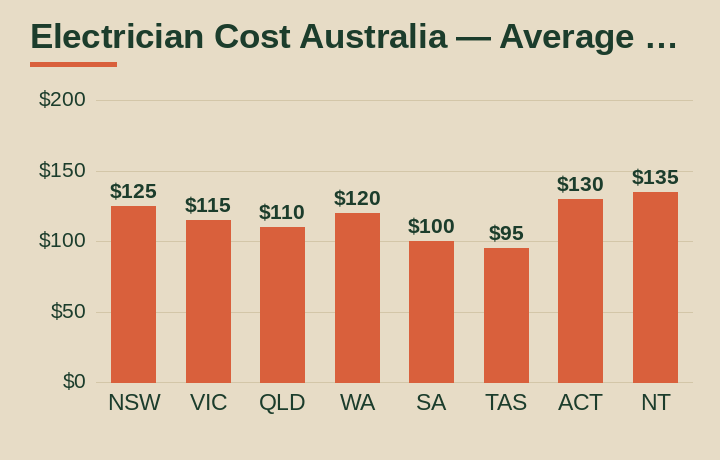
| State | Average Hourly Rate | Typical Range |
|---|---|---|
| NSW | $125 | $95 – $160 |
| VIC | $115 | $90 – $150 |
| QLD | $110 | $85 – $145 |
| WA | $120 | $95 – $155 |
| SA | $100 | $80 – $135 |
| TAS | $95 | $80 – $125 |
| ACT | $130 | $100 – $165 |
| NT | $135 | $110 – $180 |
Get free quotes from local providers in your area. No obligation.
NT and ACT consistently top the table. The NT premium is travel and remoteness; the ACT premium is regulatory overhead and a small pool of licensed sparkies serving a high-income area. SA and TAS are the cheapest mainland and island markets, mostly because rents, fuel and competition all work in your favour.
Where the money actually goes
Five things move the price more than anything else. Worth knowing before you call.
Job complexity and access
A powerpoint added to an existing wall with a stud cavity directly behind: $120-$180. The same powerpoint on a double-brick wall in a 1930s Surry Hills terrace, requiring chasing and replastering: $280-$450. Access eats labour time, and labour time is everything.
Licence level required
Standard A-grade work covers internal house wiring. Level 2 work, which includes meter installations, service mains and anything touching the grid, requires a separately accredited Level 2 sparky and runs 30-50% more. A meter upgrade for solar typically costs $400-$900 versus $250-$500 for a standard install.
Emergency vs scheduled
Standard rate, weekday daytime: $110/hr in Brisbane. The same electrician at 11pm on a Saturday: $220/hr, with a $150 call-out instead of $80. A burst-pipe-style electrical emergency on a Sunday can easily hit $600 for a one-hour fix.
Location and travel
Inner Newtown or Fremantle: $130-$160/hr. Outer Penrith or Mandurah: $90-$115/hr. The gap is partly cost of doing business, partly the willingness of inner-city tradies to charge what the market bears. Regional Tasmania and country SA come in cheaper still, around $80-$100/hr, but you’ll wait longer for a booking.
Materials markup
Most electricians mark up parts 30-60%. A double powerpoint that costs $12 at Bunnings is $20-$25 on the invoice. A $400 switchboard becomes $600. This is where supplying your own fittings, when allowed, genuinely saves money on bigger jobs.
Common jobs and what they cost
Hourly rates are useful, but most people want to know what a specific job will run. Here’s a comparison of jobs sparkies quote most often, with the typical fixed-price range and the rough labour time behind it.
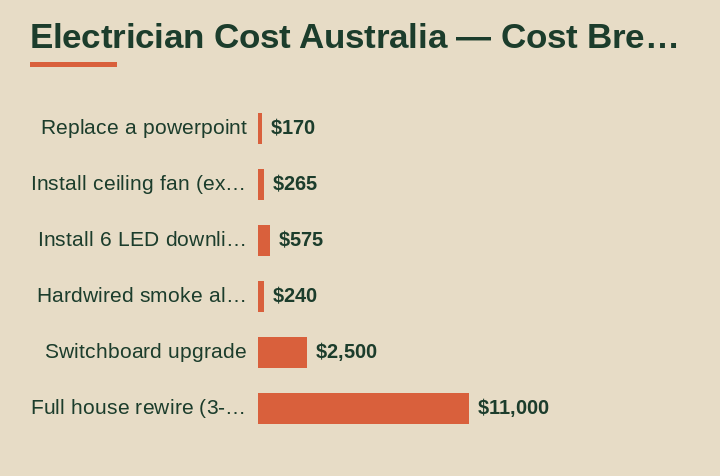
| Job | Typical Price | Time on Site |
|---|---|---|
| Replace a powerpoint | $120 – $220 | 30-45 min |
| Install ceiling fan (existing point) | $180 – $350 | 1-1.5 hr |
| Install 6 LED downlights | $400 – $750 | 2-3 hr |
| Hardwired smoke alarm install | $180 – $300 each | 45-60 min |
| Switchboard upgrade | $1,500 – $3,500 | 4-8 hr |
| Full house rewire (3-bed) | $7,000 – $15,000 | 4-10 days |
| EV charger install | $1,200 – $2,800 | 3-5 hr |
| Emergency fault find | $250 – $600 | 1-2 hr |
The takeaway from this table, comparing the figures for this guide: the cost of a sparky isn’t really hourly. It’s per-task, with hourly billing as the backup when the job runs over.
Questions to ask before you book
Five minutes on the phone before booking saves more than any post-job dispute. Ask these.
Is this an hourly rate or a fixed quote?
For anything beyond a 30-minute fault find, push for a fixed quote. Hourly billing can balloon when access turns out to be worse than expected, and you wear the difference.
What does the call-out fee actually include?
Some sparkies wrap the first 30 minutes of labour into the call-out. Others charge call-out plus labour from minute one. The difference is $80-$150 on a small job. Always clarify.
Are you A-grade or Level 2?
If your job touches the meter, mains or service lines, only a Level 2 can legally do it. Booking the wrong licence costs you a second call-out fee when they have to send someone else.
Is GST included in the quoted figure?
A quote of $1,500 plus GST is actually $1,650. Most reputable sparkies quote inclusive, but always ask. MoneySmart’s guidance on tradie quotes recommends getting everything in writing before work starts.
Do you warranty the work, and for how long?
Most states require a minimum statutory warranty, but reputable sparkies offer 12 months on labour as standard. If they hesitate, that tells you something.
Can I supply my own fittings?
Many will say yes for downlights, fans and powerpoints, no for switchboards and safety switches. Asking upfront avoids the awkward moment they arrive with their own $80 fan you’re now paying $180 for.
How to bring the cost down
- Batch small jobs into one visit. Saves $80-$150 in duplicated call-out fees. Easy win.
- Get three written quotes for jobs over $1,000. For rewires and switchboards I’ve seen quotes vary by $2,000+ on the same scope.
- Avoid after-hours unless it’s actually dangerous. Waiting until Monday saves $100-$300.
- Supply your own compliant fittings. 15-30% saving on materials, especially with bulk LED downlights or a 240V interconnected smoke alarm pack.
- Book in late autumn or winter. Diaries are quieter and some sparkies discount labour 10-15% to fill them.
According to Canstar Blue’s electrician satisfaction research, the customers who reported best value weren’t the ones who chased the lowest hourly rate, they were the ones who got fixed quotes for clearly defined scopes.
FAQs about electrician cost australia
Is the call-out fee on top of the hourly rate?
Usually yes. Most sparkies charge a $60-$120 call-out that covers travel and the first 15-30 minutes on site, then bill their hourly rate after that. Always ask before they roll up.
Do I need a Level 2 electrician for my job?
Only if the work touches the network, meter installs, service mains, overhead/underground service lines or disconnections. Most internal house work is fine for a standard A-grade electrician.
Are electrician quotes free in Australia?
For larger jobs like rewires or solar, quotes are usually free. For small fault-finding visits, you’ll typically pay the call-out fee just to have them assess.
Can I do my own electrical work to save money?
No. DIY electrical work on fixed wiring is illegal in every Australian state and voids your home insurance. You can replace plug-in items and light bulbs, that’s about it.
Why are emergency electrician rates so much higher?
After-hours, weekend and public holiday rates typically sit 50-100% above standard pricing. Expect $180-$280/hr plus a heftier call-out, sometimes $150+, for a midnight job.
People Also Ask About Electrician Cost Australia
How much does an electrician charge per hour in Sydney vs Melbourne?
Sydney sparkies typically charge $110-$160/hr, slightly above Melbourne’s $95-$140/hr. The gap reflects higher overheads, parking and travel time across Sydney’s sprawl. Inner-city suburbs in both cities sit at the top of the range.
What does it cost to rewire a whole house in Australia?
A full rewire on a typical three-bedroom home runs $7,000-$15,000 depending on age, access and whether plaster needs cutting. Older homes with knob-and-tube or fabric-insulated cable push toward the top end.
How much does it cost to install a ceiling fan?
Supply-and-install is usually $180-$350 if there’s an existing light point and easy ceiling access. Running new wiring or adding a remote receiver adds another $80-$200.
Do electricians charge GST on top of their quote?
Any electrician earning over $75,000 a year must be GST-registered, so quotes from established sparkies should include GST. Always ask if a quoted figure is inclusive or exclusive before you sign off.
Is it cheaper to hire an independent electrician or a big company?
Independents usually charge $80-$120/hr and have lower overheads. Larger franchise outfits often charge $130-$180/hr but offer fixed-price quotes, warranties and faster emergency response. Pick based on the job.
For related trade pricing in 2026, it’s worth comparing how other home services scale, like how we research our prices or seeing how single-task pet costs compare against fixed-fee vet jobs like a cat desexing in Sydney, where the pricing logic of call-out plus procedure is similar. If you’re budgeting for a wider home setup, our guides on a bearded dragon setup and aquarium installation both factor in the same kind of electrical work this article covers. For other tradie comparisons, see the way we frame dog grooming pricing in Sydney, dog boarding in Brisbane, and our breakdowns of pet X-ray costs.
Related Cost Guides
Recommended Products for Electrician Cost Australia
If you’re tackling this yourself, here are some products from Amazon Australia that can help:
Bottom line: the real electrician cost australia households face isn’t the $/hr on the website, it’s the call-out, the materials markup and the licence level the job needs. Get a fixed quote, batch the small stuff, and don’t call after-hours unless something’s smoking.
This guide contains affiliate links. We may earn a small commission from qualifying purchases at no extra cost to you.