
Wall removal cost Australia is one of those reno line items that can swing wildly depending on one critical question: is that wall holding the roof up? For a simple non-load-bearing wall, you’re looking at $1,200–$3,500 all in. For a load-bearing wall that needs a structural steel beam, engineer sign-off, and council permits, the total can easily reach $6,000–$10,000 or more. According to the Housing Industry Association, structural alterations are among the most common sources of residential building disputes in Australia, which tells you how easy it is to underestimate this kind of work.
Wall removal cost Australia typically runs $1,200–$3,500 for a non-load-bearing wall and $4,000–$10,000+ for a load-bearing wall requiring a structural steel beam. The big variable is whether your wall carries the roof load. A basic open-plan conversion in a standard Sydney or Melbourne home lands around $5,000–$7,500 all up, including engineer fees and patching.
The good news is that an open-plan conversion is genuinely one of the higher-return renovations you can do, particularly in older Australian homes with chopped-up floor plans. The bad news is that the gap between a cheap job and a proper one can be $5,000 or more. This guide lays out what you’ll actually pay, state by state, and where the money goes.
What this normally costs in 2026
The simplest way to frame it: non-load-bearing walls are a minor trade job; load-bearing walls are a construction project. The line between the two changes everything about scope, permits, and cost.
For a non-load-bearing internal wall in a standard brick-veneer or weatherboard home, expect to pay $1,200–$3,500 depending on wall length, what services run through it (power points, light switches, data cables), and what reinstatement is included. For load-bearing wall removal with a structural steel beam (RSJ or LVL), costs typically land at $4,500–$10,000+, with the steel beam alone costing $800–$2,500 depending on span.
| State | Average Cost | Typical Range |
|---|---|---|
| NSW | $5,800 | $1,500 – $10,500 |
| VIC | $5,500 | $1,400 – $10,000 |
| QLD | $5,200 | $1,300 – $9,500 |
| WA | $5,400 | $1,400 – $9,800 |
| SA | $4,800 | $1,200 – $8,500 |
| TAS | $4,600 | $1,100 – $8,000 |
| ACT | $5,900 | $1,500 – $10,500 |
| NT | $5,600 | $1,400 – $9,500 |
Get free quotes from local providers in your area. No obligation.
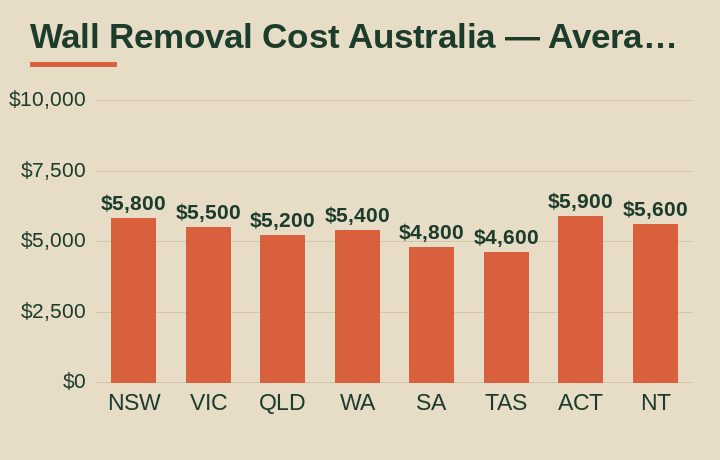
Sydney’s inner suburbs and Canberra sit at the top of the range. A load-bearing wall removal in Paddington or Newtown will typically cost more than the same job in Toowoomba or Hobart’s North, reflecting higher labour rates and tradesperson demand.
Where the money actually goes
Comparing figures for this guide, the pattern that stood out was how many homeowners receive quotes that don’t clearly separate structural engineering, permits, and builder labour. Here’s what’s actually driving that final number.
Load-bearing vs non-load-bearing
This single factor accounts for the largest price gap in wall removal. A non-load-bearing wall in a two-bedroom Queenslander might be knocked through, patched, and painted for $1,800. The load-bearing wall separating the kitchen from the lounge in the same house could easily cost $6,500–$8,000 once you factor in temporary wall supports during demolition, a fabricated steel beam, column or post installation, engineer inspection, and a building permit. The wall itself isn’t expensive to remove. The structural system you have to build around the opening is.
Structural engineer and permit fees
An engineer assessment and report runs $300–$600 for most residential jobs. If the engineer needs to produce full structural drawings specifying beam size and connection details, that rises to $800–$1,500. A building permit for structural work typically costs $500–$1,500 depending on the state and scope. In Victoria, any structural alteration to a home requires a building permit without exception. In NSW, some work qualifies as exempt development under the State Environmental Planning Policy, but a load-bearing wall doesn’t. Budget $1,000–$2,500 for the combined engineer and permit costs on any structural job.
Asbestos testing and removal
Homes built before 1987 are the main risk zone. Asbestos-cement sheeting (called fibro in most of Australia) was used extensively in internal wall linings up until the early 1980s. A pre-demolition asbestos test costs $150–$350. If asbestos is found, licensed removal adds $1,000–$3,500+ to the project, depending on how much material is involved. Skipping this step isn’t just dangerous, it’s also illegal. Any builder who quotes wall removal in an older home without mentioning asbestos testing is a red flag. For older homes where asbestos might also affect ongoing pet or family health costs, it’s worth understanding what veterinary costs for sensitive breeds can look like if dust exposure occurs.
Services rerouting (electrical, plumbing, data)
Most internal walls in Australian homes contain at least one power point or light switch. Moving one double power point costs around $180–$320. If the wall contains the main light circuit run, a bathroom exhaust fan, or (less common but possible) a plumbing stack, rerouting those services adds meaningful cost. Electrical rerouting on a straightforward wall runs $300–$700. If there’s also a gas line or water pipe involved, add $500–$1,500 for a licensed plumber on top. Always ask the builder specifically what happens to the services in the wall, because these costs are often left out of the first quote.
Wall length and ceiling height
Longer walls need larger beams, more temporary support, and more patching. A standard 3-metre opening in a single-storey home is a different job to a 6-metre kitchen-to-living-room opening. The beam cost alone scales: a 3-metre LVL beam might be $400–$600 supplied; a 6-metre fabricated steel RSJ runs $1,200–$2,200. Higher ceilings (common in Federation-era homes in inner Melbourne or Adelaide’s heritage suburbs) also increase the amount of plastering and cornicing reinstatement required.
Reinstatement and finishing
Demolishing a wall creates a mess that needs fixing. The floor where the wall sat needs to be patched (tiles, floorboards, or slab topping), the ceiling needs replastering and possibly new cornicing, and the adjacent walls need repair. Reinstatement work adds $800–$2,500 depending on floor type and finish quality. Timber floorboard matching is particularly expensive, often $600–$1,200 extra in homes with original hardwood floors that need to be sourced and colour-matched. For a sense of how reinstatement fits into broader reno budgets, our kitchen renovation cost breakdown puts the full picture in context.
Non-load-bearing vs load-bearing: what you’re actually comparing
The table below shows how the two job types differ in scope and cost. It’s not just a price difference, it’s a fundamentally different project.
| Factor | Non-Load-Bearing Wall | Load-Bearing Wall |
|---|---|---|
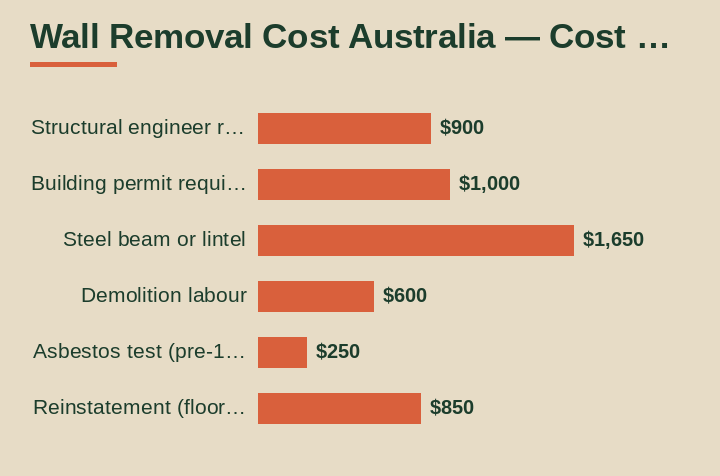
| Structural engineer required | No (verification only) | Yes ($300–$1,500) |
| Building permit required | Usually no | Yes ($500–$1,500) |
| Steel beam or lintel | No | Yes ($800–$2,500) |
| Temporary wall supports | No | Yes (labour cost) |
| Demolition labour | $400–$800 | $800–$1,800 |
| Asbestos test (pre-1987 homes) | $150–$350 | $150–$350 |
| Reinstatement (floor/ceiling) | $500–$1,200 | $800–$2,500 |
| Typical total cost | $1,200–$3,500 | $4,500–$10,000+ |
| Timeframe on site | 1 day | 3–5 days |
These figures assume a standard single-storey home with no unusual complications. Two-storey homes, multi-span openings, or heritage-listed properties all push costs higher.
Questions to ask before you book
Is this a fixed-price quote or an estimate?
Wall removal quotes frequently start as estimates and blowout once asbestos, unexpected services, or additional structural requirements emerge mid-job. Push for a fixed-price contract with a clearly defined scope. If the builder won’t commit to a fixed price, at minimum ask for a written list of the conditions that would trigger extra charges and the approximate cost of each.
Does your quote include the structural engineer and permit?
Many builders quote labour and materials only, leaving the engineer fee ($300–$1,500) and permit cost ($500–$1,500) for you to arrange separately. If you don’t ask this directly, you can end up $1,500–$2,500 over your expected budget before a single brick has been touched.
Have you done an asbestos check on this property?
Any reputable builder working on a pre-1987 home should ask about this, or conduct a visual assessment. If they don’t raise it at all, that’s a flag. Ask specifically whether an asbestos test is included in the scope, or whether you need to arrange it separately before work begins.
What happens to the power points and wiring in the wall?
A wall with a single power point looks straightforward. But if that circuit feeds multiple rooms or runs the kitchen appliance circuit, rerouting can take a licensed electrician most of a day. Get a clear answer on what’s in the wall and what it will cost to move before you sign anything.
How will the floor and ceiling be reinstated?
This is where a cheap quote often cuts corners. Some builders patch the ceiling with a paint-over-mesh approach that shows within 12 months. Ask specifically what products they’re using for patching, whether they’ll match your existing cornicing profile, and how the floor gap will be handled. For timber floors in particular, ask whether the patch will be a colour match or a contrasting insert.
Are you the builder who will do the work, or will you subcontract?
Project managers and some larger building companies quote the job and then subcontract the actual demolition and plastering to trades they’ve never worked with before. You want to know who’s physically on site and whether they’re covered under the same licence and insurance. For significant structural work, this matters.
How to bring the cost down
- Get an engineer assessment first, confirming a wall is non-load-bearing before accepting quotes can save $2,000–$5,000 if builders have assumed structural work in their pricing.
- Get three detailed written quotes, prices vary 30–40% between builders for the same scope. Don’t accept the first number. For more on managing trade costs, MoneySmart’s renovation budgeting resources are worth a look before you commit.
- Bundle with other renovation work, adding wall removal to a kitchen reno or flooring job reduces per-trade mobilisation costs. See how this plays out in our kitchen reno cost breakdown.
- Arrange your own skip bin, builder-supplied skip bins carry a margin. Booking direct saves $100–$200. You can also use heavy-duty construction waste bags for smaller debris volumes if a full skip isn’t needed.
- Do the painting yourself, post-patching painting is the easiest part to DIY. Handling it yourself can cut $500–$1,200 off the final invoice.
- Time it for the cooler months, builders are slower May through August, and you’ll often get faster scheduling and occasionally better pricing.
A quick jargon note
A few terms you’ll hear that are worth knowing before you talk to a builder:
- RSJ (Rolled Steel Joist), a standard steel I-beam used to span structural openings. Heavier than timber or LVL but required for longer spans.
- LVL (Laminated Veneer Lumber), engineered timber beam, lighter than steel and often used for shorter spans in residential work.
- Lintel, the horizontal structural element above a door or window opening. In load-bearing walls, this needs to be engineered to carry the load above.
- Acrow props, adjustable steel props used to temporarily support the ceiling while the structural wall is removed and the beam is installed.
Pre-booking checklist
- Confirm whether your wall is load-bearing (engineer assessment if unsure)
- Check your home’s build date, pre-1987 requires asbestos testing
- Request at least three fixed-price written quotes
- Confirm permit requirements with your local council or a private building surveyor
- Clarify what reinstatement is included (floor, ceiling, cornicing, painting)
- Confirm electrical and plumbing rerouting is scoped and priced
- Check the builder’s licence and insurance before signing
If you’re also budgeting for pets during the renovation disruption (boarding or pet sitting while the house is a construction zone), check our dog boarding cost breakdown for Melbourne or the pet sitting cost guide for Melbourne for current rates. Renovation dust is genuinely harmful for animals, and the cost of boarding for a week is modest compared to a vet bill. Owners of specific breeds like Chihuahuas or Dachshunds may want to factor this in, as both breeds are sensitive to respiratory irritants. Similarly, if you have a reptile at home, check reptile care requirements in NSW before assuming they can stay onsite during a dusty reno. During the patching and sanding phase, a proper P2 respirator mask is worth having regardless.
FAQs about wall removal cost Australia
How do I know if my wall is load-bearing?
The most reliable way is to hire a structural engineer for an assessment, which costs $300–$600. As a rough indicator, walls that run perpendicular to the floor joists, sit above a beam or foundation, or are in the centre of the house tend to be load-bearing. But don’t guess, the consequences of getting it wrong are serious and expensive.
Do I need council approval to remove a wall in Australia?
For non-load-bearing walls, most states treat it as exempt development and no permit is needed. For load-bearing walls, you’ll almost always need a building permit. Requirements vary by state and local council, in Victoria, for example, a building permit is required for any structural alteration. Budget $500–$1,500 for the permit itself.
How long does wall removal take?
A straightforward non-load-bearing wall can be knocked through and patched in a single day. A load-bearing wall with beam installation, electrical rerouting, and replastering typically takes 3–5 days on site, plus waiting time for engineer sign-off and permit approvals, which can add 2–4 weeks to the overall project.
What’s included in a wall removal quote?
A decent quote should itemise demolition labour, skip bin hire or debris removal, steel beam or lintel supply and installation, temporary support walls during the job, and basic patching of the ceiling, floor, and adjacent walls. Electrical and plumbing rerouting, structural engineer fees, and council permits are often quoted separately, always ask specifically.
Can I remove a wall myself to save money?
For a confirmed non-load-bearing wall with no services running through it, a competent DIYer can handle demolition. But you still need to legally verify it’s non-load-bearing, handle asbestos testing in homes built before 1987, and arrange waste disposal. Any load-bearing wall work must be done by a licensed builder with engineering sign-off. The risk of DIY on the wrong wall is a collapsed roof or floor, not worth it.
People Also Ask About Wall Removal Cost Australia
How much does a structural engineer cost for wall removal in Australia?
A structural engineer assessment for wall removal typically costs $300–$600 for a residential inspection and report. If you need full engineering drawings and specifications for the beam design, that rises to $800–$1,500. Sydney and Melbourne engineers are at the higher end; regional areas tend to be $50–$100 cheaper. This fee is separate from the builder’s quote and is almost always non-negotiable for load-bearing work.
Does removing a wall add value to a house in Australia?
Open-plan layouts are consistently popular with Australian buyers, and a well-executed kitchen-living knock-through can add meaningful value, particularly in homes built in the 1970s–1990s with compartmentalised floor plans. The return depends on the suburb and buyer demographic. In inner-city areas of Sydney or Melbourne, it’s generally considered a positive. In some regional areas with older housing stock, the payoff is less predictable.
What is the cheapest way to open up a room without removing a wall?
If a full removal is out of budget, a partial wall removal or ‘aperture’ opening can cost $800–$2,000 and still significantly open up a space. Another option is removing a standard door and replacing it with a wide sliding cavity door or bifold door, which costs $600–$1,800 installed. Neither gives you the full open-plan effect, but both improve flow without the structural engineering costs.
Does wall removal cost more if there’s asbestos?
Yes, significantly more. Homes built before 1987 in Australia may contain asbestos-cement sheeting (‘fibro’) in walls. A pre-demolition asbestos test costs $150–$350. If asbestos is confirmed, licensed asbestos removal is required, which adds $1,000–$3,500+ to the project depending on the volume of material. This is non-negotiable under Australian workplace health and safety laws.
How long does council approval take for wall removal in Australia?
Related Cost Guides
Recommended Products for Wall Removal Cost Australia
If you’re tackling this yourself, here are some products from Amazon Australia that can help:
For exempt development (non-load-bearing walls), there’s no approval required, so no waiting time. For structural work requiring a building permit, turnaround through a private building surveyor typically takes 5–15 business days. Going through local council can take 4–8 weeks. Using a private certifier is faster if your builder recommends one and the project scope is straightforward.
This guide contains affiliate links. We may earn a small commission from qualifying purchases at no extra cost to you.