
Buy a rural block with no town sewer and you inherit whatever septic system is already there, which is often a decades-old concrete relic on its last legs. That’s the moment the whole septic tank question stops being abstract and starts costing real money. When I researched current prices across the sources below, the spread shocked me, anywhere from $8,000 for a basic conventional install to $25,000 for a full aerated wastewater treatment system on a tricky site.
Septic tank cost Australia sits between $8,000 and $25,000 fully installed in 2026, depending on system type and soil. A basic concrete tank with conventional trenches runs $8,000-$13,000. Aerated wastewater treatment systems (AWTS) push $15,000-$25,000 once you add council approval, plumbing connection and a permit.
The good news? You don’t need the top-tier option for most properties. The frustrating bit is that council rules, soil type and your block size make the decision for you, not your budget. MoneySmart’s home expenses guidance flags wastewater systems as one of the bigger rural surprises buyers underestimate, and the figures here back that up.
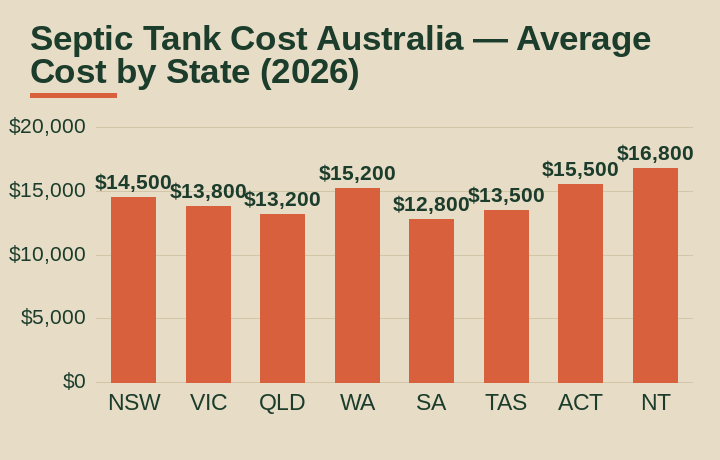
| State | Average Cost | Typical Range |
|---|---|---|
| NSW | $14,500 | $8,500 to $24,000 |
| VIC | $13,800 | $8,000 to $22,500 |
| QLD | $13,200 | $8,000 to $21,000 |
| WA | $15,200 | $9,500 to $25,000 |
| SA | $12,800 | $8,000 to $20,500 |
| TAS | $13,500 | $8,500 to $22,000 |
| ACT | $15,500 | $10,000 to $24,500 |
| NT | $16,800 | $11,000 to $26,000 |
Where the money actually goes
Four or five line items make up most of the bill. Worth knowing which ones you can influence and which ones you’re stuck with.
Tank type and material. A standard concrete septic tank costs $2,500-$4,000 supplied. A poly tank is $2,000-$3,200, lighter to install but more prone to floating in wet ground. An aerated wastewater treatment system, the kind that lets you irrigate your lawn legally, runs $8,000-$13,000 just for the unit. That’s before the hole is even dug. Most rural NSW and Victorian buyers I see in the data go concrete because it lasts.
Soil and site conditions. Sandy soil drains beautifully and lets you use a simple absorption trench system. Clay soil, common around Toowoomba and parts of the Adelaide Hills, often forces you into an AWTS with surface or sub-surface irrigation. The site evaluation alone costs $500-$900. If the result says clay, your total install jumps $5,000-$8,000.
Council approval and permits. Every council charges differently. A Wingecarribee or Macedon Ranges permit might be $800-$1,200. Some remote shires charge $400. Sydney fringe councils like Hawkesbury push closer to $1,500. You also need a licensed plumber to lodge the application, so add their fee on top.
Excavation and labour. Digging the tank pit, the trenches and connecting plumbing is $3,500-$7,000 depending on access. If your driveway is steep or the excavator can’t reach the planned spot, costs blow out fast. A mate near Mudgee paid an extra $2,200 because the truck couldn’t get past his front gate without removing a fence post.
Distance to the house and existing plumbing. Every metre of pipe and trench costs money. A tank placed 30m from the house is meaningfully cheaper than one placed 80m away. Adding an effluent filter at install time is a $150-$300 upgrade that saves thousands in trench rebuilds later.
Conventional septic vs AWTS: side by side
This is the decision most buyers wrestle with. The numbers below are 2026 installed prices for a typical 4-bedroom rural home. The AWTS costs more upfront and keeps costing through quarterly servicing, but it suits restrictive sites a conventional system can’t legally handle.
| Factor | Conventional Septic | AWTS |
|---|---|---|
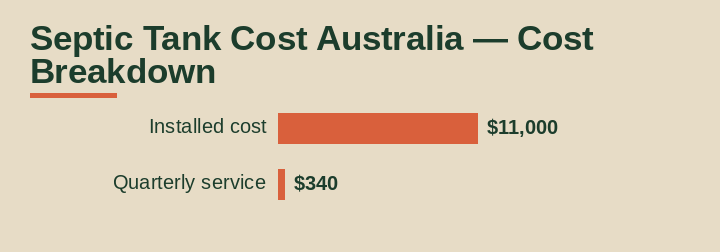
| Installed cost | $8,000 to $14,000 | $15,000 to $25,000 |
| Block size needed | 2,000m² minimum | 800m² minimum |
| Soil suitability | Sandy or loam preferred | Works on clay sites |
| Quarterly service | Not required | $280 to $400 per visit |
| Pump-out frequency | Every 3-5 years | Every 5-7 years |
| Water reuse | No (subsurface only) | Yes, garden irrigation |
| Lifespan | 30-50 years | 15-25 years (mechanical parts) |
The take-home: if you’ve got room and decent soil, conventional wins on lifetime cost. If your block is small, sloped, or clay-heavy, the AWTS is the only legal option, not really a choice. Canstar Blue’s home services research shows ongoing service contracts are where AWTS owners get caught out, with the quarterly fees adding $1,100-$1,600 per year on top of pump-outs.
Products Worth Considering
Here are a few products from Amazon Australia that pet owners find useful:
Questions to ask before you book
Is the soil evaluation included in your quote?
Some installers bundle the site assessment into their package; others quote without it and add $500-$900 mid-project. Always ask upfront. The site evaluation determines what system you can legally install, so it has to happen before any real quoting.
Who handles the council permit lodgement?
You want the plumber doing this, not you. A licensed installer charges $200-$400 to lodge but knows exactly what the council wants. DIY lodgement gets bounced back twice and delays the job by weeks.
What’s the warranty on the tank and the labour?
Decent concrete tanks come with a 20-year structural warranty. Labour should be 12 months minimum. AWTS mechanical components usually only get 2-3 years, which is short, so ask what failure looks like and what replacement parts cost.
How will the excavator access the site?
Make them walk the property with you before they quote. Hidden access problems (steep slopes, soft ground, narrow gates) are the #1 cause of variation bills. Lock the access plan into the written quote.
What’s the realistic timeline from permit to commissioning?
A straightforward conventional install runs 6-10 weeks once you’ve signed. AWTS jobs take 10-16 weeks because the units are often built to order. If a contractor promises 3 weeks, they’re glossing over council approval times.
What ongoing service contract do you offer?
For AWTS owners, the service contract is mandatory under council rules. Get the quarterly fee in writing for at least 3 years, and check what’s included, some contracts cover parts replacement, most don’t.
Questions We Get Asked Most
How much is a septic tank pump-out in 2026?
A standard pump-out runs $300-$600 for a typical household tank. Remote regional areas pay more because the truck has to travel further. Comparing the figures for this guide, NT and far-west NSW pump-outs sit closer to $700-$900.
Do I need a permit to replace an existing septic tank?
Yes, even like-for-like replacements need council approval in every state. The fee is usually lower than a new install ($300-$700), but skipping it can void your property’s certificate of occupancy. Worth doing properly.
Can I connect a second dwelling to my existing septic?
Only if the tank is sized for the extra load. Most household tanks max out at 4-5 bedrooms. Adding a granny flat usually means either upsizing the tank ($4,000-$7,000) or installing a second system.
Are septic systems covered by home insurance?
Most policies cover sudden damage (a tree root crushing the tank, for example) but not gradual failure or council-ordered upgrades. Finder’s home insurance comparison notes wastewater systems are commonly excluded, so check the PDS before assuming.
What’s the cheapest legal septic option for a small block?
A compact AWTS with subsurface drip irrigation is usually the cheapest legal solution for blocks under 1,000m². Expect $14,000-$18,000 installed. Conventional systems simply won’t get approved on small lots in most councils.
How to bring the septic tank cost down
You can’t dodge the council fees or the soil assessment, but you can shave real money off the install with a bit of planning.
- Get three quotes from genuinely local installers. City-based contractors charge a travel premium. Local plumbers in your shire know the council inspector by name and price accordingly. Typical saving: $1,500-$3,500.
- Lock in the access plan before quoting. Walk every contractor through the actual excavator route. Surprises become variations, and variations cost double.
- Pick concrete over poly if your soil allows. Concrete tanks last 40+ years and the upfront cost is similar or lower. Poly only wins on very wet sites where buoyancy is a concern.
- Schedule the install in autumn or early winter. Excavator operators have more capacity outside summer and you’ll get sharper pricing.
- Use monthly bacteria treatments from day one. Keeps the biology healthy and extends time between pump-outs.
- Install an effluent filter at the same time. Adding it later means digging up the tank lid. Doing it during install is a $200 add-on; retrofitting is $600-$900.
- Bundle the pump-out with neighbours. If you’re on a rural road, ask the truck operator for a multi-property discount. Most will knock $50-$100 off each if they can do three jobs in a row.
Related Cost Guides
If you’re researching this because you’re buying a property, get a septic inspection done as part of the building report. It’s $250-$450 and tells you whether the existing septic tank cost Australia exposure is $600 (a pump-out) or $20,000 (a full replacement). That single check is the best money you’ll spend before settlement, and worth more than any glossy install brochure.
This guide contains affiliate links. We may earn a small commission from qualifying purchases at no extra cost to you.