
Second storey addition cost Australia is the budget line most homeowners underestimate, sometimes by $50,000 or more. The build cost itself is only part of the picture. Structural upgrades to your existing home, council approvals, temporary accommodation and the inevitable scope changes mid-project all add up fast. According to the Housing Industry Association, residential construction costs have risen sharply over the past three years, and second storey work is among the most labour-intensive residential build types.
Second storey addition cost Australia sits between $180,000 and $450,000 for most residential projects in 2026. A partial addition (one or two rooms over a garage, for example) starts around $180,000–$230,000, while a full-floor addition with high-end finishes can exceed $450,000. Costs per square metre generally run $2,800–$5,500 depending on state, builder tier and structural complexity.
This guide puts real numbers to every stage of the project so you know what you’re actually committing to before you call a builder.
What a second storey addition typically costs in 2026
The short answer: most Australian homeowners spend $180,000–$450,000 for a full second storey addition in 2026. On a per-square-metre basis, that’s roughly $2,800–$5,500/m², with the variation driven by state, structural complexity and finish level.
A partial addition (two bedrooms and a bathroom over an existing single-storey section) at the lower end of quality in regional Queensland might come in around $185,000–$210,000. A full-floor addition with a luxury bathroom, ensuite, parent’s retreat and high-end finishes in a Sydney suburb like Hunters Hill or Mosman can push $480,000–$550,000 once everything is counted.
| State | Average Cost | Typical Range |
|---|---|---|
| NSW | $320,000 | $230,000 – $500,000 |
| VIC | $295,000 | $210,000 – $460,000 |
| QLD | $275,000 | $195,000 – $430,000 |
| WA | $285,000 | $200,000 – $440,000 |
| SA | $260,000 | $185,000 – $400,000 |
| TAS | $255,000 | $180,000 – $390,000 |
| ACT | $310,000 | $220,000 – $470,000 |
| NT | $300,000 | $215,000 – $460,000 |
Get free quotes from local providers in your area. No obligation.
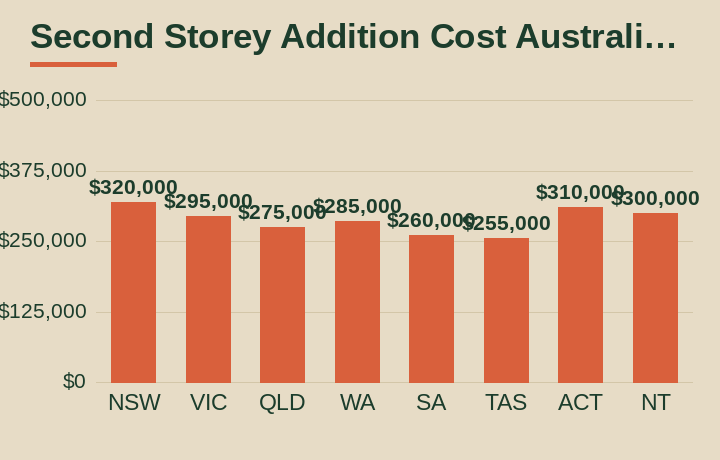
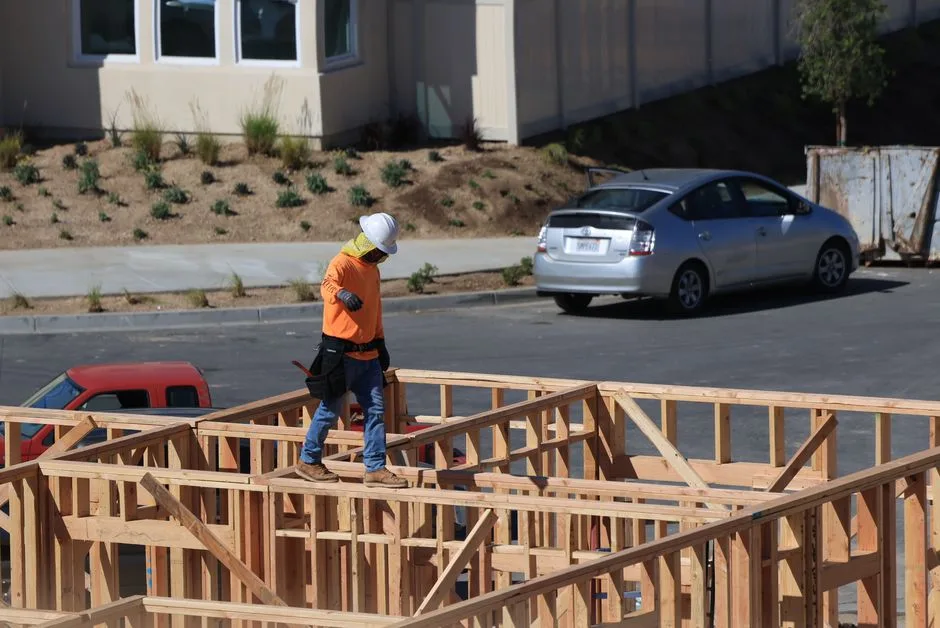
NSW and ACT sit at the top end, reflecting higher labour costs, more complex planning regimes and greater union coverage on residential builds. SA and TAS are meaningfully cheaper on average, though material costs have levelled across states more than they used to.
What’s included in the quoted price, and what isn’t
Builder quotes for second storey additions vary wildly in what they cover. Before you compare two quotes side by side, you need to know whether they’re quoting the same scope. The table below shows what’s typically bundled into a builder’s price versus what usually sits outside it.
| Typically Included | Often Charged Separately |
|---|---|
| Framing, roofing and external cladding | Structural engineering assessment |
| Internal plastering and painting | Architect or building designer fees |
| Standard windows and doors | Council DA or CDC fees |
| Basic electrical (lights, power points) | Footing or stump upgrades |
| One bathroom (standard fit-out) | Staircase (sometimes quoted separately) |
| Insulation to code minimum | Landscaping or driveway reinstatement |
| Scaffolding for the build period | Temporary accommodation during build |
| Site clean-up on completion | Upgrades to existing electrical switchboard |
The extras column adds up quickly. Structural engineering alone is $1,500–$3,500. A DA in metropolitan Sydney or Melbourne can run $5,000–$12,000 in council fees and certifier costs. If your existing footings need upgrading, add another $15,000–$40,000. Always ask builders to confirm exactly which line items are included before signing anything.
Where the money actually goes
Structural upgrades to the existing home
This is the factor people most consistently underestimate. Adding a full floor of weight to a home built in the 1960s or 1970s often means the original footings, wall frames or stumps weren’t engineered for that load. In suburbs like Yarraville or Coburg in Melbourne’s inner west, where older brick veneer homes dominate, footing upgrades of $20,000–$45,000 are not unusual before a single frame goes up on the second floor. Newer homes (post-2000) on engineered slabs typically need less work, but you won’t know until an engineer looks.
Floor area and configuration
Builders quote per square metre, so floor area directly drives cost. But configuration matters almost as much. A 70m² open-plan floor with two bedrooms and one bathroom is simpler to frame and fit out than a 65m² floor with three bedrooms, two bathrooms and a study nook, because every extra room partition, wet area and internal corner adds labour. A full-size ensuite bathroom on the second floor, by itself, typically adds $18,000–$28,000 to the build cost. Kitchen renovation costs in Australia follow a similar pattern, it’s the wet areas and trades that drive the price, not just the raw floor area.
Roof removal and reinstatement
The existing roof has to come off, then go back on (or be rebuilt entirely). This is one of the more expensive phases. Roof removal and rebuild typically costs $18,000–$35,000 depending on roof type and pitch. A complex hipped roof in Toowoomba or a steeply-pitched Queenslander-style roof costs more to remove and reconstruct than a simple gabled roof on a 1990s brick home in Geelong. If your existing roof has asbestos sheeting or ridge capping (common in homes pre-1990), expect an additional $3,000–$9,000 for licensed asbestos removal before any framing begins.
Builder tier and location
There’s a real price gap between volume builders, mid-tier residential builders and boutique custom builders, roughly 25–35% across those tiers for the same scope of work. In inner-Sydney suburbs like Balmain or Surry Hills, mid-tier builders charge $3,800–$5,000/m² for second storey additions. The same build in Penrith or Campbelltown from a comparable builder might run $2,900–$3,800/m². That’s not the outer suburbs being worse, it’s land access, parking, travel time and local labour costs all baked into the rate.
Finishes and specifications
Standard finishes (builder-grade tiles, basic cabinetry, standard tapware) sit at the lower end of the cost range. Specifying engineered timber flooring, custom joinery, stone benchtops in an upper-floor kitchenette or spa bathtubs adds cost fast. The jump from a standard bathroom to a premium bathroom fit-out on the new floor is typically $8,000–$18,000. If you’re comparing quotes, make sure both builders are pricing to the same specification sheet, otherwise you’re comparing apples to fencing.
Questions to ask before you book a builder
Is this a fixed-price contract or cost-plus?
Fixed-price means your worst case is capped (barring variations you approve). Cost-plus means you pay actual costs plus a margin, fine for straightforward jobs, but second storey additions have too many unknowns for most homeowners to absorb that risk comfortably. Push for fixed-price and insist the structural engineer’s report be completed before the contract is signed.
What’s your process if the structural assessment reveals surprises?
A good builder will have a clear protocol: pause, reassess, quote the variation, get your sign-off before proceeding. A vague answer here is a red flag. Budget blowouts on second storey additions almost always trace back to structural surprises that weren’t properly scoped before work began.
Who handles council approvals, you or me?
Some builders include DA management in their quote; others expect you to handle it yourself or engage a private certifier separately. DA management from a builder or project manager typically adds $2,500–$6,000 to the quoted price but saves significant time and stress. Know which arrangement you’re entering before you sign.
How do you handle the roof-off period?
There’s a window of days or weeks when your existing roof is removed and the new floor frame is exposed to weather. Ask specifically how the builder protects your home during this phase, temporary waterproof sheeting is standard, but execution varies. A leak during this phase can cause $15,000–$40,000 in water damage that becomes a dispute. Get the protection method in writing.
What’s not in your quote that I might need later?
Ask this directly. Good builders will tell you what’s missing. Things commonly left out: switchboard upgrades, staircase balustrade to NCC code, privacy screens required by council, external paint to match existing, and driveway or garden reinstatement after scaffolding. Each of these can be $2,000–$8,000 individually.
Do you have references from second storey additions specifically?
Second storey work is meaningfully more complex than a ground-floor extension. References from slab-on-ground extensions don’t tell you much. Ask for two or three clients who’ve had an upper-floor addition completed in the past two years, and actually call them.
How to bring the cost down without cutting corners
Get your structural engineering assessment done before you approach builders, not after. When I researched current pricing patterns across builder quotes and industry data for this guide, the clearest pattern was that projects with a completed structural report upfront had fewer mid-build variations and fewer budget blowouts. Builders who are quoting against a known structural brief give you more accurate numbers. Those quoting blind are padding for uncertainty.
Limit the number of wet areas on the new floor. Every bathroom or laundry you add costs $14,000–$28,000 in waterproofing, plumbing and tiles alone. A one-bathroom, one-ensuite layout will cost noticeably more than a single shared bathroom, and if you can design the floor around bedrooms and a main bathroom, you’ll bank real savings. See how this plays out in detailed breed-specific grooming guides too: it’s always the add-ons that push costs past the initial estimate. The same logic applies to service costs for high-maintenance breeds and major building projects alike.
Use a Complying Development Certificate (CDC) instead of a DA if your project qualifies. In NSW particularly, a CDC processed through a private certifier can be approved in 10–20 days versus 3–6 months for a DA through council. The fee saving is $2,000–$6,000, and the time saving is enormous. Ask your certifier or builder whether your site and project scope meet the criteria under the State Environmental Planning Policy.
A laser measure is worth having before and after, it lets you verify that the floor area delivered matches what you approved and paid for.
Fix the contract price before work starts and don’t approve scope variations casually. Every “while you’re up there” addition, an extra power point run, a skylight, a different tile specification, costs more mid-build than it would have in the original quote. Builders aren’t gouging you; it’s genuinely more expensive to change things mid-construction. Set a contingency of 10–15% of your total budget and treat it as your variation buffer, not free money to spend.
For those thinking about the broader financial picture of a major renovation, MoneySmart’s home improvement finance resources are worth reviewing before you commit to how you’ll fund the build.
A real-world scenario: a three-bedroom addition in Brisbane’s inner north
Consider a family in Ashgrove, QLD with a 1980s brick-and-tile single-storey home. They wanted three bedrooms, a main bathroom, an ensuite and a sitting area, approximately 85m² on the new floor. Structural assessment revealed the stumps needed upgrading ($22,000). The DA took four months and cost $7,500 in fees. The build itself was quoted at $298,000 fixed-price, covering framing, roofing, plastering, two bathrooms, flooring and standard electrical. Total spend including design fees ($14,000 for a building designer): approximately $341,500. That’s $4,018/m² all-in, roughly middle of the QLD range for a mid-tier builder with a decent finish level.
Worth noting: they chose not to add a second living area or kitchenette on the upper floor, which saved an estimated $18,000–$25,000 versus the original concept their designer drew up.
Industry terms you’ll hear
NCC (National Construction Code): The national framework that sets minimum standards for structural performance, fire safety, insulation and accessibility. Your builder must build to NCC standards as a baseline.
DA (Development Application): A formal application to your local council to approve a building project. Required for most second storey additions in Australia unless the project qualifies for a CDC.
CDC (Complying Development Certificate): A faster planning pathway for projects that meet pre-set state government criteria. Processed by a private certifier rather than council. Available in NSW, QLD and some other states.
Principal Contractor: The licensed builder who takes overall responsibility for the project and manages subcontractors. If something goes wrong, they’re the party you hold accountable, make sure they hold a current builder’s licence for your state.
Frequently Asked Questions
How much does a second storey addition cost per square metre in Australia?
Most second storey additions run $2,800–$5,500 per square metre in 2026, depending on state, builder tier and structural complexity. High-end finishes or difficult existing structures push costs toward the top of that range. A standard 60m² addition in Melbourne or Brisbane would typically land at $168,000–$270,000 for the build alone, before council fees and design costs.
Do I need council approval for a second storey addition?
Yes, in virtually every Australian jurisdiction. A second storey addition requires a Development Application (DA) or building permit, structural engineering sign-off and, in most states, neighbour notification. Some states allow a Complying Development Certificate (CDC) for additions that meet standard criteria, which is faster. Budget $3,000–$12,000 for DA fees and approvals depending on your council and project scope.
How long does a second storey addition take to build?
From DA lodgement to handover, expect 12–18 months for most projects. The build itself typically takes 4–7 months once approvals are granted. Projects with complex structural work, heritage overlays or difficult council areas can push that timeline out further. Sydney councils in particular are known for slow DA processing.
Is a second storey addition cheaper than buying a new home?
In most major Australian cities, yes, but it’s closer than many people expect. A $250,000–$350,000 addition avoids stamp duty, agent fees and moving costs, which on a $1.2m Sydney property could easily run $60,000–$80,000 alone. The calculation shifts if your existing home’s footprint, structural condition or location doesn’t suit your long-term needs.
Can all houses support a second storey addition?
Not all. Older homes built before the 1970s often have footings and wall frames not engineered for a second floor. A structural engineer’s assessment ($1,500–$3,500) will determine whether your slab, stumps or concrete footings need upgrading before work can begin. This is the assessment step you should never skip, it directly affects your total budget.
People Also Ask About Second Storey Addition Cost Australia
Do I need to vacate my home during a second storey addition?
In most cases, yes, at least during the roof removal and framing stages, which can last 4–8 weeks. Once the new floor is weather-tight, some families move back in and live around the build, though it’s genuinely disruptive. Budget $4,000–$12,000 for temporary accommodation if you need to rent elsewhere during the construction phase.
What is the difference between a second storey addition and a double storey extension?
A second storey addition adds a new floor on top of all or part of an existing single-storey home. A double storey extension typically refers to extending the footprint of a home outward with two levels in the new section. The structural and planning requirements overlap but differ in some council jurisdictions. Your architect or certifier will classify it correctly for your DA.
How much does it cost to add a second storey to a weatherboard house?
Weatherboard homes often need more structural reinforcement than brick homes before a second storey can be added, as wall frames and stumps may not meet current load requirements. Expect to add $15,000–$40,000 to the base build cost for footing upgrades and subfloor strengthening on top of the standard $180,000–$450,000 project range.
Will a second storey addition increase my property value?
Generally yes, but the return isn’t guaranteed to exceed the cost. In Sydney and Melbourne, well-executed additions in high-demand suburbs can return $1.20–$1.50 for every $1 spent. In regional areas or already-large homes, the uplift is smaller. A local buyer’s agent or valuer can give you a realistic projection before you commit.
What trades are involved in a second storey addition?
A full second storey addition involves structural engineers, architects or building designers, council certifiers, concreters or steel fabricators (for footing upgrades), framers, roofers, plasterers, electricians, plumbers, tilers, painters and a fit-out carpenter. Most people use a licensed builder as a head contractor to manage all of these, which is factored into the per-square-metre rate.
If you’re also factoring in ongoing ownership costs for a growing family, it’s worth reviewing what pets add to the household budget, from vet costs for popular breeds to boarding costs when you travel during the build. And if you’re planning a renovation budget planner, having everything documented from the start makes variation tracking much easier mid-project.
Related Cost Guides
Recommended Products for Second Storey Addition Cost Australia
If you’re tackling this yourself, here are some products from Amazon Australia that can help:
A second storey addition is one of the bigger financial decisions most Australian homeowners will make. The projects that go smoothly share a pattern: structural assessment done early, a fixed-price contract signed against a complete scope, and a contingency budget held in reserve. The ones that blow up usually skipped one of those three steps. Do the groundwork before the groundwork starts, and you’ll be in a much stronger position.
This guide contains affiliate links. We may earn a small commission from qualifying purchases at no extra cost to you.