
Conveyancer cost australia sits between $800 and $2,500 for a standard residential settlement in 2026, with most metro buyers landing somewhere around $1,200 to $1,800 once disbursements are included. The spread is wide because the job changes shape depending on the state, the property type, and whether you go with a licensed conveyancer or a solicitor. According to MoneySmart’s guidance on buying a home, conveyancing is one of the larger upfront costs buyers consistently underestimate.
Conveyancer cost australia sits between $800 and $2,500 for a standard residential settlement in 2026, with most metro buyers paying around $1,200 to $1,800. Licensed conveyancers are cheaper than solicitors. Disbursements (searches, title fees, PEXA) add another $300 to $600 on top.
When I researched current prices across firms in Sydney, Melbourne and Brisbane for this guide, the pattern that stood out was how little the headline fee actually tells you. Two firms quoting $1,100 can end up costing $1,400 versus $2,100 once searches and PEXA fees land. The fixed-fee number is the start of the conversation, not the end.
What you’ll typically pay in 2026
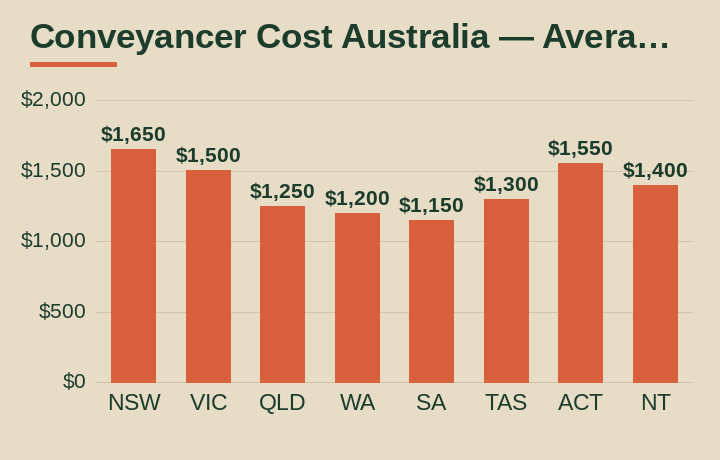
The national average for a standard residential conveyance is around $1,400 all-in. Off-the-plan, strata, and rural blocks push higher. Below is the breakdown by state, based on quotes from licensed conveyancers for a standard freestanding house purchase under $1.5 million.
| State | Average Cost | Typical Range |
|---|---|---|
| NSW | $1,650 | $1,200 – $2,500 |
| VIC | $1,500 | $1,100 – $2,200 |
| QLD | $1,250 | $900 – $1,900 |
| WA | $1,200 | $850 – $1,800 |
| SA | $1,150 | $800 – $1,700 |
| TAS | $1,300 | $950 – $1,800 |
| ACT | $1,550 | $1,100 – $2,300 |
| NT | $1,400 | $1,050 – $2,000 |
Get free quotes from local providers in your area. No obligation.

Worth noting. These figures are professional fees only. Disbursements add another $300 to $600 on top, sometimes more in NSW where searches stack up.

Licensed conveyancer vs solicitor: where the money goes
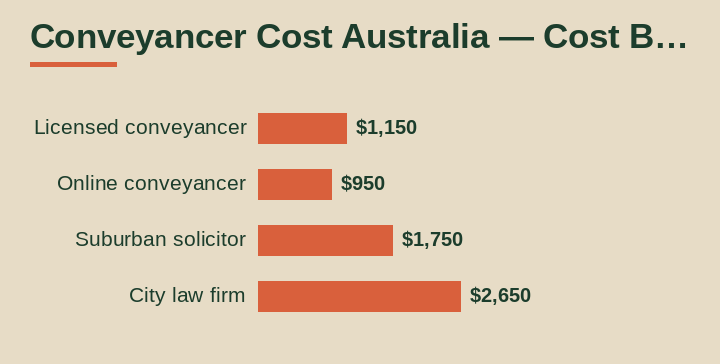
This is the trade-off most first-home buyers don’t think about until they’re three quotes deep. A licensed conveyancer in suburban Brisbane might quote $950 for a standard purchase. A solicitor in the same suburb might quote $1,650 for the same job. Both will get you to settlement.
| Option | Typical Fee | Best For |
|---|---|---|
| Licensed conveyancer | $800 – $1,500 | Standard house or unit purchase |
| Online conveyancer | $700 – $1,200 | Confident buyers, simple titles |
| Suburban solicitor | $1,300 – $2,200 | Off-the-plan, trust purchases |
| City law firm | $1,800 – $3,500+ | Complex commercial, disputes |
For about 80% of residential buyers, a licensed conveyancer is the right call. The exceptions: trust structures, foreign buyer issues, off-the-plan contracts with unusual clauses, or anything where a dispute might be on the cards.
Why prices vary so much between firms
The headline conveyancing fee doesn’t move randomly. Four things explain almost all the variation, and knowing them helps you read a quote properly.
State-based search and registration costs
NSW carries the most expensive disbursement load in the country. A standard Sydney purchase racks up around $450 to $600 in council, water, planning and title searches before you’ve paid the conveyancer a cent. The same purchase in Adelaide might run $250 to $350 in searches. That’s a $300 swing built into the postcode.
Property type and complexity
A freestanding house with a clean title is the cheapest job a conveyancer does. Strata adds an Owners Corporation certificate ($120 to $300) and extra contract review time. Off-the-plan can push the professional fee by $400 to $800 because of sunset clauses, defect periods, and amendments. Rural property with easements or shared driveways adds another layer again.
Location of the firm
You’ll pay 20-30% more with a firm in Sydney’s CBD or inner suburbs like Surry Hills than with one based in Penrith or the Central Coast handling the same purchase. The work is identical. The overheads aren’t. Same pattern shows up in plenty of Sydney service pricing, conveyancing isn’t unusual.
Fixed fee vs hourly
Most licensed conveyancers quote fixed fees now, which is the only way to budget properly. A handful of solicitors still quote hourly rates ($350 to $550/hr for a senior practitioner). For a clean settlement that takes 6-8 hours of actual work, hourly can come out cheaper. For anything that hits a snag, fixed fee protects you. Always ask which model you’re getting and what triggers extra charges. You can grab an A4 document organiser to keep every quote and disbursement schedule in order while you compare.
What’s bundled and what’s extra
One firm’s $1,100 quote includes contract review, settlement, and post-settlement notifications. Another firm’s $1,100 quote covers settlement only and bills $180 per amendment, $90 per follow-up email, and $250 to attend if settlement is delayed. Ask for the full schedule of variable charges, not just the headline.
Questions to ask before you book
The quote is only useful if you know what it covers. These five questions surface the differences that actually matter.
Is this a fixed fee inclusive of GST?
Some quotes are quoted ex-GST, which means a $1,000 quote is really $1,100. Always confirm the figure you’re comparing includes GST. It’s a 10% mistake to make.
What disbursements should I expect on top?
A good firm gives you an estimated disbursement schedule upfront, even if the exact figures shift slightly. If they can’t ballpark it, that’s a flag, they’ve done enough of these to know.
Who specifically handles my file?
Larger firms run high volumes. You want to know if you’re dealing with a licensed conveyancer or a paralegal under supervision. Both can be fine, but at $1,500+ you’re entitled to know.
What happens if settlement is delayed?
Delays happen, lender hold-ups, vendor issues, PEXA glitches. Some firms absorb a short delay. Others charge $200 to $400 to re-book. Find out before you sign.
Do you offer a buy-and-sell discount?
If you’re selling one property and buying another, most firms discount the combined fee by $200 to $400. They rarely volunteer this. You have to ask.
How do you communicate updates?
Some firms use online portals where every document and milestone is tracked. Others rely on email and phone calls. Neither is wrong. Just pick what suits how you work.
How to bring the cost down
There’s genuine room to save here without compromising the outcome. A few practical levers:
- Get three fixed-fee quotes minimum. Quotes for the same job vary by $400 to $700, no exaggeration. Use comparison sites like Finder’s conveyancing comparisons as a starting point, not a finishing point.
- Pick a licensed conveyancer for a standard purchase. Saves $300 to $800 versus a solicitor with no real downside for most buyers.
- Bundle buy and sell. $200 to $400 off when one firm handles both sides.
- Ask for itemised disbursements. Some firms mark up third-party searches. Knowing the real cost lets you push back.
- Skip duplicated services. If you’ve already arranged a building and pest inspection, don’t pay the conveyancer to organise one too. A solid plain-English guide to the Australian buying process helps you know what you actually need.
Hidden costs nobody mentions upfront
The fee quote and the final bill rarely match, and it’s not because the firm’s dishonest. It’s because settlement throws up extras that weren’t on the table when you engaged them. Choice’s buying property research consistently flags these as the surprises that catch first-home buyers out.
Title insurance ($300 to $700), the PEXA settlement fee ($118 in 2026), bank cheque fees if your lender doesn’t go through PEXA, mortgage registration fees ($150 to $200 depending on state), and the transfer registration fee (which scales with property value and can hit $400+ on a $900,000 purchase). None of this is the conveyancer’s fee, but it all lands in their settlement statement.
If you’re juggling other big expenses around the move, our breakdowns of dog boarding around Sydney and Adelaide pet grooming rates are worth a look. Small costs add up when you’re settling and moving simultaneously.
Frequently asked questions about conveyancer cost australia
Is a conveyancer cheaper than a solicitor?
Yes, usually by $300 to $800 for a standard residential settlement. Licensed conveyancers handle the same paperwork but carry lower overheads. Solicitors make sense for trusts, complex off-the-plan, or anything with dispute potential.
What’s included in a fixed-fee quote?
Contract review, liaising with the other party, preparing settlement statements, PEXA settlement, and post-settlement notifications. Disbursements are separate and itemised.
When do I pay?
Most firms take $100 to $300 upfront when you engage them, with the balance deducted from settlement funds. Disbursements are billed as they’re incurred.
Can I do my own conveyancing?
Legally yes in some states, practically no. You can’t access PEXA as a private individual, and one missed search can cost more than the fee you’d save.
Why do NSW and VIC charge more?
Higher property values, more complex contracts (especially strata and off-the-plan), and higher firm overheads in Sydney and Melbourne. All of it gets reflected in professional fees.
People Also Ask About Conveyancer Cost Australia
How long does conveyancing take in Australia?
From contract exchange to settlement is typically 30 to 42 days for residential property. Most of the active work happens in the first week and the final week before settlement, with the middle stretch waiting on searches, finance approval and vendor confirmations.
Do conveyancers handle stamp duty payments?
Yes. Your conveyancer calculates stamp duty, lodges the transfer with the state revenue office, and arranges payment at settlement from your funds. They administer it, but the money comes from you.
What’s the difference between a fee and disbursements?
The fee is the conveyancer’s professional charge. Disbursements are third-party costs they pay on your behalf, title searches, council certificates, PEXA fees, registration fees, then bill back at cost (or with a small admin loading).
Can I change conveyancers mid-purchase?
Yes, but you’ll pay the original firm for work done up to that point. Only worth doing if there’s a real service problem. A second opinion on a contract is cheaper than starting over.
Are online conveyancers safe?
Reputable online firms are licensed the same as local ones and use PEXA like everyone else. The risk isn’t the platform, it’s choosing a firm that’s overloaded. Check reviews and confirm who specifically handles your file.
Related Cost Guides
Recommended Products for Conveyancer Cost Australia
If you’re tackling this yourself, here are some products from Amazon Australia that can help:
Settling on a property is one of the few moments where saving $500 on professional fees can genuinely improve your week. Get three fixed-fee quotes, push back on vague disbursement estimates, and don’t pay solicitor rates for a job a licensed conveyancer can handle. That’s how you keep conveyancer cost australia closer to $1,000 than $2,500 in 2026.
This guide contains affiliate links. We may earn a small commission from qualifying purchases at no extra cost to you.