
The cost that most people underestimate in a knockdown rebuild isn’t the build itself. It’s everything that happens before the slab goes down: demolition, asbestos removal, council approvals, temporary accommodation, connecting new services, landscaping at the end. According to the Australian Bureau of Statistics, residential construction costs have risen sharply since 2021, and that trend hasn’t fully reversed. The all-up knockdown rebuild cost australia homeowners are dealing with in 2026 is meaningfully higher than the numbers circulating from even two years ago.
A knockdown rebuild in Australia typically costs $280,000 to $650,000 all up in 2026, covering demolition ($15,000–$35,000), council fees, and the new build itself ($220,000–$550,000+). Volume builders sit at the lower end; custom architects push well past $650,000. The land is yours already, but expect the total project to run higher than most people budget.
That said, for a block in a suburb you love, it’s often the right call financially and practically. You keep your location, avoid the stamp duty on a new purchase, and get a new build warranty. The numbers just need to go in with eyes open.
What a knockdown rebuild typically costs in 2026
The total cost of a knockdown rebuild in Australia breaks down across three main buckets: demolition and site preparation ($15,000–$35,000), council and statutory fees ($5,000–$20,000+), and the new build itself ($220,000–$550,000+ for most suburban homes). Add these up and you’re looking at $280,000 on the absolute lower end for a basic volume build in a regional area, through to $650,000 or well beyond for a large custom home in Sydney or Melbourne.
Volume builders like Metricon, Simonds and Henley sit at the more accessible end of this range. Fully custom architect-designed homes push well past the upper figure. The land, of course, is already yours.
| State | Average Total Cost | Typical Range |
|---|---|---|
| NSW | $480,000 | $350,000 – $700,000+ |
| VIC | $440,000 | $320,000 – $650,000+ |
| QLD | $400,000 | $290,000 – $580,000+ |
| WA | $390,000 | $280,000 – $560,000+ |
| SA | $370,000 | $270,000 – $520,000+ |
| TAS | $355,000 | $260,000 – $490,000+ |
| ACT | $495,000 | $360,000 – $680,000+ |
| NT | $410,000 | $300,000 – $560,000+ |
Get free quotes from local providers in your area. No obligation.
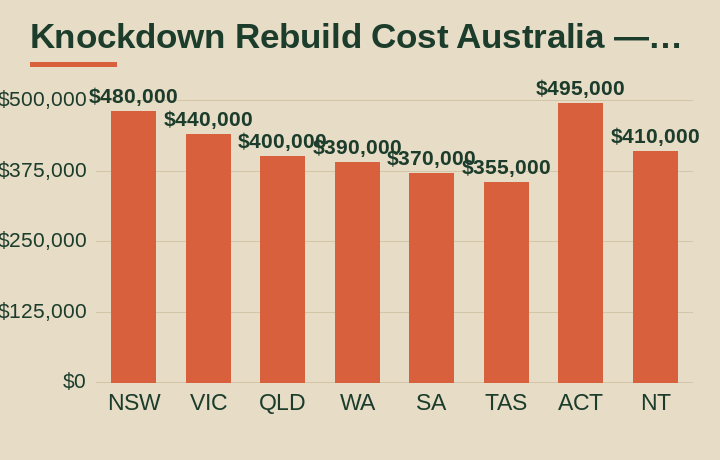
NSW and ACT sit highest, largely due to council fee structures, higher land costs and the labour rates that come with a tight trades market in Sydney and Canberra. Western Australia and South Australia remain comparatively affordable, particularly outside Perth and Adelaide’s inner rings.
What’s included and what isn’t
One of the biggest budget surprises in a knockdown rebuild is discovering how much the builder’s contract doesn’t cover. Volume build contracts look like a complete price on the surface. They often aren’t. Comparing what’s included versus what you’ll pay extra for will save you from a painful variation conversation mid-project.
| Typically Included in Build Contract | Usually Not Included (budget separately) |
|---|---|
| Slab and structural frame | Demolition of existing home |
| External cladding and roof | Asbestos removal (if present) |
| Internal plasterwork and painting | Council DA or CDC application fees |
| Standard kitchen and bathroom fit-out | Landscaping, lawns, garden beds |
| Electrical and plumbing to code | Fencing and retaining walls |
| Basic driveway (often concrete only) | Decking, alfresco, pergola |
| Fixed floor coverings (standard carpet/tiles) | Window furnishings and blinds |
| Insulation to minimum code | Letterbox, clothesline, TV aerial |
The items in that right column add up fast. Landscaping alone on a standard suburban block can run $20,000–$50,000 if you want it to look like a finished home rather than a construction site. Fencing a typical 600m² block runs another $8,000–$18,000. Budget at least $30,000–$60,000 on top of your build contract for external and finishing items.
Where the money actually goes
1. Demolition and site preparation
Demolishing a standard 3–4 bedroom home on a suburban block typically costs $15,000–$25,000. Add hazardous materials like asbestos (common in homes built before 1990) and that figure can jump to $35,000–$55,000. Site preparation after demolition, including tree removal, stump grinding, soil testing and connection of temporary services, adds another $3,000–$10,000 depending on the block. Don’t skip the pre-demolition asbestos inspection. It costs $300–$600 and completely changes your planning if asbestos is found.
2. Council fees and statutory costs
This is the invisible cost that catches almost everyone. Development Application (DA) fees in Sydney’s inner-west suburbs like Leichhardt or Marrickville can run $8,000–$15,000 just for the application. Add private certifier costs, occupation certificates, long service levy (0.35% of build value in NSW), and building approval fees across most states, and you’re looking at $10,000–$25,000 in statutory costs before a single trade sets foot on site. The Choice Australia consumer guide on home building highlights approval costs as consistently the most underestimated line item in new build budgets.
3. Builder tier and design complexity
A volume builder’s standard 4-bedroom, 2-bathroom home on a flat block in Craigieburn or Logan typically runs $220,000–$310,000 for the build contract. Push to a mid-tier builder with some customisation and you’re at $330,000–$430,000. A custom architect-designed home in a premium suburb starts at $430,000 and regularly exceeds $700,000 for anything over 300m². The tier jump between volume and custom is the single biggest variable in the whole equation.
4. Block size, slope and soil conditions
A flat 450m² block in a new suburb is the easiest scenario. A sloped 700m² block in Wahroonga or Templestowe is a different project entirely. Retaining walls on a steep block can cost $25,000–$70,000. Reactive soils (common in parts of Queensland and South Australia) require engineered slabs, adding $5,000–$20,000 above a standard slab. A soil test before you finalise your build contract is not optional on any block with unknown conditions.
5. Temporary accommodation and holding costs
This one gets forgotten in almost every initial budget. You can’t live on site. For a build that runs 16–20 months (realistic for most knockdown rebuilds), renting a comparable property nearby in Sydney costs $2,800–$4,500 per month. In Brisbane or Adelaide, more like $2,000–$3,200. Over 18 months, that’s $36,000–$81,000 in rent that doesn’t go toward any asset. If you have kids in local schools and can’t move suburbs, your rental options are limited and priced accordingly. For more context on ongoing pet and family ownership costs, see our guide on the real cost of owning a Staffy in Australia, which covers the kind of recurring costs people forget to budget.
Questions to ask before you commit
Is the contract price fixed, or does it allow variations?
Fixed-price contracts protect you from material and labour cost increases during the build. Always ask what triggers a variation and what the estimated cost of common variations (like soil condition upgrades or plan changes) would be. A contract with too many variation clauses can blow a $350,000 quote out to $420,000 without you making a single change request.
Does the quote include demolition, or is that separate?
Many builders quote the new home only. Demolition is often a completely separate contractor arrangement. Get clarity on who is managing demolition, whether asbestos costs are excluded, and who is responsible for disconnecting utilities and capping services before the knock-down. Misunderstanding this has cost some owners $20,000+ in unexpected costs.
What’s the actual build time, and what happens if it blows out?
Ask for the contract build time in weeks, what milestones trigger payment drawdowns, and what remedy you have if the builder exceeds the schedule. Delays add holding costs and can affect your construction loan interest. A contract that says “approximately 12 months” without penalty clauses leaves you exposed.
Have you done a knockdown rebuild on this street or suburb before?
Experienced local builders know council idiosyncrasies, soil conditions and common DA issues in your area. A builder who’s done 20 knockdown rebuilds in Toowoomba or Fremantle’s northern suburbs will navigate approval faster and budget more accurately than one coming to the area fresh.
What’s covered under the structural warranty, and for how long?
All states require a minimum builder’s warranty (6 years structural in NSW, 6 years in QLD, 10 years in VIC). Ask for the specific warranty document, not just a verbal confirmation, and check what’s excluded. Waterproofing defects in particular have a short window in some states.
Are site costs capped or open-ended?
Site costs, including soil testing, site levelling and connecting services, are often listed as estimates in volume builder contracts. An open-ended site cost estimate is one of the most common sources of budget blowout. Push for a capped or fixed site cost, or at minimum a written estimate based on an actual soil test result, before signing. You can use a home building budget planner to track all these variable line items from the start.
How to bring the cost down
Choose a volume builder for a standard design if your block suits it. Builders like Henley, Metricon and Simonds have negotiated supplier pricing that independent builders genuinely can’t match at scale. The trade-off is less flexibility on layout and finishes. For most suburban knockdown rebuilds, this trade-off is worth it. The saving over a custom build typically runs $50,000–$120,000 on a standard 4-bedroom.
Use a CDC instead of a DA wherever your council allows it. A Complying Development Certificate is a private certifier pathway that bypasses the full council DA process for builds that meet standard planning codes. It can shave 3–5 months off your timeline and save $2,000–$5,000 in consultant and approval costs. Not every block qualifies, but it’s worth asking your certifier about upfront. If you’re planning other projects alongside the rebuild, like a kitchen renovation, lock in those decisions at contract stage rather than as variations later.
Get the asbestos inspection done before you get demolition quotes. Knowing upfront whether you’re dealing with asbestos (and how much) lets demolition contractors price accurately. Springing it on them during the job turns a $19,000 demolition into a $38,000 one with emergency licensed removal costs loaded in.
Lock in a fixed-price contract before material costs shift again. The residential construction sector saw significant cost volatility between 2021 and 2024. Fixed-price contracts have a premium baked in, but they’re still better value than an open-ended arrangement that exposes you to timber or steel price movements mid-build. An understanding of what’s in your build contract before signing matters more than most people realise.
Time your build start for the April–July window if your schedule allows. Builder demand eases slightly outside the spring rush, and you’ll find more negotiating room on inclusions and price. It won’t transform the budget, but a 5–8% improvement on a $400,000 contract is still $20,000–$32,000.
For reference on similar ownership costs in the building and renovation space, see the Border Collie cost guide on how ongoing versus upfront costs can differ significantly from initial estimates, a pattern that applies just as much to building projects.
Frequently asked questions
Is a knockdown rebuild cheaper than renovating?
Sometimes, but not always. A full renovation of an older home can easily cost $200,000–$450,000 and still leave you with dated bones. A knockdown rebuild gives you a new build warranty, modern energy efficiency and a layout you actually chose. For homes with serious structural issues or asbestos, demolishing and rebuilding often works out cheaper in the long run. The honest answer is: get quotes for both before deciding.
How long does a knockdown rebuild take in Australia?
Expect 12 to 24 months from first quote to move-in. Demolition itself takes 1–2 weeks. DA approval and council processes can add 3–6 months, sometimes longer in NSW. The build phase typically runs 6–14 months depending on the builder’s workload and whether you’ve chosen a volume or custom build. Budget for at least 18 months of temporary accommodation costs.
Do I need council approval to knock down my house?
Yes. In most states you need a demolition permit from council before any work starts. You’ll also need a new Development Application (DA) or a Complying Development Certificate (CDC) for the new build. Some states allow fast-track CDC approvals for standard volume builds, which can shave months off the timeline. A private certifier can help speed up this part.
What is asbestos removal and how much does it add to the cost?
Homes built before 1990 in Australia frequently contain asbestos in walls, eaves, roofing or flooring. Licensed asbestos removal is mandatory and adds $5,000–$30,000+ to demolition costs depending on how much is present and where. A pre-demolition asbestos inspection ($300–$600) is worth doing before you finalise any demolition quote, so you’re not hit with a surprise mid-project.
Can I live on site during a knockdown rebuild?
No. The property needs to be vacant before demolition begins and will remain unliveable throughout the build. Most families rent nearby during the process. Budget $1,500–$3,500 per month for temporary rental depending on location and family size. Over 18 months that’s $27,000–$63,000 in rent alone, which many first-time builders completely forget to include in their total cost calculation.
People Also Ask About Knockdown Rebuild Cost Australia
What happens to my mortgage during a knockdown rebuild?
Your existing mortgage continues during demolition and construction. If you’re using a construction loan, the lender draws down funds in stages as each build milestone is reached. You typically pay interest-only during construction, then switch to principal and interest once the build is complete. Talk to your broker early, as the loan structure for a knockdown rebuild differs from a standard home loan refinance.
Do knockdown rebuilds include landscaping in the price?
Rarely. Most volume builder contracts cover the structure, plumbing, electrical and a basic driveway, but landscaping, fencing, decking and letterboxes are typically excluded. Budget an extra $15,000–$50,000 for basic landscaping and external finishes on top of your build contract price, depending on your block size and taste.
Is stamp duty payable on a knockdown rebuild?
You’ve already paid stamp duty when you bought the land, so there’s no additional stamp duty on the build contract itself. However, if you need to refinance or restructure your loan significantly, there may be mortgage registration fees. Check with your conveyancer or broker for your specific situation, as state rules vary slightly.
Can I knockdown rebuild in a heritage area?
It depends on the heritage listing. A local heritage overlay or listing may prevent full demolition or require the new build to match the streetscape character of the existing home. Full demolition of a heritage-listed property is usually not permitted. Check your planning certificate (known as a Section 10.7 certificate in NSW, or a Planning Certificate in other states) before buying or committing to a knockdown rebuild plan.
What’s the difference between a project home and a custom build for a knockdown rebuild?
A project home (volume build) uses a pre-designed plan from a catalogue, with limited customisation. It’s faster and cheaper, typically $220,000–$380,000 for a standard 4-bedroom. A custom build is designed from scratch by an architect or building designer, giving you full control over layout, materials and style. Custom builds start around $380,000 and easily exceed $700,000 for larger or complex homes. Most knockdown rebuilds in suburban areas use a volume builder.
Related Cost Guides
Recommended Products for Knockdown Rebuild Cost Australia
If you’re tackling this yourself, here are some products from Amazon Australia that can help:
If you’re weighing up the broader financial picture, resources like MoneySmart’s home building guidance are worth a look before you commit to a construction loan structure. And for related pet and household costs as you plan a major life change like this, see our guides on dog boarding in Melbourne, pet sitting costs in Melbourne, and vet consultation costs for when life gets complicated during a long build.
This guide contains affiliate links. We may earn a small commission from qualifying purchases at no extra cost to you.