
I keep lovebirds, so this is one I can speak to from experience. Lovebird prices vary wildly depending on mutation, age, and where you buy. A common green peach-faced lovebird from a breeder runs $80-$120, while a rare violet or creamino mutation hits $250-$350. Pet shops typically sit in the middle at $100-$180 but offer less transparency about genetics and health history.
A lovebird in Australia typically costs $80-$350 depending on mutation and age, with rare colour mutations reaching $350+. Initial setup (cage, toys, food bowls) adds $200-$600, while ongoing monthly costs average $40-$80 per bird. Buying a bonded pair costs 15-25% more than single birds but prevents loneliness.
Prices updated July 2026 from current Australian sources.
| Cost | Typical range | Notes |
|---|---|---|
| Purchase | $80 to $350 | Rare colour mutations $350+ |
| Setup (cage, toys, food bowls) | $200 to $600 | |
| Ongoing per month | $40 to $80 per bird |
A bonded pair costs 15 to 25% more than a single bird but prevents loneliness, which lovebirds are especially prone to. Avian vet care should be budgeted for.
The biggest thing I’d pass on, both from keeping lovebirds and from working in a pet store, is to never feed an all-seed diet. Lovebirds need a mix of pellets, some quality seed, greens and vegetables. Sunflower and safflower seeds are fine as an occasional treat, but a lot of birds will pick out only the sunflowers and leave the rest, and those seeds are very high in fat, honestly about the equivalent of eating McDonald’s every day. A high-fat diet leads to health and behavioural problems, and the most common one I see is feather plucking, which then costs you in avian vet bills. Getting the diet right from the start is the cheapest thing you can do.
Sources (July 2026): PetRescue, Adopt a pet, RSPCA Australia, Animal Medicines Australia, Pets in Australia 2025, Pet Shop Direct
Beyond the bird itself, setup costs matter. You’re looking at $200-$600 for cage, toys, bowls, and initial supplies, more if you’re buying for a pair.
This guide breaks down real 2026 lovebird cost Australia figures, state variations, and what actually affects your final bill.
Lovebird Cost Across All States
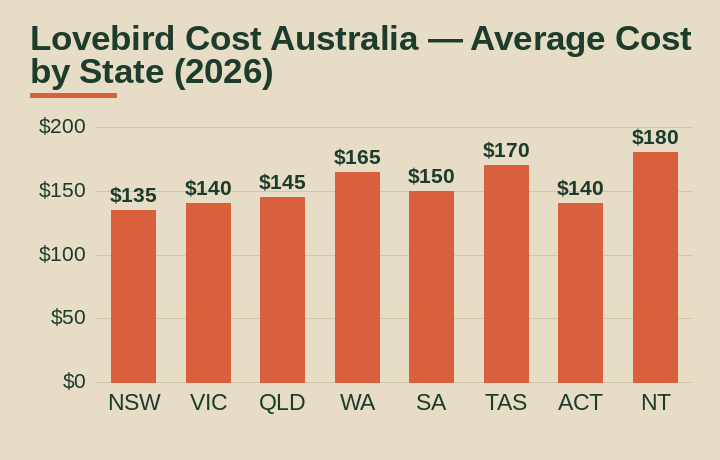
Prices shift a bit between states, mostly due to breeder density and transport costs. NSW and Victoria have the most breeders, which keeps prices competitive. Remote areas in WA, NT, and Tasmania pay premiums due to freight or limited local supply.
| State | Average Cost | Typical Range |
|---|---|---|
| NSW | $135 | $80 to $320 |
| VIC | $140 | $85 to $310 |
| QLD | $145 | $90 to $330 |
| WA | $165 | $100 to $350 |
| SA | $150 | $95 to $325 |
| TAS | $170 | $110 to $340 |
| ACT | $140 | $85 to $315 |
| NT | $180 | $120 to $350 |
These prices cover the bird only. Setup costs stay fairly consistent nationwide at $200-$600, though you’ll pay slightly more for delivery to regional areas.
Real-World Example: Buying a Bonded Pair in Melbourne
Sarah from Melbourne’s inner north wanted two lovebirds to keep each other company while she worked full-time. Here’s what she paid in early 2026:
- Bonded peach-faced pair (blue and lutino mutations): $280 from a suburban breeder
- Large powder-coated cage (80cm x 50cm x 50cm): $145 from an online pet supplier
- Natural wood perches (4 pieces, varying diameters): $32
- Shredding toys, bells, and foraging toys: $48
- Stainless steel food and water bowls: $22
- Initial pellet and seed mix supply: $38
- First vet check for both birds: $95
Total upfront: $660. Her monthly costs run about $55 for food, fresh produce, and toy replacements. Over the birds’ estimated 12-year lifespan, she’s budgeting roughly $8,500 including periodic vet visits.
Sarah reckons buying the pair upfront saved her the hassle and cost of introducing a second bird later, which often fails and wastes money.
What Affects Your Lovebird Cost
Mutation and Colour Rarity
Common green or wild-type peach-faced lovebirds sit at the bottom of the price range ($80-$120) because they breed prolifically. Popular mutations like lutino, pied, or pastel blue cost $150-$220. Rare colours, violet, creamino, or certain opaline combinations, hit $250-$350 because they require specific breeding pairs and produce fewer offspring.
You’re paying for aesthetics, not personality. A $90 green lovebird is just as affectionate as a $300 violet.
Hand-Raised vs Parent-Raised
Hand-raised lovebirds cost $20-$50 more because they’re socialised to humans from 2-3 weeks old, making them calmer and easier to handle. Parent-raised birds are flightier initially but tame down with patience. If you want a cuddly bird from day one, hand-raised is worth the premium. If you’re experienced with birds and don’t mind slower bonding, parent-raised saves money.
Age of the Bird
Baby lovebirds (8-12 weeks, just weaned) command top prices because buyers want to bond with them young. Juveniles (3-6 months) drop $10-$25 as they’re past the ‘baby cute’ phase. Mature adults (1+ years) often sell for $60-$100, especially if rehomed due to owner circumstances. Older birds can bond strongly with new owners, age doesn’t kill their affection.
Breeder Reputation and Location
Established breeders with health guarantees and detailed records charge $120-$350 depending on mutation. Backyard breeders selling through classifieds run $70-$150 but offer no guarantees and sometimes poor genetic diversity. Pet shops sit around $100-$180 but source from various breeders with inconsistent quality.
Urban breeders in Sydney, Melbourne, and Brisbane face more competition, keeping prices lower. Regional and remote breeders charge $20-$50 extra to cover lower sales volume and transport costs.
Single Bird vs Bonded Pair
Buying two lovebirds together costs 15-25% more than double the single-bird price because breeders discount pairs slightly. A single $130 bird becomes $240-$260 for a pair, not $260. Pairs share one cage, reducing setup costs compared to housing two separately later. The Australian Veterinary Association notes that paired lovebirds show fewer stress behaviours than lone birds in working households.
Cage and Setup Quality
A bare-minimum cage runs $80-$100, but proper horizontal-bar cages with 60cm+ width cost $120-$250. Lovebirds are active climbers, tall cages without width frustrate them. Factor in $40-$80 for perches and toys initially, plus $10-$20 monthly for replacements since they destroy toys quickly. Stainless steel bowls at $15-$25 outlast cheap plastic ones that crack within months, which is fair value long-term.
Mistakes That Cost People Money
- Buying the cheapest bird without health history: Backyard breeders at $60-$80 sometimes sell inbred or sick birds. One serious illness costs $200-$600 in vet bills, wiping out any savings. Spend the extra $40-$80 for a reputable breeder with health checks.
- Choosing a tiny cage to save $40-$60: Undersized cages cause feather plucking, aggression, and depression. Treating behavioural issues costs $150-$400 in avian vet consults and enrichment upgrades. Buy the right size cage upfront, it’s cheaper.
- Skipping the initial vet check: A $60-$100 wellness exam catches respiratory issues, parasites, or nutritional deficiencies early. Waiting until the bird is visibly sick turns a $80 problem into a $300-$800 emergency. Budget for this from day one.
- Feeding only cheap seed mix: Seed-only diets cause fatty liver disease and vitamin deficiencies, leading to $400-$1,200 in vet treatment over the bird’s life. A quality pellet and fresh food diet costs $5-$10 more monthly but prevents expensive health crises. Most avian vets recommend a quality pellet diet formulated for small parrots as 60-70% of daily intake.
How to Bring the Cost Down
Cutting costs without compromising bird welfare takes a bit of strategy. Here’s what actually works:
Buy Direct from Breeders, Not Pet Shops
Reputable breeders charge similar prices to pet shops ($120-$200 for common mutations) but include health guarantees, detailed mutation info, and ongoing advice. Pet shops mark up birds by $20-$60 and often can’t answer genetic or behavioural questions. You’re paying the same or less for better quality and support.
Adopt Mature Lovebirds from Rescues
Bird rescues and rehoming groups charge $40-$80 adoption fees, and mature lovebirds (2-5 years old) bond just as strongly as babies with a few weeks of patience. Some adoptions include the cage, saving another $100-$200. Check local Facebook groups, Gumtree, or organisations like bird-specific rescues in your state.
Choose Common Mutations Over Rare Colours
A green or standard peach-faced lovebird at $80-$120 has the same personality as a $300 violet. Colour doesn’t affect temperament, health, or lifespan. If you’re after a pet, not a show bird, save $150-$230 by picking common mutations.
Make DIY Toys from Safe Materials
Lovebirds shred toys within days. Store-bought toys cost $8-$15 each, adding up to $25-$40 monthly. Use untreated pine blocks, paper towel rolls, cardboard boxes, and natural wicker balls from craft shops. Materials cost $3-$8 monthly versus $25-$40, saving $20-$30. Just avoid treated wood, metals, and toxic glues.
Buy Pellets and Seed in Bulk Online
Pet shops charge $10-$15 for 500g pellet packs. Online suppliers sell 5kg bags for $40-$50, lasting 6-8 months for one bird. That’s $6-$8 monthly versus $10-$15. Over a year, you save $50-$85. Same logic applies to seed mixes, bulk buying cuts per-kilo costs by 30-40%.
Skip Stainless Steel Cages Unless You’re Breeding
Stainless steel cages at $1500-$3000 last forever and can be great in certain circumstances, but for lovebirds, a quality powder-coated cage at $120-$180 lasts 10+ years with proper care. Unless you’re running a breeding operation or have birds that destroy or chew on the coating, powder-coated is fine.
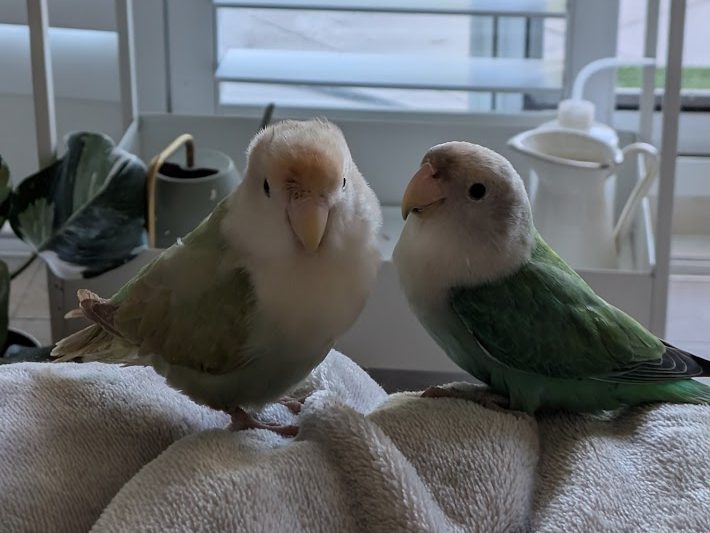
Meet my two little lovebirds Joey and Yoshi above :). I paid $80 each for them in 2023.
Recommended Products
If you’d like to be prepared at home, these products from Amazon Australia are worth a look (these are affiliate links):
- spacious lovebird cage with horizontal bars, Provides essential climbing space and prevents feather damage
- quality pellet diet formulated for small parrots, Prevents nutritional deficiencies common with seed-only diets
- rotating selection of shredding toys, Keeps intelligent lovebirds mentally stimulated and prevents boredom
- natural cuttlebone for calcium, Essential for beak health and prevents mineral deficiencies
Planning to add a lovebird (or two) to your family? Factor in not just the sticker price but the decade-plus of care costs. These little parrots give back heaps of personality and affection, but they’re a genuine financial commitment. Do the maths before you commit, and you’ll avoid the stress of unexpected bills down the track.
Common Questions
How much does a lovebird cost in Australia?
A lovebird in Australia costs $80-$150 for common mutations like green or peach-faced, $150-$250 for popular colours like lutino or pied, and $250-$350+ for rare mutations like creamino or violet. Hand-raised babies cost $20-$50 more than parent-raised birds.
Is it better to buy one lovebird or two?
Two lovebirds are better unless you can provide 4-6 hours daily interaction. Single lovebirds bond strongly with humans but become depressed without constant attention. Bonded pairs cost 15-25% more upfront but are happier and require less human interaction, making them better for working owners.
What’s the difference between pet shop and breeder lovebird prices?
Pet shop lovebirds cost $100-$180 but often lack detailed health history or mutation information. Reputable breeders charge $120-$350 but provide health guarantees, mutation details, and better socialisation. Breeders also offer ongoing support which saves money on behavioural issues later.
How much does lovebird setup cost in Australia?
Initial lovebird setup costs $200-$600 including cage ($80-$250), perches and toys ($40-$80), food and water bowls ($15-$30), initial food supply ($30-$50), and vet check ($60-$120). Larger cages for pairs push costs toward the higher end.
What are monthly costs for keeping a lovebird in Australia?
Monthly lovebird costs average $40-$80 per bird including pellets and seed mix ($15-$25), fresh fruit and vegetables ($10-$20), replacement toys ($10-$20), and occasional vet visits ($5-$15 averaged monthly). Pairs cost roughly 60-70% more than single birds, not double, due to shared resources. Lovebirds are much cheaper to feed than bigger birds due to them eating much less.
Other Questions Worth Asking
Do lovebirds talk or mimic sounds?
Lovebirds rarely talk but can learn to mimic simple sounds like whistles, kisses, and phone rings. They’re not known for clear speech like budgies or cockatiels. Their charm is in their playful, affectionate personality rather than vocal ability.
How long do lovebirds live in captivity?
Lovebirds live 10-15 years with proper care, though some reach 20 years. Their lifespan depends on diet quality, mental stimulation, and regular vet checks. This long commitment means budgeting for 12-15 years of care costs totalling $6,000-$12,000 over their lifetime.
Can lovebirds live alone or do they need a partner?
Lovebirds can live alone if you provide 4-6 hours daily interaction, but they’re naturally social and thrive in pairs. Single birds bond intensely with humans but risk depression if left alone frequently. Working owners should buy pairs to prevent loneliness-related health issues.
What’s the quietest lovebird mutation for apartments?
All lovebird species have similar noise levels, they’re vocal birds regardless of colour. Peach-faced lovebirds are slightly louder than masked or Fischer’s, but the difference is minor. No mutation is truly ‘quiet’. Expect frequent chirping, especially mornings and evenings, which carries through apartment walls.
Are male or female lovebirds better pets?
Male lovebirds are slightly calmer and less territorial, while females can be feistier and more prone to nesting behaviour. Honestly, individual personality varies more than gender differences. Hand-raised birds of either sex make affectionate pets, and DNA sexing costs $30-$50 if you want certainty.
Other Lovebird Ownership Costs to Consider
Beyond the purchase price and setup, lovebirds carry ongoing expenses that add up. Annual vet checks run $60-$100 per bird, essential for catching early signs of respiratory issues or nutritional deficiencies. Emergency vet visits for injuries or sudden illness cost $150-$400, and serious conditions requiring hospitalisation hit $600-$1,200.
Toy replacement is constant. Lovebirds are destructive chewers, demolishing toys weekly. Budget $10-$20 monthly if buying commercial toys, or $3-$8 if making your own. Food costs stay steady at $15-$25 monthly per bird for quality pellets, seed mix, and fresh produce.
If you travel, boarding facilities charge $15-$25 daily, or you’ll need a trusted friend willing to care for them. Some owners also invest in mobile vet services for convenience, which cost slightly more but save travel stress for the birds.
Over a typical 12-year lifespan, total lovebird cost Australia runs $6,500-$11,000 per bird including purchase, setup, food, toys, and routine vet care. That’s $540-$915 annually, not cheap, but manageable if you budget for it upfront.
Related Cost Guides
This guide contains affiliate links. We may earn a small commission from qualifying purchases at no extra cost to you.