Dog training in Sydney confuses a lot of owners because the price range is genuinely enormous. You can spend $50 on a Saturday group class at your local park, or $3,000+ on a two-week board-and-train program with a behaviourist. Those aren’t the same service, obviously, but the industry does a poor job of making that clear. According to the Australian Veterinary Association’s recent cost-pressure report, Australians are scrutinising pet service spending more carefully than they were two years ago. That context matters here.
Dog training cost Sydney sits around $50 to $80 for a group obedience class and $120 to $250 per session for private one-on-one training. Puppy preschool programs typically run $180 to $320 for a 4-week course. Board-and-train packages, where your dog stays with the trainer, can reach $1,800 to $3,500 per week.
Prices updated July 2026 from current Australian sources.
| Training type | Typical Sydney price | Notes |
|---|---|---|
| Group obedience class | $50 to $80 per class | Best value per session |
| Private one-on-one session | $120 to $250 per session | In-home sits at the top end |
| Puppy preschool (4-week course) | $180 to $320 | Often run through vet clinics |
| Board-and-train (per week) | $1,800 to $3,500 | Dog stays with the trainer |
Prices depend on the trainer’s experience, the format, and your dog’s behaviour issues. In-home sessions in inner suburbs cost the most. Package deals and mid-week bookings usually work out cheaper per session.
Sources (July 2026): Airtasker AU, How much does dog training cost, Mad Paws
Sydney’s training market is competitive and largely unregulated. Anyone can call themselves a dog trainer without a qualification. That’s not an argument against using trainers, but it does mean you need to know what you’re paying for before you hand over money.
| State | Average Cost (Private Session) | Typical Range |
|---|---|---|
| NSW | $175 | $120 to $250 |
| VIC | $165 | $110 to $230 |
| QLD | $150 | $100 to $200 |
| WA | $155 | $105 to $210 |
| SA | $140 | $95 to $185 |
| TAS | $130 | $90 to $170 |
| ACT | $160 | $110 to $215 |
| NT | $125 | $85 to $165 |
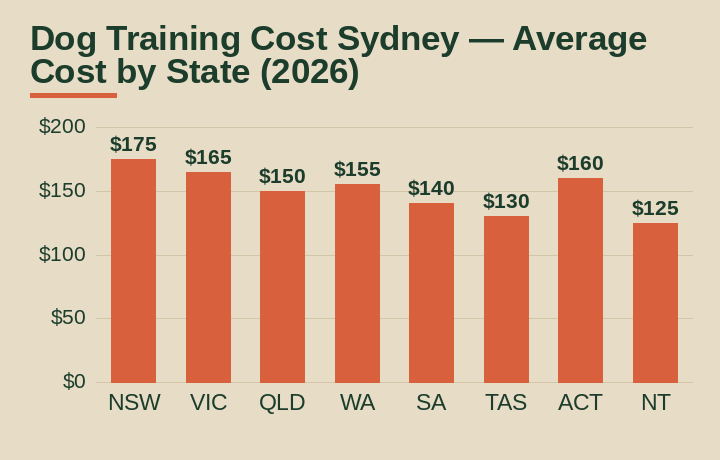
Sydney is clearly the most expensive market in Australia for private training. That gap is real and it’s driven by rent, demand and a denser market of specialist behaviourists. If you’re comparing quotes from interstate friends, their prices won’t translate directly.
Where the money actually goes
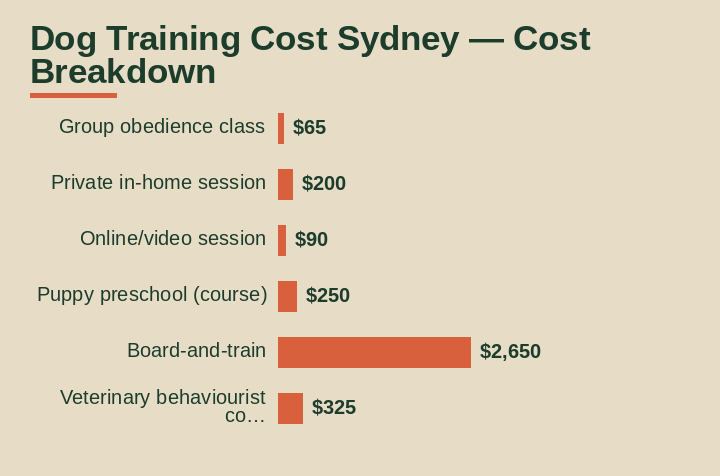
Training format is the biggest cost driver. Group obedience classes at a club or park in Sydney run $50 to $80 per session, or roughly $280 to $480 for a 6-week course. Private sessions with the trainer coming to your home sit at $150 to $250 per hour. The price gap isn’t just about exclusivity, it’s about travel time, preparation and a trainer who is focused entirely on your dog for that hour. For a dog with reactivity issues or aggression, private is usually the only practical format anyway.
Trainer qualifications push rates up noticeably. A trainer with a Certificate IV in Companion Animal Services and membership with the Pet Industry Association of Australia typically charges $160 to $220 per session. A veterinary behaviourist, a vet with a specialist qualification in animal behaviour, charges $250 to $400 for an initial consultation. For complex cases like separation anxiety or inter-dog aggression, that specialist rate is often worth it. Cheaper isn’t better when the problem is serious.
Location within Sydney makes a 20 to 30% difference. Inner-suburb trainers covering Newtown, Surry Hills and Paddington generally charge $180 to $250 for a private session. The same service in Penrith, Campbelltown or Blacktown typically runs $120 to $165. That reflects rent, travel costs and the demographic reality of who their clients are. If you’re in the outer west and a trainer is quoting inner-city rates, ask why.
Specialisation adds a meaningful premium. A trainer offering basic sit-stay-come obedience is priced differently from someone who specialises in reactive dog management, scent work or assistance dog foundations. Specialist trainers in Sydney can charge $200 to $280 per session, but for the right problem, they’ll solve it faster than a generalist working outside their expertise. Puppy school pricing follows a different structure again and is worth reading if your dog is under 16 weeks.
Board-and-train packages are priced per week, and the numbers are confronting. Reputable board-and-train programs in Sydney run $1,800 to $3,500 per week. Two weeks is typical for a full obedience program. That’s $3,600 to $7,000. You need to ask hard questions before committing to this format (covered below), because the handover process is critical and not all programs include it properly. Using standard dog boarding alongside separate training sessions is often cheaper for dogs without major behavioural issues.
Training format comparison: what you get at each price point
Before choosing a format, it helps to see the actual trade-offs in one place. Group classes are genuinely good value for socialisation and basic obedience. Private sessions are worth the premium when your dog has specific issues or you want faster results. Board-and-train is for owners who’ve tried other formats and need intensive intervention.
| Format | Typical Sydney Cost | Best For | Watch Out For |
|---|---|---|---|
| Group obedience class | $50 to $80 per session | Puppies, basic manners, socialisation | Distracted dogs learn slower in group settings |
| Private in-home session | $150 to $250 per hour | Reactive dogs, specific behavioural issues | Progress depends on owner practising daily |
| Online/video session | $60 to $120 per session | Basic obedience, owner education | Not effective for aggression or reactivity |
| Puppy preschool (course) | $180 to $320 for 4 weeks | Under 16 weeks, socialisation window | Limited value if started too late |
| Board-and-train | $1,800 to $3,500 per week | Intensive rehabilitation, serious behavioural issues | Behaviour can revert without proper handover |
| Veterinary behaviourist consult | $250 to $400 initial consult | Anxiety, aggression, complex cases | May also require ongoing medication management |
Questions to ask before you book
What training methods do you use, and why?
This is the single most important question. Force-free, reward-based training is backed by current behavioural science and has better long-term outcomes. If a trainer mentions dominant theory, pack hierarchy or relies on prong collars and e-collars as standard tools, that’s a red flag. The answer should reference positive reinforcement and be said with some confidence, not defensiveness.
What qualifications do you hold?
Ask specifically for their Certificate IV in Companion Animal Services or equivalent, and whether they’re members of a professional body. Unqualified trainers aren’t automatically bad, but you have no way to assess their knowledge or hold them accountable if something goes wrong. A trainer charging $200 per session with no credentials is charging qualified rates for unqualified work.
How many sessions will my dog realistically need?
Any trainer who promises results in one or two sessions for a dog with genuine behavioural problems is overselling. A realistic answer for a reactive dog is 8 to 15 sessions minimum. For a puppy needing basic obedience, 4 to 6 sessions plus daily home practice is reasonable. Get a ballpark in writing so you can budget properly. You can also read about what puppy school typically costs to compare.
What’s included in a board-and-train handover?
Board-and-train programs that don’t include at least 1 to 2 dedicated handover sessions are selling you half a service. The dog has learned to respond to the trainer, not you. Without handover time where you learn the cues, timing and management strategies, some dogs revert within weeks. Ask specifically how many handover hours are included and whether they’re at the facility or in your home environment.
Do you have references or video of dogs you’ve worked with?
Reputable trainers will have client testimonials, case study videos or before-and-after footage without hesitation. Be sceptical of anyone who deflects this request. Ask specifically about dogs with similar issues to yours, not just happy labs doing sits in a park.
Is the session rate fixed or does it change based on my dog’s issues?
Some trainers charge a flat rate regardless of complexity. Others charge more for aggression cases or dogs that require significant equipment or safety management. Neither approach is wrong, but knowing upfront means no surprise invoices. The difference can be $50 to $80 per session for complex cases.
Recommended Products for Dog Training Cost Sydney
If you’re tackling this yourself, here are some products from Amazon Australia that can help (these are affiliate links):
How to bring the cost down
- Start with group classes. For a dog without serious behavioural problems, a 6-week group course at $280 to $480 covers the same foundational skills as 2 to 3 private sessions at $150 to $250 each. Save private sessions for when you’ve hit a specific wall. You can compare formats further in our guide to mobile vs salon pet services in Australia, which applies the same logic to other pet care decisions.
- Buy a session bundle upfront. Most Sydney trainers offer packages. A trainer charging $190 per session often bundles 5 sessions for $850 to $880, saving you $70 to $100. Always ask before paying session by session.
- Use a trainee trainer for basic work. Students completing their Certificate IV offer supervised sessions at $50 to $80 each. For sit, stay, recall and loose-leash walking, that’s genuinely sufficient. Save the qualified specialist for complex issues.
- Maximise your home practice. Each 10-minute daily practice session between professional visits reduces the total number of paid sessions needed. A trainer once told me the owners who practise daily need about 40% fewer sessions overall. That maths adds up fast at $180+ per session. a good treat pouch makes home sessions faster and more consistent.
- Check the RSPCA NSW and local council programs. The RSPCA Australia and some Greater Sydney councils run subsidised community training programs at $25 to $45 per session. They’re not always listed prominently, worth a direct phone call to your local council’s companion animal team.
- Consider online sessions for foundational work. Video call sessions with a qualified trainer run $60 to $120, compared to $150 to $250 in-person. For basic obedience with a puppy, they work well. Use the saving to fund in-person sessions when you actually need physical presence. Also consider mental stimulation toys which reduce boredom-driven problem behaviours and can cut the number of sessions you need overall.
- Address health issues first. Dogs in pain or discomfort often present as difficult or reactive. A mobile vet consultation or standard vet check before starting training can confirm there’s no underlying physical issue driving the behaviour. Treating the symptom (behaviour) without addressing the cause (pain, anxiety) wastes training money.
The MoneySmart pet ownership page has useful budgeting frameworks for ongoing pet costs, including training. Worth bookmarking if you’re mapping out the full cost of dog ownership across the year. And if you’re looking at the broader picture, the costs involved in things like dog vaccinations and desexing should sit alongside training in your year-one budget planning.
Dog training cost Sydney is genuinely higher than most other Australian cities, and there’s no shortcut around that if you need specialist help. But for the majority of dogs with basic obedience goals, the group class market here is solid, well-priced and gets results when owners put in the daily practice. The mistake most people make is jumping straight to expensive private sessions before trying the cheaper formats first.
Sydney sits at the top end nationally. Private session rates in Sydney ($150 to $250) are noticeably higher than in Brisbane ($120 to $180) or Adelaide ($100 to $160). Melbourne is comparable. The cost difference tracks rent and cost-of-living more than any meaningful difference in trainer quality.
Frequently Asked Questions
How much does a private dog trainer cost in Sydney?
Private one-on-one sessions in Sydney typically cost $120 to $250 per hour. Trainers in inner suburbs like Newtown, Paddington or Surry Hills tend to sit at the upper end, while trainers in outer areas like Penrith or Liverpool may charge $100 to $150. Some trainers offer starter packages of 3 sessions for $320 to $420, which usually works out cheaper than paying individually.
Is puppy preschool worth the money in Sydney?
Generally, yes. A 4-week puppy preschool course costs $180 to $320 and covers basic commands, socialisation and bite inhibition. The socialisation window closes around 14 to 16 weeks, so getting a puppy into a class early has real behavioural benefits that are much harder to replicate later. Vet clinics often run these courses, which has the added bonus of getting your pup comfortable in a clinical environment.
What’s the difference between a group class and board-and-train?
Group classes run once a week and require you to practise daily with your dog in between. They’re cheaper but require owner commitment. Board-and-train involves your dog living with the trainer for 1 to 4 weeks, with intensive daily training. Results can be faster, but you still need a handover session to learn how to maintain the trained behaviours. Without that, some dogs revert quickly.
Are there any free or low-cost dog training options in Sydney?
Some council-run or RSPCA-affiliated programs offer subsidised obedience classes. The RSPCA in NSW occasionally runs low-cost training sessions, and some local councils partner with trainers for community programs. YouTube channels by certified trainers are genuinely useful for basic obedience work. They’re not a replacement for hands-on instruction but can supplement paid lessons meaningfully.
How many sessions does a dog typically need?
A dog with basic obedience goals usually needs 4 to 8 sessions of private training, or a 6 to 8 week group class program. Dogs with reactive behaviour, separation anxiety or aggression issues can need 10 to 20 sessions or more, sometimes combined with veterinary behavioural support. Expecting a single session to fix a complex problem is the most common mistake owners make.
People Also Ask About Dog Training Cost Sydney
Can I claim dog training costs as a tax deduction in Australia?
Generally no, for a family pet. However, if your dog is a working dog (livestock management, security, assistance animals), training costs may be deductible as a business expense. Personal pet training doesn’t qualify under ATO rules. If you’re unsure, run it past your accountant.
How do I know if a Sydney dog trainer is actually qualified?
Look for trainers who hold a Certificate IV in Companion Animal Services or are members of the Pet Industry Association of Australia or the Delta Society. These aren’t legally required, but they indicate the trainer has completed formal education and subscribes to a code of conduct. Avoid anyone who relies heavily on punishment-based tools like prong collars or shock collars, the science no longer supports these methods.
Is online dog training worth it compared to in-person in Sydney?
Online training via video call costs $60 to $120 per session, roughly 30 to 40% cheaper than in-person. It works well for puppies and dogs without complex behavioural issues. For reactive dogs or aggression cases, in-person is significantly more effective because the trainer needs to read body language and environment in real time.
What age should I start training my dog in Sydney?
Puppies can start basic socialisation and luring exercises from 8 weeks. Puppy preschool is most effective between 8 to 14 weeks, before the socialisation window closes. Adult dogs can be trained at any age, though ingrained behaviours take longer to modify. The idea that ‘you can’t teach an old dog new tricks’ isn’t true, it just takes more sessions.
Are Sydney dog trainers more expensive than other Australian cities?
Related Cost Guides
This guide contains affiliate links. We may earn a small commission from qualifying purchases at no extra cost to you.