
Bengals cost more than most people expect, and that’s before you account for the annual bills that follow. According to Animal Medicines Australia’s 2025 Pets in Australia report, cats are the second most popular pet in the country, but Bengals sit at the premium end of the market. You’re not buying a regular domestic cat. You’re buying a high-energy, intelligent animal that will cost you accordingly.
Bengal cat cost Australia sits between $1,500 and $5,000+ for the cat itself, depending on breeder reputation and coat quality. Annual ownership costs typically run $2,000 to $4,500, covering food, vet care, insurance and enrichment. Budget around $3,000 to $6,000 for your first year once you factor in setup costs.
Prices updated July 2026 from current Australian sources.
| Cost | Typical range | Notes |
|---|---|---|
| Purchase | $1,500 to $5,000+ | Depends on breeder reputation and coat |
| Year one | $3,000 to $6,000 | Includes setup costs |
| Ongoing per year | $2,000 to $4,500 | Food, vet, insurance, enrichment |
Bengals are active, intelligent cats that need plenty of enrichment, which adds to the ongoing cost. Buy only from a registered breeder to avoid health and temperament issues.
Sources (July 2026): PetRescue, Adopt a pet, RSPCA Australia, Adopt a pet, Animal Medicines Australia, Pets in Australia 2025
The purchase price from a registered breeder runs $1,500 to $5,500 depending on coat quality, generation and lineage. Then there’s food, vet care, enrichment, insurance, it adds up. MoneySmart’s pet ownership guide recommends budgeting for the full lifecycle cost before committing to any pet. That advice is especially relevant here.
What you’ll typically pay for a Bengal cat in 2026
Let’s separate the two categories of cost: what you pay to acquire the cat and what you pay to keep it alive and happy every year after.
A pet-quality Bengal from a registered breeder in Australia costs $1,500 to $3,500. Show-quality cats with exceptional rosette patterning or desirable coat colours (silver, charcoal, snow) push into $4,000 to $5,500 territory. Breeding-rights cats can exceed that. The spread is wide because Bengals are genuinely graded, not just priced arbitrarily.
First-year setup costs add another $800 to $1,500 on top of the purchase price. That covers things like microchipping (if not already done by the breeder), initial vaccinations, desexing if required, cat carrier, litter tray, scratch posts and your first round of toys. Don’t underestimate this, Bengals need more enrichment gear than the average cat.
| State | Average Annual Cost | Typical Range |
|---|---|---|
| NSW | $3,200 | $2,400 to $4,500 |
| VIC | $3,000 | $2,200 to $4,200 |
| QLD | $2,900 | $2,100 to $4,000 |
| WA | $3,100 | $2,300 to $4,300 |
| SA | $2,700 | $2,000 to $3,800 |
| TAS | $2,600 | $1,900 to $3,500 |
| ACT | $3,300 | $2,500 to $4,600 |
| NT | $2,800 | $2,100 to $3,900 |
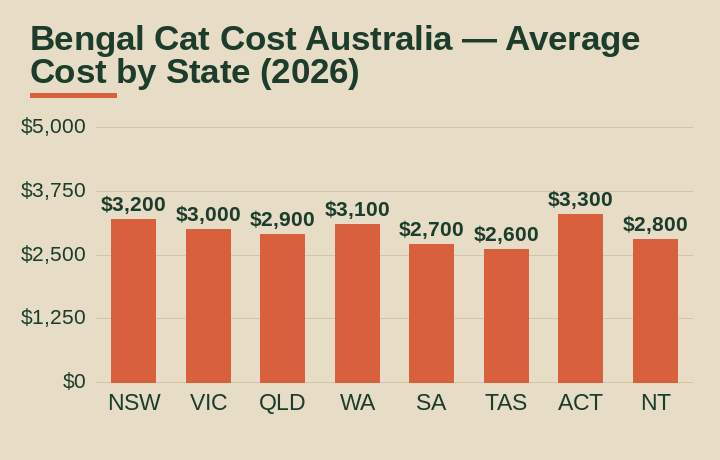
NSW and ACT sit highest, driven by vet costs and premium food prices in Sydney and Canberra. Tasmania and South Australia are generally the most affordable states for ongoing Bengal ownership. That said, limited vet specialists in regional areas can push costs up when you need specialist care.
If you want to compare how mobile vet services might change your equation, see our breakdown of mobile pet vet costs in Australia.
Where the money actually goes
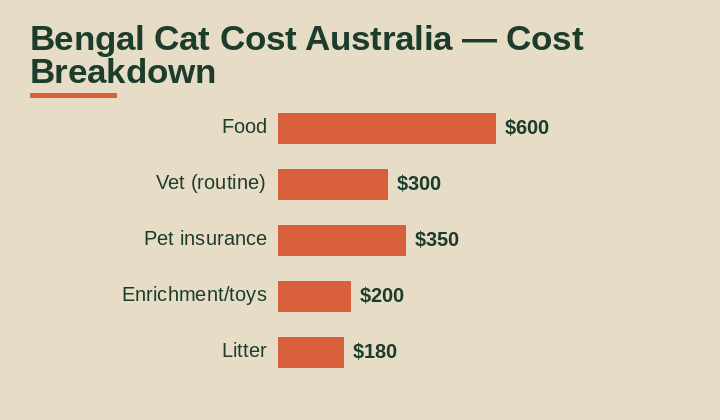
Breaking down the annual costs makes it easier to plan. Here’s what you’re actually spending on.
Food: $600 to $1,400 per year
Bengals are active, muscular cats that need high-protein diets. A quality dry food like Royal Canin Instinctive or Hill’s Science Diet runs $50 to $80 per month depending on pack size. Many Bengal owners supplement with raw chicken wings or mince, adding roughly $15 to $30 per month. At the higher end, owners feeding primarily raw or premium wet food spend $90 to $120 per month. That’s a real cost difference over 12 months.
Vet care: $400 to $1,200+ per year
Routine care, annual check-up, booster vaccinations, flea and worming treatments, typically runs $300 to $500 per year. The complication with Bengals is their genetic predisposition to hypertrophic cardiomyopathy (HCM) and progressive retinal atrophy (PRA). An HCM cardiac screening costs $180 to $350 per visit. If something shows up, specialist cardiology appointments in Sydney or Melbourne can run $600 to $1,200. This is where pet insurance earns its keep. For context on how annual vaccination costs stack up, see our pet vaccination cost Australia breakdown.
Pet insurance: $350 to $700 per year
Breed-specific risks make insurance less optional with Bengals. A mid-tier policy with a $300 excess and 80% reimbursement runs $29 to $58 per month depending on the insurer and your state. Comprehensive cover with a higher annual limit sits toward $700 per year. Worth it? If your Bengal develops HCM at age 4, yes. Genuinely.
Enrichment and toys: $200 to $600 per year
This is the cost most first-time Bengal owners underestimate. These cats are not lap cats. They need interactive wand toys built for high-energy cats, climbing structures, tunnels and puzzle feeders. A quality tall cat tree from a pet store costs $150 to $350 once. Toys get destroyed and need replacing. Budget $200 per year at the minimum, more if you’re buying quality. A Bengal left without stimulation will redecorate your house for free.
Litter: $180 to $420 per year
Clumping litter runs $15 to $35 per month depending on brand and whether you’re buying in bulk. Tofu or crystal litter options sit at the higher end. Bengals are clean animals and will protest a dirty tray loudly, so keeping a good supply matters.
For a wider picture of cat grooming and maintenance costs, our cat grooming cost Australia guide covers what owners pay for professional grooming sessions.
| Cost Category | Annual Low | Annual High | Notes |
|---|---|---|---|
| Food | $600 | $1,400 | Higher if feeding raw or premium wet |
| Vet (routine) | $300 | $500 | Annual check-up plus vaccinations |
| Vet (unexpected) | $0 | $2,000+ | HCM or PRA can push costs high |
| Pet insurance | $350 | $700 | Mid to comprehensive cover |
| Enrichment/toys | $200 | $600 | Higher in year one for big gear |
| Litter | $180 | $420 | Depends on brand and usage rate |
| Grooming | $0 | $150 | Short-haired, mainly DIY brushing |
| Total annual | $1,630 | $5,770 | Year one higher due to setup costs |
Recommended Products for Bengal Cat Cost Australia
If you’re tackling this yourself, here are some products from Amazon Australia that can help (these are affiliate links):
Why Bengal cat prices vary so much
Coat pattern and generation
F1 and F2 Bengals (those closest to the Asian leopard cat ancestor) are rarer and more expensive, sometimes exceeding $6,000. Most pet Bengals are F4 or further removed, which is also where the temperament is most suitable for home life. Rosette patterning commands a premium over spotted or marbled coats. A silver Bengal with clear, defined rosettes from a reputable breeder in outer Melbourne will sit at $3,000 to $4,500; a brown spotted Bengal from the same breeder might be $1,800 to $2,500.
Breeder reputation and health testing
Registered breeders with ANCATS or CCCA membership invest in HCM and PRA testing for their breeding cats. That testing costs money, which flows into kitten prices. A breeder charging $2,800 with full health certificates is genuinely cheaper in expected lifetime cost than a backyard breeder at $900 with no paperwork. The Australian Veterinary Association consistently recommends sourcing pets from breeders who conduct health screening. The vet bills from untested lines are real.
Location in Australia
You’ll pay more for a kitten in Sydney or Melbourne simply because breeders in inner-city areas have higher costs. A Bengal kitten in Penrith or Geelong might be $200 to $400 cheaper than the same quality cat from a Newtown-based breeder. Regional breeders in Queensland (Toowoomba, Sunshine Coast hinterland) often charge less, but you may need to factor in interstate pet transport costs if you’re buying across state lines.
Colour and rarity
Snow Bengals (seal lynx, seal mink, seal sepia) are less common and priced accordingly. Charcoal is another premium pattern. A charcoal silver rosetted Bengal from a quality NSW breeder can push $4,500 to $5,500. If you’re happy with a standard brown spotted Bengal (which is still genuinely beautiful), you’ll find the most options at the lower end of the price range.
Age at sale
Most breeders release kittens at 12 to 16 weeks. Older kittens or retired breeding cats are sometimes available at reduced prices, $500 to $1,500, and can be excellent pets. Prices honestly bounce around for older cats depending on how long they’ve been listed. Worth asking breeders directly if they have any adults available.
For related enrichment and care costs, see what owners typically spend on pet acupuncture in Australia, which some Bengal owners use for stress and joint management in older cats.
Questions to ask before you buy a Bengal
Can I see the HCM and PRA test results for both parents?
This is the most important question. HCM cardiac scans and PRA DNA tests should be current and for both the sire and dam. If a breeder deflects or says “my cats have never had problems,” that’s not the same as tested. Don’t skip this.
Is the kitten registered with ANCATS or CCCA?
Registration means the breeder has agreed to a code of ethics. It’s not a guarantee of quality, but it’s a meaningful filter. Ask for the registration number and verify it. An unregistered Bengal kitten is a red flag, not a bargain.
Is the purchase price inclusive of desexing and microchipping?
Some breeders include these; others sell entire and require a desexing contract. Knowing upfront saves a surprise $250 to $450 vet bill in the first month. Desexing costs vary by vet and location, so worth clarifying the expected price range too.
What food is the kitten currently eating?
Abrupt food changes cause digestive upset in cats, especially kittens. A good breeder sends the kitten home with a starter bag of their current food and a transition schedule. If they don’t know what the kitten eats, that tells you something about their level of care.
What’s the temperament of the parents?
Bengals vary from social and trainable to anxious and destructive. Meeting the mother cat (and ideally the father) gives you a realistic read on what temperament you’re getting. A breeder who won’t let you visit should be approached with caution.
What’s the return policy if the kitten becomes seriously ill within 30 days?
Reputable breeders offer some form of health guarantee, usually 72 hours to 14 days for congenital defects. Knowing this upfront matters. A kitten that presents with serious illness in the first week can cost $500 to $2,000 in emergency vet care before you’ve even paid your first insurance premium.
How to bring the cost down
- Choose a registered breeder and pay the proper price upfront. The $900 kitten from Gumtree often costs $2,000 to $5,000 more in vet bills over its lifetime. Genetic conditions from unscreened parents are real and expensive.
- Get insurance while the cat is a kitten and healthy. Pre-existing conditions are excluded. A policy started at 12 weeks covers conditions diagnosed later. Waiting until something looks wrong means you’re already too late.
- Buy enrichment gear second-hand. Cat trees, tunnels and feeders from Bengal owner Facebook groups often sell for $20 to $60. These cats love novelty, so rotating second-hand gear keeps them stimulated without constant new purchases.
- Use puzzle feeders for mentally active cats to extend meal times and reduce boredom, less destruction means fewer replacement costs around the house.
- Build a DIY catio from Bunnings materials rather than paying $1,500 to $3,000 for a professional cat enclosure. Basic frames and wire mesh cost $200 to $500 and let Bengals experience outdoor enrichment safely.
- Join a local Bengal cat club or Facebook group. Members share vet recommendations, bulk-buy food together and give genuine advice on managing costs specific to the breed.
For owners thinking about the full picture of pet ownership expenses, our dog boarding cost guide is a useful reference for understanding how holiday pet care fits into annual budgets, the same logic applies to cat boarding and pet-sitting costs.
Bengal cat cost Australia is significant, and it doesn’t stop at the purchase price. The cats that end up genuinely well-cared for and cheaper to own long-term are almost always the ones bought from responsible, health-testing breeders at what feels like an uncomfortable upfront price. Factor in the full year-one budget of $3,000 to $6,500 before committing, get insurance early, and invest in proper enrichment. If you do those three things, you’ll find Bengal cat ownership is rewarding in a way that most domestic cats simply aren’t.
FAQs about Bengal cat cost Australia
How much does a Bengal cat cost in Australia?
From a registered breeder, expect to pay $1,500 to $3,500 for a pet-quality Bengal and $3,500 to $5,500 or more for show or breeding quality. Prices vary by coat pattern, generation and breeder reputation.
Are Bengal cats expensive to keep?
Yes, more so than the average domestic cat. Their high energy means higher enrichment costs, and they’re prone to certain genetic conditions that can increase vet bills. Budget $2,000 to $4,500 per year once they’re settled in.
Is pet insurance worth it for a Bengal cat?
Genuinely, yes. Bengals are predisposed to hypertrophic cardiomyopathy (HCM) and progressive retinal atrophy (PRA). A cardiac workup alone can cost $600 to $1,200. Insurance with a decent limit protects you from those bills.
Can I buy a Bengal cat for under $1,000 in Australia?
You’ll see listings that low, but approach them carefully. Unregistered kittens sold cheaply often come from unscreened parents, meaning higher health risks down the track. RSPCA adoption occasionally has mixed-breed Bengals, which is a better budget option.
What ongoing costs should I plan for with a Bengal cat?
The main recurring costs are premium cat food ($600 to $1,200/year), pet insurance ($350 to $700/year), annual vet checks and vaccinations ($150 to $300/year), and enrichment like toys and cat trees ($200 to $500/year). Microchipping, desexing and initial setup are one-off costs in year one. See our full pet vaccination cost breakdown for what annual boosters typically run across Australia.
People Also Ask About Bengal Cat Cost Australia
How much does a Bengal cat cost from a registered breeder in Sydney?
Sydney breeders typically charge $2,500 to $3,800 for a pet-quality Bengal kitten. Show-quality or breeding-rights kittens sit higher, often $4,000 to $5,500. Inner-city breeders in areas like Surry Hills or Newtown are rare, most reputable NSW breeders are in outer suburbs or regional areas.
Do Bengal cats need special food that costs more?
Not necessarily, but they do better on high-protein diets. Premium brands like Royal Canin Indoor or a raw-supplemented diet suit their metabolism well. Expect to spend $50 to $90 per month on food, which is higher than the average domestic cat but not dramatically so.
What health tests should a Bengal cat breeder provide?
Responsible breeders test for hypertrophic cardiomyopathy (HCM) and progressive retinal atrophy (PRA-b). Ask to see the HCM cardiac scan results from both parents and PRA DNA test certificates. If a breeder can’t produce these, walk away, the future vet bills aren’t worth the cheaper upfront price.
Is it cheaper to adopt a Bengal cat than buy from a breeder?
Yes. Rescue Bengals occasionally appear through the RSPCA or breed-specific rescues for $150 to $400 in adoption fees. The trade-off is that you’ll have less information about health history and breeding. For a younger kitten with health documentation, a registered breeder is still the lower-risk option long term.
How much does it cost to desex a Bengal cat in Australia?
Desexing a female Bengal cat typically costs $250 to $450 and a male $150 to $300, depending on the vet and your state. Most registered breeders sell pet-quality kittens already desexed, or include a desexing contract as a condition of sale. See our full guide on pet desexing costs in Australia for more detail on what affects the price.
Related Cost Guides
This guide contains affiliate links. We may earn a small commission from qualifying purchases at no extra cost to you.