
How much does a home office conversion cost in Australia? The honest answer: anywhere from $3,000 to well over $25,000, depending on what you’re starting with and how far you want to take it. A basic spare-room refresh with paint, flatpack furniture and a lighting upgrade sits at the lower end. A fully custom fit-out with built-in joinery, dedicated electrical circuits, soundproofing and climate control is a different conversation entirely.
Home office conversion cost in Australia ranges from roughly $3,000 for a basic spare-room fit-out to $25,000 or more for a fully custom build with electrical, data cabling, insulation and premium joinery. Most homeowners spend $7,000–$14,000 for a mid-range conversion. The final figure depends heavily on room size, whether structural changes are needed, and your choice of finishes.
Comparing prices across the sources compiled for this guide, the biggest variable isn’t the state you live in, it’s the scope of work. A Sydney homeowner who just needs a dedicated desk space and an extra power point will spend far less than someone in Adelaide who wants a custom joinery setup and a separate entrance for client visits. Knowing your scope before you talk to anyone is the single most useful thing you can do.
According to MoneySmart’s home renovation planning resources, renovation costs consistently blow out when scope isn’t defined upfront. That’s particularly true for office conversions, where it’s easy to add one more thing until the budget’s doubled.
What you’ll pay by state in 2026
Labour costs vary across Australia, and so do material supply costs and tradie availability. Here’s what a mid-range home office conversion (one existing room, standard electrical, flatpack or semi-custom joinery, paint and flooring) typically costs by state.
| State | Average Cost | Typical Range |
|---|---|---|
| NSW | $12,500 | $5,000 – $22,000 |
| VIC | $11,800 | $4,500 – $20,000 |
| QLD | $10,900 | $4,000 – $19,000 |
| WA | $11,200 | $4,500 – $20,500 |
| SA | $9,800 | $3,500 – $17,000 |
| TAS | $9,200 | $3,200 – $16,000 |
| ACT | $13,100 | $5,500 – $23,000 |
| NT | $12,000 | $5,000 – $21,000 |
Get free quotes from local providers in your area. No obligation.
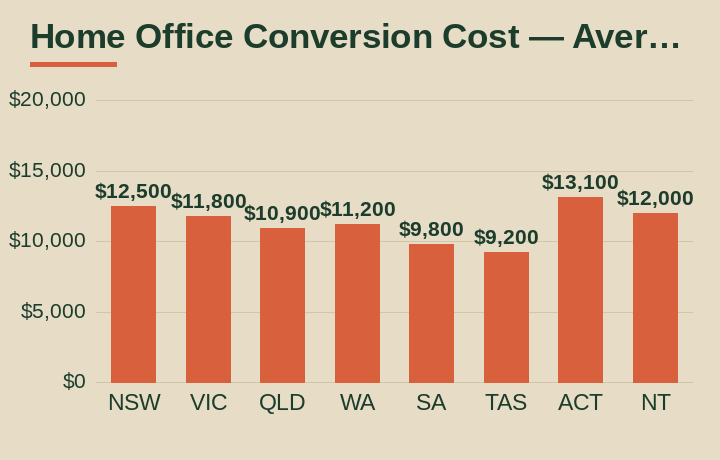
The ACT sits high because Canberra tradespeople can charge a premium in a tight labour market. NSW and NT follow, largely driven by Sydney and Darwin labour rates. SA and TAS are the most affordable markets, though the gap narrows when you’re using premium finishes anywhere.
Basic vs mid-range vs full custom: what each level actually includes
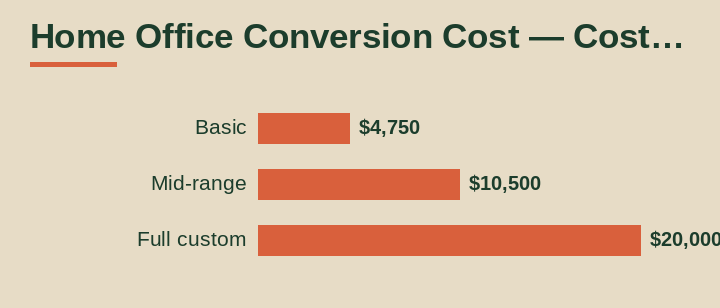
The three-tier breakdown below is where most people figure out what they actually want. The jump from basic to mid-range is usually joinery and electrical. The jump from mid to full custom is almost always about finishes and specialisation.
| Fit-out Level | Typical Cost | What’s Usually Included |
|---|---|---|
| Basic | $3,000 – $6,500 | Paint, flatpack desk and shelving, basic lighting swap, one or two extra GPOs |
| Mid-range | $7,000 – $14,000 | Semi-custom or flatpack joinery, dedicated electrical circuit, data cabling, new flooring, climate control |
| Full custom | $15,000 – $25,000+ | Custom built-in joinery, acoustic treatment, split-system AC, fibre or Ethernet data panel, feature lighting, premium finishes throughout |
Most people who contact a builder or project manager for a quote end up in the mid-range bracket. The basic fit-out is usually self-managed. Full custom tends to be for people converting a larger space, adding a second workstation, or setting up for video production or client-facing work.
Where the money actually goes
Joinery is the biggest line item. Custom built-in desks, shelving and storage from a cabinet maker typically cost $3,500–$8,000 for a single room. That’s the bench, overheads, and any drawers or file storage. Semi-custom options (think Kaboodle or IKEA hacked with custom faces) drop that to $1,200–$3,000. If budget is a real constraint, a height-adjustable standing desk from an online retailer is a fraction of the price and genuinely ergonomic.
Electrical work adds up faster than most people expect. A standard spare room might have one double GPO and a single light circuit. A proper home office needs at least four to six GPOs, ideally on a dedicated circuit, plus data points and possibly a USB charging station. An electrician in Sydney or Melbourne will charge $800–$2,200 for that scope of work. In regional Queensland or South Australia, budget $600–$1,600. Running the Ethernet cable at the same time adds $150–$400 depending on how many drops and where the patch panel lives.
Flooring matters more than people think. If you’re coming from carpet, switching to timber-look hybrid flooring costs $60–$110 per square metre supplied and installed. A 10-square-metre office room is $600–$1,100. Polished concrete is more expensive at $80–$130 per square metre but is popular in Melbourne’s inner-east and Fremantle-area renovations for a reason: it’s durable, easy to clean and holds temperature well. Keeping the existing carpet and adding a good chair mat costs about $80. Different priorities, different answers.
Soundproofing: basic vs real. Adding acoustic foam panels (about $150–$350 for a full room) reduces echo and background noise on video calls. That’s all most people need. Genuine sound isolation (staggered stud walls, MLV barriers, acoustic insulation) costs $3,000–$8,000 per wall and is only worth it if you’re recording podcasts or music, or the adjacent room is genuinely loud. A set of acoustic panels from a reputable supplier handles the video-call problem for under $300.
Climate control is often an afterthought that becomes the priority. A split-system air conditioner installed in a Sydney home by a licensed refrigeration mechanic runs $1,500–$2,500 for a 2.5kW unit. In Cairns, Darwin or anywhere with serious heat, it’s non-negotiable. In Hobart or southern Victoria, a panel heater ($120–$250) might be enough. Don’t assume you can skip it and manage. You’ll spend your afternoons uncomfortably aware you were wrong.
Questions to ask before you book
Is this a fixed quote or an estimate?
Tradies often use these words interchangeably, but they’re not the same thing. A fixed quote means the price won’t change unless you change the scope. An estimate means it might. For any job over $3,000, push for a fixed-price contract. The difference matters when an electrician finds unexpected wiring behind the walls.
What’s not included in your quote?
Painting is often excluded from an electrician or cabinet maker’s quote. Flooring prep, patching walls, and removal of old furniture often aren’t in scope. Get a list of exclusions in writing. On a $10,000 conversion, the exclusions can easily add another $2,000–$3,000 if you’re not paying attention.
Do you handle council approvals if needed?
Most room conversions don’t need council approval, but if you’re adding a new structure, changing external walls, or converting to a space that will have client visits, you might. Ask your tradie or builder whether approval is needed and who handles the paperwork. Some builders include it; most don’t.
Who’s doing the actual work?
Some renovation companies quote the job and then subcontract everything. That’s not automatically a problem, but it can mean less oversight and longer timelines. Ask who will actually be on-site. If it’s subcontractors, ask whether they’ve worked together before.
What happens if there’s a problem after the job’s done?
Electrical work and structural changes come with statutory warranty periods in most states (generally 6 years for major defects, 2 years for minor ones under Australian Consumer Law). For general fit-out work, ask what their defects period is and how complaints are handled. Get it in writing, not just a verbal assurance.
Can you show me similar jobs you’ve completed?
Photos on a website are fine. A reference from a recent local client is better. For any job over $7,000, it’s worth making one phone call to someone they’ve worked for. Most good tradies expect this and won’t blink at the request.
What you can and can’t DIY
Painting, flatpack assembly, minor hardware changes and basic cable management are all reasonable DIY territory. Installing a new LED panel ceiling light as a like-for-like swap is generally fine if you’re comfortable and in a state that allows simple lighting changes. Anything involving the switchboard, new circuits, or data cabling from the main panel is licensed-trades territory. Same goes for any structural changes. The savings from DIY electrical aren’t worth the safety risk or the hassle if you sell and a building inspector flags unlicensed work.
See our guide to kitchen renovation costs in Australia for a useful comparison on where DIY genuinely saves versus where it creates problems later.
Seasonal timing: does it matter?
Yes, slightly. Australian tradies are busiest in spring (September to November) and in the lead-up to Christmas. Booking in late January through March typically gets you better availability and sometimes a better price, simply because competition for their time is lower. Mid-winter (June–August) is also quieter for interior trades. If your conversion isn’t urgent, waiting for the right booking window can save 10–15% on labour.
Frequently asked questions
Do I need council approval to convert a spare room into a home office?
In most cases, no. If you’re converting an existing room and not making structural changes, planning approval isn’t required. You will need council approval if you’re adding a new structure (like a backyard studio), changing the building footprint, or running a business with staff or clients visiting regularly. Check with your local council if you’re unsure.
How long does a home office conversion take?
A basic fit-out (painting, flatpack furniture, lighting swap) can be done over a long weekend. A mid-range conversion with a tradie for electrical and a cabinet maker for built-ins typically takes 2–4 weeks once everyone’s booked. Full custom builds with structural changes or a separate studio can run 6–10 weeks.
Can I claim home office conversion costs on my tax?
The conversion cost itself (capital works) isn’t immediately deductible, but you may be able to depreciate it over time. You can separately claim running costs like electricity and internet under the ATO’s fixed-rate method. Talk to an accountant, what’s claimable depends heavily on your employment situation and how the space is used. MoneySmart’s tax and work-from-home section has a useful starting point.
Is it cheaper to build a backyard studio or convert an existing room?
Converting an existing room is almost always cheaper, typically $5,000–$15,000 versus $20,000–$60,000 for a purpose-built backyard studio. Studios need footings, electrical connection, insulation and weatherproofing from scratch. The trade-off is separation from the house, which some people value enormously.
What’s the most expensive part of a home office conversion?
Joinery, custom built-in desks, shelving and storage, is usually the biggest single cost, often $3,000–$8,000 on its own. Electrical work (extra power points, data cabling, lighting circuits) is typically the second-largest expense at $800–$3,000 depending on scope.
How to bring the cost down
- Define the scope before you call anyone. Knowing exactly what you want prevents scope creep, which is responsible for more budget blowouts than any other single factor.
- Use flatpack joinery where the fit allows. A well-planned IKEA Alex or Kallax configuration does the storage job at $800–$1,500 versus $5,000+ for custom. The Galant range is worth a look for desk configurations.
- Get electrical and data cabling done in one visit. Running extra power points and Ethernet in the same job saves a return call-out fee of $150–$250.
- Paint it yourself. A single room, properly prepped and painted, takes a day. The materials cost $80–$150 at Bunnings. A painter charges $400–$900 for the same room. The maths is clear.
- Repurpose what’s already there. A solid timber door on trestles from Bunnings makes a genuinely good large desk for around $120. Purpose-built desks of the same size start around $600.
- Get three quotes, always. Tradie pricing for fit-out work varies more than most people realise. Three quotes on a $10,000 job regularly reveals a $1,500–$2,500 spread.
- Book in the off-season. Late summer to early autumn (February to April) and mid-winter are quieter for interior trades. Better availability, sometimes better pricing.
If you’re also thinking about your pet’s costs while setting up your home life, it’s worth knowing what ongoing expenses look like for common breeds. Our guides on the real cost of owning a Staffy and owning a Husky in Australia break down annual ownership figures if that’s relevant to your situation.
For a home office conversion, the honest advice is to lock in the scope, get three quotes, and resist adding things mid-job. The people who spend $25,000 when they budgeted $12,000 almost always did it to themselves, one reasonable-sounding addition at a time. According to the Australian Bureau of Statistics, over 37% of employed Australians work from home at least part of the time, a dedicated space genuinely earns its cost for most of them. Just don’t let the fit-out become the renovation version of feature creep.
People Also Ask About Home Office Conversion Cost
Does a home office conversion add value to your property in Australia?
Generally yes, though the uplift depends on how well it’s done and the local market. A professionally finished home office in a suburb where working from home is common (inner Sydney, Melbourne’s inner east) can add 2–5% to a property’s appeal. A poorly converted room with no storage or natural light may not add value at all. According to CoreLogic Australia, functional living spaces consistently rank as top renovation priorities for resale.
What size room is ideal for a home office conversion?
Most people find 9–12 square metres workable for a single-person office. That’s enough for a desk, chair, storage and a small meeting area or second screen setup. Under 7 square metres tends to feel cramped once furniture’s in. If you’re converting a room that’s used for video calls, make sure there’s 1.5–2 metres of camera distance behind the desk.
How much does it cost to soundproof a home office in Australia?
Basic acoustic treatment (foam panels, a door sweep, heavy curtains) costs $200–$600 and handles echo and minor noise bleed. Real soundproofing involving staggered stud walls, acoustic insulation and double-glazed windows runs $3,000–$8,000 per wall. Most home workers don’t need the latter unless they’re recording audio or have genuinely noisy neighbours.
Can I convert a garage into a home office in Australia?
Yes, and it’s a popular option. Garage conversions cost $8,000–$20,000 depending on whether you’re adding insulation, a bathroom, heating and cooling, and new flooring. You’ll likely need a building permit for a change of use in most states. The advantage is separation from the main living area, which many remote workers find genuinely better for focus.
What internet connection do I need for a home office conversion?
Related Cost Guides
Recommended Products for Home Office Conversion Cost
If you’re tackling this yourself, here are some products from Amazon Australia that can help:
For video calls and standard office work, a reliable NBN connection (25–50 Mbps) is sufficient. If you’re running large file transfers or hosting local servers, upgrade to NBN 100 or higher. Budget $50–$100/month for a decent business-grade plan. Running Ethernet cable to your office during the conversion (cost: $150–$400 for a tradie to run one or two cables) is worth doing while walls are accessible.
This guide contains affiliate links. We may earn a small commission from qualifying purchases at no extra cost to you.