
The snake enclosure setup cost Australia sits between $350 and $2,800 depending on your python’s size, species, and your climate zone. Around Sydney’s reptile keeping community, I’ve seen new keepers drop $600-$900 on a starter carpet python setup, while experienced breeders in Brisbane might spend $1,800+ on temperature-controlled environments for finicky species.
In a hurry? Skip straight to our live Australian reptile electricity cost calculator → Drag the sliders for a price that fits your pet.
Snake enclosure setup cost Australia ranges from $350-$800 for hatchling pythons to $1,200-$2,800+ for adult carpet pythons or larger species. Your total depends on enclosure size (60cm to 180cm+), heating elements (heat mats vs ceramic bulbs), lighting requirements, and whether you're keeping tropical or arid species. NSW and Victoria tend to run 10-15% higher than Queensland for the same setup.
Prices updated July 2026 from current Australian sources.
| Enclosure | Typical cost | Notes |
|---|---|---|
| Hatchling python setup | $350 to $800 | |
| Adult carpet python or larger species | $1,200 to $2,800+ |
Your total depends on enclosure size (60cm to 180cm+), heating (heat mats versus ceramic bulbs), lighting and whether you keep tropical or arid species. NSW and Victoria tend to run 10 to 15% higher than Queensland.
Sources (July 2026): Petbarn, Kellyville Pets, Pet Shop Direct
Here’s what actually drives your costs.
If you are pricing a setup, I have gone through the enclosures worth buying in Australia and the thermostats I would trust to run them. I keep reptiles in melamine myself, and the short version is that it holds heat far better than glass, which shows up on your power bill every winter.
Snake Enclosure Setup Cost Across Australia
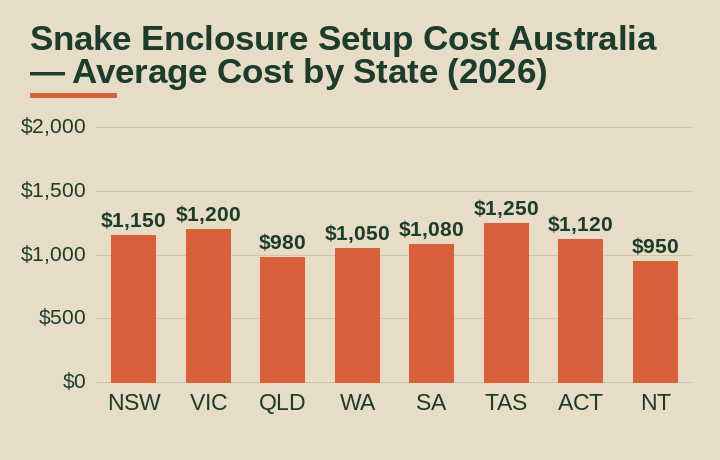
Prices bounce around quite a bit between states. NSW and Victoria run higher because heating costs more year-round, while Queensland keepers save on winter heating bills. Western Australia sits in the middle, and regional areas everywhere add $50-$100 in freight charges for larger enclosures.
| State | Average Cost | Typical Range |
|---|---|---|
| NSW | $1,150 | $450 to $2,800 |
| VIC | $1,200 | $480 to $2,900 |
| QLD | $980 | $350 to $2,400 |
| WA | $1,050 | $400 to $2,650 |
| SA | $1,080 | $420 to $2,700 |
| TAS | $1,250 | $500 to $2,950 |
| ACT | $1,120 | $440 to $2,750 |
| NT | $950 | $380 to $2,350 |
Those ranges reflect hatchling setups at the low end through to adult coastal carpet python or scrub python enclosures with premium equipment. Most first-time keepers land around $700-$1,100 for a juvenile python setup that’ll last 18-24 months.
A Real World Example
Let’s walk through what Sarah from Melbourne’s outer east spent setting up for her 8-month-old jungle carpet python in early 2026. She wanted quality gear without going overboard.
Enclosure (120x45x60cm melamine vivarium): $420 from Reptile City during their autumn sale
Heat mat (28-watt, 40x28cm): $52
Ceramic heat emitter (100-watt) with dome: $68
Thermostat (basic pulse proportional): $87
Two thermometers/hygrometers: $34
Water bowl (large ceramic): $28
Two hide caves: $45
Climbing branch: $0 (collected and sanitised from her garden)
Aspen substrate (first bag): $26
Reptile licence (VIC): $53
Total: $813
That’s honestly pretty typical for Victoria. She skipped UVB initially but added a 5% tube six months later for another $58. The setup handles Melbourne winters fine and her jungle’s thriving.
What Affects Your Snake Enclosure Setup Cost
Five main factors shift what you’ll actually pay.
Enclosure Size and Construction
Size matters most. A 60x45x45cm hatchling enclosure costs $180-$280 in melamine or PVC. Once you hit 120cm length for juvenile pythons, you’re looking at $350-$550. Adult coastal carpets or diamond pythons need 150-180cm enclosures running $600-$900, sometimes $1,200 for custom-built units with sliding glass fronts.
Glass terrariums look nice but cost more and lose heat faster than melamine. A 120cm glass terrarium sits around $450-$650 versus $350-$480 for equivalent melamine. Most experienced keepers prefer melamine or PVC because they hold temperature gradients better, which matters heaps in Adelaide or Canberra winters.
Heating Equipment Requirements
Your heating setup varies wildly by species and location. Heat mats alone work for many pythons in warmer climates, expect $35-$80 depending on wattage. Add a ceramic heat emitter for ambient warmth and you’re up another $55-$120 including the dome fixture.
Thermostats aren’t optional despite what some budget guides suggest. A basic on/off thermostat costs $45-$75, but pulse proportional models ($80-$150) control temperature more accurately and your python will benefit. I’ve seen snakes with thermal burns from unregulated heat mats, so don’t skip this bit.Keepers in Tasmania or Victoria’s high country often run both mat and emitter, pushing heating gear to $200-$280 total.
Lighting and UVB Considerations
Pythons don’t technically need UVB to survive, but research from the Australian Veterinary Association increasingly suggests it improves overall health. A basic LED hood for day/night cycles costs $35-$65. Adding a low-output UVB tube (5-7%) adds $40-$75 for the bulb plus another $45-$85 for the fixture.
Many keepers start without UVB and add it later. That’s fine, just factor it into your eventual costs if you decide to upgrade. The tubes need replacing annually, so budget $45-$65 per year ongoing.
Substrate and Decor Choices
Substrate options run from free newspaper to $35-$50 bags of cypress mulch or aspen shavings. Reptile carpet costs $25-$45 and lasts years but holds bacteria if not cleaned obsessively. Most keepers I know use aspen ($22-$32 per bag) or newspaper initially.
Decor depends on your style. Two basic hide caves cost $30-$60 total. Add climbing branches ($15-$40 if you buy them, free if you collect and sanitise), maybe some fake plants ($12-$35), and a proper water bowl heavy enough not to tip ($18-$40). You can easily spend $80-$150 on decor or keep it minimal for $40-$60.
Species-Specific Needs
Different pythons have different requirements. Children’s pythons and spotted pythons do fine with simpler setups, heat mat, basic thermostat, smaller enclosure. Total setup might be $450-$650. Carpet pythons need more space and often benefit from additional ambient heating, pushing costs to $700-$1,100.
Green tree pythons or water pythons have specialised needs (high humidity, vertical space, specific temperatures) that can double your costs to $1,500-$2,800. Coastal carpets and scrub pythons need massive enclosures as adults. Know your species before you shop because a reptile fogger for humidity control adds another $60-$95 if you’re keeping tropical species.
Common Mistakes to Avoid
- Buying adult-sized enclosures for hatchlings: Hatchling pythons get stressed in huge spaces and struggle to find food. Start small, upgrade as they grow, and you’ll have healthier snakes plus lower initial costs.
- Skipping the thermostat to save $80: Unregulated heating kills more pet pythons than any other husbandry mistake. That $85 thermostat prevents $300+ emergency vet bills and dead snakes. Just buy it.
- Trusting stick-on thermometers: Those circular adhesive thermometers from pet shops read 3-5°C inaccurate. Spend $15-$25 on a proper digital thermometer with a probe or you’ll never know your actual temperatures.
- Forgetting ongoing costs: The setup is one-time, but electricity ($15-$35 monthly), substrate replacements ($25 every 6 weeks), and feeder mice or rats ($8-$18 per feed) add up. Budget for the snake’s life, not just the enclosure.
Recommended Products
A few items from Amazon Australia worth having on hand (these are affiliate links):
Frequently Asked Questions
What’s the minimum enclosure size I need for a snake in Australia?
Hatchling pythons start in 60cm enclosures, but adults need 120-180cm depending on species. Carpet pythons typically need 120x60x60cm minimum, while coastal carpets often require 150-180cm length. The general rule: enclosure length should equal or exceed the snake’s body length.
Do I need a licence to keep snakes in Australia?
Yes, all Australian states require a reptile keeper’s licence. NSW charges $60 for a basic licence, Victoria’s is around $53, Queensland $76, and WA $53. You’ll need this before purchasing any python species, and some states require property inspections for enclosure compliance.
Can I use a glass fish tank as a snake enclosure?
Not recommended for most pythons. Fish tanks lack proper ventilation, can’t maintain heat gradients effectively, and screen tops don’t hold humidity. Purpose-built reptile enclosures with front-opening doors and proper ventilation cost $200-$600 but work far better than adapting a fish tank.
How much does it cost to run a snake enclosure per month?
Running costs sit around $15-$35 monthly in electricity depending on your state’s power rates and enclosure size. Heat mats use 15-50 watts, ceramic bulbs 50-150 watts. Queensland keepers pay less in winter than Victorian owners who need heating year-round.
What’s the difference between a heat mat and a ceramic heat emitter?
Heat mats cost $30-$80, sit under the enclosure, and work well for smaller pythons and arid species. Ceramic heat emitters cost $40-$90, provide ambient warmth from above, and suit tropical species or larger enclosures. Many keepers use both for proper temperature gradients. A quality ceramic heat emitter in the 75-100 watt range handles most adult python enclosures effectively.
What Else People Ask
How often do I need to replace substrate in a snake enclosure?
Spot clean weekly and do full substrate changes every 4-6 weeks for most pythons. Aspen shavings cost $18-$30 per bag and typically last one change for a 120cm enclosure. Snakes that defecate in their water bowl may need more frequent changes.
Can I keep two pythons in the same enclosure to save money?
Not recommended for most species. Pythons are solitary and housing them together causes stress, competition during feeding, and potential aggression. You’ll also struggle to monitor individual health and feeding responses. Only very experienced keepers house certain species together temporarily.
Do I need UVB lighting for pythons?
It’s debated among keepers, but emerging research suggests low-level UVB benefits python health even though they’re nocturnal. A 5-7% UVB tube costs $35-$65 and lasts 12 months. Many keepers now include it despite pythons surviving without it for years.
What’s the best enclosure material for Australian climates?
Melamine or PVC enclosures hold heat and humidity better than glass in most Australian homes. They cost $250-$700 depending on size, insulate well, and maintain gradients easier than glass terrariums which lose heat quickly, especially in southern states during winter.
How long does a python enclosure setup last before needing replacement?
Quality enclosures last 10-15 years with proper care. Heat mats and ceramic bulbs need replacing every 3-5 years, thermostats every 5-7 years, and UVB tubes annually. Budget around $80-$150 every few years for equipment replacement beyond the initial setup cost.
Setting up properly from the start costs more but saves you money and stress down the track. Your python will live 15-25 years in captivity, so spending $800-$1,200 upfront for quality gear honestly works out to about $40-$80 per year over the snake’s life. That’s cheaper than most dog boarding costs for a single weekend. If you’re considering other pets alongside your reptiles, understanding the broader picture of emergency vet expenses or even routine grooming services can help you budget across all your animal care needs.
Related Cost Guides
Check your local reptile society for second-hand gear, join Facebook groups like Australian Carpet Python Keepers for advice, and don’t rush the setup. Get the temperatures stable and verified before you bring a snake home, and you’ll avoid the expensive mistakes that trip up most new keepers.
This guide contains affiliate links. We may earn a small commission from qualifying purchases at no extra cost to you.