
Quick question worth answering up front: what does dog walking cost Australia-wide actually look like in 2026? Most owners pay between $20 and $55 per walk, with the bulk landing around $28-$38 for a standard 30-minute solo session. Group walks come in cheaper, weekends push prices up, and the gap between Surry Hills and a regional town like Toowoomba can be $20 a walk for the same service.
Dog walking cost Australia typically runs $25-$45 for a 30-minute solo walk and $20-$35 per dog for a group walk. Inner-city Sydney and Melbourne push the top of that range, while outer suburbs and regional towns sit closer to $20-$28. Weekend, public holiday and one-off bookings add 20-40%.
Prices updated July 2026 from current Australian sources.
| Walk type | Typical price | Notes |
|---|---|---|
| 30 minute solo walk | $25 to $45 | One-on-one attention |
| Group walk (per dog) | $20 to $35 | Shared with other dogs |
Inner-city Sydney and Melbourne sit at the top of these ranges, while outer suburbs and regional towns run closer to $20 to $28. Weekend, public holiday and one-off bookings add 20 to 40%. Ongoing weekly bookings are usually discounted.
Sources (July 2026): Airtasker AU, How much does a dog walker cost, Pawshake Australia, Dog walking Sydney, Bark Australia, Cost of a dog walker
When I researched current prices across walker websites, Mad Paws listings and local Facebook groups for this guide, the pattern that stood out wasn’t the headline rate. It was the surcharges. Most walkers advertise a base price, then add loadings for weekends, holidays, extra dogs and outside-zone travel that nobody mentions until you book. MoneySmart’s pet ownership guidance flags walking as a regular ongoing cost, but doesn’t get into how variable the real figures are. So here’s the proper breakdown.
| State | Average Cost (30-min walk) | Typical Range |
|---|---|---|
| NSW | $35 | $25 to $55 |
| VIC | $33 | $25 to $50 |
| QLD | $30 | $22 to $45 |
| WA | $32 | $24 to $48 |
| SA | $28 | $22 to $40 |
| TAS | $27 | $20 to $38 |
| ACT | $34 | $26 to $50 |
| NT | $30 | $22 to $42 |
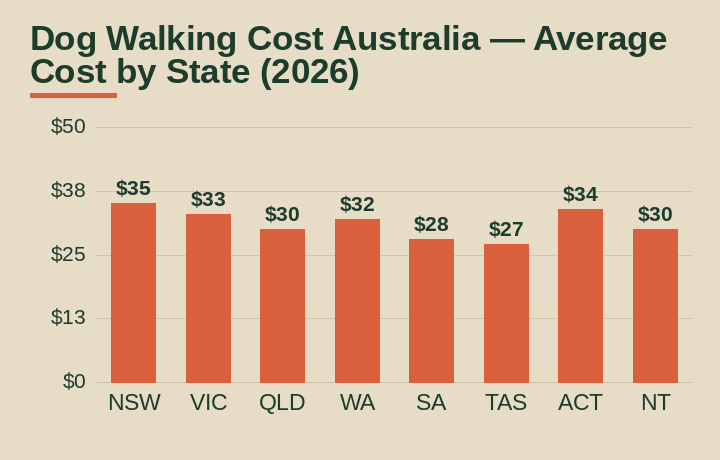
NSW and the ACT sit at the top because of inner-city density and higher operating costs. Tassie and SA are the cheapest end of the market by a fair margin.
Bush and long grass walks in tick country are worth a daily check when you get home. Paralysis ticks explains where the risk sits geographically and what the first symptoms actually look like.
Why the price swings so much
Five things move the needle on what you’ll pay. Each one is worth understanding before you book, because most walkers won’t volunteer the detail unless asked.
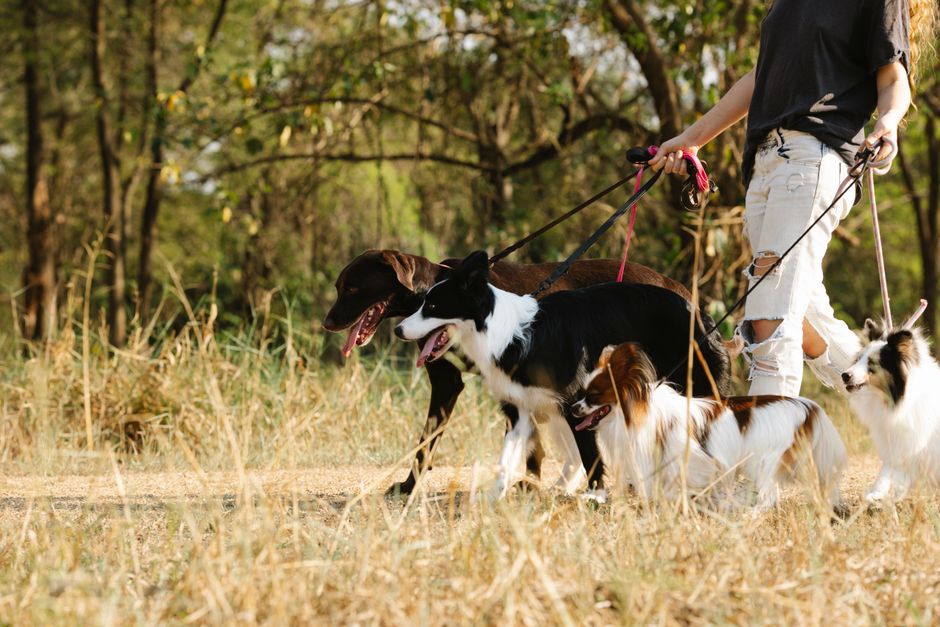
Solo vs group walks. A solo walk in Newtown runs $32-$45. The same walker takes your dog out with two others for $22-$30. The labour cost per dog drops, and they pass some of it on. Group walks aren’t always cheaper in the long run though, if your dog is reactive or anxious and gets pulled from the group, you’re back to solo rates anyway.
Suburb and travel zone. A 30-minute walk in Paddington or South Yarra is genuinely $10-$15 more than the same service in Penrith or Frankston. Inner-city walkers have higher rent, more competition for parking and shorter routes between clients. In regional areas like Geelong or the Sunshine Coast hinterland, you might pay $22-$28 for the same walk, but travel surcharges of $5-$10 are common if you’re outside their core zone.
Walk duration. A 30-minute walk is the industry default. Bump it to 45 minutes and expect $35-$55. A full hour runs $45-$70 solo. Some walkers also offer 20-minute ‘potty walks’ for senior dogs at $18-$25, which is genuinely useful if your dog can’t manage a full session anymore.
Days and times. Weekday mornings between 9am and 3pm are the cheapest, that’s the walker’s bread and butter slot. Weekend rates carry a 20-30% loading. Public holidays usually double the base rate. Early starts before 7am or evening walks after 6pm often add $5-$10. A Hands-free bungee lead is worth grabbing if you decide to handle peak-rate days yourself.
Your dog’s behaviour and size. Large breeds, pullers and reactive dogs sometimes attract a ‘handling premium’ of $5-$15. Border Collies and Huskies in particular tend to get charged at the higher end because they need more managed energy. Multi-dog households get the opposite, a 30-40% discount on the second dog walked together.
Group vs solo: what you’re actually getting
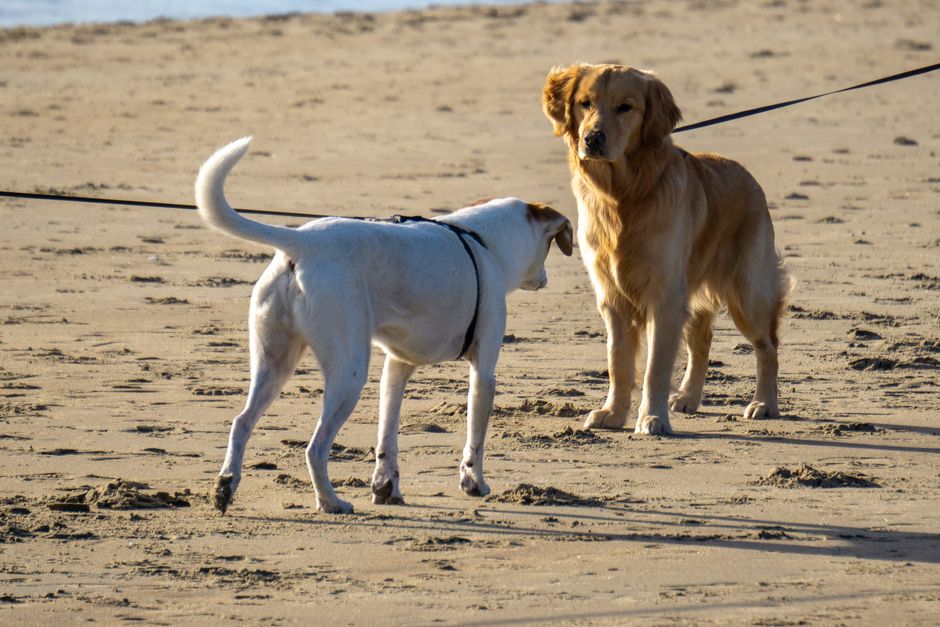
The choice between group and solo isn’t purely about price. It’s about what your dog needs and what the walker is genuinely delivering during that half hour. Here’s how the two stack up.
| Factor | Solo Walk | Group Walk (3-4 dogs) |
|---|---|---|
| Typical price | $28-$45 | $20-$32 per dog |
| Attention per dog | One-on-one | Split across the group |
| Best for | Reactive, senior, recovering dogs | Social, energetic, well-trained dogs |
| Walk pace | Tailored to your dog | Set by the slowest dog |
| Socialisation | Minimal | Built-in |
| Risk of incident | Low | Higher, scuffles can happen |
For a confident, well-socialised Labrador or Kelpie, group walks are usually the better value. For an anxious rescue or a dog with leash reactivity, the extra $10 a session for solo is money well spent. Don’t let the price gap alone decide it.
Products Worth Considering
Some practical picks from Amazon Australia for this part of pet ownership (these are affiliate links):
What city dwellers actually pay
The state averages flatten out some big differences. Inner-Sydney, inner-Melbourne and parts of Brisbane sit well above the state average, while outer suburbs and regional centres sit well below.
In Surry Hills, Newtown and Bondi, expect $35-$50 for a solo 30-minute walk. Travel-friendly suburbs like Marrickville and Erskineville run $30-$42. Penrith and Campbelltown drop to $25-$32.
Across Melbourne, Brunswick, Fitzroy and Carlton sit at $32-$45. Footscray and Reservoir are $28-$38. Out at Werribee or Pakenham you’re closer to $24-$30.
In Brisbane, New Farm and Paddington walkers charge $30-$42. Outer suburbs like Ipswich or Logan are $22-$30. Same goes for the Gold Coast, beachside walkers in Burleigh charge more than those in Nerang.
If you’re juggling dog costs more broadly, our breakdowns on Sydney dog boarding rates and Sydney dog grooming prices are worth a look, walkers, boarders and groomers tend to track each other in the same suburbs.
Questions to ask before you book a walker
The advertised rate isn’t the booking price. These are the questions that expose the actual figure and the service you’ll get.
Is this a solo or group walk, and how many dogs are in the group?
Some walkers advertise a ‘small group’ rate but the group is six dogs. Two to four is reasonable. More than that and your dog is getting walked, not exercised properly.
What surcharges apply on weekends, holidays and outside core hours?
Get the actual percentage in writing. A ‘20% weekend loading’ on a $35 walk is $7 extra. A ‘50% loading’ is $17.50. Walkers who hedge on this question often charge the higher end.
Do you carry pet care public liability insurance?
You want a yes, with cover of at least $5 million. Ask to see the certificate. Walkers found through Mad Paws and Pawshake have platform insurance, but it only kicks in for bookings made through the app.
What’s your policy if my dog gets injured or sick during a walk?
The right answer involves a vet protocol: nearest emergency clinic, owner contact, willingness to use a pre-authorised credit limit. If they fumble this question, keep looking.
How do you handle reactive dogs or scuffles in group walks?
You want specific answers about leash positioning, separation distance and recall training. A walker who says ‘oh, all dogs get along fine’ hasn’t been doing this long enough.
Are there discounts for weekly bookings or multiple dogs?
Almost always yes, but you usually have to ask. Standard discounts are $3-$8 off per walk for a weekly commitment, and 30-40% off the second dog in the same household.
How to bring the cost down
Walking costs add up fast, $35 a walk, five days a week, is $9,100 a year. Worth getting strategic about.
- Lock in a weekly package. Most walkers cut $3-$8 per walk for committed 3-5x weekly bookings. Save: $60-$160 a month.
- Switch to group walks where it suits your dog. Save $5-$15 per walk. Choice Australia’s consumer guidance on pet services is a good sanity check on what you should expect for the price.
- Trade weekend for weekday walks. Skip a Saturday surcharge and you save $8-$15 a walk straight away.
- Find an independent through a local community group. Facebook neighbourhood groups and noticeboards often surface walkers who are $5-$12 cheaper than app-based ones.
- Train out the pulling. A Front-clip no-pull harness plus a few weeks of consistent leash work can remove the ‘difficult dog’ surcharge some walkers add.
- Walk your dog yourself 2-3 days a week. Even cutting walker bookings from 5 to 3 days saves $30-$45 a week, or $1,500-$2,300 a year.
So where does that leave the dog walking cost Australia owners should actually budget for? For most households, plan on $28-$38 per walk for a standard service, with weekly bookings and group walks pulling that closer to $22-$28. Ask the surcharge questions before you book, and don’t pay for an inner-city rate if your walker is driving in from two suburbs over. The market is fragmented enough that genuinely good walkers exist at every price point, you just have to ask the right questions to find them.
Frequently asked questions
How much does a dog walker cost per hour in Australia?
An hour-long solo walk typically runs $45-$70 depending on city and suburb. Most owners book 30-minute walks instead, which sit between $25 and $45.
Is group walking cheaper than solo walking?
Yes, usually by $5-$15 per walk. Group walks generally cost $20-$35 per dog while solo walks run $25-$45. Group walks aren’t suitable for reactive or anxious dogs though.
Do dog walkers charge extra for weekends?
Most do. Expect a 20-30% surcharge on weekends and a 50-100% loading on public holidays. Some walkers also charge a small premium for early-morning or after-6pm slots.
Are dog walkers in Australia insured?
Reputable walkers carry pet care public liability insurance, usually $5-$20 million in cover. Always ask before booking, as platform-based casual walkers don’t always have it.
Can I claim dog walking on tax or pet insurance?
No, dog walking isn’t claimable on standard pet insurance or personal tax. The only exception is registered assistance dogs, where some costs may be deductible.
Other Questions Worth Asking
What qualifications do Australian dog walkers actually need?
There’s no mandatory licence to be a dog walker in Australia, which surprises a lot of owners. The good ones hold a pet first aid certificate, public liability insurance and often a Certificate III in Animal Studies. Council permits are required in some areas for walking more than 4 dogs at once.
How long should a dog walk be?
For most adult dogs, 30-45 minutes once a day is the standard professional walk. Working breeds like Kelpies, Border Collies and Huskies generally need 60+ minutes or two shorter walks. Senior dogs and short-snouted breeds like Pugs usually do better with 20-minute walks.
Are dog walking apps cheaper than independent walkers?
Not really. Apps like Mad Paws and Pawshake show prices from $20-$25, but service fees, booking fees and walker loadings often push the actual cost to $30-$40. Independents found locally typically sit at $25-$35 with no hidden fees.
Do dog walkers pick up and drop off?
Yes, almost all professional walkers collect from your home using a key or lockbox. Most include this in the standard rate within their service area, though some charge a $5-$10 travel surcharge if you’re outside their usual zone.
What’s the difference between a dog walker and a doggy daycare?
A walker takes your dog out for 30-60 minutes, while daycare is supervised play for 4-10 hours. Daycare runs $40-$75 per day, so for owners working full days it can work out similar to two walks but with more social time.
Related Cost Guides
This guide contains affiliate links. We may earn a small commission from qualifying purchases at no extra cost to you.