
Restumping costs somewhere between $8,000 and $25,000 for a typical 3-bedroom weatherboard, and the gap is wider than most homeowners expect. The answer to ‘how much will mine cost?’ comes down to stump count, access and material, and you genuinely won’t know until someone crawls under the house with a torch. According to MoneySmart’s guidance on home maintenance budgeting, structural repairs are the single category most owners under-budget for, and restumping is exhibit A.
Restumping cost Australia typically runs $8,000 to $25,000 for a standard 3-bedroom house, depending on stump count, access and material. Concrete stumps average $80-$150 each installed; steel galvanised stumps run $180-$300 each. Melbourne and inner Brisbane sit at the higher end due to access and labour rates.
When I researched current 2026 quotes for this guide across Victorian and Queensland restumping specialists, the pattern that stood out was how much the soil type alone shifted the bottom line. A Melbourne house on reactive clay can quote $4,000-$6,000 more than the same house on stable Brisbane soil. Worth knowing before you panic at the first number. Choice Australia’s home repair coverage also makes the point that getting three written quotes is non-negotiable for jobs over $5,000, and restumping always clears that bar.
What restumping cost looks like state by state
Below is the typical national price range for a standard 3-bedroom weatherboard with roughly 40-60 stumps. These figures assume concrete stumps and reasonable access, no slope, no flooded subfloor, no surprise asbestos.
| State | Average Cost | Typical Range |
|---|---|---|
| NSW | $14,500 | $9,000 to $22,000 |
| VIC | $15,800 | $10,000 to $25,000 |
| QLD | $13,200 | $8,500 to $20,000 |
| WA | $13,800 | $9,000 to $21,000 |
| SA | $12,500 | $8,000 to $19,000 |
| TAS | $13,000 | $8,500 to $20,000 |
| ACT | $14,800 | $10,000 to $22,000 |
| NT | $15,500 | $11,000 to $24,000 |
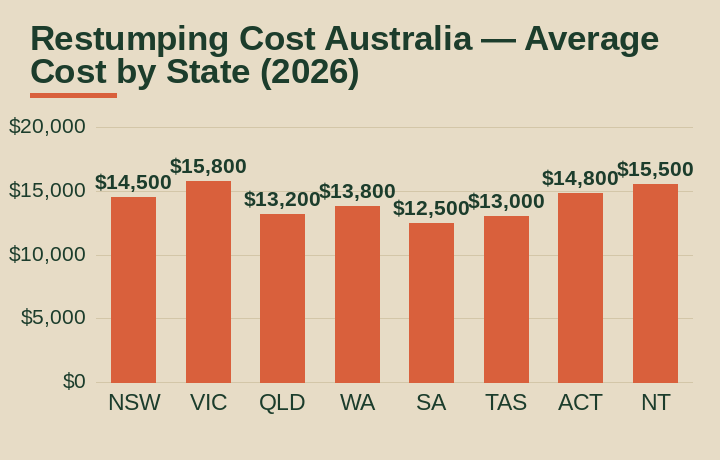
Victoria runs hottest because of reactive clay across most of metropolitan Melbourne, plus the highest permit overhead in the country. Queensland is the value pick, more competition, easier access on raised homes, less paperwork.
A real Brunswick example, itemised
To make the numbers real: a 1920s weatherboard in Brunswick, Melbourne, 11 squares, 52 stumps. The owner had three quotes in 2026. Here’s how the middle quote broke down.
- 52 concrete stumps supplied and installed: $7,280 ($140 per stump)
- Permit and engineer’s certification: $1,450
- Excavation and spoil removal: $1,800
- Jacking and levelling labour: $3,200
- Reinstatement of brick perimeter: $1,400
- Plaster patching allowance (8 internal cracks): $950
- Total: $16,080 incl. GST
The cheapest quote was $11,900 but excluded the permit, the engineer and any plaster work. The dearest was $21,400 with full internal repaint included. Same house, $9,500 spread. That’s why three quotes matters.
Concrete vs steel stumps: where the money goes
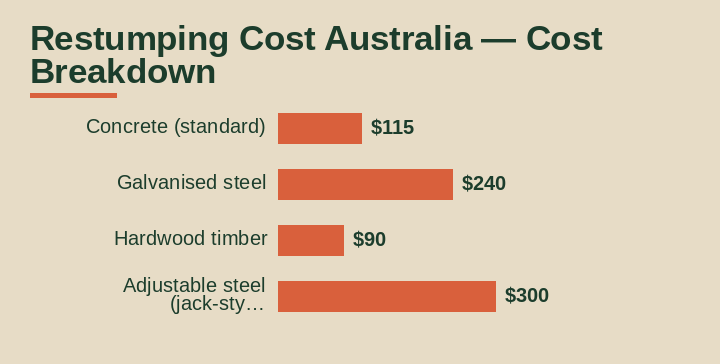
Material choice is the single biggest line item you control. Here’s the trade-off in plain numbers.
| Stump Type | Cost Per Stump (Installed) | Lifespan | Best For |
|---|---|---|---|
| Concrete (standard) | $80 to $150 | 80-100 years | Most Australian homes |
| Galvanised steel | $180 to $300 | 100+ years | Termite zones, reactive clay |
| Hardwood timber | $60 to $120 | 30-50 years | Heritage matching only |
| Adjustable steel (jack-style) | $220 to $380 | 100+ years | Reactive soils, future levelling |
For a 52-stump house, the gap between standard concrete and full galvanised steel is roughly $5,000-$8,000. Not nothing. Steel makes sense in termite-active regions like SE Queensland and northern NSW, or on highly reactive clay where you may need to re-level in 15 years. For a typical Melbourne weatherboard or an Adelaide Hills cottage, concrete is the sensible call.
Why two quotes for the same house can be $8,000 apart
Five factors do most of the work. Here’s what each one actually adds to a quote.
Stump count and house size
A small 2-bedroom cottage might have 28-35 stumps; a sprawling Queenslander can have 90+. At $130 per stump installed, the difference between 35 and 90 stumps is $7,150 in materials and labour alone. Get the count confirmed in writing before signing anything.
Soil type and site conditions
Reactive clay (most of Melbourne, parts of Adelaide and inner Brisbane) requires deeper footings and engineering input. That adds $2,500-$5,000 versus a sandy or stable site. A Footscray quote will almost always beat a Glen Iris quote on identical houses purely because of soil.
Subfloor clearance and access
A house with 900mm subfloor clearance is a dream to work under. A house with 400mm clearance means crawl-only work, slower jacking and more labour hours, typically adding $2,000-$4,000. Sloping blocks add another $1,500-$3,000 because the crew can’t roll equipment in.
Permit and engineering requirements
In Victoria, restumping requires a building permit and engineer’s certification. Budget $1,200-$2,000. NSW and Queensland are lighter unless you’re changing stump height. The ABS construction cost data shows compliance costs have risen sharply since 2023, and most quotes now itemise them separately.
Repair scope after the jack-up
When the house gets lifted and re-levelled, plaster cracks. Skirting boards pop. Tiles can lift. Some builders include a $1,000-$2,000 reinstatement allowance; others quote the structural work only and leave repairs to you. A self-levelling laser level is worth $80 if you want to spot-check the floor slope before and after, useful for arguing about variations later.
Products Worth Considering
Here are a few products from Amazon Australia that pet owners find useful:
Questions to ask before you sign
Restumping is one of those jobs where the cheap quote often isn’t. These five questions sort the operators from the price-droppers.
Is the engineer’s certificate included or extra?
A Victorian job legally needs one. If it’s not in the quote, you’ll pay $800-$1,500 separately. Always ask in writing.
What’s the stump count, and what happens if it’s wrong?
Some operators quote on ‘estimated 45 stumps’ and then add $130 per extra stump on discovery. Get a firm count after a physical inspection, not from the floor plan.
Who repairs the plaster, tiles and brick perimeter?
This is the single most disputed line item in restumping. Get it written down clearly: who reinstates the perimeter brick course, who patches internal cracks, and who pays if a tile cracks during jacking.
What’s the policy on variations?
Rotten bearers, asbestos in old vermiculite, or unexpected plumbing under stumps, all common discoveries. Ask what gets quoted before work proceeds versus charged on completion. You want approval before, not invoice after.
Is there a warranty, and what does it cover?
Reputable restumpers offer 10-25 year structural warranties on concrete and steel stumps. Ask for it in writing and check whether it transfers to a new owner, sale time is exactly when you’ll want that document.
Have you done a similar-era house nearby?
A crew that’s done 30 houses in your suburb knows the soil, the typical stump configuration and the council inspector. That’s worth a small premium over a cheaper out-of-area operator.
Common restumping mistakes to avoid
- Believing the cheapest quote is the same job. It rarely is. Compare line items, not totals.
- Skipping the permit in Victoria. Cheaper now, but it’ll surface at sale time and tank your contract.
- Ignoring subfloor ventilation. If moisture rotted your old stumps, it’ll attack the new ones. A subfloor ventilation fan for $300-$600 buys decades of stump life.
- Doing it just before selling. If you’ve lived with sloping floors for ten years, the new buyer can negotiate the price. Better to fix it 3-5 years out or just disclose at sale.
If you’re staring down the barrel of stump replacement and also weighing up other structural work, browse our broader methodology on how we research prices so you understand what ‘average’ really means in our tables.
Questions We Get Asked Most
How long does restumping a house take?
Most jobs run 3-7 working days. A small weatherboard with good access can be done in 2-3 days; a large Queenslander or a house needing full re-blocking and council approval can stretch to two weeks.
Can I live in the house during restumping?
Usually yes, but it’s noisy and the floors will shift slightly. Most builders recommend moving fragile items off shelves, and you can’t use the house normally for the day each section is being jacked.
Do I need council approval for restumping?
In Victoria, yes, restumping requires a building permit. Queensland and NSW depend on whether you’re replacing like-for-like or changing stump height. Most reputable restumpers handle the paperwork for you.
Concrete or steel stumps, which is better?
Concrete is cheaper and standard for most jobs. Galvanised steel costs more but suits termite-prone areas and reactive clay soils. For most Melbourne suburbs, concrete is fine.
Will restumping increase my home’s value?
Indirectly. It won’t add value the way a kitchen renovation does, but failing stumps will absolutely kill a sale or knock $30,000-$80,000 off the price at inspection.
Other Questions Worth Asking
What are the signs my house needs restumping?
Sloping floors, doors that won’t close properly, cracks in plaster walls, gaps between skirting and floor, and visibly rotting or cracked stumps under the house. If you’re seeing two or more of these, get an inspection.
How often do house stumps need replacing?
Timber stumps typically last 30-80 years depending on soil moisture and termite exposure. Concrete stumps installed since the 1970s should last 80-100 years. Steel galvanised stumps are usually rated for the life of the house.
Is restumping covered by home insurance?
Almost never. Standard home insurance treats stump deterioration as wear and tear, not sudden damage. The only exception is if a specific insured event (flood, vehicle impact) caused the failure. Canstar’s home insurance comparisons are worth checking if you want to see what’s actually covered under structural policies.
Can a Queenslander be restumped on its existing height?
Yes, and it’s the most common approach. Raising a Queenslander during restumping is also popular but adds $15,000-$40,000 to the bill for legal-height conversion and re-stairs.
What’s the difference between reblocking and restumping?
Nothing, they’re the same job. ‘Reblocking’ is the Victorian term, ‘restumping’ is used in Queensland and NSW. Both mean replacing the stumps under a raised house.
Related Cost Guides
Bottom line: restumping cost Australia rewards homeowners who get three written quotes, ask the hard questions about variations, and don’t chase the cheapest number. Budget realistically, somewhere in the $12,000-$18,000 range for most standard houses, and treat anything dramatically cheaper as a flag, not a bargain.
This guide contains affiliate links. We may earn a small commission from qualifying purchases at no extra cost to you.