
It’s a Tuesday morning in Penrith, you’ve just stepped into a cold shower, and now you’re frantically Googling hot water system cost australia while toweling off. Been there. The honest answer in 2026 sits anywhere between $900 and $5,500 fully installed, depending on the fuel type and what’s already plumbed into your house. According to Canstar Blue’s hot water buying guides, hot water makes up around 21% of household energy bills, so getting the right system matters beyond just the install cost.
Hot water system cost australia typically runs $900 to $5,500 fully installed in 2026. A basic electric storage tank sits at $900-$1,800, gas storage $1,400-$2,800, heat pumps $3,200-$5,500, and solar hot water $3,800-$6,500 before rebates. Installation, location and existing plumbing can shift these figures by hundreds.
When I researched current prices across the sources below, the gap between the cheapest electric tank and a mid-range heat pump was almost $4,000. But the running cost difference flips the maths within five years. MoneySmart’s energy saving advice backs this up, electric storage on a continuous tariff is genuinely the worst-value option you can buy in 2026.
What you’ll typically pay across Australia
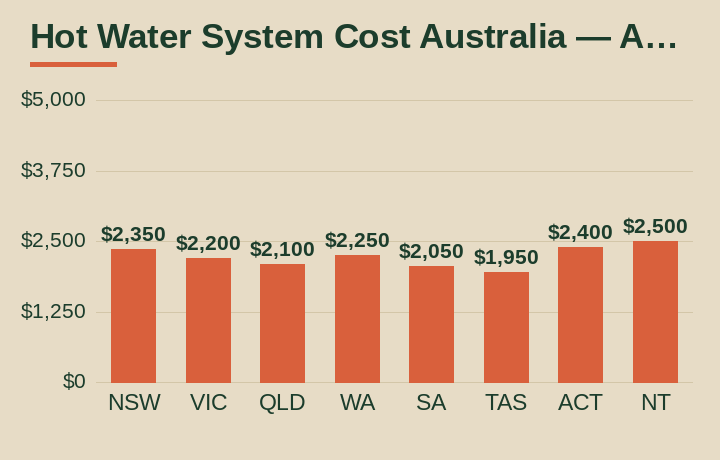
Prices vary by state mostly because of labour rates and rebate stacking. Tasmania and SA tend to be the cheapest for install labour. Sydney and Melbourne charge the most. The table below shows what a mid-range gas storage system (around 170L) costs fully installed.
| State | Average Cost | Typical Range |
|---|---|---|
| NSW | $2,350 | $1,800 – $2,900 |
| VIC | $2,200 | $1,700 – $2,750 |
| QLD | $2,100 | $1,600 – $2,600 |
| WA | $2,250 | $1,750 – $2,800 |
| SA | $2,050 | $1,550 – $2,500 |
| TAS | $1,950 | $1,500 – $2,400 |
| ACT | $2,400 | $1,850 – $2,950 |
| NT | $2,500 | $1,900 – $3,100 |
Get free quotes from local providers in your area. No obligation.
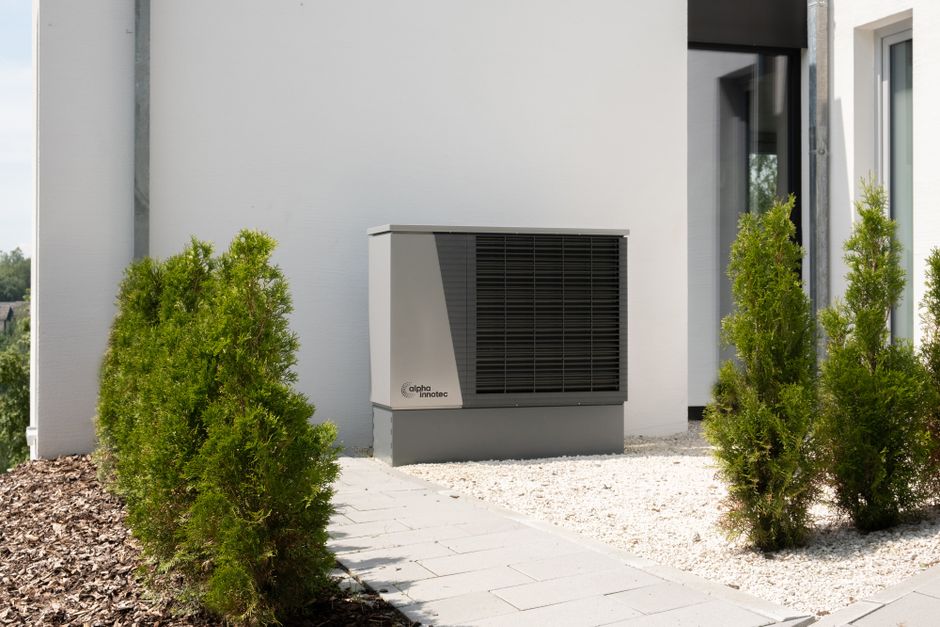
Heat pump and solar systems sit roughly $1,500-$2,500 above these figures before rebates. Basic electric storage sits roughly $600-$900 below.
Comparing the four main system types
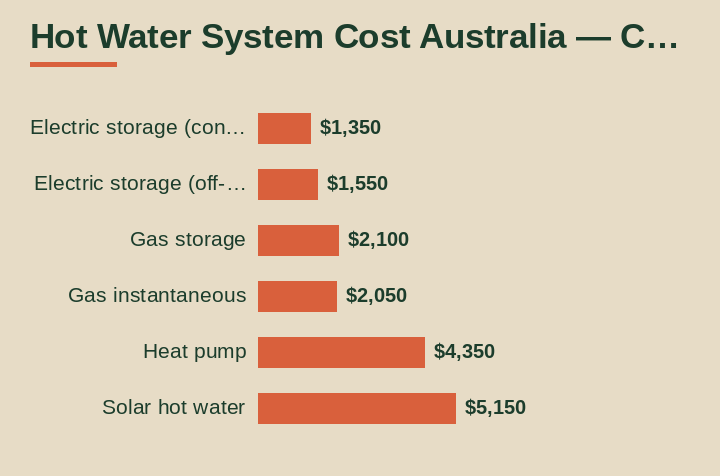
Each fuel type has a real trade-off between upfront cost and what you’ll pay to run it. The cheapest sticker price almost never wins on total cost of ownership over a decade. I pulled the annual running figures from Canstar’s energy reports for a typical four-person household.
| System Type | Installed Cost | Annual Running Cost | Lifespan |
|---|---|---|---|
| Electric storage (continuous) | $900 – $1,800 | $750 – $1,100 | 8-12 years |
| Electric storage (off-peak) | $1,100 – $2,000 | $400 – $600 | 8-12 years |
| Gas storage | $1,400 – $2,800 | $350 – $550 | 8-12 years |
| Gas instantaneous | $1,500 – $2,600 | $300 – $500 | 12-20 years |
| Heat pump | $3,200 – $5,500 | $200 – $350 | 10-15 years |
| Solar hot water | $3,800 – $6,500 | $150 – $300 | 15-20 years |
The honest takeaway? Gas instantaneous and heat pumps tend to be the sweet spot for most households in 2026. Solar still wins on running cost, but the payback timeline stretches past 10 years for many homes.
Where the money actually goes
Five things drive most of the price variation. Worth understanding before you accept a quote.
Fuel type and unit choice. A 250L Rheem electric tank runs around $1,200. A 270L Reclaim heat pump from the same wholesaler is $3,900. Same household demand, vastly different sticker.
Installation complexity. Like-for-like swap in a Brisbane suburb? $450-$700 in labour. Move the unit from inside to outside, add a new gas line, or upgrade electrical? That climbs to $1,400-$1,900. Older homes in Hobart’s North often need pipework brought up to code, adding $300-$500.
Rebates available in your state. Federal STCs slash $800-$1,500 off heat pumps everywhere. Victorians stack another $1,000 from the Victorian Energy Upgrades scheme. A heat pump that quotes at $4,800 in Geelong can land at $2,200 after rebates, while the same unit in Cairns Northern Beaches stays closer to $3,800.
Tank size and household demand. A 125L tank for a couple costs $200-$400 less than a 315L tank for a family of five. Oversizing wastes money twice, once at purchase, then again on standby heat loss. A good tank insulation blanket can cut that standby loss meaningfully on older units.
Plumber pricing and demand. A burst-tank emergency on a Sunday in Surry Hills will cost $300-$600 more in callout and weekend rates than a planned swap booked three weeks ahead. Quotes from a 15-minute review of Finder’s hot water comparison data showed the same job priced from $1,650 to $2,800 between three Sydney plumbers.
Questions to ask before you book the plumber
Is the quote for a like-for-like replacement or full upgrade?
Some quotes assume your existing pipework and electrical are fine. If they’re not, you’ll get a variation invoice on the day. Push for a fixed quote that covers any compliance work.
Are STC rebates already included in the price?
Heat pump and solar quotes should show the STC discount applied upfront. If a quote looks $1,200 higher than competitors, it usually means rebates haven’t been factored in yet.
What’s the warranty on the tank versus the parts?
Tanks usually carry 5-10 year warranties. Elements, valves and thermostats often only 1-3 years. A 10-year tank warranty means nothing if the element fails year four and isn’t covered.
Will you remove and dispose of the old unit?
Most plumbers include this, but not all. Disposal at a transfer station yourself runs $40-$80 in tip fees plus the hassle of moving a 100kg cylinder.
Are you accredited under the relevant rebate scheme?
For Victorian VEU or NSW ESS rebates, the installer must be accredited. Using an unaccredited plumber forfeits the rebate, sometimes $1,000+.
How long until installation if I book today?
Honest answer matters more than a fast one. A plumber promising same-day for a planned heat pump install is probably cutting corners somewhere, usually on pre-install electrical assessment.
How to bring the cost down
Going through the rebate documents for this guide, what surprised me was how often homeowners leave $1,000-$2,000 on the table by not stacking schemes. The big saves below are real, not marketing fluff.
Stack federal STCs with state rebates. A Victorian household replacing electric storage with a heat pump can claim $1,200 in STCs plus $1,000 from VEU. That’s the difference between a $4,500 quote and a $2,300 final bill.
Plan the replacement before the tank fails. Emergency callouts cost $300-$600 more in weekend rates and rushed unit selection. If your tank is 10+ years old, get quotes now while you can compare three installers properly.
Match the system to actual usage, not maximum demand. Most quotes default to 315L. If you’re a couple working from home with one shower a day each, a 170L gas continuous-flow or 250L heat pump is enough. Smaller unit, $400-$700 saved.
Put electric tanks on controlled load. Almost every Australian retailer offers a dedicated off-peak tariff for hot water at half the standard rate. Switching cuts annual running cost by $350-$500. Adding an off-peak timer automates it if your retailer doesn’t offer dedicated metering.
Service before it breaks. A $200 anode rod replacement at year 5 can add 3-5 years to a tank’s life. For more cost-comparison reading on home services that benefit from preventive maintenance, our notes on how we research these prices outline the same logic.
Hot water system cost australia: real scenarios
A family of four in Newtown replacing a dead 250L electric tank with another electric tank: $1,450 installed, completed in 3 hours, no rebates available. Annual running cost on continuous tariff $850.
Same family, same job, choosing a 270L heat pump instead: $4,800 quoted, $1,300 STC rebate, final bill $3,500. Annual running cost drops to $280. Payback against the electric option lands at year 4, after which they’re $570/year ahead.
A retired couple in Toowoomba on gas instantaneous swap: $2,200 fully installed. Their existing gas line just needed an updated isolation valve. The plumber did it in 4 hours.
If you’re juggling other household budgets at the same time, our breakdowns on the cost of setting up an aquarium or rabbit vet costs use the same approach, real quotes, no marketing gloss. The Sydney dog boarding guide follows the same approach for ongoing service pricing too.
Frequently asked questions
How long does a hot water system last in Australia?
Electric and gas storage tanks usually last 8-12 years. Heat pumps run 10-15 years if serviced. Solar hot water can push 15-20 years for the panels, though the tank often needs replacing sooner.
Are there government rebates for heat pump hot water?
Yes. The federal Small-scale Technology Certificate (STC) scheme knocks $800-$1,500 off heat pumps and solar systems, applied as an upfront discount by the installer. Victoria, NSW and the ACT add state-level rebates worth $500-$1,000 more.
Is it cheaper to repair or replace an old hot water system?
If the tank itself is leaking, replace it. If it’s a thermostat, element or valve on a unit under 8 years old, repair makes sense at $150-$450. Past 10 years, repair money is usually wasted.
How much does installation alone cost?
Standard like-for-like swap runs $400-$900 in labour. Switching fuel types (electric to gas, or adding a heat pump) lifts that to $900-$1,800 because of new wiring, gas lines or relocation work.
What size hot water system do I need?
A 1-2 person household needs 80-125L electric or 135L gas. A 3-4 person home needs 250-315L electric, 170L gas, or a 270L heat pump. Households of 5+ should look at 315-400L tanks.
People also ask about hot water system cost australia
Which hot water system is cheapest to run in 2026?
Heat pumps are now the cheapest to run in most of Australia, costing around $200-$350 a year for a family of four. Solar hot water with electric boost sits at $250-$400. Standard electric storage on continuous tariff is the worst at $750-$1,100.
Can I install a hot water system myself in Australia?
No. All hot water installations must be done by a licensed plumber, and electric or gas connections need the relevant licensed trade. DIY work voids the warranty and your home insurance, and resale won’t pass building inspection.
How long does it take to install a new hot water system?
A straightforward like-for-like swap takes 2-4 hours. Switching fuel type or moving the unit to a new location adds half a day to a full day, especially if electrical or gas line extensions are needed.
Why are heat pump hot water systems so expensive upfront?
The compressor and refrigeration components push manufacturing costs above standard tanks. Installation is also more involved due to condensate drainage and dedicated wiring. The payback usually arrives in 4-6 years through lower running costs.
Does the brand of hot water system matter?
Yes, but less than you’d think. Rheem, Rinnai, Bosch and Dux all have similar 5-7 year warranties and reliability. Cheaper brands often skip on tank lining quality, which is what actually determines how long it lasts.
Related Cost Guides
Recommended Products for Hot Water System Cost Australia
If you’re tackling this yourself, here are some products from Amazon Australia that can help:
The bottom line on hot water system cost australia in 2026: budget $1,500-$2,500 for a straightforward gas or electric swap, or $3,000-$4,000 for a heat pump after rebates. Get three quotes, stack every rebate you qualify for, and don’t let an emergency force the decision. Plan now while the old tank’s still working, you’ll save somewhere between $500 and $2,500 doing it that way.
This guide contains affiliate links. We may earn a small commission from qualifying purchases at no extra cost to you.