
So how much is a new fence actually going to set you back? Honest answer: the typical fencing cost australia homeowners pay in 2026 lands between $80 and $650 per linear metre installed, and the spread is mostly about material. When I researched current quotes across Sydney, Melbourne and Brisbane fencer directories for this guide, the same 20-metre Colorbond job came back anywhere from $2,800 to $4,600 depending on suburb and access.
The typical fencing cost australia homeowners pay in 2026 sits between $80 and $650 per linear metre installed. Treated pine and chain wire are the cheapest at $80-$160/m, Colorbond runs $110-$220/m, and hardwood, brick or rendered masonry pushes $250-$650/m. Site access, removal of the old fence and council rules can add $30-$80 per metre.
That’s a $1,800 spread on one job. Worth knowing before you sign anything. According to Canstar Blue’s home services research, fencing is one of the categories where homeowners most often overpay because they take the first quote that comes in.
What you’ll typically pay in 2026
The headline figure is per linear metre, installed, including materials, labour and standard post setting. Gates, removal of the old fence, retaining works and tricky access aren’t usually in that number. Always check the exclusions.
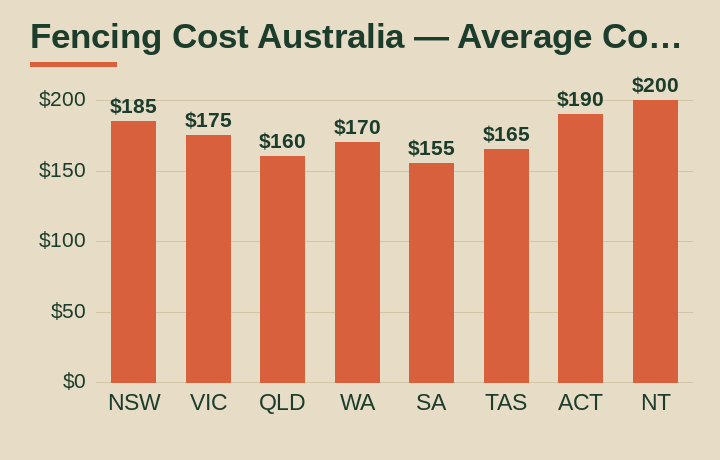
Here’s how the typical fencing cost australia homeowners are quoted breaks down by state. These are mid-range materials (Colorbond or hardwood paling, 1.8m height) on a flat suburban block.
| State | Average Cost | Typical Range |
|---|---|---|
| NSW | $185/m | $140 – $260/m |
| VIC | $175/m | $135 – $245/m |
| QLD | $160/m | $125 – $230/m |
| WA | $170/m | $130 – $240/m |
| SA | $155/m | $120 – $215/m |
| TAS | $165/m | $130 – $235/m |
| ACT | $190/m | $145 – $270/m |
| NT | $200/m | $150 – $290/m |
Get free quotes from local providers in your area. No obligation.
NSW and the ACT sit at the top because of labour rates and council requirements. NT is dearer mainly because materials cost more to freight in. South Australia is consistently the cheapest mainland state for fencing work.
Price by material type
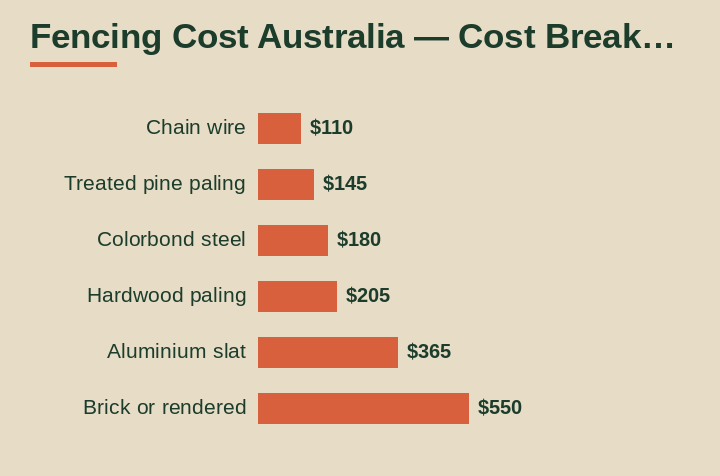
Material is the single biggest lever on price. Going from treated pine to brick changes the cost by 5-6x for the same length of fence. Comparing the quotes for this guide, the gap between cheapest and dearest material was bigger than the gap between cheapest and dearest state.
| Material | Installed Cost | Lifespan |
|---|---|---|
| Chain wire | $80 – $140/m | 15-25 years |
| Treated pine paling | $110 – $180/m | 10-15 years |
| Colorbond steel | $140 – $220/m | 20-30 years |
| Hardwood paling | $160 – $250/m | 15-25 years |
| Aluminium slat | $280 – $450/m | 25+ years |
| Brick or rendered | $450 – $650/m | 50+ years |
Colorbond has become the default for most metro backyards because the long-term maintenance is close to zero. Timber looks better, but you’re up for staining every 3-5 years or replacing rotten palings.
Why prices vary so much
Quote variation isn’t random. There are 5 factors that move the number, and good quotes will tell you which ones apply.
Site access and slope
A flat backyard with rear lane access is the cheapest scenario. A steep block in the Adelaide Hills or Hobart’s North where everything gets carried in by hand can add $40-$70 per metre. Stepped fencing on slopes (where each panel drops down) costs 20-30% more than straight runs.
Removing the existing fence
Demolition isn’t free. Pulling out an old paling fence and disposing of it runs $25-$50 per metre, with tip fees on top. An old fence with concrete-set steel posts is the worst case, $60-$90 per metre because the posts have to be dug out or cut at ground level.
Post depth and concrete
Cheap quotes often skimp here. A proper 1.8m fence needs posts dug 600mm deep and set in concrete. Some quotes assume 400mm with rapid-set bags. The difference is about $15-$20 per metre, but the cheap version will lean within 5-7 years. Worth paying for. Some DIYers buy bags of rapid-set concrete and set posts themselves to keep the cost down.
Gates and special features
A standard 900mm pedestrian gate adds $400-$700. A double driveway gate runs $1,200-$2,500. Lattice toppers on a timber fence add $35-$55 per metre. None of these are in the base per-metre rate, so always ask what’s included.
Location and labour rates
You’ll pay 20-25% more for the same job in inner Sydney suburbs like Surry Hills or Newtown than in outer Brisbane suburbs like Logan. The job is identical. The difference is what local fencers can charge and still stay booked. Regional WA and FNQ also sit high because there’s less competition.
DIY vs hiring a fencer
For a short straight run on a flat block, DIY is genuinely worth considering. For anything over 30 metres or anything with slopes, get a pro.
| Approach | 20m Cost | Time |
|---|---|---|
| Pro install (Colorbond) | $2,800 – $4,400 | 1-2 days |
| DIY Colorbond kit | $1,400 – $2,200 | 2-3 weekends |
| Pro install (timber paling) | $2,400 – $3,800 | 1-2 days |
| DIY timber paling | $1,100 – $1,800 | 2-3 weekends |
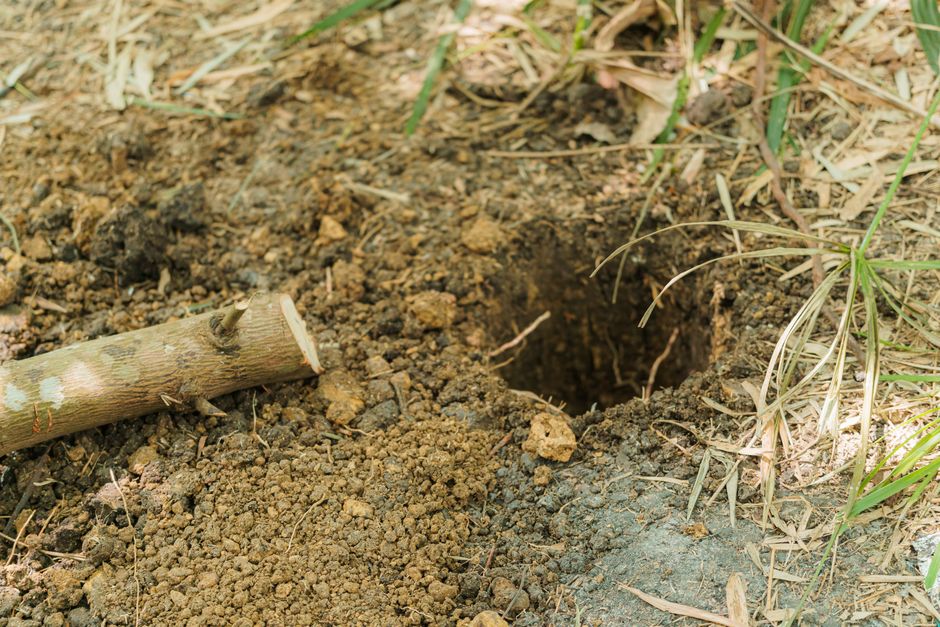
The catch with DIY: post-hole digging is the worst part of the job. Hire an auger or buy a manual digger if you’ve only got a few holes to do. Hand-digging 12 post holes in Sydney clay is a special kind of misery.
Questions to ask before you book
Is removal of the old fence included?
This is the #1 hidden cost. If the quote says “supply and install” without mentioning demolition, expect a $500-$1,500 variation once the fencer arrives. Push for a yes/no in writing.
How deep are the posts being set?
For a 1.8m fence you want 600mm minimum, set in concrete. If a quote is suspiciously cheap, this is usually why. A fence with shallow posts will lean inside 5 years and you’ll be paying for the job twice.
Have you served a fencing notice on my neighbour?
If it’s a dividing fence, your neighbour pays half. But only if you’ve followed the legal notice process in your state. MoneySmart’s home maintenance section covers the basics, and each state’s fair trading website has the actual notice template. Skipping this step can leave you wearing 100% of the bill.
Does the quote include council approval if needed?
Most suburban fences are exempt development. Heritage areas, corner blocks, and anything over 2.1m usually aren’t. A good fencer will know your local council’s rules. A bad one will let you find out via a stop-work notice.
What’s the warranty on workmanship?
A decent fencer warrants their work for 5-7 years against leaning, sagging or failed posts. Some only offer 12 months. The warranty length tells you a lot about how confident they are in their post setting.
Are gates and hardware extra?
Almost always yes. Confirm the price of each gate, the type of latch and hinges, and whether keyed locks are included. Gate hardware alone can be a $200-$400 variable depending on quality.
How to bring the cost down
- Share the cost with your neighbour. Half off a $4,000 fence is $2,000 back in your pocket. Serve the fencing notice properly.
- Get three quotes minimum. The spread on identical jobs is routinely $1,500-$3,000.
- Demo the old fence yourself. Saves $25-$50 per metre plus tip fees.
- Book in winter. Quotes drop 10-15% from May to August when fencers are quieter.
- Stick to standard heights. Custom 2m+ panels or stepped designs add 20-40% to the bill.
FAQs about fencing cost australia
How much does a 20 metre Colorbond fence cost?
A standard 1.8m Colorbond fence over 20 metres runs $2,800-$4,400 installed in most metro areas in 2026. Add $400-$800 for a pedestrian gate.
Do I really need to tell my neighbour before building a fence?
Yes, if you want them to pay half. Every state has a Dividing Fences Act that requires a written notice. Skipping it usually means you wear the whole cost.
What’s the cheapest fence that still looks decent?
Treated pine paling at around $130-$160 per metre. Looks neat, lasts 10-15 years, and you can stain it any colour. Chain wire is cheaper but only really suits rural blocks.
How long should a Colorbond fence last?
20-30 years if installed properly with posts set in concrete to the right depth. Coastal homes within 1km of saltwater should expect closer to 15-20 years before paint starts to chalk.
Are pool fence costs different to regular fencing?
Yes, significantly. Pool fences have to meet AS 1926.1, which means specific gap and gate requirements. Glass pool fencing runs $350-$700 per metre installed, well above regular fencing prices.
People Also Ask About Fencing Cost Australia
What’s the cheapest type of fence to install in Australia?
Chain wire and treated pine paling are the two cheapest options, sitting around $80-$140 per metre installed. Chain wire is the absolute floor for rural blocks, while treated pine is the cheapest timber option that still looks tidy in a suburban backyard.
How much does a 6 foot Colorbond fence cost in Australia?
A 1.8m (6ft) Colorbond fence runs $140-$220 per linear metre installed in most metro areas in 2026. A typical 20-metre backyard run lands around $3,200-$4,400, with extras like a gate adding $400-$800 each.
Can I install a Colorbond fence myself to save money?
Yes, and DIY can cut the bill roughly in half if you’ve got the time. Materials for a 20m Colorbond fence run $1,400-$2,200 from Stratco or Bunnings, but you’ll need a post hole digger, a level, and a weekend of help to get posts plumb.
How deep should fence posts be set in concrete?
As a rule of thumb, one-third of the post should be in the ground. For a 1.8m fence, that means digging at least 600mm deep and around 250-300mm wide. Skimping on depth is the most common reason fences lean within a few years.
Do fencing quotes include removing the old fence?
Not always. Some quotes assume the site is clear, and removal adds $25-$50 per metre plus tip fees. Always ask whether demolition, rubbish removal and stump grinding are included before you compare prices.
Related Cost Guides
Recommended Products for Fencing Cost Australia
If you’re tackling this yourself, here are some products from Amazon Australia that can help:
Bottom line: the realistic fencing cost australia homeowners should budget for in 2026 is $140-$220 per metre for a standard Colorbond or hardwood job, with a $500-$1,500 buffer for the extras nobody mentions in the first quote. Get three quotes, talk to your neighbour, and don’t book the cheapest one without checking post depth.
This guide contains affiliate links. We may earn a small commission from qualifying purchases at no extra cost to you.