
The divorce cost australia question doesn’t have one answer, and anyone who tells you otherwise is selling something. The court filing fee is fixed at $1,100 in 2026. But what most people underestimate is everything that sits around that fee: lawyers, mediation, valuers, property settlement, and the parenting disputes that can drag on for years. According to MoneySmart’s guidance on separation and divorce, the financial side of separating is often more expensive and complex than the divorce paperwork itself.
The divorce cost australia in 2026 starts at $1,100 for the court filing fee (or $365 reduced fee) if you DIY. Add a lawyer and you're looking at $2,500-$8,000 for an uncontested divorce. Once property and parenting disputes go to court, total costs commonly hit $20,000-$50,000+ per person.
When I researched current prices across federal court schedules, Legal Aid commissions and family law firm websites for this guide, the pattern that stood out was how much of the spend is optional. A DIY uncontested divorce costs $1,100. A contested matter with property and kids? It’s a different universe. The Australian Bureau of Statistics’ marriage and divorce data shows roughly 49,000 divorces are granted each year, and most of them don’t go anywhere near a contested hearing.
What divorce actually costs in 2026
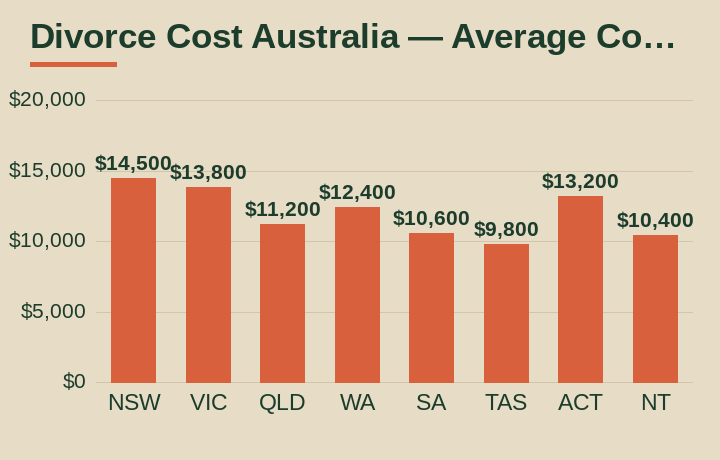
The headline number people quote, that $1,100 filing fee, is just the entry ticket. Here’s what the typical spend looks like by state once you factor in lawyers, mediation and the property side of things. Filing fees themselves don’t vary by state (it’s a federal court), but lawyer rates and mediation costs do.
| State | Average Total Cost | Typical Range |
|---|---|---|
| NSW | $14,500 | $1,100 – $55,000 |
| VIC | $13,800 | $1,100 – $50,000 |
| QLD | $11,200 | $1,100 – $42,000 |
| WA | $12,400 | $1,100 – $45,000 |
| SA | $10,600 | $1,100 – $38,000 |
| TAS | $9,800 | $1,100 – $34,000 |
| ACT | $13,200 | $1,100 – $48,000 |
| NT | $10,400 | $1,100 – $36,000 |
Get free quotes from local providers in your area. No obligation.

Those averages assume a moderately contested matter with some property to divide and one round of mediation. A clean joint application with no kids and no assets sits at the very bottom of the range. A bitter Federal Circuit and Family Court fight with two barristers and a forensic accountant sits at the top, and can blow well past it.
Where the money actually goes
There are really only five places your money disappears to. Understanding the split helps you work out which levers you can pull.
The court filing fee ($1,100 or $365 reduced)
This is the only unavoidable cost. The full fee in 2026 is $1,100, with a reduced fee of around $365 for concession card holders, full-time students and applicants who can demonstrate financial hardship. The fee is reviewed annually on 1 July. Joint applicants split this however they want.
Lawyer fees ($350-$650/hr typical)
Family lawyer rates have crept up sharply since 2022. In Sydney’s CBD and inner east (Bondi Junction, Surry Hills, North Sydney), expect $500-$650/hr for a senior associate and $700-$900/hr for a partner. Out in Penrith, Parramatta or Wollongong, the same work runs $350-$500/hr. Melbourne tracks similarly, Collins Street firms charge top dollar, suburban practices in Frankston or Werribee charge 30-40% less. A simple consent order drafted by a fixed-fee firm costs $1,500-$3,000. A contested property matter that runs to trial easily hits $40,000-$80,000 per side.
Mediation and Family Dispute Resolution ($0-$3,500)
Mediation is the cheap lever. Relationships Australia and Family Relationship Centres offer Family Dispute Resolution on a sliding scale, often free for low-income parties, capped around $300 a session at the top end. Private mediators charge $2,000-$3,500 for a full-day session. Compared to letting it go to court, mediation routinely saves people tens of thousands and months of waiting. The Finder breakdown of divorce costs in Australia consistently flags mediation as the single biggest cost saver outside of agreeing privately.
Valuations and expert reports ($500-$8,000)
If you own a house, a business, or have complex super, you’ll need a valuation. Residential property valuations run $500-$900. Business valuations from a forensic accountant start around $4,000 and can hit $15,000+ for anything complex. Family reports for parenting disputes cost $3,500-$8,000, usually split between the parties.
Process server, certified copies, admin ($100-$500)
Small stuff but it adds up. Serving documents on a non-cooperative ex through a process server runs $150-$300. Certified copies of your marriage certificate cost $60-$80 from Births, Deaths and Marriages. Courier and filing admin if your lawyer handles it: another $200-$400.
Uncontested vs contested: the real comparison
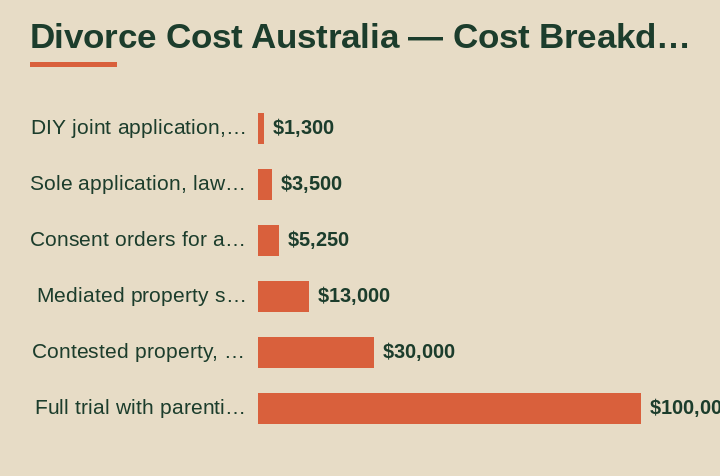
This is where the difference becomes brutal. The single biggest variable in your total bill is whether you and your ex can agree on the money and the kids. Everything else is noise next to this.
| Scenario | Typical Total Cost | Timeframe |
|---|---|---|
| DIY joint application, no kids, no assets | $1,100 – $1,500 | 4-5 months |
| Sole application, lawyer drafts only | $2,500 – $4,500 | 5-6 months |
| Consent orders for agreed property split | $3,500 – $7,000 | 6-9 months |
| Mediated property settlement | $8,000 – $18,000 | 9-15 months |
| Contested property, no trial | $20,000 – $40,000 | 12-24 months |
| Full trial with parenting dispute | $50,000 – $150,000+ | 2-4 years |
The pattern is obvious. Every step away from agreement multiplies the cost by 2-5x. If there’s any path to a negotiated outcome, even a frustrating one, it’s almost always cheaper than letting a judge decide.
Questions to ask before you hire a family lawyer
Most people sign their costs agreement in a fog of stress and don’t ask the questions that would save them thousands. Here are the ones that actually move the needle.
What’s your hourly rate, and who at the firm will actually do the work?
Partners charge $700-$900/hr, paralegals $180-$280/hr. You want most of the routine work done at the junior rate with partner sign-off, not the partner drafting every letter. Ask for the breakdown explicitly.
Do you offer fixed-fee work for any stages?
Many firms will now fix-fee the divorce application ($1,500-$2,500), consent orders ($2,000-$3,500) and initial advice ($350-$600). It caps your exposure for the predictable parts. If they refuse to fix-fee anything, that’s a flag.
What’s your minimum billing unit?
Standard is 6 minutes (0.1 of an hour). Some firms still bill in 15-minute units, which means a 2-minute phone call costs you a quarter-hour. Over a long matter the difference is hundreds of dollars.
How will you communicate with me, and how often?
Set this up front. “Email only, weekly summary unless urgent” is much cheaper than constant phone calls. Every unsolicited update letter you receive is billable.
Have you mediated matters like mine, and what’s your success rate?
A lawyer who pushes mediation early is usually trying to save you money. One who talks immediately about “taking it to court” might be optimising for their fees, not your outcome.
What’s your estimate of total costs to resolution?
They can’t give you a precise number, but they should give you a realistic range based on what you’ve told them. “Anywhere from $5,000 to $100,000” is not an answer.
How to bring the cost down
Some of these are obvious. Some aren’t. All of them are things people who’ve been through it wish they’d known on day one.
- Use FDR mediation before lawyers. Free or low-cost mediation through Relationships Australia routinely resolves matters that would have cost $15,000+ in legal fees. Even a partial agreement reduces what’s left to fight about.
- File a joint application. Joint applications skip the serving step and don’t need anyone to appear in court (if no kids under 18). Saves $200-$400 in admin and a day off work.
- Apply for the reduced filing fee. The fee drops from $1,100 to around $365 if you qualify. Worth checking, the threshold is broader than people assume.
- Get consent orders, not just a private agreement. A handshake deal isn’t legally binding for property. Spend the $2,000-$3,500 on consent orders now and you avoid being dragged back to court in five years when your ex changes their mind.
- Batch your communication. One weekly email with all your questions costs far less than ten phone calls. A good self-help handbook can answer half the questions you’d otherwise pay a lawyer to answer.
- Check Legal Aid eligibility. Income thresholds vary by state, and if there’s family violence or parenting issues involved, the bar is lower than for property-only matters.
State variation: what’s different across Australia
The federal court system means the divorce process itself is identical from Hobart to Darwin. What varies is the cost of the people you hire along the way.
Sydney and Melbourne are the most expensive markets, senior family lawyers in the CBD charge $700-$900/hr, and contested matters routinely run higher because court waiting times push out total billable hours. Brisbane and Perth sit in the middle. Adelaide, Hobart and Darwin tend to be cheaper for one simple reason: fewer mega-firms and lower commercial rents flow through to lower hourly rates. A mediated property settlement that runs $14,000 in inner Sydney might cost $9,500 in Hobart’s northern suburbs or Toowoomba.
One thing that genuinely surprised me going through the fee schedules: regional Victoria (Geelong, Ballarat, Bendigo) consistently undercuts metro Melbourne by 25-35% for the same work, even when the firm has a Melbourne office. If you’re flexible on where you instruct, it’s worth a phone call.
Common mistakes that cost people money
- Skipping consent orders after a private agreement. Without orders, either party can come back years later and reopen the property split. The cost of that mess dwarfs the $2,500 you saved upfront.
- Letting emotions drive litigation. Fighting over the dining table is one thing. Spending $40,000 in legal fees to win $15,000 worth of furniture is a thing that actually happens.
- Waiting too long to apply. You can apply for property orders up to 12 months after the divorce is finalised. Miss that window and you need the court’s permission, which is expensive and not guaranteed.
- Ignoring super. Super is property under the Family Law Act. Forgetting to include it in negotiations means you may have walked away from tens of thousands.
The Choice consumer guidance on legal services consistently flags getting a written costs agreement before any work starts, not after the first meeting. Worth repeating.

FAQs about divorce cost australia
What is the court filing fee for divorce in Australia in 2026?
The standard divorce filing fee is $1,100 in 2026, with a reduced fee of around $365 for eligible applicants (Centrelink concession card holders, full-time students, those experiencing financial hardship). The fee is set federally and the same regardless of state.
Can I get divorced without a lawyer?
Yes. You can lodge a sole or joint application yourself through the Commonwealth Courts Portal. Most uncontested divorces don’t need a lawyer at all, just the filing fee and proof of 12 months’ separation. The application form is genuinely doable for most people.
How long does a divorce take in Australia?
From filing to the divorce order becoming final takes around 4-5 months for a straightforward application. You must have been separated for at least 12 months before you can apply. Property settlement is separate and can take much longer.
Is property settlement separate from the divorce?
Yes, and this catches people out. The divorce itself just ends the marriage. Splitting assets, super and debts is a separate legal process, and it’s where most of the real cost sits. You should sort property orders before or shortly after the divorce is finalised, not years later.
Does it matter which state I file in?
Not really for the filing fee, it’s federal. But lawyer rates, mediator availability and court waiting times do vary between states, with Sydney and Melbourne typically the most expensive and Hobart, Adelaide and Darwin generally cheaper.
People Also Ask About Divorce Cost Australia
Who pays the divorce filing fee if it’s a joint application?
There’s no rule, you can split it 50/50, one party can pay the lot, or you can agree any other split. The court doesn’t care who hands over the money, only that the $1,100 (or reduced fee) is paid when you file.
Can I claim divorce costs back from my ex?
Generally no. Each party pays their own legal costs in family law matters. The court can order costs against a party in limited circumstances, like unreasonable conduct or refusing to negotiate, but it’s not the default.
What happens to super in a divorce settlement?
Superannuation is treated as property and can be split between spouses. You’ll need a valuation and a super splitting order or agreement. Adds roughly $500-$2,000 in valuation and drafting costs depending on the fund.
Do I need to attend the divorce hearing in person?
Usually no. For sole applications without children under 18, you don’t need to appear. If there are children under 18, you must attend (in person or by phone/video) unless it’s a joint application.
Is divorce cheaper if we agree on everything?
Dramatically. A joint application with agreed property terms and consent orders typically runs $2,000-$5,000 all up. The same matter contested through court can easily hit $30,000-$80,000 per person. Agreement is the single biggest cost lever you have.
Related Cost Guides
Recommended Products for Divorce Cost Australia
If you’re tackling this yourself, here are some products from Amazon Australia that can help:
The honest summary: the real divorce cost australia figure depends almost entirely on how much you and your ex can agree on before lawyers get involved. The $1,100 court fee is fixed. Everything beyond that is, to a surprising degree, optional. Spend an hour reading how we research our prices, get a fixed-fee initial consult, try mediation before litigation, and you’ll keep the bill closer to $5,000 than $50,000.
This guide contains affiliate links. We may earn a small commission from qualifying purchases at no extra cost to you.